[OpenSource - Satellite Imagery & Geospatial Data]
Accessing high-quality, up-to-date satellite imagery usually means dealing with expensive commercial data providers or navigating clunky, outdated scientific portals. 🛑
worldview by NASA (nasa-gibs) is an incredible open-source interactive web interface that lets you browse over 1,000 global, full-resolution satellite imagery layers completely for free.
Here is how this powerful tool brings Earth observation data directly to your browser. 🧵👇
1/4
[AI News - 3D Web Exploration & AI-Assisted Game Dev]
San Francisco has just been transformed into a fully playable, open-world video game that runs directly in your browser without any downloads. 🛑
Created by 20-year-old OpenAI robotics engineer Thijs (@cdngdev), this viral side project uses real-world 3D city data to let you explore the entire city of SF like a massive digital sandbox.
Here is how AI coding assistants helped build this impressive interactive experience. 🧵👇
1/2
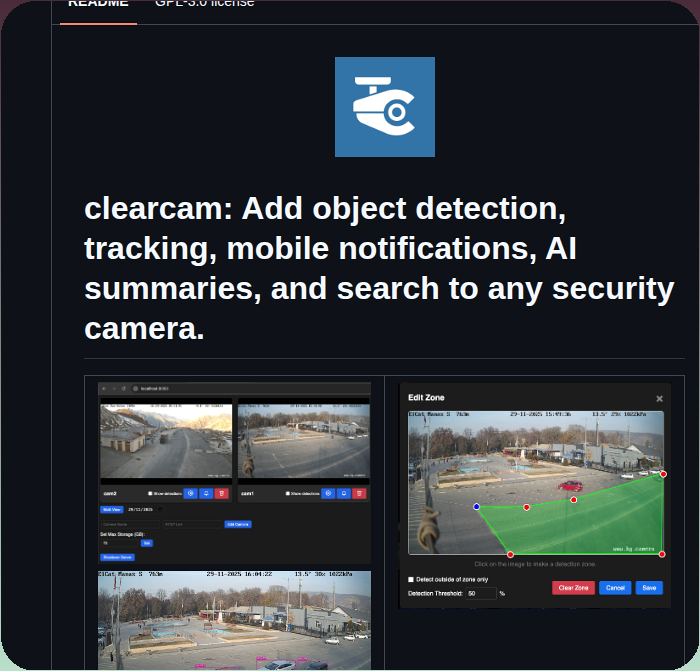
Self-hosted Clearcam turns any security camera into an AI monitor that detects and tracks objects, sends mobile alerts, and writes plain-language summaries of each event so you can search for what happened.
https://t.co/pzdwatS4sG
Mac dictation shouldn’t require sending every recording to the cloud.
Pindrop is a native macOS menu-bar dictation app for builders who want speech-to-text that can stay local.
It helps you turn spoken notes into usable text without leaving your workflow by offering on-device transcription engines, configurable hotkeys, and automatic clipboard output.
Key features:
• Local engine choices – choose WhisperKit, Parakeet, SenseVoice, or Apple’s on-device speech stack
• Global hotkeys – start, stop, push-to-talk, and cancel dictation without hunting through menus
• Multilingual dictation – dictate in 16 languages; the interface is localized into 31 languages with RTL support
• Transcript workspace – search, edit, play back, and export transcripts as JSON, CSV, or plain text
• Built-in MCP server – lets AI agents dictate, transcribe files, and query your transcript library
It’s open-source (MIT license).
Link in the reply 👇
HR systems get rigid fast. This repo gives builders room to adapt.
MintHCM is an open-source, AI-native human capital management platform for teams building and running custom HR systems.
It helps you manage HR processes while retaining control over the code, data model, and deployment environment instead of being limited to configuration options.
Key features:
• AI agent connections – supports MCP, WebMCP, and A2A for connecting HR processes with compatible agents
• Core HR coverage – includes recruitment, onboarding, offboarding, employee profiles, leave, and time tracking
• Custom workflows – modular architecture, flexible data model, and custom business logic support tailored processes
• Deployment choice – can run on-premises, in public or private cloud, or in hybrid environments
• Integration path – offers an open API plus integrations with external systems and AI services
It’s open-source (GNU Affero General Public License v3.0 license).
Link in the reply 👇
Invaluable resource for any organization that builds any type of system >> The @NASA Systems Engineering Handbook — download the 297-page PDF here: https://t.co/5YXGDg4cY7
Your coding agent needs better guardrails — not a bigger prompt.
Context Engineering Kit is a collection of context-engineering techniques, skills, commands, and plugins for builders using Claude Code, OpenCode, Cursor, Antigravity, Gemini CLI, and similar agent tools.
It helps you make agent work more predictable by installing focused plugins that load only their specific agents, commands, and skills.
Key features:
• Selective plugin installs – choose the plugins you need instead of loading the full collection into context
• Context-conscious design – favors command-oriented skills and subagents to reduce unnecessary context
• Reflection workflow – use `/reflect` to review a previous response and surface improvements
• Spec-driven path – turn a task into a refined specification, then run an implementation workflow
• Review tooling – includes commands for reviewing local changes and pull requests with specialized agents
It’s open-source (GNU General Public License v3.0 license).
Link in the reply 👇
Explore Tokyo's public transit in real time on a free 3D map - watch trains and flights move across the city, search routes, and see stations with underground views.
Explore it here:
https://t.co/aHKKZ2imhd
Microservices need to communicate, but there’s more than one way to do it.
In this guide, @abisoyeOladayo compares REST, gRPC, and event-driven messaging.
You’ll learn when to use each approach based on performance, scalability, and system design tradeoffs.
https://t.co/yyjgyorg21
Frontend prompts get messy fast. This repo gives you a starting point.
Frontend UI Design Agents Collection is a curated collection of Claude prompts for UI/UX design, web development, and frontend components.
It helps you move from an interface task to a customizable Claude prompt by grouping prompts by job, from design systems and components to accessibility and responsive layouts.
Key features:
• Task-based categories – browse UI design, web development, components, UX research, animation, responsive, and accessibility prompts
• Simple starting workflow – choose a relevant prompt, paste it into Claude, then customize it for your project
• Agent-style prompt format – each prompt is structured with a name, description, model, category, difficulty, tags, examples, and sample results
• Design-system coverage – includes a Design System Generator for design systems with tokens and components
• Frontend implementation prompts – the collection includes React component, CSS architecture, mobile-first layout, and ARIA implementation specialists
It’s open-source (MIT license).
Link in the reply 👇
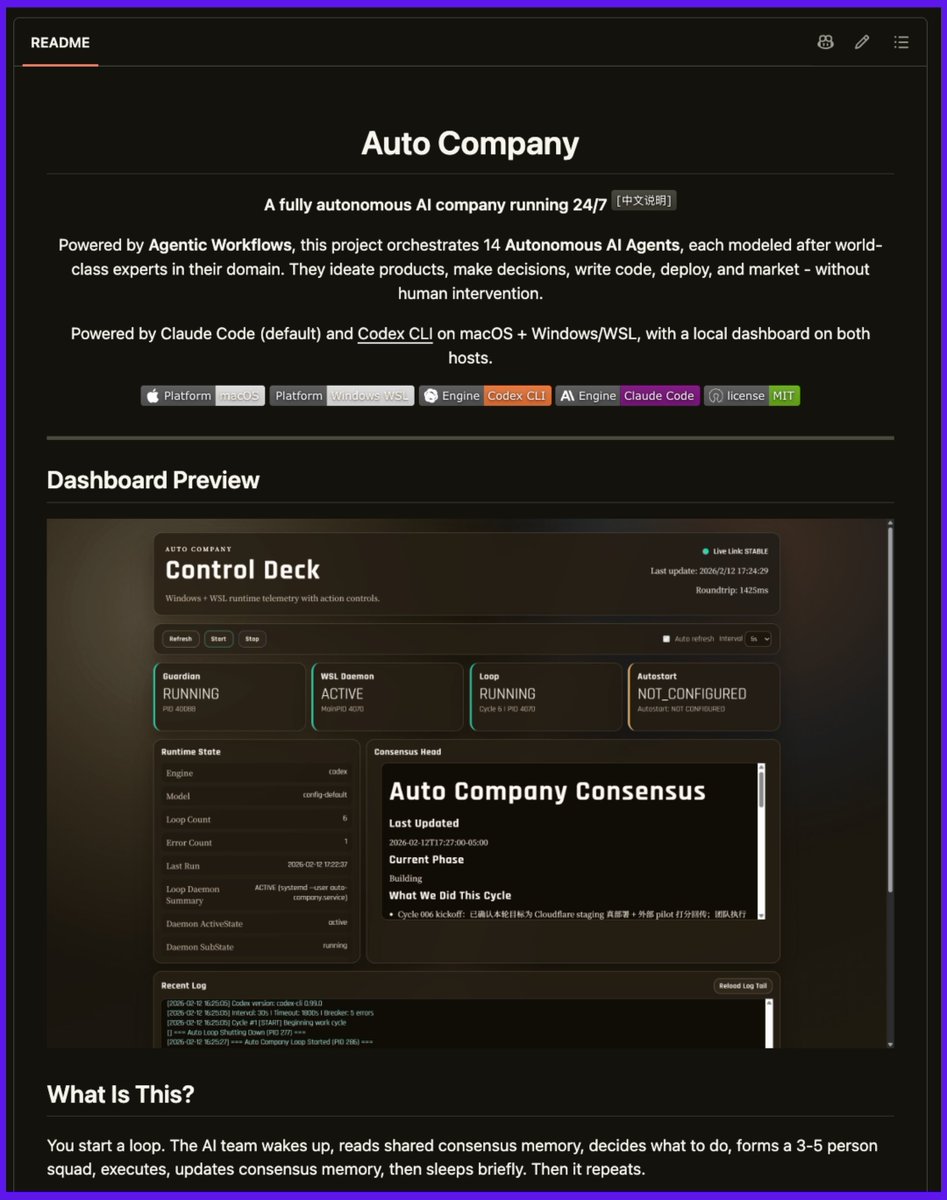
Someone open-sourced an entire company that runs 24/7 on your laptop.
14 autonomous AI agents. One markdown file for memory. No vector DB.
Auto-Company is a multi-agent system where each role is modeled after a real expert. CEO thinks like Jeff Bezos. CTO like Werner Vogels. Inversion like Charlie Munger. Full-stack like DHH. Marketing like Seth Godin. Product design like Don Norman.
14 personas across strategy, product, engineering, business, and intel. Plus a shared arsenal of 30+ skills (deep research, security audit, financial modeling, SEO, etc.) any agent can load mid-cycle.
The interesting part is how it stays alive without going in circles.
Most multi-agent setups have two failure modes. Either they get stuck in endless discussion loops where every agent adds an opinion and nothing ships, or they need a complex vector database to carry context across sessions.
Auto-Company kills both.
Every cycle is an independent CLI call to Claude Code or Codex. The only cross-cycle state is a single markdown file called consensus md. Read at the start of a cycle, rewritten at the end. That's the baton.
No embeddings, no memory manager, no orchestration graph. Just a shared doc that the next cycle reads.
To prevent talking loops, it hardcodes a convergence flow:
- Cycle 1: brainstorm, rank top 3 ideas
- Cycle 2: pre-mortem, market check, unit economics, GO or NO-GO
- Cycle 3+: GO means build, deploy, ship. NO-GO means move on.
Pure discussion cycles are explicitly forbidden.
The daemon runs on launchd (mac) or systemd --user (WSL), auto-restarts on crash, and ships with circuit breakers, rate-limit backoff, and consensus rollback if a cycle doesn't produce valid output.
A local dashboard shows real-time cycle status, cost consumption, and agent activity.
And when you want to steer it, you don't restart anything. You just edit "Next Action" in consensus md. The next cycle picks up the new direction.
MIT licensed. Works with Claude Code or Codex CLI.
Repo: https://t.co/a6sysZSFed
Deep Learning With TensorFlow Videos
What you will learn:
- Build a practical understanding of this part of deep learning
- Build a clearer mental model of deep Learning
- Build a clearer mental model of TensorFlow
- Build the foundations before jumping into advanced deep learning material
- Build a clearer mental model of artificial Intelligence
Link is in the reply 👇
♻️ Share this with your network if you found it useful or insightful.
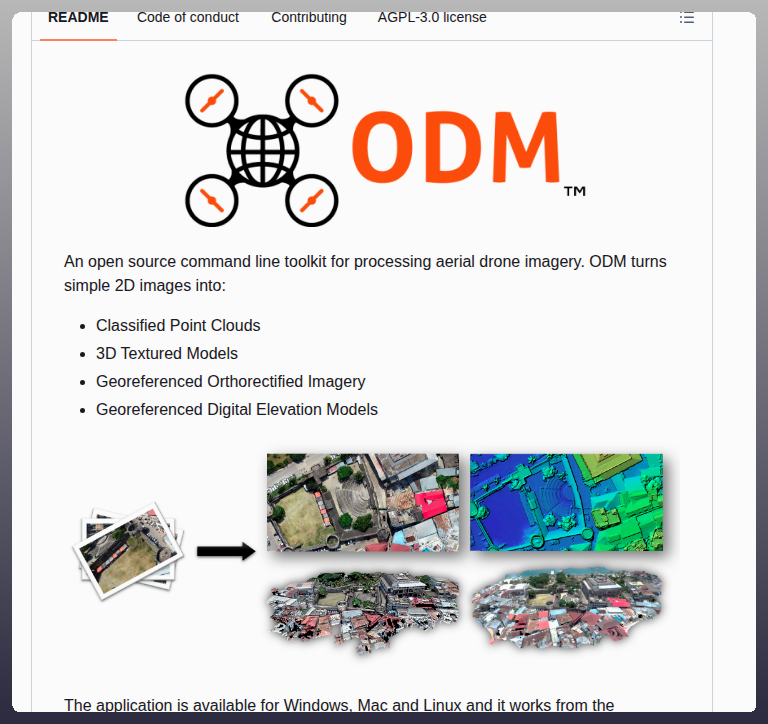
City2Graph is a new Python library that transforms geospatial data like buildings, streets, and transit feeds into heterogeneous graphs, bridging GeoPandas and PyTorch Geometric for…
https://t.co/Hvg9FvcVpR
#MachineLearning#AI#LLM#DeepLearning#AgenticAI
Curates a list of essential technical concepts including algorithms, data structures, and distributed systems for software developers.
https://t.co/iI6JdFY5JR
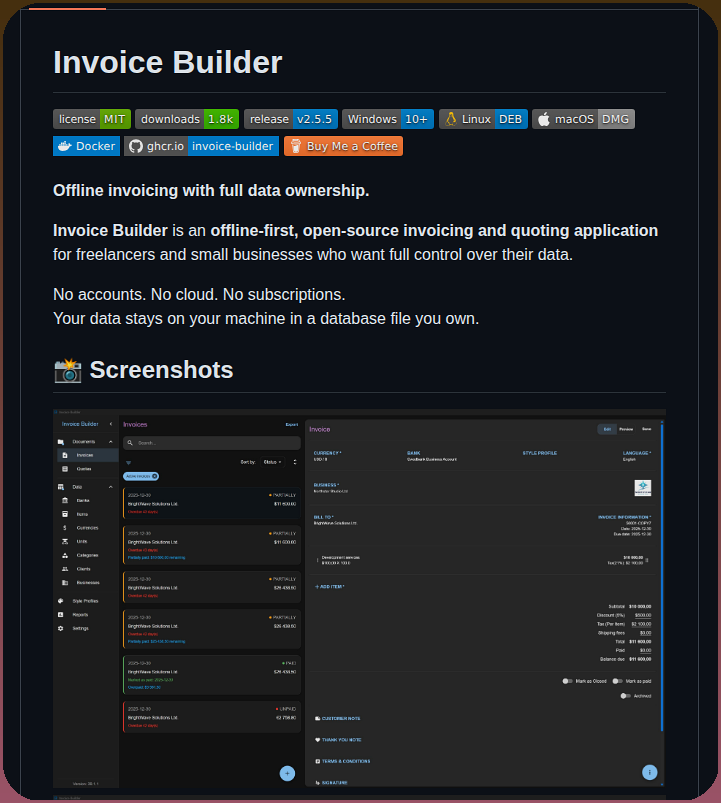
Invoice Builder is an offline-first invoicing application for freelancers and small businesses. It creates and exports invoices and quotes while storing all data locally in a database file, eliminating the need for cloud subscriptions or account registration.
https://t.co/OiRVdxAwOP
Le tumbaron el github a este dev porque nos dio ABSOLUTAMENTE GRATIS una app para entrenar que no te pide cuenta, suscripción ni guardar tus datos en la nube y que es MUCHÍSIMO MEJOR QUE CUALQUIER OTRA EN LA APP STORE
[openGym]
Un tracker de entrenamiento self-hosted en el que puedes:
• Planificar tu semana
• Seguir entrenamientos guiados
• Registrar cada serie, peso y repeticiones
• Ver PRs, estadísticas y evolución
• Registrar peso corporal
• Crear superseries
• Seguir progresiones automáticas
• Analizar qué músculos estás entrenando
• Usar passkeys / Face ID / Touch ID
• Funcionar offline
• Sin anuncios
• Sin tracking
• Sin suscripción
• Sin depender de los servidores de una empresa
Además, tiene 1.324 ejercicios, importa datos desde FitNotes, Strong y Hevy, y permite exportar todo en JSON.
REPOOO👇


![TheTechDiggest's tweet photo. [OpenSource - Satellite Imagery & Geospatial Data]
Accessing high-quality, up-to-date satellite imagery usually means dealing with expensive commercial data providers or navigating clunky, outdated scientific portals. 🛑
worldview by NASA (nasa-gibs) is an incredible open-source interactive web interface that lets you browse over 1,000 global, full-resolution satellite imagery layers completely for free.
Here is how this powerful tool brings Earth observation data directly to your browser. 🧵👇
1/4](https://pbs.twimg.com/media/HQjyFL3XwAATS9z.png)





![ErickSky's tweet photo. Le tumbaron el github a este dev porque nos dio ABSOLUTAMENTE GRATIS una app para entrenar que no te pide cuenta, suscripción ni guardar tus datos en la nube y que es MUCHÍSIMO MEJOR QUE CUALQUIER OTRA EN LA APP STORE
[openGym]
Un tracker de entrenamiento self-hosted en el que puedes:
• Planificar tu semana
• Seguir entrenamientos guiados
• Registrar cada serie, peso y repeticiones
• Ver PRs, estadísticas y evolución
• Registrar peso corporal
• Crear superseries
• Seguir progresiones automáticas
• Analizar qué músculos estás entrenando
• Usar passkeys / Face ID / Touch ID
• Funcionar offline
• Sin anuncios
• Sin tracking
• Sin suscripción
• Sin depender de los servidores de una empresa
Además, tiene 1.324 ejercicios, importa datos desde FitNotes, Strong y Hevy, y permite exportar todo en JSON.
REPOOO👇](https://pbs.twimg.com/media/HQa8sUTXMAAT-ST.png)


