Excited to share our latest preprint on scE2G – a new model to link enhancers to target genes using single-cell data – with state-of-the-art performance across multiple perturbation benchmarks.
https://t.co/id1eCkQVdM
Read more below!
1/12
In collaboration with Reuben Saunders, @JswLab, and Xiaowei Zhuang, we are very excited to release Perturb-Multi: a platform for pooled multimodal genetic screens in intact mammalian tissue.
Check it out!
https://t.co/iJ8hi3ddz4
Excited to share our new paper where we explore why dCas9-KRAB protein levels drop so drastically after neuronal differentiation in WTC11 and KOL2.1J iPSC lines.
https://t.co/SBRXfWau75
A great collaboration with the ML team here at Genentech. Happy to see this pre-print out: https://t.co/QTpIkcLE5H (@lal_avantika @gokcen@suragnair and many others)
Available now via @biorxivpreprint is our preprint on live-cell transcriptomics with engineered virus-like particles @broadinstitute https://t.co/z04hDgTT4x
Some suggested weekend reading: a new primer out in @TrendsinBiotech from our first postdoc @arthurwchow on key concepts and new developments in single-cell multi-omics! Check it out here! https://t.co/HmhHXKHu7l.
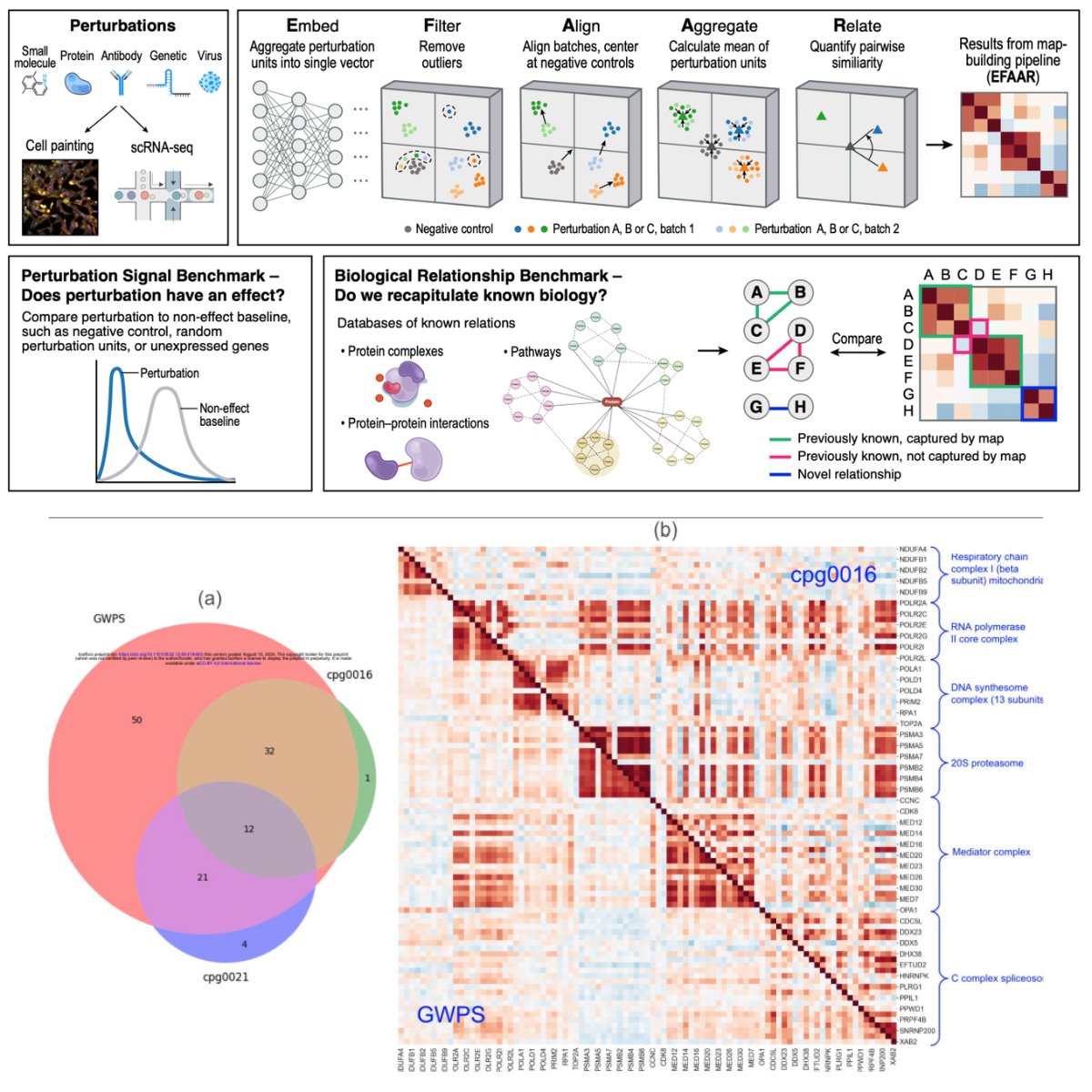
An updated preprint reveals how scientists at Recursion & @Genentech make digital #maps of #biology – scaling genetic perturbation techniques w/ high-dimensional assays such as cellular microscopy & RNA sequencing to create “maps” that both capture known biological relationships & uncover new associations that can lead to new therapeutic discoveries. Learn more: https://t.co/hqSWugGgsk @bertonearnshaw@ImranSHaque
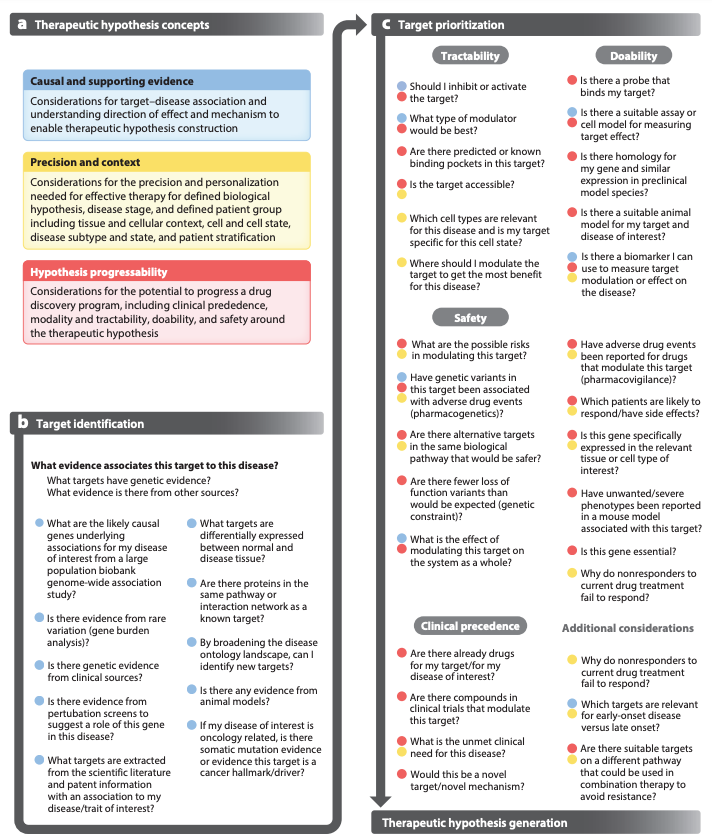
Out now in @AnnualReviews!
We share our perspective on using human genetics for drug target identification, with examples from our work of the past 10 years, and our framework for building therapeutic hypotheses
#OpenTargetsat10
https://t.co/9LzTJPh2Ja
Excited to share our work introducing EPInformer🧬, a scalable and lightweight deep learning framework to predict gene expression by integrating promoter-enhancer sequences with epigenomic signals and chromatin contacts. 📜https://t.co/YSWOsueEJZ (1/11)
Excited to share our preprint "Multiome Perturb-seq unlocks scalable discovery of integrated perturbation effects on the transcriptome & epigenome". This work extends single-cell CRISPR screens to simultaneously profile gene expression & chromatin accessibility.
Combining chromatin and transcriptional profiling reveals regulatory programs driving Th17 heterogeneity and insights into CD4 T cell plasticity. Excited to share this collaboration with @alexa_schnell out in @NatImmunol https://t.co/R5xtvZgORf
Thrilled to share the bulk of my PhD work, now up on bioRxiv!
This project brings together aspects of network theory, systems biology, and single cell genomics, towards understanding properties of gene regulatory networks (GRNs). Read on for more —> (1/)
https://t.co/RY1syLiS6S
How do genetic perturbations change cells? How are these effects shaped by cell type and dosage? How do we best extract insight from modern massive perturbation atlases? Im pleased to share a new preprint where we develop a suite of statistical approaches to these Qs (link below)
🚨Free for 1 month:
Revealing gene function with statistical inference at single-cell resolution https://t.co/XnM8ejiTnG #Review by @coletrapnell@uwgenome
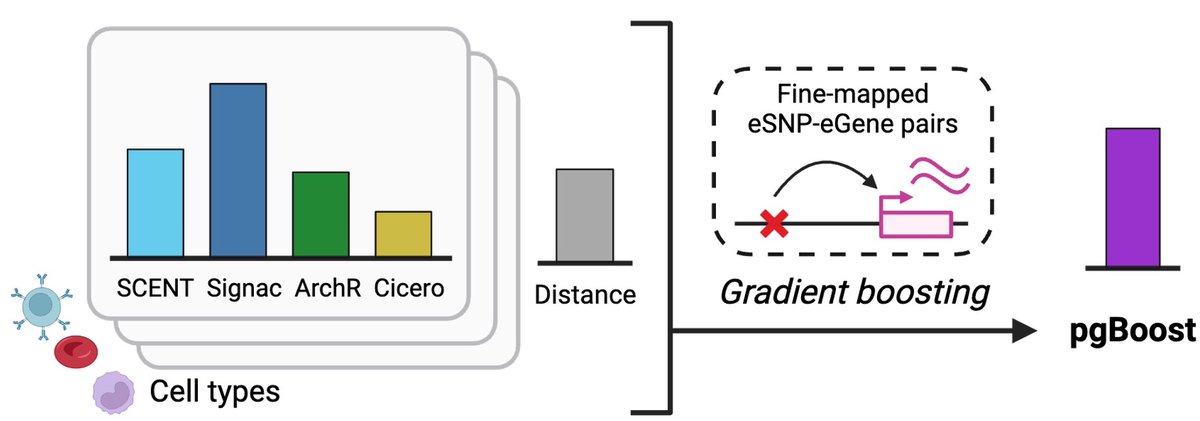
Excited to share our preprint proposing pgBoost, an eQTL-informed gradient boosting model that integrates scores from single-cell enhancer-gene linking methods and genomic distance to predict regulatory SNP-gene links (a key step in interpreting GWAS discoveries)!🧬
1/4
Our perspective with @fabian_theis , @YUHANHAO2 , and @mo_lotfollahi on the power and potential of reference mapping across disease states, molecular modalities, perturbations, and species: https://t.co/ybtNNHjA3c
Could not be more delighted to present our work investigating how over 220,000 complex and molecular trait-associated genetic variants affect transcriptional regulation using massively parallel reporter assays!
https://t.co/1eoN4OxAvd
See below for a 🧵. 1/n
@michecurtis and I are thrilled to share our preprint "Reproducible single cell annotation of programs underlying T-cell subsets, activation states, and functions" from the @soumya_boston lab @BrighamResearch and @broadinstitute!
https://t.co/OexYxSnc3D
1/12