We'll be spending a lot more time trying to understand the outputs of language models. A few thoughts, tips & tricks:
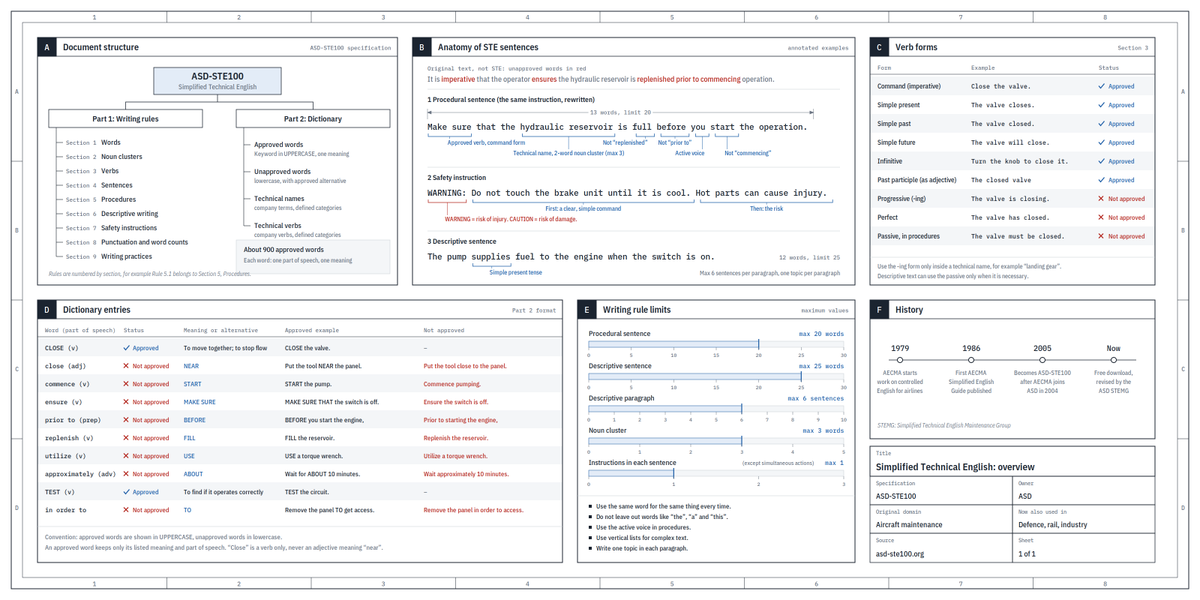
Writing. Something I've had success with: Ask your LLM to explain something in ASD-STE100, it's a controlled language specification originally developed for aerospace maintenance documentation. LLMs well-versed in this language and it comes with heavy constraints on clean writing style that I often find a lot more readable. Sometimes I've tried to soften it a bit e.g. ask for "80% of the way to ASD-STE100" because the spec is quite stringent. But even better:
Diagrams / images. Instead of writing, ask your LLM to create a diagram. These can be a lot easier to process, parse, and understand. But even better:
Web pages. Ask for output "in HTML" to get a beautiful, interactive webpage. LLMs are getting really good at frontend and can create beautiful experiences, animations, etc. But even better:
Explainer videos. The output format I am most bullish on is fully custom / bespoke explainer videos generated on any arbitrary topic. Experiment with things like "Create a 3b1b style video explainer on X. Use my ElevenLabs API key for audio narration". (you'd need an API key for the latter or you can ask your LLM to find you decent free alternatives that use your local compute). This is actually starting to work!
In summary:
- As LLMs get better, they will do more and more of the legwork autonomously, and a lot more of our work will rise up the abstractions into oversight and understanding.
- Luckily, LLMs can help here too because as intelligence and code are increasingly abundant, you can ask for large, custom, discardable software artifacts (e.g. web apps, video explainers) that would have never made sense to create before. Push the boundaries here and you'll be surprised.
Get more out of GPT-6 Astra by revisiting your skills, AGENTS.md, and task prompts.
Make skill triggers specific, load guidance when it's relevant, and define what done looks like.
https://t.co/UGF0AC8Z5Y
We're publishing our most detailed threat intelligence report to date.
It covers how people tried to misuse Claude—for cyberattacks, influence operations, surveillance, biology, and building weapons—and how we found and stopped them.
We disrupted every operation in the report, and used the lessons from them to strengthen our safeguards. Where appropriate, we also shared what we found with authorities and other AI companies.
These cases are not typical: we’re highlighting some of the most sophisticated misuse we’ve seen. But they’re especially important to discuss, because they show us where AI misuse is headed, where our safeguards work, and where they need to improve.
We’re publishing this report so others can spot the same activity on their own platforms, and so we can give the public a clearer view of how emerging threats develop.
Read the report: https://t.co/0EJUnYEgfz
For my first post, I’m sharing a letter @NVIDIA signed on why open models matter.
AI will transform every industry, power every company, and be built by every country.
Open models strengthen safety and cybersecurity, accelerate innovation and diffusion, and enable sovereignty.
The world needs both frontier closed models and frontier open models.
https://t.co/AUKzoQ5Ikb
Claude Code can now handle long-running tasks in the background.
Start your dev server, run tests, or build your project without blocking your workflow
announcing: kisuke, a native ios ide
kisuke is your fav pocket engineer.
you get:
- claude code (use your anthropic acc + all CC features)
- multi tab terminal
- code editor
- browser + built-in devtools
- port forwarding (auto-detected and available inapp)
"AI is too complex for my business"
Translation:
"I'd rather stay comfortable than grow"
Builders are automating,
While the rest make excuses.
Which side of history are you choosing?