⚛️ Quantum technologies hold transformative potential across sectors and remain largely in a pre-competitive stage, making early alignment on standards a critical opportunity to shape global markets.
GMF’s @LindsayPGorman and Alexandra Pugh offer recommendations for how the US, Japan, and Europe can align on innovation and economic security to compete with China.
➡️ Read here: https://t.co/9dpjdZF0ew
🇺🇦 Ukraine’s latest government reshuffle has raised questions about transparency, accountability, and wartime governance.
GMF’s Oleksandra Antypenko argues that opaque personnel decisions risk weakening institutional credibility at home and with Ukraine’s international partners.
🔗 Read here: https://t.co/osz2iN6IKA
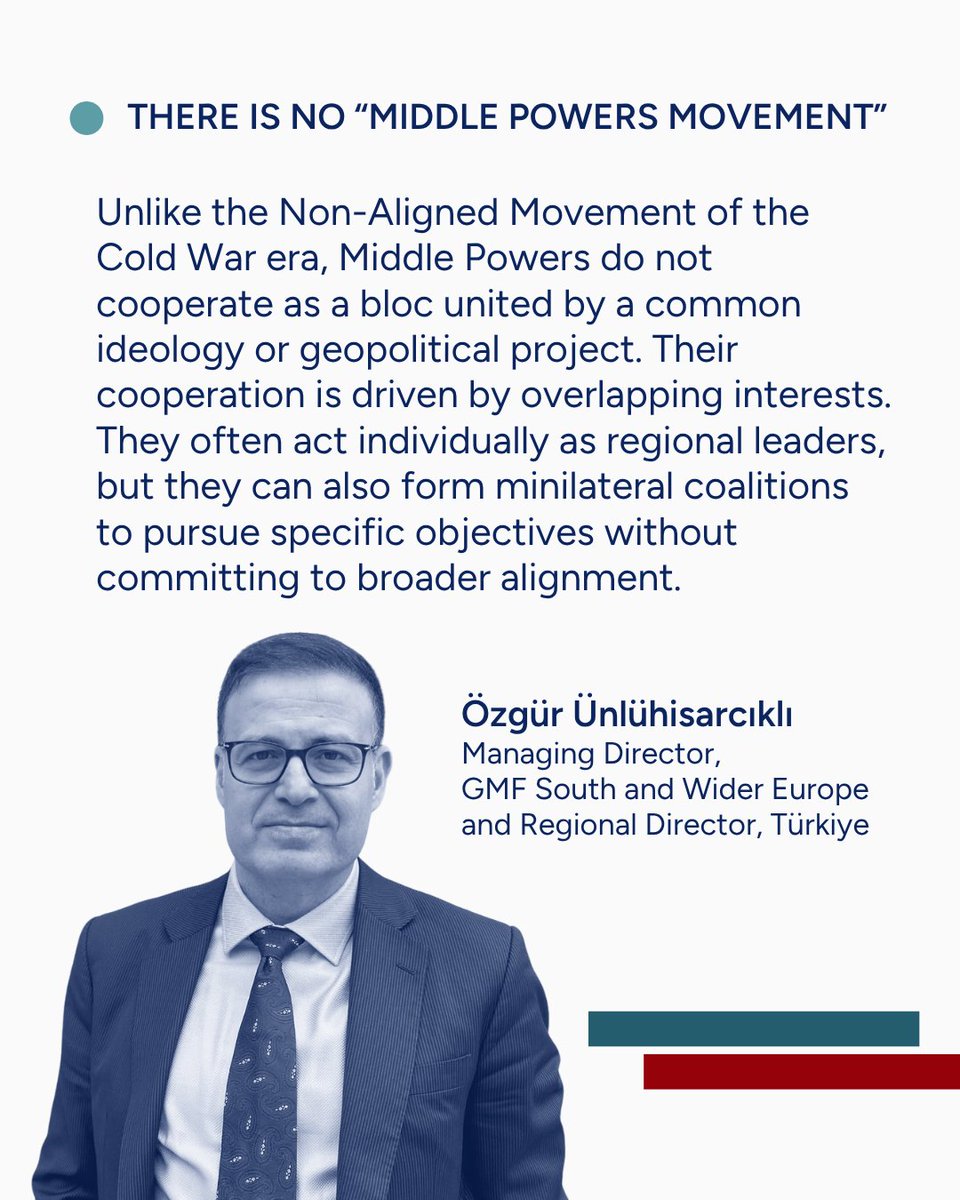
🌐 Discussion of Middle Powers has grown as the international system shifts toward multipolarity.
Most recently, @USWPColby weighed in on the growing debate, arguing in a post on X that these countries do not have a coherent basis for alignment and that efforts to build a collective Middle-Power strategy rest on a flawed understanding of international relations.
His comments highlight a larger question that has become increasingly central to international affairs: What role will Middle Powers play in shaping a more multipolar world?
Our experts share their perspectives👇
@CarrieALee1@OzgurHisarcikli Martin Quencez, Chris Ogunmodede and @Sharinee_J
🔗 Read the full analysis: https://t.co/6Pig74ARe4
🇪🇺🇺🇦 “Crisis anticipation takes political courage.”
H.P. Schreinemachers, Head of the Justice, Security, and Migration Team, Netherlands' Permanent Representation on why crisis anticipation is key to resilience.
🔗 Watch the recording and learn about the initiative: https://t.co/rGFuP8yl55
🇺🇦🇭🇺
I am particularly pleased to share the first policy brief produced within the Hungary–Ukraine Reconciliation Initiative, authored by @CsikiVarga, exploring pathways towards the disciplined normalization of #Hungary–#Ukraine relations in the security domain.
More papers will follow over the coming days—stay tuned.
@gmfus
https://t.co/zqIUDoiNbP
🇪🇺 Is the EU ready for war with Russia?
@PToveri, Member of the EU Parliament, discussed the level of European preparedness if war with Russia were to break out now, at the launch of GMF's Unbreakable Europe Task Force in Brussels.
🔗 Watch the recording and learn about the initiative: https://t.co/rGFuP8yl55
🇺🇦 Oleksandr Prokudin, Governor of the Kherson region, shares how the region has kept critical services running and protected communities under fire at the launch of GMF's Unbreakable Europe Task Force in Brussels.
🔗 Watch the recording and learn about the initiative: https://t.co/rGFuP8yl55
“I do not tend to subscribe to this theory that wars start and then they spiral and they can’t be ended. What happens is that both sides have to believe that continued fighting and continued conflict is gaining them something in the negotiation.”
GMF's @CarrieALee1 joined @F24Debate to discuss why hostilities between the US and Iran keep flaring back up.
🔗 Watch in full: https://t.co/roFTc96lpW
🇮🇷🇺🇸 Why keep reigniting the conflict?
@gmfus' @CarrieALee1 argues the #IranWar persists because both sides seemingly believe continuous conflict gains them greater leverage in negotiations. More on #F24Debate➡️ https://t.co/dPy61DyKoN
🇪🇺 “Europe has a lot of cards, a lot. It's just not using it.” — GMF President @AdeHoopScheffer
In a @ForeignPolicy debate, de Hoop Scheffer argued that Europe already has significant economic, diplomatic, military, and financial leverage—but too often lacks the cohesion to use it effectively.
As the United States recalibrates its role in European security, Europe must move faster to strengthen its defense capabilities, reduce strategic dependencies, and build greater sovereignty across defense, technology, and energy.
⤵️ Watch the full debate here: https://t.co/zFBANvyPH2
“Europe, to a big extent, always fails to be a responsible geopolitical or geo-economic actor because it is fragmented.” — GMF President @AdeHoopScheffer
In a @ForeignPolicy debate, de Hoop Scheffer argued that Europe's fragmentation continues to limit its ability to act strategically on the global stage.
Building greater sovereignty, she noted, requires strengthening Europe's defense industrial base, advancing critical technologies, and securing its energy future—all while reducing strategic dependencies on both the United States and China.
⤵️ Watch the full debate here: https://t.co/zFBANvyPH2
"It's maybe much less about Trump himself and much more about thinking and shaping what comes next." — GMF President @AdeHoopScheffer
In a @ForeignPolicy debate, de Hoop Scheffer argued that today's transatlantic tensions should be understood in the context of longer-term structural shifts in US foreign policy—not just changes from one administration to the next.
From the Obama administration's pivot to Asia to policy continuity across subsequent administrations, she urged Europeans to focus less on reacting to individual leaders and more on preparing for a changing strategic landscape.
⤵️ Watch the full debate here: https://t.co/zFBANvyPH2
GMF expert @ClaudMajor featured in Bloomberg
@business on the future of NATO and Europe's growing defense role: “Europe would prefer to work with the Americans in a trusted, mutually valued relationship. So it’s not out of choice that they’re looking for a Plan B. It’s out of necessity.”
Major explains what a more European-led NATO could mean for transatlantic security and the risks of a widening gap between expectations and capabilities.
🔗 Read the article here (paywalled): https://t.co/vryPGqlZrX
🛡️ What does credible deterrence look like in the Taiwan Strait?
On Taiwan Frontlines, GMF's @BonnieGlaser speaks with @brandontseng2, President and Co-Founder of @shieldaitech, about developing Taiwan's drone ecosystem and how emerging technologies could reshape deterrence.
Drawing lessons from Ukraine, Tseng argues that the goal of deterrence is simple: creating enough uncertainty and capability to make an adversary reconsider its next move.
🎧 Listen to the full conversation: https://t.co/j7XPRIeUDO
Today on FP Live: @NathalieTocci and @AdeHoopScheffer join FP’s @RaviReports to debate what the trans-Atlantic relationship actually is, what it’s for, and whether it has a future.
Tune in at 12:00PM ET: https://t.co/PmE7Gumxhn
"Kherson survived what Europe rightly fears. This book shows how." — President Volodymyr Zelenskyy
Unbreakable Kherson tells the story of how a Ukrainian frontline region has maintained governance, protected civilians, and kept essential services running through war—and what Europe can learn from that experience.
Co-authored by GMF's @JoshRudes, Valeriia Ivanova, Ayleen Cameron, and Sofiia Kozak in partnership with the Kherson Regional State Administration.
📖 Unbreakable Kherson: Ukrainian Wartime Resilience Lessons for Europe is available now: https://t.co/FtpDKzdFdp
📢 Applications for @GMFAsia and @SPF_PR's 2027 Young Strategists Forum are now open!
Registration for the application portal closes at 11:59 a.m. on August 13, and completed applications must be submitted by 11.59 a.m. on August 14.
More details here: https://t.co/bpXln8sz7T
Is the trans-Atlantic relationship over? @NathalieTocci and @AdeHoopScheffer have different views on what’s next for the alliance. They will join FP Live tomorrow at 12:00PM ET to debate the future of the relationship between Europe and the U.S.
Register here: https://t.co/xgKoZFKZMg
GMF Distinguished Fellow @ian_lesser in The @guardian on what shaped the mood and dynamics of the NATO Summit:
"Trump, more than many, puts his personality out there when he deals with international affairs. He has a tendency to see the world through not so much through alliances, but through individual countries and, above all, individual leaders … he has a sceptical view of alliances."
Lesser argues that personal relationships between leaders played a visible role throughout the summit, offering insight into the dynamics shaping transatlantic relations and alliance politics today.
🔗 Read here: https://t.co/3mD1lpG1Jb