Thomas Massie: "I vote with Republicans 91% of the time. And the 9% I don't, they're taking up for pedophiles, starting another war, or bankrupting our country."
An absolute mic drop. 🎤⬇️
LIGHTNING ECONOMICS: The Bridge Between Bitcoin's Two Identities
The first published ROIC framework for Lightning-deployed capital. Co-published with @axiombtc.
Free download, no email required.
https://t.co/fNIITMN4HH
Agile Has Broken Your Company
The Agile Manifesto was signed in 2001 by 17 developers trying to fix broken software projects. It worked…until it didn't. Twenty-five years later, Agile has become a $20B+ industry, and the software it produces is getting worse.
The Four Principles
The Manifesto prioritized:
- Individuals and interactions over processes and tools
- Working software over comprehensive documentation
- Customer collaboration over contract negotiation
- Responding to change over following a plan
These aren't wrong in isolation but the problem is what they became in practice.
"Responding to change" became an excuse to never finish anything. Stanford researchers found scope creep was institutionalized and rebranded as "sprint replanning," one of the top drivers of cost overruns.
"Working software over documentation" quietly gutted institutional knowledge. A 2023 GitLab survey found only 12% of developers felt their codebase was well-documented. In other words, technical debt became structural.
"Velocity" replaced quality. Story points. Burn-down charts. Throughput. None of these measure whether the software is any good. The Manifesto said build software that works, and a focus on velocity forgot that.
The Numbers Are Damning
McKinsey found technical debt now consumes 20–40% of engineering capacity in most large organizations.
The Consortium for Information & Software Quality estimated poor software quality cost U.S. companies $2.41 trillion in 2022, with $1.52 trillion from operational failures alone. Agile has been the dominant methodology for most of that period.
The Standish Group's CHAOS Report found that in 2020, only 31% of software projects were considered successful.
What You Don't Notice Until It's Too Late
Current software development best practices have killed systems thinking.
When your planning horizon is two weeks, you don't design systems anymore, you assemble features. The result is a mess of fragmented architectures, microservices sprawl, and codebases no single engineer fully understands.
The "Product Owner" role that was supposed to represent the customer became a bureaucratic proxy. A layer between engineers and business outcomes, distorting requirements at every handoff.
The Alternative: Software Factory
The best engineers have always known what actually works. They write specs. They think in systems. They document decisions. They go slow to go fast.
At 8090, we call this approach Software Factory. We look at software delivery like a production system with defined inputs, quality gates, and measurable outputs. Architecture is a first-class citizen from day one, not something you refactor into after 40 sprints. Documentation is built in, not bolted on.
Quality Is Speed
Every hour spent on rework, incident response, and technical debt is an hour that could have gone into upfront design or testing. Speed and quality don’t need to be in tension - it’s a false choice in modern mythology.
If your team still measures success in story points and sprint velocity, ask yourself: What's your defect rate? Your documentation coverage? Your time to onboard a new engineer? Your incident frequency?
If you don't like the answers, it's probably time for a different model.
Try Software Factory at https://t.co/fkfTXgdfXK
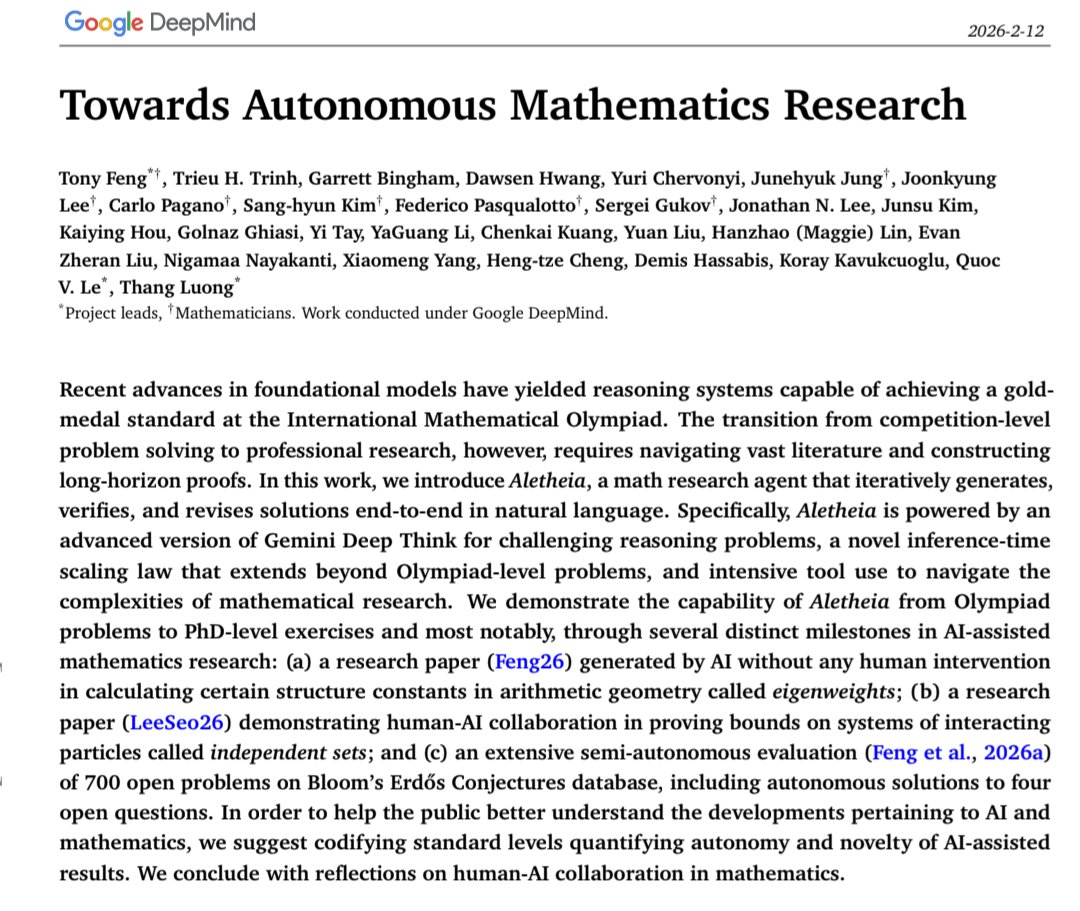
The #Aletheia paper is finally available on arXiv https://t.co/8pLHmZZQO4! Excited to share the 1st wave of papers on AI for math research! More to come very soon, stay tuned!
Blog: https://t.co/NblFQxG5tM
Introducing The Darwin Gödel Machine: AI that improves itself by rewriting its own code
https://t.co/wEEB4LGPr0
The Darwin Gödel Machine (DGM) is a self-improving agent that can modify its own code. Inspired by evolution, we maintain an expanding lineage of agent variants, allowing for open-ended exploration of the vast design space of such “self-improving” agents.
Modern agentic systems, while powerful, remain static—once deployed, their intelligence remains fixed. We believe continuous self-improvement is key to the development of stronger AI capabilities. Our Darwin Gödel Machine is built from the ground up to enable AI systems that can learn and evolve their own capabilities over time, just as humans do.
On SWE-bench, DGM automatically improved its performance from 20.0% to 50.0%. Similarly, on Polyglot, the DGM increased its success rate from an initial 14.2% to 30.7%, significantly outperforming representative hand-designed agents.
Learn more about our approach in our technical report: https://t.co/kDNWFgCI6C
This work was done in collaboration with Jeff Clune (@jeffclune)’s lab at UBC, and led by his PhD students Jenny Zhang (@jennyzhangzt) and Shengran Hu (@shengranhu), together with Cong Lu (@cong_ml) and Robert Lange (@RobertTLange).
Code: https://t.co/RcYLd22TB5