Environment generation is the missing scaling axis for embodied AI.
Introducing SimWorld Studio: a self-evolving factory for endless interactive 3D env where agents act, fail & learn.
Env-agent co-evolvution improves navigation success 50% → 90%.
From a prompt, our SimCoder writes code to automatically build an interactive world. Agents train inside it. And their performance shapes the next world.
My take:
Antigravity is a framework (SDK + CLI +IDE) that uses agent runtime (probably powered by ADK) and the new Managed Agent API (ability to build/run the agent with tools, skills, sandbox, etc just from one API call).
Antigravity SDK and CLI is exposing these same capabilities to Devs.
Google changes product names way too fast, hard to keep up.
Microsoft has released a 4B parameter model that turns any image into a 3D asset in 3 seconds.
It uses a new geometry format called O-Voxel that converts to a textured mesh in under 100ms on CUDA.
Outputs GLB files with full PBR textures, ready for Blender, Unity, and Unreal.
100% Open Source.
Anthropic pays $750,000+ a year for engineers who can build LLM architectures from scratch. Stanford taught the entire thing in 1 hour lecture & released it for free.
Bookmark & watch this today before someone takes it down.
Elon Musk explains his 5-step algorithm for solving any problem:
"The most common mistake of smart engineers is to optimize a thing that should not exist."
"I have this very basic first principles algorithm that I run as a mantra."
Elon breaks it down:
Step 1: Question the requirements.
"Make the requirements less dumb. The requirements are always dumb to some degree, no matter how smart the person who gave you those requirements. You have to start there, because otherwise you could get the perfect answer to the wrong question."
Step 2: Try to delete it.
"Try to delete the part or the process step entirely. If you're not forced to put back at least 10% of what you delete, you're not deleting enough. Most people feel like they've succeeded if they haven't been forced to put things back in. But actually they haven't, they've been overly conservative and left things in that shouldn't be there."
Step 3: Optimize or simplify.
"The most common mistake of smart engineers is to optimize a thing that should not exist. So you don't optimize until after you've tried to delete."
Step 4: Speed it up.
"Any given thing can be done faster than you think. But you shouldn't speed things up until you've tried to delete it and optimize it otherwise, you're speeding up something that shouldn't exist."
Step 5: Automate.
"And then the fifth thing is to automate it."
Elon explains why the order matters:
"I've gone backwards so many times where I've automated something, sped it up, simplified it, and then deleted it. I got tired of doing that. So that's why I have this mantra."
Earth is a single point of failure for human consciousness. The scale of the universe makes becoming a multi-planetary species a requirement, not an option. @elonmusk is solving the right problem.
Brian Cox reveals that every tiny dot is a galaxy hosting 100 billion stars. That thin line at the top? A billion light-year span. Even at the speed of light, it would take a billion years just to cross that sliver. We are part of a cosmic ocean containing 30 sextillion stars, and yet, this is only the part we can see.
The room went completely silent as the scale settled in. It is one thing to hear the numbers, but seeing that map makes you realize we are drifting in a vast, beautiful ocean of light. This is the observable universe, a tiny fraction of a much larger reality. Pure cosmic awe is the only appropriate response to our place among the stars. It makes every earthly struggle feel both infinitely small and our existence infinitely precious.
Source: Horizons: A 21st Century Space Odyssey (Live Tour)
An AI cow collar just created a billion-dollar company.
Farmers draw boundaries on a phone app, and the collars guide cows using sound and vibration.
It works by collecting over 6,000 data points per min, feeding ML models that track grazing patterns, predict disease, and detect peak breeding times.
And they call it the "Cowgorithm."
It saves farmers 20-40 hours of labor per week and has already replaced over 800,000 km of physical fencing.
The collars are also solar-powered and built with bulletproof glass to survive daily wear from 1,000-pound animals.
The founder grew up on a New Zealand dairy farm where his parents started work at 4am and often worked 100+ hours a week. He built Halter to solve the problems he watched growing up.
Larry Page (Google's founding CEO) knew it back in 2007
"When AI happens, it's going to be a lot of computation and not so much clever Blackboard, whiteboard kind of stuff, clever algorithms, but just a lot of computation.
My theory is that if you look at your programming, your DNA, it's about 600 megabytes compressed, so it's smaller than any modern operating system, smaller than Linux or Windows or anything like that, your whole operating system. "
---
From "Google TechTalks" YT channel (link in comment)
Tons of improvements shipped with this one:
- Opus 4.6 1M is now the default Opus model for Claude Code users on Max, Team, and Enterprise plans.
- No more long context price increase in the API.
- No beta header required in the API.
- Include up to 600 images in one request.
Elon Musk just exposed the exact mathematical equation that causes corporations to die.
When system penalizes failure more than it rewards execution, entire architecture defaults to biological self-preservation.
Incrementalism is death sentence in age of superintelligence.
Cannot win planetary-scale arms race making safe, two-percent improvements. Have to take massive, asymmetric bets.
Musk: “If you punish people too much for failure, then they will respond accordingly. And the innovation you will get will be very incrementalist.”
Humans don’t optimize for mission. They optimize for whatever the incentive structure punishes or rewards.
Penalty for missing the mark is severe? Operator simply refuses to take the shot.
Musk: “The risk-reward must be balanced, and favor taking bold moves. Otherwise, it will not happen.”
System fires architect for pushing boundary? Boundary never moves. Entire enterprise mathematically overwritten by faster competitor.
Ultimate bottleneck to technological velocity is not physics.
It’s biological fear of getting fired.
Musk: “Nobody’s going to try anything bold for fear of getting fired or being punished in some way.”
Fatal flaw of traditional economy. Employees aren’t inherently lazy. They’re hyper-rational.
Catastrophic failure pursuing breakthrough leads to termination? Human operator naturally optimizes for safest, most insignificant execution possible.
Don’t build post-scarcity economy with terrified employees.
Build it creating environment where aggressive failure is treated as high-velocity data ingestion, not career-ending vulnerability.
Cannot build multi-planetary civilization with workforce optimizing for zero defects.
Tech monopolies dominating board don’t view failure as negative metric. View it as necessary cost of rapid iteration.
Not failing? Execution loop simply moving too slowly.
Traditional world demands perfection on first attempt. Mathematically guarantees irrelevance.
Winners demand raw velocity. Requires tolerance for breaking things on physical board.
Operators winning next decade ruthlessly strip penalty of failure from organizations.
Maximizing algorithmic speed over biological illusion of safety.
Because the equation is simple. Punish failure and you get incrementalism. Reward bold moves and you get breakthroughs.
Every dead company on the board chose biological safety over asymmetric execution.
They were never outcompeted. They were outrun by someone who wasn’t afraid.
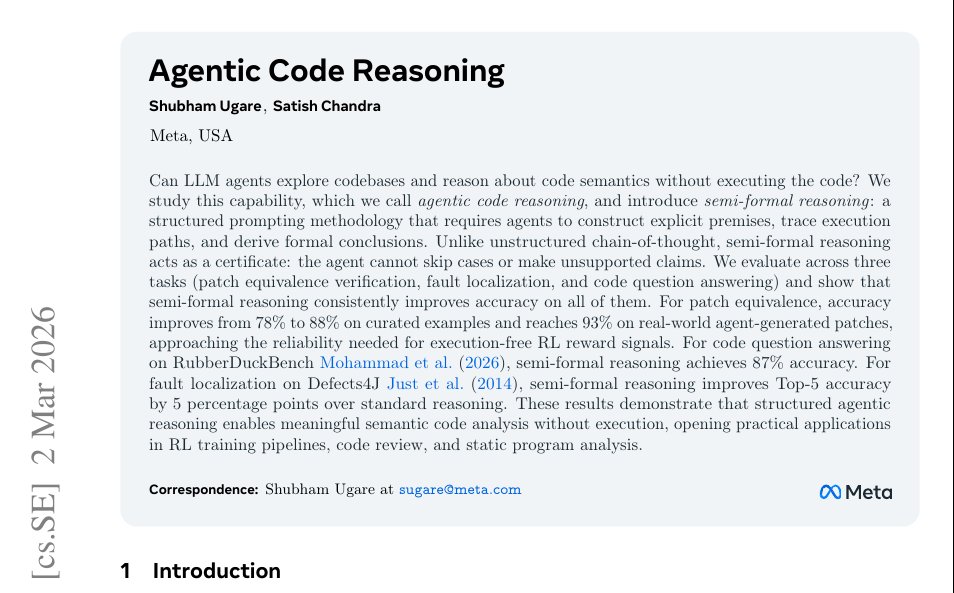
Meta discovered that if you force an LLM to show its reasoning step by step with proof, its code patch error rate drops by nearly 50%.
If you just ask a standard LLM to check the code without running it, the model usually just glances at the function names and makes a confident guess.
The paper talks about how when asked to compare 2 different code fixes, the standard AI saw a common word and assumed it meant the normal system tool.
Because it skipped reading the actual files, the AI completely missed that this specific project had created its own custom tool with the exact same name.
Meta solves this by using a mandatory checklist template that prevents the model from skipping ahead.
The model must explicitly write down what the code modifies, trace the exact execution path, and prove its conclusion with specific evidence.
This simple change forces the AI to actually read the local files and follow the real logic instead of relying on assumptions.
This method pushed accuracy to 93% on real code patches without needing any expensive new training or complex systems.
Overall, it shows that a basic structured prompt can give you highly reliable code verification without the massive computational cost of actually running the software tests.
----
Paper Link – arxiv. org/abs/2603.01896
Paper Title: "Agentic Code Reasoning"
Elon Musk explains his 5-step algorithm for running companies
“First, make your requirements less dumb. Your requirements are definitely dumb… It’s particularly dangerous if a smart person gave you the requirements because you might not question them enough.”
In this interview at Starbase, Elon elaborates on his methodology for shipping everything from electric cars to rockets.
Here’s his “algorithm” quoted in full from the Walter Isaacson biography:
1. Question every requirement. Each should come with the name of the person who made it. You should never accept that a requirement came from a department, such as from "the legal department" or "the safety department." You need to know the name of the real person who made that requirement. Then you should question it, no matter how smart that person is. Requirements from smart people are the most dangerous, because people are less likely to question them. Always do so, even if the requirement came from me. Then make the requirements less dumb.
2. Delete any part or process you can. You may have to add them back later. In fact, if you do not end up adding back at least 10% of them, then you didn't delete enough.
3. Simplify and optimize. This should come after step two. A common mistake is to simplify and optimize a part or a process that should not exist.
4. Accelerate cycle time. Every process can be speeded up. But only do this after you have followed the first three steps. In the Tesla factory, I mistakenly spent a lot of time accelerating processes that I later realized should have been deleted.
5. Automate. That comes last. The big mistake in Nevada and at Fremont was that I began by trying to automate every step. We should have waited until all the requirements had been questioned, parts and processes deleted, and the bugs were shaken out.
Elon shares a costly example of doing this process in reverse on the Tesla Model 3 production line and optimizing a part that didn’t even need to exist.
“It’s possibly the most common error of a smart engineer to optimize a thing that should not exist. Everyone’s been trained in high school and college that you answer the question — convergent logic. You can’t tell the professor your question is dumb or you’ll get a bad grade. You have to answer the question. So everyone, without knowing, basically has this mental straight jacket on and they’ll work on optimizing the thing that should simply not exist.”
Video source: @Erdayastronaut (2021)