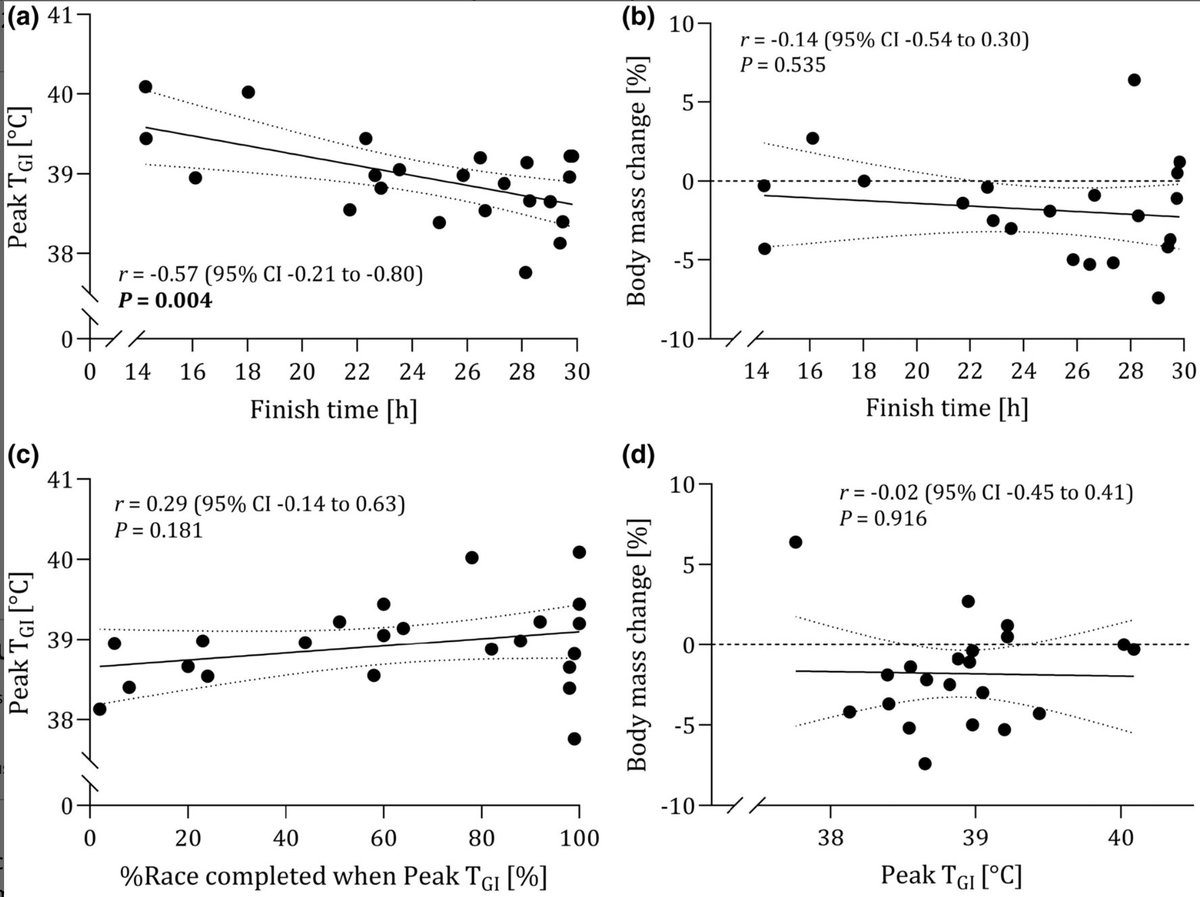
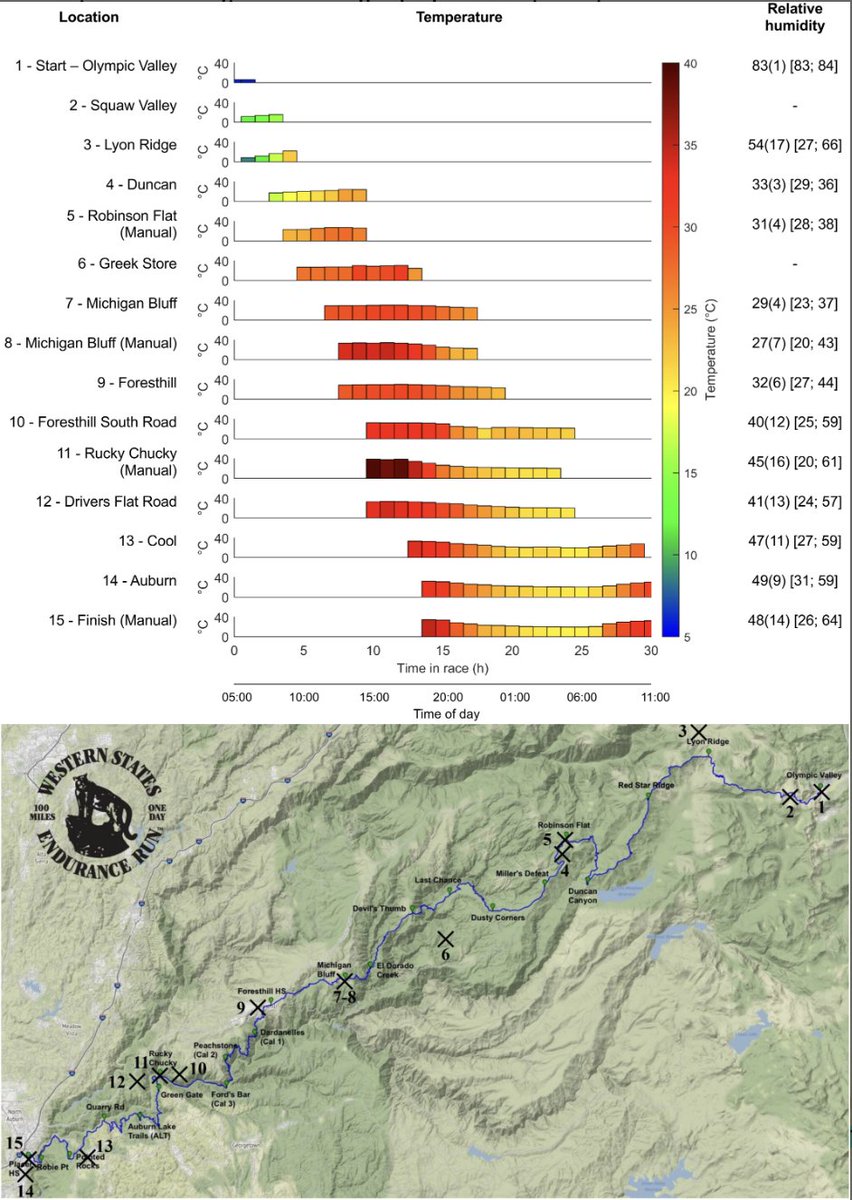
New paper in Physiological Reports from Western States Endurance Run 2025!
We tracked gastrointestinal (core) temperature in 23 finishers of the Western States 100 — a 100-mile race in extreme heat — using ingestible telemetric pills, including 2 podium finishers.
🆕"The purpose of this review is to highlight current injury prevention measures that are used among professional football players & to review the level of evidence for each specific program ⚽️"
👉M. Khodaee @PrunaDoc@m_buckthorpe et al, 2025 🇺🇸
📂 https://t.co/KXPILAB6rk
Great to see proofs of our latest manuscript..
Assessing Deceleration Performance: Methodological & Practical Considerations
📌In past, focus on assessing acceleration & max velocity capabilities
📌Evolution of sports,⬆️necessity to DECELERATE & assess this movement skill👇
New in @japplphysiol from @LoisMougin@steve_mears:
Heat stress impairs exogenous carbohydrate oxidation during prolonged running when maintaining euhydration 👇
https://t.co/0dex0CO7rN
Exercise Intensity Terminology is a bit of a mess 😵💫
Our attempt to try & summarise some of the different approaches, and make some recommendations going forward, has finally been published in both MSSE: https://t.co/iHdsdK4Mhx & JSaMS: https://t.co/ONLEM5g8U8.
🚨 New Publication in Sports Medicine
The Effect of Heat Stress and Dehydration on Carbohydrate Use During Endurance Exercise: A Systematic Review and Meta-Analysis
📄 https://t.co/X6SxCM57J3
Key findings below!
25 years later and we are still debating this. Robergs review should be part of undergrad teaching so we can stop wasting time on this: https://t.co/JeEFSGfARs
Excited that our article: "Running in the heat similarly reduces lipid oxidation and peak oxygen consumption in trained runners and inactive individuals." in @japplphysiol with @steve_mears , @LJJ_nutrition, @DrLeeTaylor is now online: https://t.co/Or9JrxlJ9q
📝 Some advise for physiologist and athletes both testing and receiving tests with metabolic carts.
It is crucial to ask questions, have the right equipment, do due diligence and don't think that because you do a test breathing into a mask the data will be correct…
-There are multiple brands of metabolic carts. Some are very good and scientific. Others are not that great and others don’t even have a CO2 sensor which doesn’t qualify them as valid scientific “metabolic cart” to use with athletes.
-Calibration is absolutely Key.
You should have your cart perfectly calibrated. The metabolic cart should be calibrated every day or even before every test. Also, ideally you should be able to use a manual calibration. For competitive athletes, do not trust those carts which are calibrated every so often. Chances are that they will not give you correct data. Metabolic carts get decalibreated all the time and need to be calibrated constantly. You should be able to do a manual calibration test for O2 and CO2 so you can see exactly wat calibration error is and repeat calibration until it is perfect. O2 is precisely 20.94% and CO2 0.04%. A calibration that gives you a 20.99% of O2 and especially a 0.02% or 0.06% of CO2, will pass the test and will allow you to perform the test. However, that metabolic cart is not perfectly calibrated and you will have high chances of not getting accurate information for a competitive athlete. The metabolic cart should have 2 calibration tanks (O2 and CO2) simulating expired air from the lungs as control, so concentration should be exactly what the tank reads which is~16% and ~5% for O2 and CO2 respectively. Same for calibration Ventilation through the pneumotachograph.
When I was a competitive cyclist, I went to a lab and my VO2max was 94ml/kg/min. I told the person running the test (an exercise physiology student) that it couldn’t be right and probably the ventilation was not properly calibrated. It was in fact upon proper calibration my VO2max was 76.3ml/kg/min.
When working with competitive athletes, all different calibrations in the process need to be repeated until they are PERFECT.
-For athletes: Always do your due diligence on the person who is performing the test on you as it has to be either an exercise physiologist, a physiologist, doctor… all who have received an academic education and experience with metabolic carts. Many coaches are not necessarily physiologists and I have seen many coaches without any formal education or degree, performing metabolic test obtaining completely wrong data as the metabolic cart was not properly calibrated and they never noticed it due to lack of knowledge and preparation…I get athletes sending me reports from their coaches and several “labs” with high VO2max and especially impossible fat and CHO oxidation rates. I have even seen from a “pro coach” a FATmax of 0.98g/min at maximal exercise intensity…That is absolutely impossible. However, the coach didn’t even notice it…Hence, the training zones and data can be quite wrong and jeopardize several aspects of the preparation of an athlete such as training and nutrition.
Anyways, in the midst of so many athletes getting metabolic testing and so many labs popping out with multiple brands of metabolic carts, it is key to watch out and do due diligence on different aspects. Who is performing the test, what is the academic background, certifications, what metabolic cart is being used, Does it have a CO2 sensor, is the metabolic cart calibrated every day or even every test?…Otherwise, so many athletes and coaches will keep getting completely wrong information in so many instances…
Hope this helps…
Tomorrow starts the @UTMBMontBlanc and @walmsleyrunsperformance will be closely scrutinised.
❌Why hasn't he won on his last few attempts?
✅Why he will win Saturday ?
Here are some answers through the prism of the force-velocity-endurance #FOVE from @LIBM_lab@Univ_Savoie
🧵1/9
Want to be successful at losing weight?.
Loosing body fat should be attainable and sustainable for most people with the correct and individualized exercise program. It also takes time, even when you maximize fat oxidation (burning) while exercising at your FATmax (which is Zone 2 for most people). However, although it takes time, patience and perseverance should pay off and you could achieve an important and sustainable decrease in body weight.
Example/Tip:
Your FATmax (~Zone 2) is 0.40g/min and you exercise ~75min each session, 4x week. So, your FATox would be ~30g (270Kcal) per session and ~120g/week, so ~480g (0.48kg/1Lb) per month. In 6 months this would represent roughly 3Kg/6.5Lbs of body fat and in one year, 6kg/13Lbs. This loss in body fat is quite good whether it is for health or performance purposes. However, it takes time and consistency. Also, if you don't optimize your fat oxidation during exercise as you may not be hitting the right exercise zone, weight loss could take longer.
Moreover, if you calculate your nutrition properly and without “magic/miraculous” diets, and just elicit a caloric deficit of ~300-500Kcal/day, this weight loss could be significantly higher and especially both attainable and sustainable.
In my humble opinion, this goal is quite achievable and sustainable. However, the most important thing is to have time and cosnsistancy when so many of us struggle with time…Conclusion: we need to work less and retire earlier 😜
New in @FrontSportsAL
Nutrition, hydration and supplementation considerations for mountaineers in high-altitude conditions: a narrative review
https://t.co/rR00c2qzOM
Recently we demonstrated that sustaining a high % of VO2max during exercise training results in greater adaptations (Odden et al)
Here's how to attain a high % of VO2max during interval training!
@ingvillodden@Hamarsland_H@MrMoelmen#Trainome
https://t.co/FoNqvhQKEw
Continuing to develop our environmental extremes research, teaching & consultancy capacity @ARU_Sport
Thanks to @para_monte, @AltitudeCentre & @Affinity_Ltd_, we've got some new kit to undertake hypoxic conditioning, AMS screening & alternate heat therapy research projects
🗻🌡️