World models are becoming increasingly important, and keeping up with the research is getting harder.
In my blog, I’m breaking down key papers and tracking the latest developments in the field.
🔗 https://t.co/gDn7XdKnr1
Introducing LeVJEPA 1.5 Large, the first step in scaling our method.
It closes the gap to V-JEPA on both image and video benchmarks, trained with 5.6x less compute and over an order of magnitude less data.
Yann LeCun and Randall Balestriero just Proved the Platonic Representation Hypothesis, and found a better way to achieve it.
The Platonic Representation Hypothesis suggests that AI models trained on different modalities, like images and text, eventually learn similar representations of the world. But this paper shows that how models are trained matters more than simply scaling them up.
So they mathematically show that, under certain conditions, two JEPAs trained completely separately can learn essentially the same underlying representation of the world. One learns from different images of the same scene, while the other learns from different descriptions of that scene, without ever being trained on image-text pairs.
Their approach achieves the same image-text alignment with 42x fewer training samples than next-token prediction. A 109M-parameter text JEPA even outperforms LLMs up to 72B parameters on cross-modal alignment benchmarks.
https://t.co/3j1enq9qF7
Introducing EmbeddingGemma 2, a new open multimodal model that sets the standard for on-device efficiency.
- our first open, natively multimodal embedding model
- handles text, code, image, video, and audio tasks within a lightweight, modular 740M parameter form factor
- ideal for offline, privacy-first RAG when paired with Gemma 4
- outperforms some specialist models more than twice its size
Weights available now on Hugging Face.
New 3h31m video on YouTube:
"Deep Dive into LLMs like ChatGPT"
This is a general audience deep dive into the Large Language Model (LLM) AI technology that powers ChatGPT and related products. It is covers the full training stack of how the models are developed, along with mental models of how to think about their "psychology", and how to get the best use them in practical applications.
We cover all the major stages:
1. pretraining: data, tokenization, Transformer neural network I/O and internals, inference, GPT-2 training example, Llama 3.1 base inference examples
2. supervised finetuning: conversations data, "LLM Psychology": hallucinations, tool use, knowledge/working memory, knowledge of self, models need tokens to think, spelling, jagged intelligence
3. reinforcement learning: practice makes perfect, DeepSeek-R1, AlphaGo, RLHF.
I designed this video for the "general audience" track of my videos, which I believe are accessible to most people, even without technical background. It should give you an intuitive understanding of the full training pipeline of LLMs like ChatGPT, with many examples along the way, and maybe some ways of thinking around current capabilities, where we are, and what's coming.
(Also, I have one "Intro to LLMs" video already from ~year ago, but that is just a re-recording of a random talk, so I wanted to loop around and do a lot more comprehensive version of this topic. They can still be combined, as the talk goes a lot deeper into other topics, e.g. LLM OS and LLM Security)
Hope it's fun & useful!
https://t.co/75mXcUBI8L
What's better than 10x performance of major molecular modeling tools? Getting it into 10x as many hands. That's why we're thrilled to announce Balto. Finally, a useful AI Assistant for drug discovery 👇
https://t.co/2mfFydbwhG
Presenting MELON, a technique that can determine object-centric camera poses entirely from scratch while reconstructing the object in 3D. MELON can easily be integrated into existing NeRF methods and requires as few as 4–6 images of an object. Learn more → https://t.co/K6OrAEt3xj
Introducing SANPO, a multi-attribute video dataset for outdoor human egocentric scene understanding composed of both real-world and synthetic data, including depth maps and video panoptic masks with a wide variety of semantic class labels. Read more → https://t.co/bY0ePje0Ss
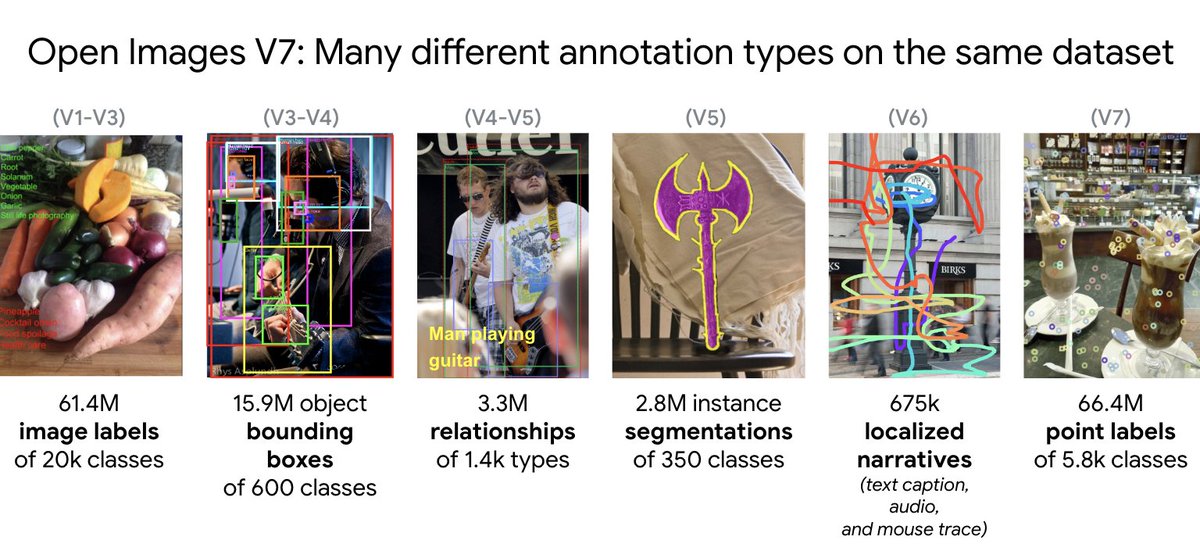
Open Images contains ~9M images with labels spanning thousands of categories. Visit the #ICCV2023 Google booth today at 3:30 PM to find out how this dataset stimulates progress toward genuine scene understanding. Learn more at https://t.co/M2hDwEDf43 and https://t.co/lD15uqrJyi
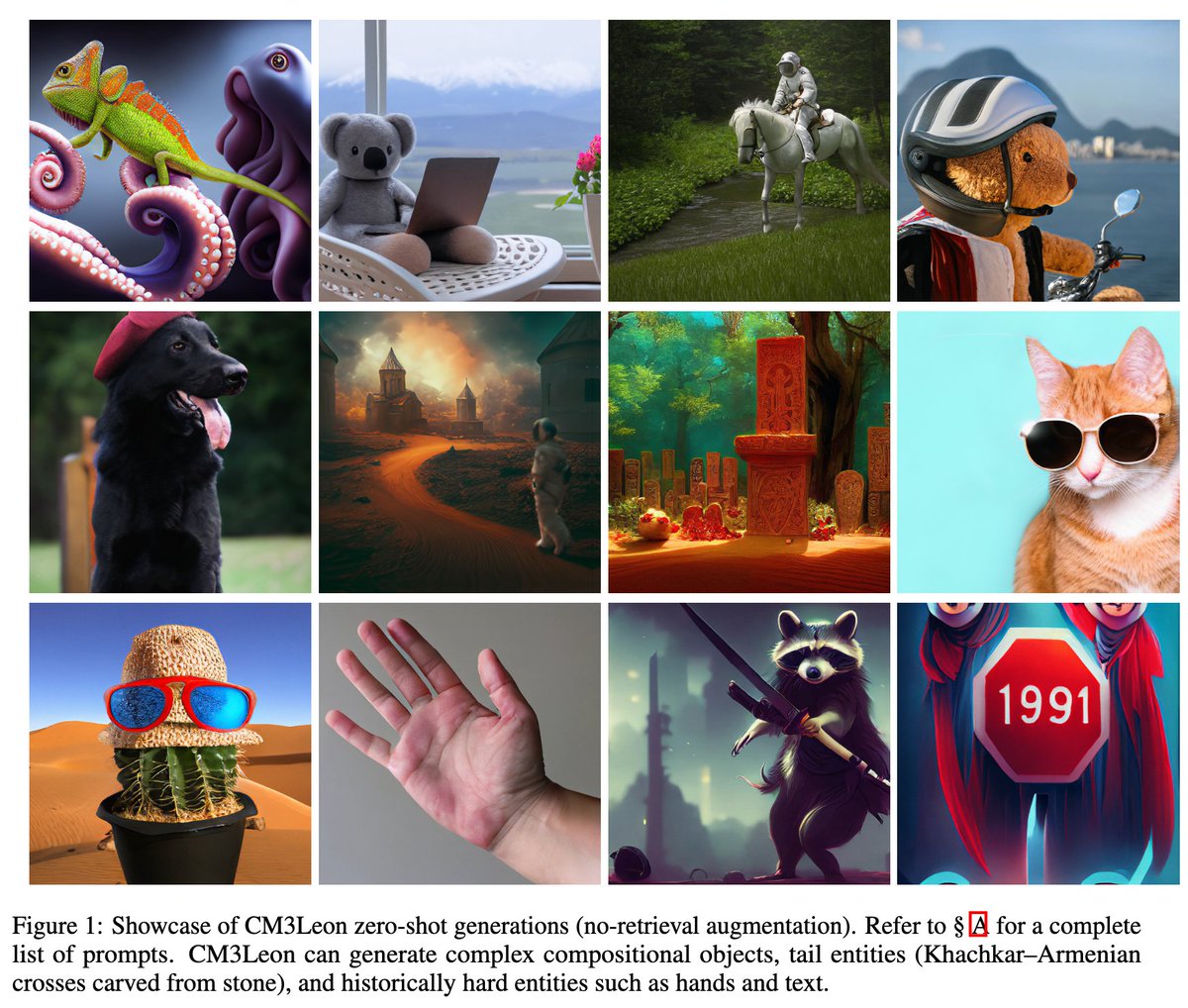
I’m excited to release our most recent work setting a new SOTA FID of 4.88 on text-to-image generation we call CM3Leon (pronounced chameleon)! https://t.co/KEGNFqFt3l
We developed a new navigation model that can be trained on many robots and provides a general initialization for a wide range of downstream navigational tasks: https://t.co/om3rsEudDT
ViNT (Visual Navigation Transformer) is a general-purpose navigational foundation model: 🧵👇
E3B is a method for exploring complex environments which vary across episodes. This work set a new SOTA for MiniHack & reward-free exploration on Habitat in October.
Read the paper ➡️ https://t.co/5oxIf1kDAy
Get the code ➡️ https://t.co/omz9GLkkha
📣 New paper: Emergence of Maps in the Memories of Blind Navigation Agents
Humans have the ability to navigate poorly lit spaces by relying on touch and memory. Our research shows that blind AI agents can learn to do the same.
Read the paper ➡️ https://t.co/XY5kNU5FwR
Introducing #AlphaCode: a system that can compete at average human level in competitive coding competitions like @codeforces. An exciting leap in AI problem-solving capabilities, combining many advances in machine learning!
Read more: https://t.co/yaXfMWtEfe 1/
Want to explore the wav2vec pretrained models or play with the code? You’re in luck! It’s all open source. Create your own positive #Impact on language here: https://t.co/YmcLKxzjaG.
Introducing a novel approach for interpretable, robust, and reliable deep neural networks (DNNs) that employs controllable rule representations, which do not require retraining to adjust the rule strength at inference. Learn more below ↓ https://t.co/MjBUnj4GTT