@simonateba There used to be a burst of activity under your post, bro. Then I noticed the nudging, then your language, then...Do you have a part to correct?
@OgbeniDemola What would a borderless, monolithic nation of Africa look like? Is it fair to give the devil its due in colonialism? Which ‘Africa’ is it-black or Arab one? Aware of two Africas before colonialism? Will Africa now progress or regress?
@jones91kevin@DGAfrica_MFA A little price to pay for development is welcomed. What has that pristine habitat given TZ in all the years of underdevelopment? This sound of yours sounds familiar. Stop it, please. Let TZ move on with her betterment.
@ForensicsKuria@kipmurkomen Go on, but I’m sure you are not making sense. Does your difficult job grant you a summary dismissal of a country in whose tragedies you seem to have found exposure and benefits? Where are you heading to?
@realma1na@kipmurkomen To prevent such unfortunate deaths, and to forge a better future understanding is wholly the veritable reason of establishing diplomatic relations between and among countries. Hasira ya nini bwana?
@ForensicsKuria@kipmurkomen Naongea nawe, @forensicsKuria. Your comment above lacks geopolitical wisdom. Countries don’t engage in diplomatic relations because they have something in common; it’s the opposite.
@RichardOmo21432@kipmurkomen Sasa, uhusiano mwema ungemaanisha nini kwako? Kwanza unaongea Kiswahili bofu. Unabongaje sasa! Kuishi na kufanya biashara pande zote za mipaka ndiyo “diplomatic relations.” Umetoka wapi?
“Excessive dancing invites disorder and demons.”
“For Her Majesty’s Government, keep the natives orderly.”
Colonial rule was not just about controlling land and labour. It was about controlling culture, expression, assembly, and identity.
The language sounds ridiculous today. The mentality should concern us even more.
#DecoloniseGovernance #ReKe #PeoplePower
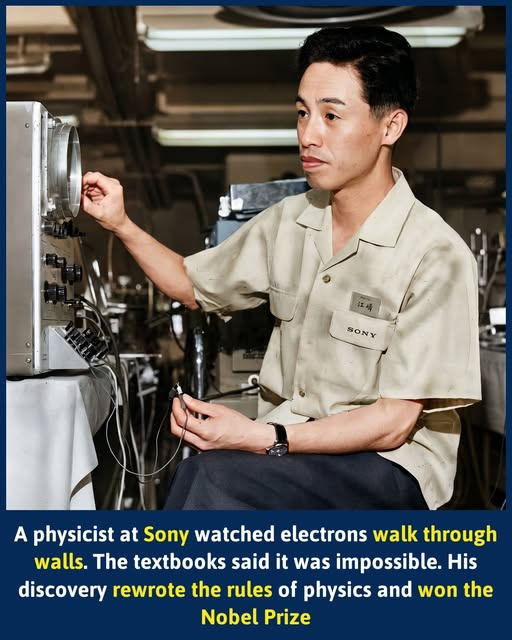
The year was 1957. Inside a modest Sony research laboratory in Tokyo, a 32-year-old physicist named Leo Esaki was doing something that looked almost embarrassingly simple. He was pressing a tiny sliver of germanium semiconductor between two electrodes and watching what happened. No massive particle accelerators. No sprawling university budgets. Just a quiet man, a small crystal, and an idea that the textbooks said shouldn't work.
What Esaki noticed was extraordinary. Electrons weren't behaving the way classical physics demanded. Instead of climbing over an energy barrier the way any sensible particle was supposed to, they were slipping straight through it. Vanishing on one side and reappearing on the other, as if the wall simply didn't exist. This was quantum tunneling, a phenomenon that had been theorized for decades but never cleanly demonstrated in a semiconductor until that moment.
The implications were staggering. Esaki hadn't just confirmed a ghostly quirk of quantum mechanics. He had shown that it could be harvested, controlled, and put to work. The device born from his discovery, the tunnel diode, could switch between states faster than any conventional transistor of its era. It was a signal that the future of electronics wouldn't just be about building smaller components, but about bending the rules of nature itself.
Physics laboratories across the world took notice almost immediately. The tunnel diode ignited a wave of research into quantum devices that rippled from Bell Labs in New Jersey to research centers in the Soviet Union. Scientists who had spent careers working within the comfortable boundaries of classical electronics suddenly found themselves peering into the strange, probabilistic world of quantum mechanics.
In 1973, the Nobel Committee in Stockholm made it official. Esaki was awarded the Nobel Prize in Physics alongside Ivar Giaever, the two of them recognized for independently illuminating the tunneling phenomenon from different angles, Esaki in semiconductors and Giaever in superconductors. It was a recognition not just of two brilliant careers, but of an entire new chapter in the story of physics.
Today, Leo Esaki turns 101 years old. Born in Osaka on March 12, 1925, he has lived long enough to watch the quantum principles he uncovered in that Tokyo lab become foundational to the technology billions of people carry in their pockets every single day. The man who once watched electrons walk through walls is still here. And the world he helped build is still catching up to him.
@PonnieSheila@SSOX211@StephenMogga2 Are you a foreigner? Why would you post something that you know will discredit you, your country and the officials governing it? Learn to edit stuff and elevate your standard. I don’t need to write this. Keep up the good work that you always do.