@Nolan_Mc@jacksantucci * NEMBs = Neutral election management bodies.
Strategically, DSA should prioritize these, so they can benefit from MMP’s finer proportionality than they’d get from the OLPR district magnitudes we are ready to accept.
But they’re interested in ideologies much more than winning.
@Nolan_Mc@jacksantucci I should say for record here, I mean avoid STV as well as IRV for leg bodies, in favor of OLPR. Minor parties can’t afford vote leakage. My current feeling is MMP may be too subject to decoy-party mischief until we have NEMBs.* (Can anyone imagining us avoiding temptation?)
@Nolan_Mc@jacksantucci Your instinct is right. RCV doesn’t help DSA/WFP/Libertarians/Greens/any minor party grow, beyond small initial boost in visibility. They need PR for legislative bodies & stop thinking mainly of exec elections. Exec fusion w/b better for them than exec RCV - for bargaining power.
@bbs1derzy@leedrutman “I don’t see anyone else I like” (after ranking N, where N=0,1,2,…) is a perfectly valid and powerful political statement. Requiring/suggesting more rankings muddies the political picture with false data.
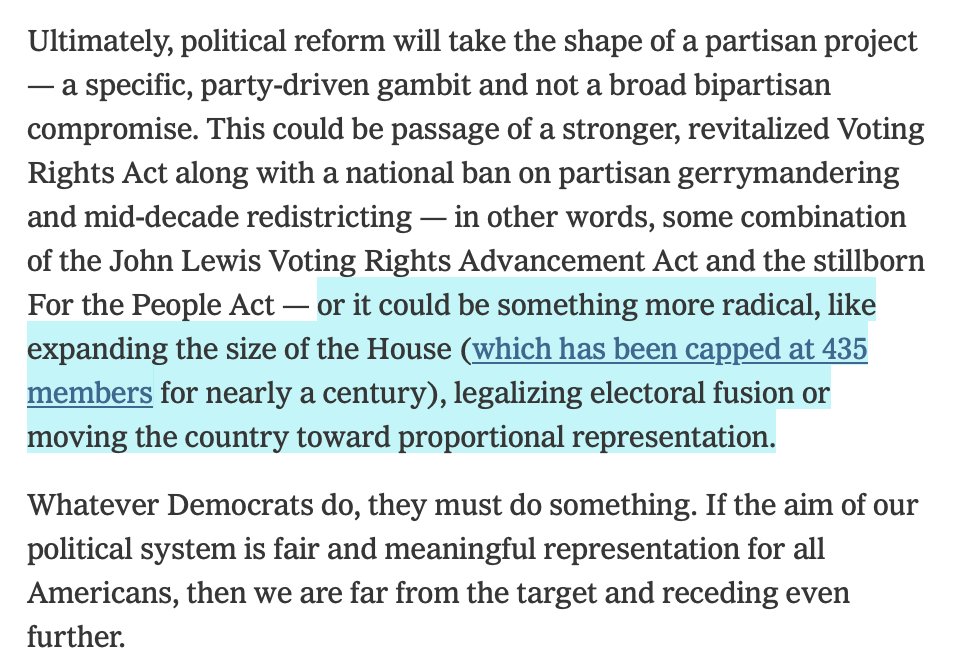
"...(only) two states … appear to be insulated from partisan redistricting: Arizona and Michigan, purple states where it’s unlikely that one party could marshal enough support to override their commissions."
But they’ll still have to live with the broken national system.
@Maxwell_Stearns Yes, timing needs to be “up front.” But no, vetting can’t be by “individual voters” - who by definition don’t have info to vet candidates properly and can’t do it collectively before they begin campaigning, to keep them out of a race, which is what “up front” needs to mean.
There is actually considerable evidence against claims that the variation in electoral institutions across US states have a meaningful effect on the level of fraud in elections. (As I explain below, institutions do matter for perceptions).
Here is one example: one common argument is that voter ID laws prevent the fraudulent casting of ballots. If that were true, then imposing a voter ID law should reduce turnout.
A consistent finding, across many studies, is that voter ID laws have zero or a minute effect on turnout. This fact is hard to reconcile with a lack of voter ID laws facilitating the fraudulent return of ballots.
Likewise, all-mail elections have small effects on turnout and no consistent effect on vote share for candidates from a particular political party.
I'm not aware of a careful study on "ballot harvesting", but we have good reason to be skeptical the effect is large. The total effect of all mail elections or no excuse absentee voting on turnout necessarily bounds the ballot harvesting effect. Also, an individual must have their ballot in hand to have it harvested.
@TheUnOfficialPg@FairVoteCanada Trust me from south of the border. You don’t want to vote on PMs/Premiers! Have you watched how a separately elected US president can control a two-party legislature? You and we need more (and healthier) parties that can keep rogues on a tighter leash.
@ElectionBabe@laderafrutal Since the votes are counted and summed electronically, the type of election rule is largely irrelevant to speed of processing. Processing can be organized for maximum election night reporting if CA wants it - front-load process to day of receipt; enlarge equipment capacities.👀
@leedrutman A better point: If RCV is as transformative in Maine as advocates have claimed, a clean independent (or perhaps D write-in) candidate should be emerging to fill the several vacuums the Platner disclosures create, such as among D among women. But the barriers are too tall.
A healthy democracy should not fear new parties, new political labels, or voters organizing in new ways. It should not fear candidates building cross-constituency support—or voters having better tools to express what they actually believe at the ballot box. @jefftimmer
@laderafrutal The successes keep piling up.
Now if I could just get co-workers here in MI to use it to assess their design options (and subtract some factor >0.8 for primaries and embeddedness)…
This New York Times piece is worth your time. Here’s what is happening, as simply as I can put it.
Back in January, Trump sued the IRS, an agency he controls, demanding $10 billion over the leak of his tax returns a number of years ago.
IRS lawyers did their jobs. They wrote a memo laying out the defenses that could beat the suit, including the fact that Trump filed too late. His own lawyer was in court when the leaker pleaded guilty in October 2023, more than two years before Trump sued.
The Justice Department never showed up to court. Never argued back. Never used the defenses sitting on their desk.
The judge got suspicious and ordered both sides to explain whether they were actually opposing each other or just colluding. The day before that brief was due, Trump dropped the suit.
Same day, his Justice Department announced a $1.776 billion taxpayer-funded “anti-weaponization fund.”
Trump gets a formal apology. The IRS agrees to drop any audits of him and his family, even though a 2024 Times report found a loss in an ongoing audit could cost him over $100 million.
The acting Attorney General, Trump’s former criminal defense attorney, picks the five commissioners who decide who gets paid. Trump can fire any of them. Proud Boys and Oath Keepers are not ruled out.
This is the most corrupt thing I’ve ever seen from an American president.
Where in the hell are my Republican colleagues?
https://t.co/La0nlLuz1r
A perhaps under appreciated advantage of PR: the effect of interparty competition on intraparty politics.
Big parties have some incentive to tolerate this (can expand a potential coalition’s reach) and some to preempt it (by presenting lists that balance their factions).
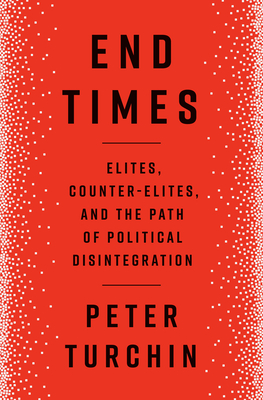
@RonBrownstein See the data-driven works of @Peter_Turchin on what it takes to begin to exit the loop.
Only after that will come new taxes, constitutional amendments, global treaties & legislation changing the balance-of-economic-power between corporations, employees, customers and voters.
What a book! One of the best I’ve read in a while. End Times by @Peter_Turchin uses mathematical models and historical data to explain why societies become unstable: rising inequality, too many elites competing for power, weaker institutions, and public anger. It makes social collapse feel less random and more understandable 👌
https://t.co/91fGoutmav