A 501B open model just landed on the Hub, and you can own it! Beam by @reflection_ai:
501B MoE, 23B active
1M token context
Built for coding + agents
Token Efficient
Apache 2.0
Day-0 in transformers, vLLM, SGLang. We also kicked the tyres hard on this, with shipped SFT + RL recipes 🧵
Beam is now available across platforms, with open weights under the Apache 2.0 license - in collaboration with an ecosystem of 40+ partners.
We're releasing:
- Weights, tokenizer, and reference implementation
- BF16, FP8 and NVFP4 weights and a DFlash2 drafter
- The open source harness we built and trained Beam on: Mirror CLI
Weights and model card on Hugging Face: https://t.co/tPqWpk9RXL
ICYMI, new @NoPriorsPod with @reflection_ai cofounder @MishaLaskin on China, safety, market structure of ai, the business model of open models, reasoning efficiency, distillation, and what it takes to ship massive frontier AI
“Competitive tension is just good.”
I have great affection for research mathematicians even after leaving academia post-PhD, and they are essentially correct when they say that LLMs are likely to kill the model of academic mathematics that has been practiced since WW2.
However…
I'm sorry but you don't own the math problems. Any one is free to solve them and publish what they want. You can ignore it, criticize it, or debunk it. But they have the right to publish.
@augusteprompt@teortaxesTex Umm...so just hire more? Also sry to put this bluntly but people outside of frontier labs tend to overestimate how much of frontier AI is about "secrets" versus good culture and good execution.
@augusteprompt@teortaxesTex Why would they need a fucking spy, when they can just hire an employee from oai, who knows most of the "secrets" anyways? This is completely legal and normal.
@teortaxesTex Do these people not understand that the cost of a spy is much higher than just, I dunno, poaching an employee to work for a Chinese lab. Not that labs like Deepseek need that much frontier knowledge from OAI and ANT anyways.
I have learned so much from our pretraining team in just a month. We have a group of people truly at the frontier of pretraining science. Come join us!
I am so proud of Beam.
Beam is Reflection's first open-weight model. It's the result of a ~year of hard work, ingenuity, and camaraderie of one of the most incredible teams I've ever seen in AI 🔥
I joined Reflection last November. Pretraining in particular was so nascent – only 5-10 people and a bit of code! We didn't yet have a crawler, or a resilient GPU infra, or a deduplication pipeline, or in-house evals, or even sufficiently big MoEs. All that started in earnest in 2026, in one of the most satisfying sprints I've ever had the pleasure to live through.
What we nailed, I think, was a perfect blend of scientific rigor, startup intensity, team iteration, and ambition. We did not YOLO decisions in pretraining, that tends to blow up in your face when you scale up 🙂 But we also made sure to move fast and play to our strengths as a nimble, high-ownership, high-trust team. The resulting system of systematic iterations and fast cross-team back-and-forths really paid off.
The midtraining, RL, and post-training teams really really cooked here on top of the pretrained base. The announcement below details the sheer scale and payoff of that investment, I'll let the team cover it, it's remarkable. On many agentic coding capabilities the model kept going up without any sign of a plateau.
Feel free to read more in the announcement today – but later this month we will also drop the full weights release under Apache 2.0, a detailed tech report with the cool LLM science, and partner integrations with the OSS ecosystem. It's an open model after all. I strongly believe open intelligence is the future of AI, this is why I'm here.
And I encourage y'all to join us on the open side 😉
We are introducing Beam today, a 500b open model that excels in coding, agentic, and scientific workloads.
Beam is very token-efficient, pre-trained from scratch, and scaled with the largest RL run documented openly we are aware of.
Getting here was challenging, rewarding, and personal.
I immigrated to the USA during childhood when my parents got jobs as scientists at PNNL, a national lab located in a rural town in Washington state.
Growing up, I developed an interest in physics because it was grounded in simple principles, was foundational, and had long-term impact.
Physics was the foundational science of the 20th century. The first general computer (ENIAC), the transistor, GPS, and much of modern technology had its roots in physics.
In 2016, during my graduate studies, I noticed the birth of a new foundational science - Artificial Intelligence.
AlphaGo, the superintelligent Go agent developed by DeepMind, had come out and made me feel what was about to come.
A neural network, trained to imitate human players, and then improve itself through trial and error, mastered the most intellectually challenging board game in the world.
What surprised me about AlphaGo is how it was conceptually simple, general, and scalable. The system could in principle improve itself forever, it was just a function of compute.
This is when I became “AGI pilled” as they say.
I switched from physics to AI because I thought this would become the root node science of the 21st century, much like physics was the root node science of the 20th century.
I believe that working on foundational science is not enough on its own. Foundational science must also remain open and widely accessible.
We remember Newton for his contributions to physics, but he was also an alchemist.
Alchemy was done in secret, because the artificial production of gold was deemed lucrative but also dangerous with the potential do destroy entire economies. Newton even wrote his alchemy notebooks in cypher.
On the other hand, Principia was published in the Philosophical Transactions of the Royal Society, the knowledge was made widely available, passed down for generations in what we now call Newton’s laws.
The computer, transistor, GPS were possible to build because physics as a science was open. Openness creates an ecosystem of innovation.
The notion of openness, which is a core tenet of scientific discovery, has also become a guiding principle for how foundational technology gets built and distributed.
The internet was built on open protocols. The most widely used operating systems are open. The field of cybersecurity exists because strong encryption protocols were made open in the 1990s.
Open also means safer. The best defence is a distributed one. Commonly used open source software is robust and battle-tested because it is inspected and patched by a community of developers.
AI is different but also similar to software in many ways, though with a much larger surface area of vulnerabilities. It is impossible for a small group of safety researchers working in secrecy to remediate all of the potential issues regardless of their intentions. It is like entrusting a handful of white blood cells to protect your body.
AI is both foundational as a science and a technology, and the safest way that also ensures the benefits of AI are distributed evenly is by making it open.
I’m excited for what developers and scientists build and learn from this model, and for Beam to play a small part in ensuring that AI is made widely accessible, safe, and beneficial to all.
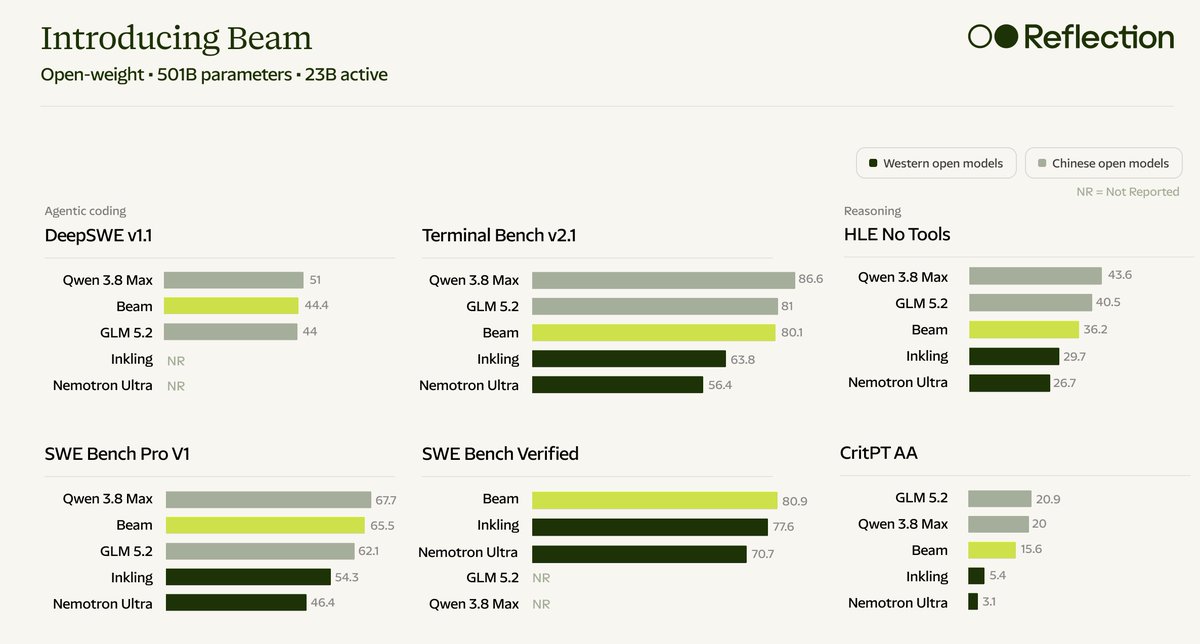
Introducing Beam: a highly efficient agentic open model with 501B total parameters and 23B active.
- Frontier reasoning efficiency
- Advances the Western open frontier on coding & agentic tasks
- Trained end-to-end from scratch
Full weights release this month.
Learn more about Beam: https://t.co/c3Qx2cpM8G
@henrylhtsang I don't like working purely in tmux but the codex app still adds a lot offriction to basic workflows. For example it cannot start a new chat session in an existing Worktree folder. Also cannot switch folders mid session.
I've written a blog post responding to the letter about maths and AI signed by 25 Fields medallists. As with the Leiden Declaration, I didn't sign it, but I agree with much of it and welcome its existence.
https://t.co/M126UUJvG0