Ever wondered what a cell has experienced in the past? This is in general hard to measure. Here we introduce the recordanelle, to equip cells with a tool that lets them record their own history.
https://t.co/JVM3yOit8s
@NatureBiotech@ETH@randall_platt@ETH_BSSE
Many AI-based protein design and engineering examples are exciting, but what we really want to see is success in areas that have been difficult to tackle with existing approaches.
They present a simple, powerful framework with truly impressive applications.
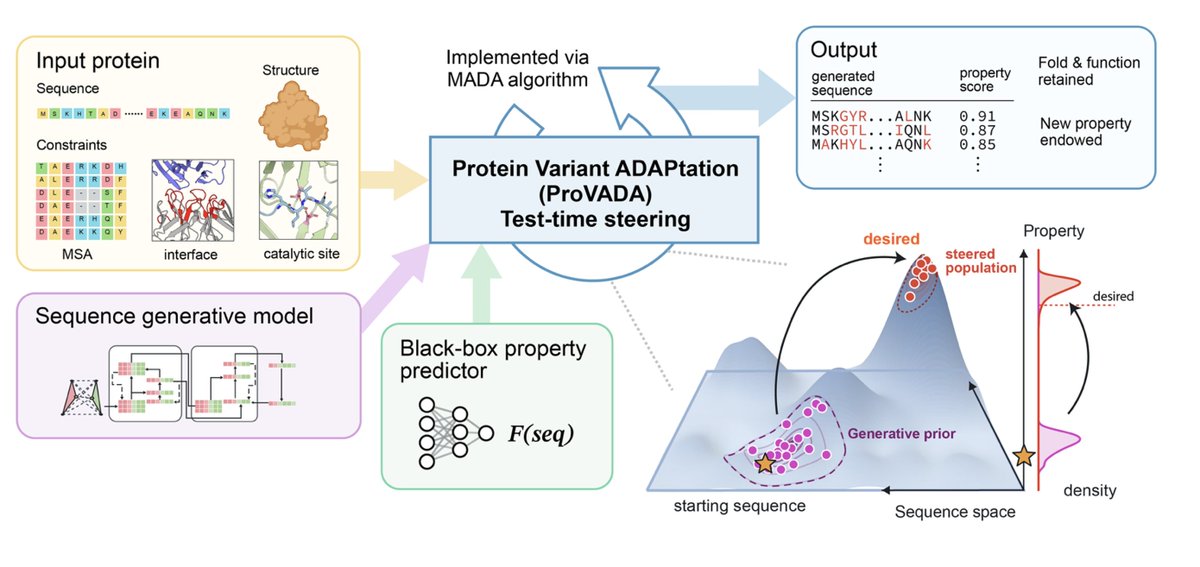
We deimmunized a clinical CD19 CAR binder with experimentally detected HLA-I epitope depletion while retaining tumor killing, and rescued a secreted protease to function in the cytosol.
Both done with one unified design framework: ProVADA.
How it works and what we tested 🧵 (1/11)
We deimmunized a clinical CD19 CAR binder with experimentally detected HLA-I epitope depletion while retaining tumor killing, and rescued a secreted protease to function in the cytosol.
Both done with one unified design framework: ProVADA.
How it works and what we tested 🧵 (1/11)
Numerous biotech innovations started with adapting a protein to its non-native context, which often requires substantial experimental optimizations. Here’s a breakdown by our lead, @Xiaowei0402, on a versatile, efficient computational framework to facilitate such adaptations.
Very excited to release ProVADA! It was so much fun working with the incredible @Xiaowei0402, @sluu_06, and the rest of the team. Check out Xiaowei's thread for more details!
Lastly, it’s indeed an intellectual inspiring journey working on this multidisciplinary project with everyone in this amazing team!
Can’t be more grateful to the co-leads: @sluu_06 on the algorithmic and statistical foundation, and @bviggiano_13 on the codebase and benchmarks!
Special thanks to Laura Yang and Prof. @BingfeiY for supporting ESCAPE-seq; Kevin Reynolds and Elena Sotillo with Prof. Crystal Mackall for all the CAR-T experiments; @sophiaburick, @haoyu_dai_dhy and @santimillef on the renin designs and validations; as well as @Geonhu_Lee and Zi for deimmunization validations!
In the end, huge thanks to Xiaojing and Wing, this work would not be possible without your guidance and dedication!
Read the preprint: https://t.co/ANibUVz4RD
(11/11)
Out now in Molecular Cell! Retrons protect bacteria from phage infection, and this one has one of the craziest mechanisms we’ve ever seen. (1/8) https://t.co/LXIxdKtNC0
Detectrons are now published in Nature Biotechnology!
Programmable RNA sensing meets DNA barcode production in living bacteria.
https://t.co/MravsG9pdx
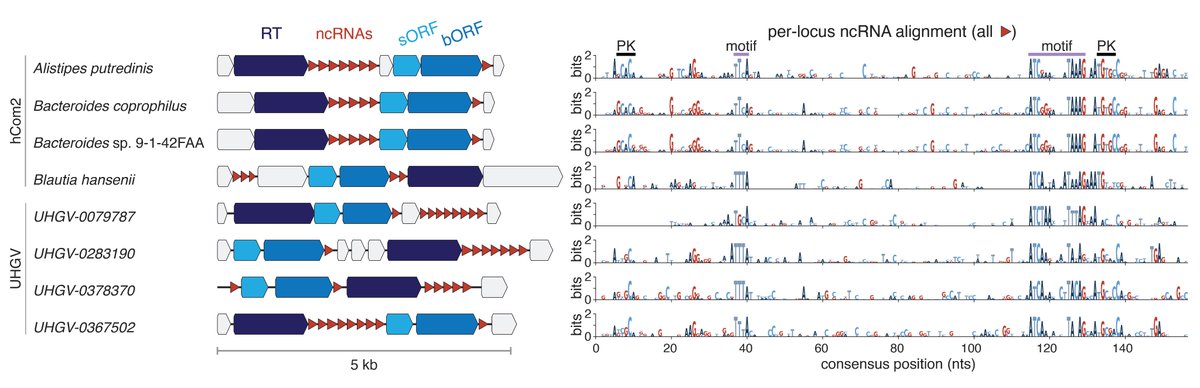
Excited to share Minerva, our approach using genome language models for biological discovery! Using Minerva, we find that UG27 reverse transcriptase systems encode variable arrays of diverse ncRNAs with a shared structure, each templating a short DNA hairpin. With @garykbrixi.
You can now use Proto in ChatGPT!
Here is de novo nanobody design with Germinal (https://t.co/OSjF4ao1I2) and semantic design with Evo 2 (https://t.co/xbX9iUyb6i).
Check out the Rosalind Workbench Research Preview: https://t.co/0PZtDS8PhP
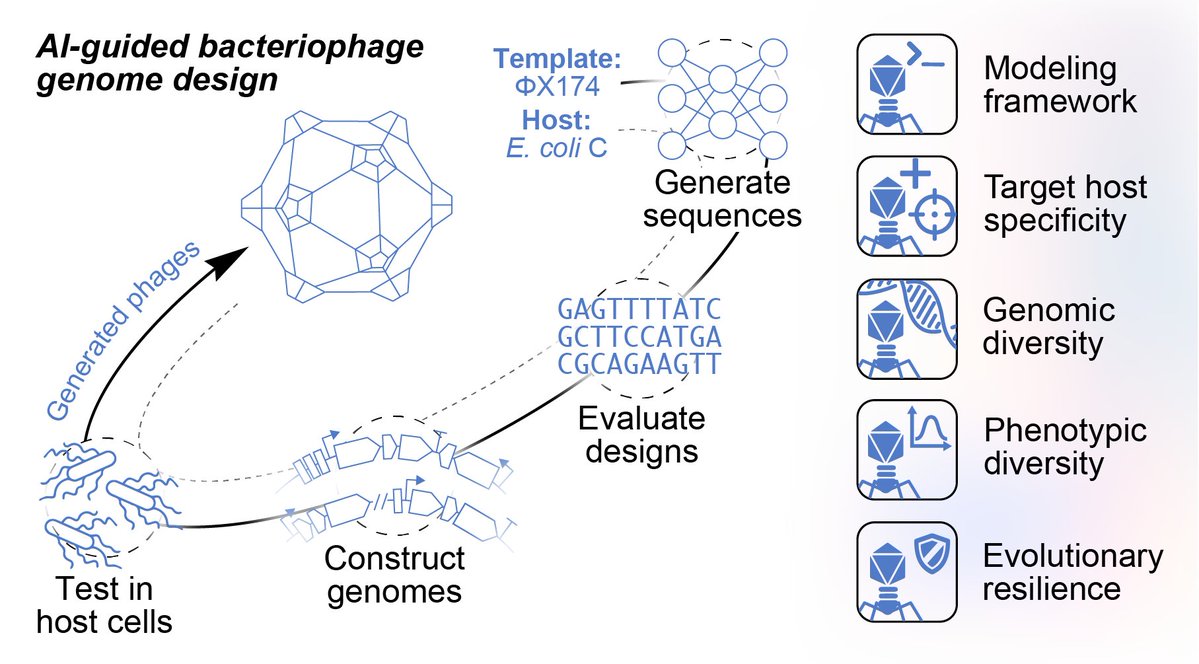
One of our most popular preprints of 2025 is now published in @ScienceMagazine. Congrats to @BrianHie, @samuelhking, and team on establishing a framework for generating and evaluating AI-generated genomes.
- Access the paper: https://t.co/p5qMhTroK2
Heading to mSBW? Check out work by @cnnrcall (Poster 47, genetically encoded urinary reporter to noninvasively monitor live molecular events), JS (Poster 46, efficient biophysical design of orthogonal DNA duplex libraries), and @mengzhang668 (talk, ablating cancer using RADAR).
When we talk with AI researchers, one question comes up most frequently: do you have datasets focused on mutations at key protein positions?
Until now, building libraries for that usually meant a lot of DNA synthesis. We developed HGT-DGR as a faster and cheaper way to make them.
https://t.co/MWiRth0OU6
Been working on a really strange retron bacterial immune system, here's the preprint: https://t.co/iWP8qH1Fe7
Type VI retrons are unlike any other. Phage infection triggers reverse transcription of a DNA fragment that activates translation of a toxin to kill the infected cell.