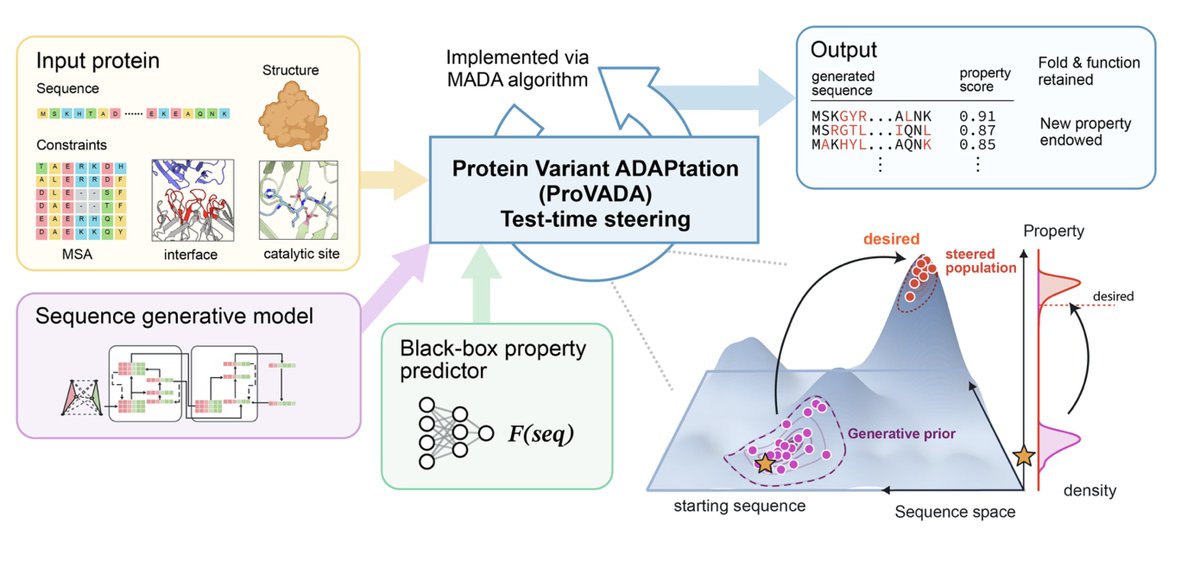
Numerous biotech innovations started with adapting a protein to its non-native context, which often requires substantial experimental optimizations. Here’s a breakdown by our lead, @Xiaowei0402, on a versatile, efficient computational framework to facilitate such adaptations.
We deimmunized a clinical CD19 CAR binder with experimentally detected HLA-I epitope depletion while retaining tumor killing, and rescued a secreted protease to function in the cytosol.
Both done with one unified design framework: ProVADA.
How it works and what we tested 🧵 (1/11)
Xiaowei is the mastermind, also with contributions from current and former lab members @ sophiaburick, @haoyu_dai_dhy, @Geonhu_Lee, Zi Liu, and @santimillef. Read here: https://t.co/dnOpjIrTyH
Numerous biotech innovations started with adapting a protein to its non-native context, which often requires substantial experimental optimizations. Here’s a breakdown by our lead, @Xiaowei0402, on a versatile, efficient computational framework to facilitate such adaptations.
We deimmunized a clinical CD19 CAR binder with experimentally detected HLA-I epitope depletion while retaining tumor killing, and rescued a secreted protease to function in the cytosol.
Both done with one unified design framework: ProVADA.
How it works and what we tested 🧵 (1/11)
Laura Yang and @BingfeiY for guiding us through ESCAPE-seq so that we can collect an experimental proxy for HLA-I binding, and Elena Sotillo and Kevin Reynolds from the Mackall lab for CAR function validation.
As with biological design, AI can also accelerate biological discovery.
In new work led by @_David_Li and @garykbrixi with @mfgrp, we show how genome language models enable systematic discovery of genetic elements, revealing a new class of reverse-transcriptase mechanisms.
As with biological design, AI can also accelerate biological discovery.
In new work led by @_David_Li and @garykbrixi with @mfgrp, we show how genome language models enable systematic discovery of genetic elements, revealing a new class of reverse-transcriptase mechanisms.
@chang_m_yun@Codex_Changelog I guess for a field we care deeply about, we just can't wait for it to move fast :D Sometimes what makes the difference is whether one has the fortune of having ppl like Santi and Xiaowei to lead such projects...
@chang_m_yun@Codex_Changelog I resonate with many of your points :) I have to say tho depending on what we mean by synbio, we'd like to claim we are in the stone-bridge-to-modern-bridge age, but we could actually be in the pre-stone-bridge age imo... we could use better machine-guided stone design too.
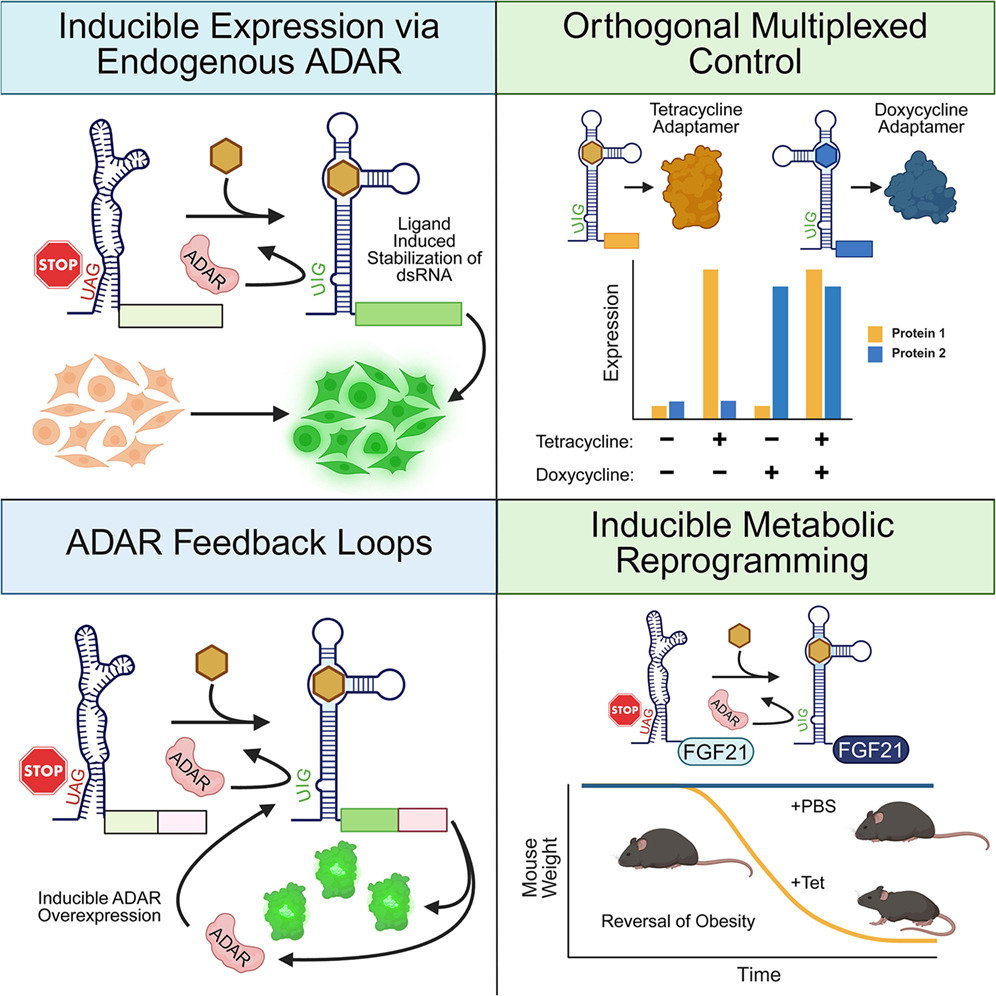
Heading to mSBW? Check out work by @cnnrcall (Poster 47, genetically encoded urinary reporter to noninvasively monitor live molecular events), JS (Poster 46, efficient biophysical design of orthogonal DNA duplex libraries), and @mengzhang668 (talk, ablating cancer using RADAR).
Please RT: We're hiring! Computational postdoc for foundation model and sequence-structure-function studies of intrinsic disordered proteins through a consortium and unique large datasets. Ideal candidates have led ML/AI projects in protein design/analysis.