Curious about what China’s nuclear force is evolving into? Using Chinese primary sources, my latest publication from @NBRnews maps out what China is building and the goals it intends to serve. 🧵 https://t.co/PlXOZgKtAn
It’s not just in the hard sciences. There is also an extensive body of Chinese writings on military affairs, statecraft, and grand strategy that we are largely ignoring to our own detriment, leaving us to either mirror image or else hope for preferred outcomes.
While the idea that the term "strategic competition" (战略竞争) might be limited in the CCP's external messaging, through its internal discourse, Xi Jinping is frequently exhorting his military leaders that they are in "strategic competition" as seen in this March 2017 speech:
Five Eyes was built for another era. We get diminishing value from four partners, and ties with Britain are at a low point. Time to rethink the alliance around those actually delivering intelligence value — Israel, Poland, Ukraine, UAE, Japan, ROK and other serious partners.
@RealVanJackson Van, we should be more careful than portraying an anecdote as representative of the entire officer class... I was just sitting with several groups of officers all last week who all thought completely differently than this on Iran, but I also wouldn't claim that's representative.
Curious about what China’s nuclear force is evolving into? Using Chinese primary sources, my latest publication from @NBRnews maps out what China is building and the goals it intends to serve. 🧵 https://t.co/PlXOZgKtAn
Well that's an unfortunate naming coincidence, but my Air Force days did not include flying planes or retiring in 1996. Don't train the PLA on how to kill us you fucks.
Chapter by Gerald C. Brown (@GeraldC_Brown) in NBR's new PLA volume examines the future trajectory of #China’s #nuclear force as it shifts to a “world-class” #nuclearforce, including drivers, political objectives, employment, and capability developments. https://t.co/QK2HO6US4b
@injunjohn86@RadioFreeTom Serving in the military does not make one immune to criticism. Civilians not only have every right to, but also should, comment on these topics. We have a military under civilian control in this country.
To be clear, its not that Schelling is never mentioned in Chinese strategic texts, but he is omitted far more often than one would expect and in areas he should clearly be listed while others such as Brodie, Kahn, etc. are not.
I've never quite understood this. One example, the strategic missile encyclopedia, put together by the missile forces as a comprehensive overview, has a section describing every key text to understand nuclear strategy that includes every key Western text except for Schelling
One observation from reading a lot of Chinese language strategic & military texts is that while there is a broad range of Western scholars & works they frequently cite--from Mahan to Kissinger--one author who seems to rarely get mentioned at all is Thomas Schelling.
In case you missed it, Kerry Brown wrote a book that plagiarized Shelley Rigger’s classic book title.
I, along with others who were asked to review Kerry’s manuscript, said verbatim to change the title.
In the most tacky and unprofessional fashion, he stole her title anyway.
From NBR's new book, the chapter by Gerald C. Brown (@GeraldC_Brown) examines the future trajectory of #China’s nuclear force as it shifts to a “world-class” #nuclear force, including drivers, political objectives, employment, and capability developments. https://t.co/1eNFhVir88
Well if everyone's going to be talking about nukes, might as well learn what China's moving towards on that front...
Seriously though, these problems aren't going away and are more relevant than ever--this affects much more than a small cadre of nuclear specialists.
Curious about what China’s nuclear force is evolving into? Using Chinese primary sources, my latest publication from @NBRnews maps out what China is building and the goals it intends to serve. 🧵 https://t.co/PlXOZgKtAn
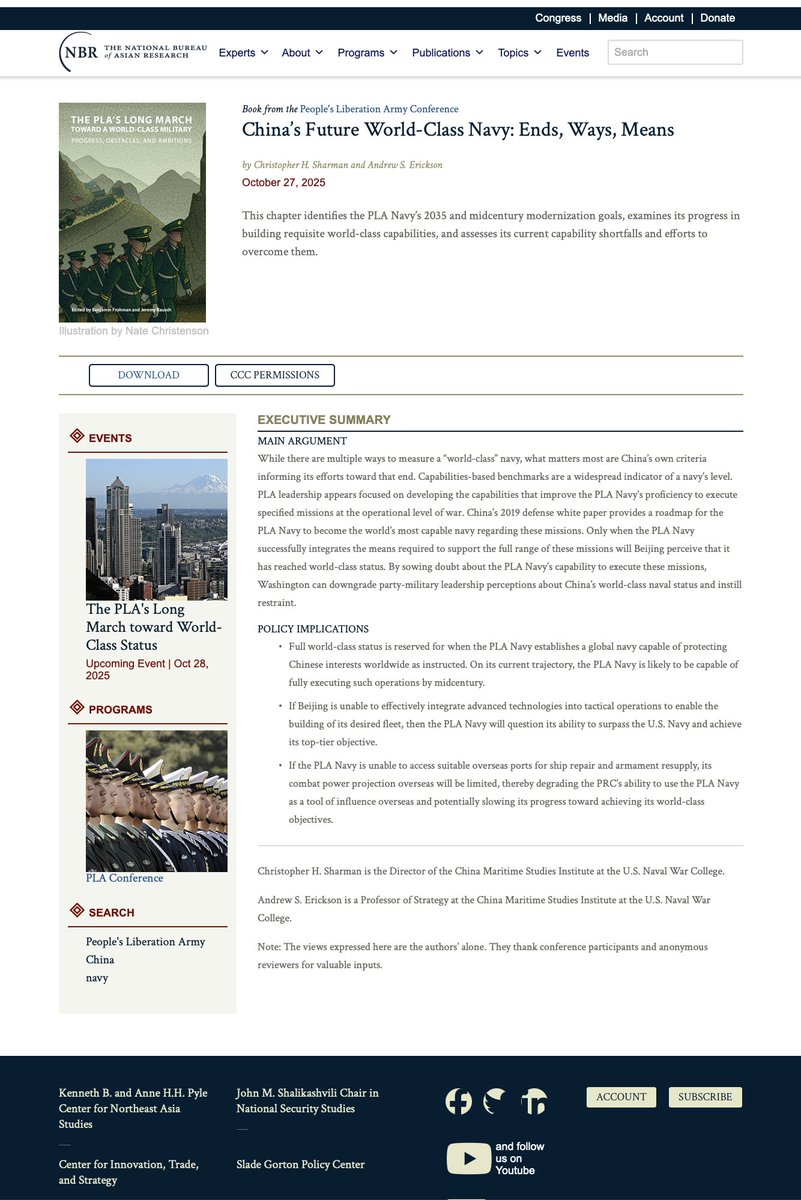
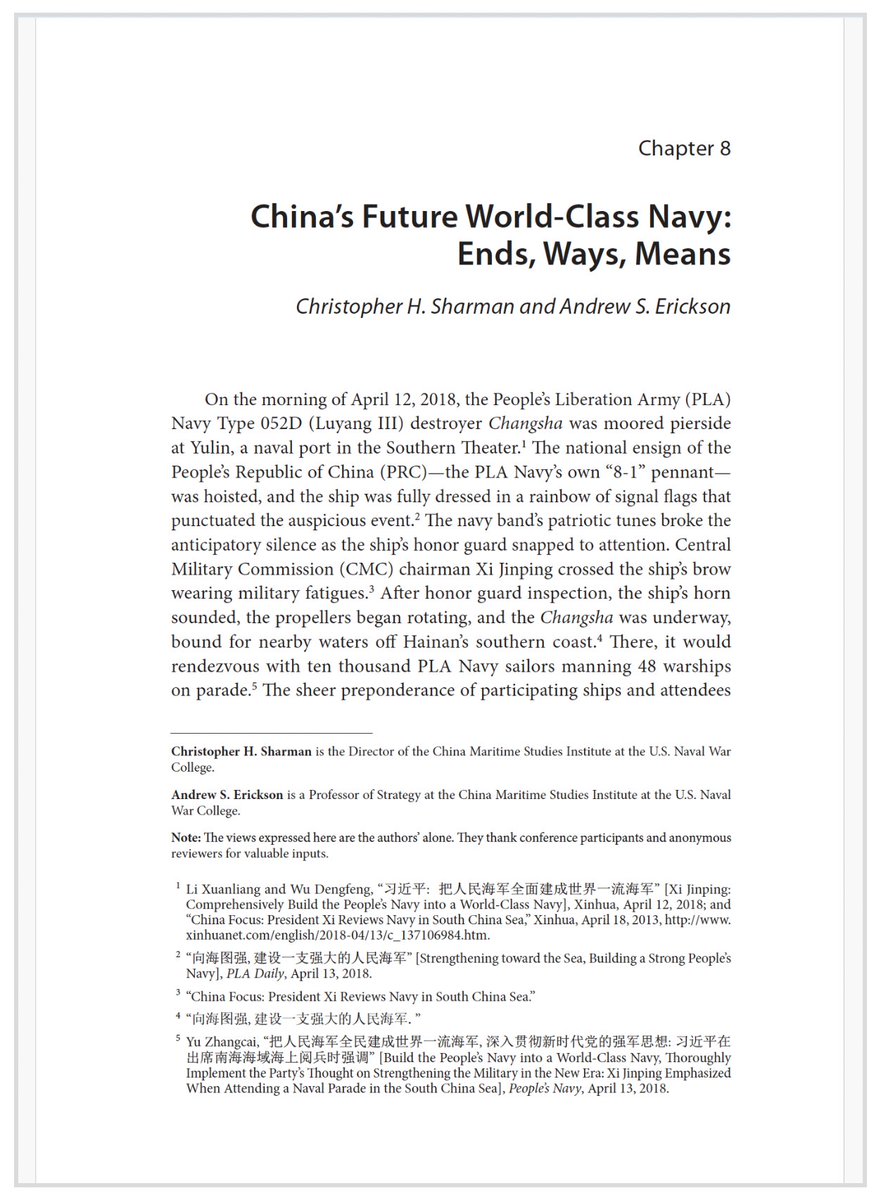
Honored to coauthor chapter with @NavalWarCollege/@ChinaMaritime Director @ChrisHSharman — “#China’s Future World-Class #Navy: Ends, Ways, Means”!
Key Points: https://t.co/8zkTiWrKKf
Full text: https://t.co/dRDKrgVzd5
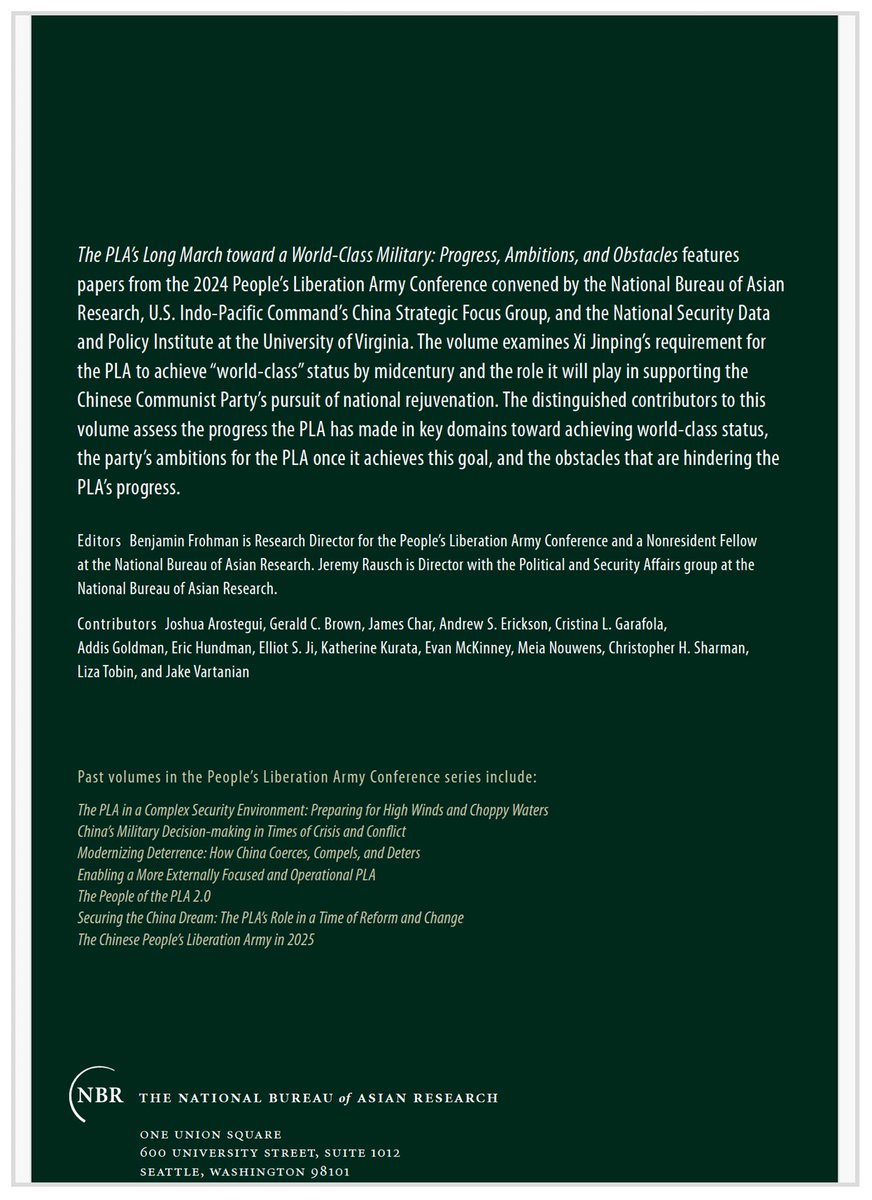
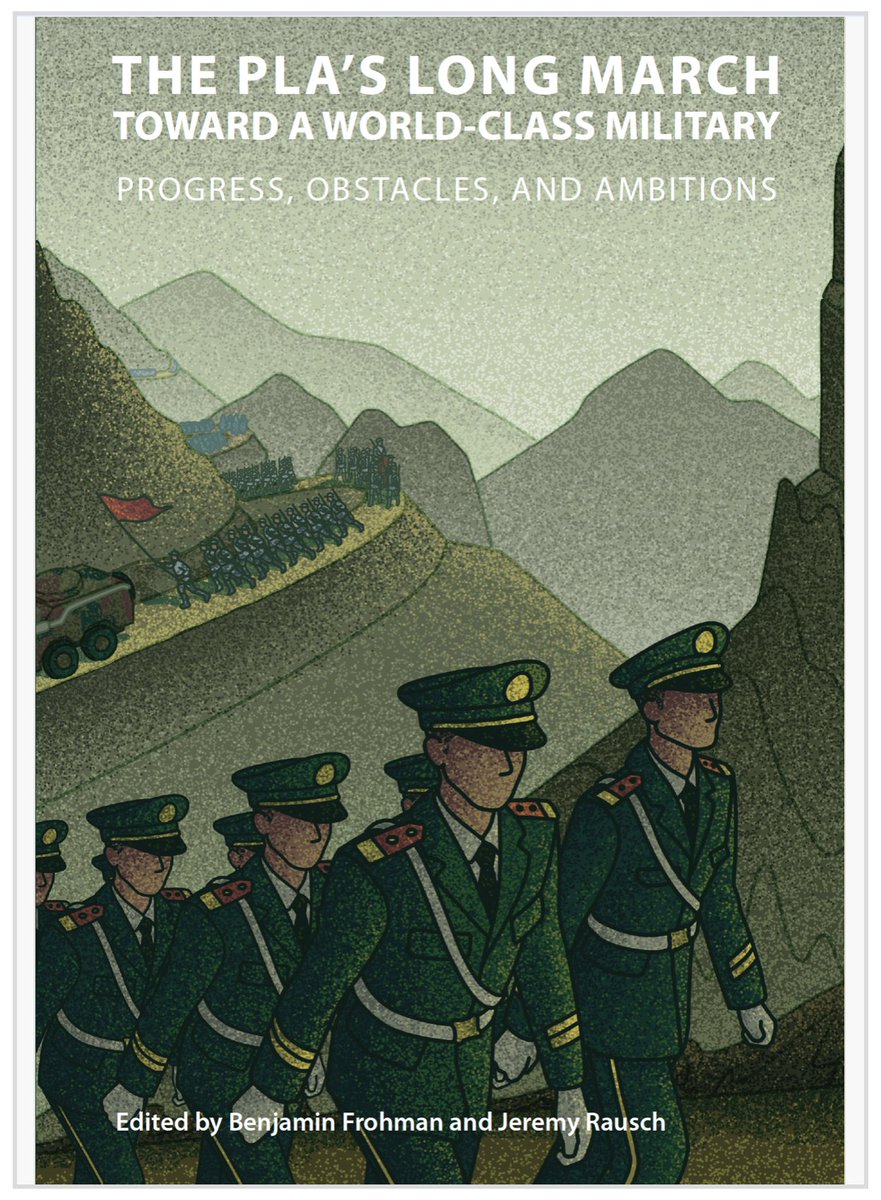
Great to be included in @BenjaminFrohman & @JeremyRausch’s new @NBRnews volume!
The PLA’s Long March toward a World-Class #Military: Progress, Ambitions, and Obstacles
Download full text of book: https://t.co/nsd2e6o2Nh
China’s Future World-Class Navy: Ends, Ways, Means
by Christopher H. Sharman & Andrew S. Erickson
October 27, 2025
This chapter identifies the PLA Navy’s 2035 & midcentury modernization goals, examines its progress in building requisite world-class capabilities, & assesses its current capability shortfalls & efforts to overcome them.
MAIN ARGUMENT
While there are multiple ways to measure a “world-class” navy, what matters most are China’s own criteria informing its efforts toward that end. Capabilities-based benchmarks are a widespread indicator of a navy’s level. PLA leadership appears focused on developing the capabilities that improve the PLA Navy’s proficiency to execute specified missions at the operational level of war. China’s 2019 defense white paper provides a roadmap for the PLA Navy to become the world’s most capable navy regarding these missions. Only when the PLA Navy successfully integrates the means required to support the full range of these missions will Beijing perceive that it has reached world-class status. By sowing doubt about the PLA Navy’s capability to execute these missions, Washington can downgrade party-military leadership perceptions about China’s world-class naval status and instill restraint.
POLICY IMPLICATIONS
⚓ Full world-class status is reserved for when the PLA Navy establishes a global navy capable of protecting Chinese interests worldwide as instructed. On its current trajectory, the PLA Navy is likely to be capable of fully executing such operations by midcentury.
⚓ If Beijing is unable to effectively integrate advanced technologies into tactical operations to enable the building of its desired fleet, then the PLA Navy will question its ability to surpass the @USNavy & achieve its top-tier objective.
⚓ If the PLA Navy is unable to access suitable overseas ports for ship repair & armament resupply, its combat power projection overseas will be limited, thereby degrading the PRC’s ability to use the PLA Navy as a tool of influence overseas & potentially slowing its progress toward achieving its world-class objectives.
Read other illuminating chapters by Joshua Arostegui @CLSC_USAWC, @GeraldC_Brown/@csisponi/@SAISStrat, @JamesCharChina, @CLGarafola/@RANDCorporation, @addis_goldman, @ehundman/@BluePathLabs, Elliot S. Ji @INSSatNDU/@NDU_EDU, @KatherineKurata/@ChinaSelect, Evan McKinney @usairforce (ret.), @MeiaNouwens/@IISS_org, @Liza_D_Tobin & Jake Vartanian @us_awc!
ATTN: @JerryHendrixII