I posted this trending video of Nigerian Army’s horrific public torture of these hapless Igbo youths in 2017 to underscore the following facts:
1, Any Igbo who viewed this video (and they’re in the millions) felt vicariously traumatized. Even foreigners felt the same way.
2, The video did so much to alienate Ndigbo, especially the youths from the Nigerian Army.
3, Without more, the video became an instant recruitment windfall for the Biafran agitation.
4, The video evidenced the sharp contrast with how Boko Haram members are treated respectfully, deemed rehabilitated, given lots of money, and then reintegrated into the society.
5, The failure of the authorities to bring these soldiers to account left the impression that the authorities were complicit.
6, The video did more damage to the Nigerian unity these soldiers thought they were defending.
This is the story of how Prof. Catherine Acholonu was able to trace the family of Olaudah Equiano all the way to Iseke in Anambra State.
It’s a story that will take you back almost 300 years ago when a young Igbo boy was snatched from his ancestral roots and sold into slavery.
But Olaudah self-educated himself, and wrote a book that remains a bestseller to this day, helping scholars to understand the true human tragedy of slavery.
The Igbos have invested more in One Nigeria than any other group. They have left their homeland in the largest numbers, built businesses, markets, and communities across the North, West, and Middle Belt, and poured capital into cities where others merely reside.
In Lagos, Kano, Abuja, and elsewhere, Igbo enterprises are visible and substantial. By contrast, Yoruba, Hausa, and Fulani investments in the Southeast remain negligible, almost nonexistent.
A people who have staked so much on the Nigerian project deserve engagement, not persecution. When Igbos raise grievances - whether about marginalization, equity, or self determination - the proper response is dialogue, not proscription, not attritional law enforcement.
Lengthy imprisonments and repression do not silence legitimate demands; they amplify them. They convert agitators into symbols, deepen resentment, and make the case for agitation stronger and more mainstream.
A government that is guided by a keen sense of justice would recognize the unique sacrifice Igbos have made by investing in Nigeria (more than any other group) and treat their demands with the respect such sacrifice warrants.
By ALOY EJIMAKOR.
5. ASSOCIATION IS NOT TERRORISM
When prosecutors dropped the violent attack count against Paul Okechukwu and proceeded solely on "membership," they admitted they had zero evidence of violence. Jailing a human being for two decades for mere association—detached from any proven act of violence—is judicial violence.
6. A DIRECT WARNING TO DETAINEES: DO NOT PLEAD GUILTY UNDER COERCION
To every Igbo youth and Biafran activist languishing in the notorious Wawa Barracks or other secret detention facilities across the country: Do not succumb to psychological torture, starvation, or isolation by pleading guilty to crimes you did not commit.
The state's strategy is simple: break your spirit through indefinite, inhumane detention until a 20-year prison sentence feels like a relief compared to their dungeons. A coerced plea is not freedom—it is a trap that legalises your torment and cements your imprisonment.
Hold the line: Desperation does not validate a false confession, and psychological coercion voids any guilty plea under Section 36 of the Constitution.
Demand legal access: Refuse to sign pre-drafted admissions or accept plea bargains without independent, uncoerced legal counsel.
Force the state to prove its case: An executive designation is not proof of individual guilt. Make the prosecution discharge its heavy constitutional burden under a valid written law.
FIVE QUESTIONS THE BENCH CANNOT EVADE
How can the state rely on an ex parte order while ignoring Justice Nyako’s binding inter partes ruling that IPOB is lawful?
By what constitutional logic does a 14-day interim order become a permanent presumption of criminal guilt?
How can a conviction delivered under a repealed statute satisfy Section 36(12) of the Constitution?
Where is the written law converting peaceful advocacy or Biafran identity into a 20-year terrorist offence?
What specific, overt act of violence did Paul Okechukwu commit to justify stealing 20 years of his life?
A judge's gown does not elevate him above the Constitution, and labeling a movement "terrorist" does not suspend human rights.
The Constitution remains supreme. The law must prevail over political intimidation.
Christopher Chidera, Esq. Legal Practitioner & Public Interest Analyst
TWENTY YEARS FOR IPOB MEMBERSHIP: NIGERIA’S COURTS CANNOT TURN AN EX PARTE PROSCRIPTION ORDER INTO A LICENCE TO CRUSH BIAFRAN IDENTITY
By Christopher Chidera, Esq.
The sentencing of 48-year-old Paul Okechukwu to 20 years’ imprisonment by Justice Hauwa Yilwa of the Federal High Court in Abuja for alleged IPOB membership exposes a grotesque abuse of judicial power. It is a desperate, state-engineered campaign to criminalise political identity, bypass statutory rules of proof, and weaponise administrative labels to silence the Biafran self-determination movement.
The Abuja bench must answer one unassailable question: When did an un-appealed, procedurally defective, ex parte administrative order replace the constitutional requirement to prove a specific crime under a valid written law?
1. YOU CANNOT ERASE JUSTICE NYAKO’S BINDING RULING
On March 2, 2017, Justice Binta Nyako explicitly struck out six counts against Mazi Nnamdi Kanu, ruling firmly inter partes that IPOB was not an unlawful society. Months later, the state engaged in blatant forum shopping—running to Justice Abdul Abdu-Kafarati in a closed-door ex parte session to procure an administrative proscription order without putting IPOB on notice.
Burying an inter partes judicial determination under a one-sided administrative decree is not justice; it is political subjugation.
2. AN EX PARTE ORDER IS NOT A CONSTITUTIONAL BLANK CHEQUE
Under Order 26, Rule 12 of the Federal High Court Rules, an ex parte order is a temporary emergency measure with a strict 14-day lifespan. Transforming a two-week interim procedural order into a permanent, 20-year penal trap violates basic civil procedure and Section 36 of the 1999 Constitution:
Status is not conduct: Proscription regulates an organization's administrative status; it is not proof of individual guilt.
No shortcuts on proof: An executive label does not relieve the state of proving an overt criminal act against a living defendant.
3. KANU’S APPELLANT BRIEF GUT-DOCKS COUNT THREE
Mazi Nnamdi Kanu’s 22-ground Appellant Brief guts the foundation of these prosecutions:
Lack of Presidential Authority: The proscription order failed to satisfy basic statutory prerequisites—a principle reinforced by Justice James Omotosho himself in MultiChoice Nigeria Ltd v. FCCPC, where he held that statutory powers vested in a specific authority cannot be bypassed or assumed without explicit compliance with condition precedents.
Ex Parte Cannot Defeat Inter Partes: A closed-door administrative order cannot override an existing, binding judgment.
Pending Apex Review: Rushing lower courts to hand down maximum sentences while the Supreme Court is actively seized of the proscription’s legality proves the regime is in a frantic race to silence dissent before its legal house of cards collapses.
4. CONVICTING UNDER A DEAD LAW
Justice James Omotosho’s November 20, 2025 judgment against Nnamdi Kanu set a lawless precedent by convicting him under the Terrorism (Prevention) (Amendment) Act 2013—a statute expressly repealed by the 2022 Act.
Now, Justice Hauwa Yilwa has recycled that exact constitutional illegality to sentence Paul Okechukwu to 20 years in prison under Section 16 of the same dead 2013 Act.
Section 36(12) of the 1999 Constitution strictly prohibits convicting any person under a non-existent written law. A general statutory savings clause preserves pending proceedings and accrued liabilities; it does not resurrect a dead penal statute to serve as the operative legal basis for a conviction. Delivering two-decade prison sentences on the skeleton of an expired statute is an outright nullity.
@njcNig@FederalHigh@NigerianBarz@NigBarAssoc@NGRSenate@IBAnews@StateDept@USinNigeria@FCDOGovUK@UKinNigeria@UNHumanRights@UN@HumanRightsCtte@downingstreet@officialABAT@SwissMFA@amnesty@AmnestyNigeria
Join me in demanding justice for ATIKU ABUBAKAR ISAH, former President of the National Association of Nigerian Students (NANS).
According to a post by Omoyele Sowore, Isah was yesterday “remanded in Keffi prison and BRUTALIZED after arraignment following what was a highly questionable arraignment over cybercrime allegations.”
Isah is someone I know very well, and I can vouch for him any day as a law-abiding citizen who is often targeted for fighting injustice in high places.
I recall his recent visit to MAZI NNAMDI KANU in Sokoto, and his abiding solidarity with #MNK from when he was detained at the DSS.
He had also publicly supported the calls to #FreeNnamdiKanu on several occasions.
A friend in need, is a friend indeed.
Isah deserves our support and solidarity in this hour of need.
#FreeAtikuAbubakarIsah.
MY LORD, YOU ARE BIASED:
When a self-represented defendant in a capital case openly accuses the judge of bias amid a courtroom confrontation between them, the safer course under Nigerian law is to adjourn, not rush conviction of the defendant on the same day.
PAUL OKECHUKWU, an Igbo man whose only proven offence was confessing membership of IPOB, has been condemned to 20 years in prison. Paul never killed anyone. He never attacked security forces. The sole count linking him to violence was withdrawn and struck out.
Conversely, Boko Haram fighters who massacred thousands (soldiers, police, and civilians alike) are “rehabilitated,” handed money, vocational training, and reintegrated into the society,
So, for merely associating with a “proscribed” group, Paul received a sentence many actual killers never face. This is not law or justice; it is pure ethnic persecution dressed as counter-terrorism.
When those who slaughtered security agents are rewarded with second chances while a non-violent Igbo is buried in a prison cell for 20 long years, the Nigerian state is deliberately pushing the Igbo further from the federation.
Such a brazen double standard does not preserve unity; it destroys it and fuels the very demand for self-determination the State aims to suppress. It is indeed a double whammy, and a provocation to boot.
By ALOY EJIMAKOR.
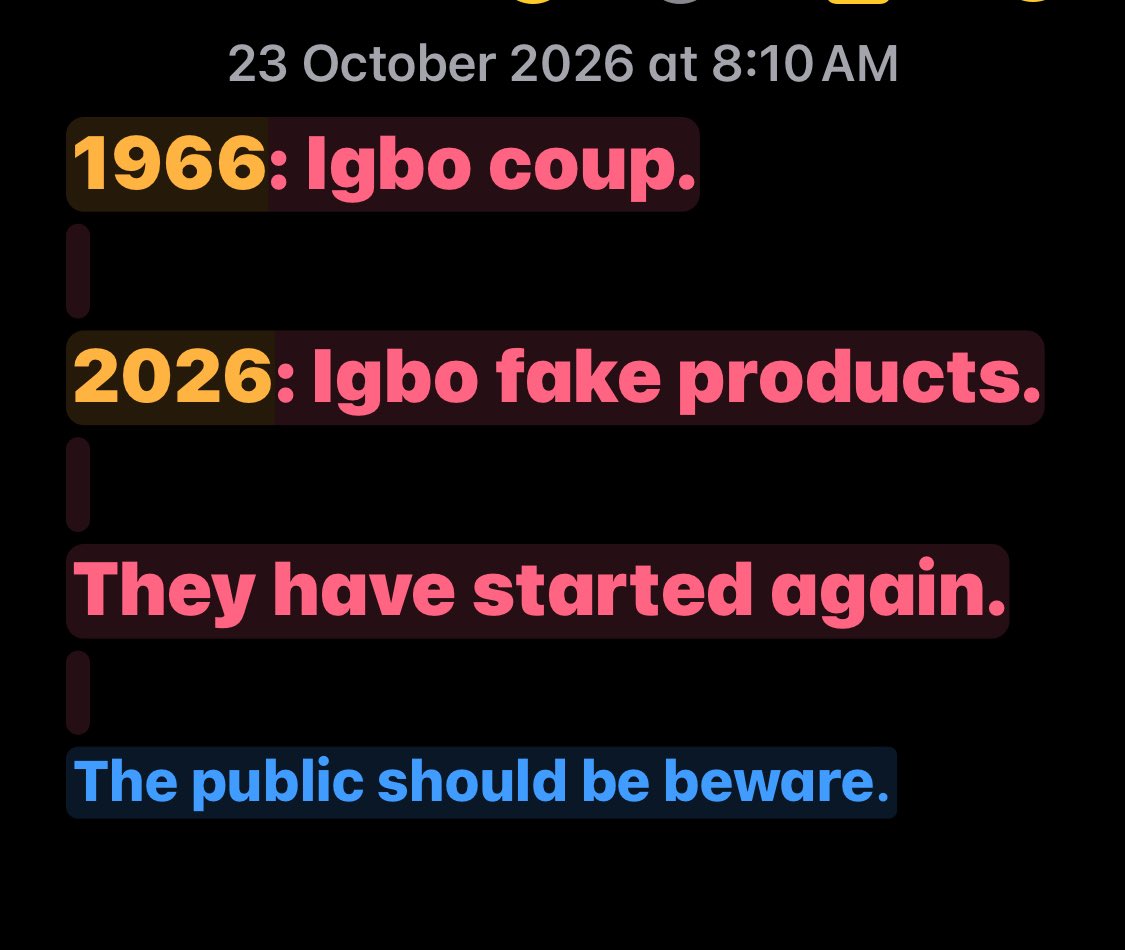
If they blame IGBOS for fake products, who gets blamed for these?👇🏽
. Large-scale banditry, mass kidnappings for ransom, and rural terrorism concentrated in the Northwest and parts of the North-Central.
. Oil bunkering, pipeline vandalism, and resource-related militancy centered in the Niger Delta.
. Persistent ethno-religious conflicts and reprisal killings that have devastated Middle Belt farming communities.
. Extremism and insurgency (Boko Haram and its offshoots) that originated and remain most entrenched in the Northeast.
To be sure, all these problems, including fake products, are driven by governance failures, economic desperation, weak institutions, and individual human dispositions, not by some tribal conspiracy to go rogue.
But if anybody insists on scapegoating Ndigbo alone for the proliferation of fake products, let the scapegoating go round to the other ills that convulse Nigeria the more, and which are generally not associated with Igbos.
In the end, it shall be clear that we all live in glass houses.
By ALOY EJIMAKOR.
It doesn't matter when you were appointed to a position in IPOB. Once you are removed or stop being loyal, you get out.
It was Mazi Nnamdi Kanu I trusted before giving my intellect and wisdom towards freedom, not you. So get out.
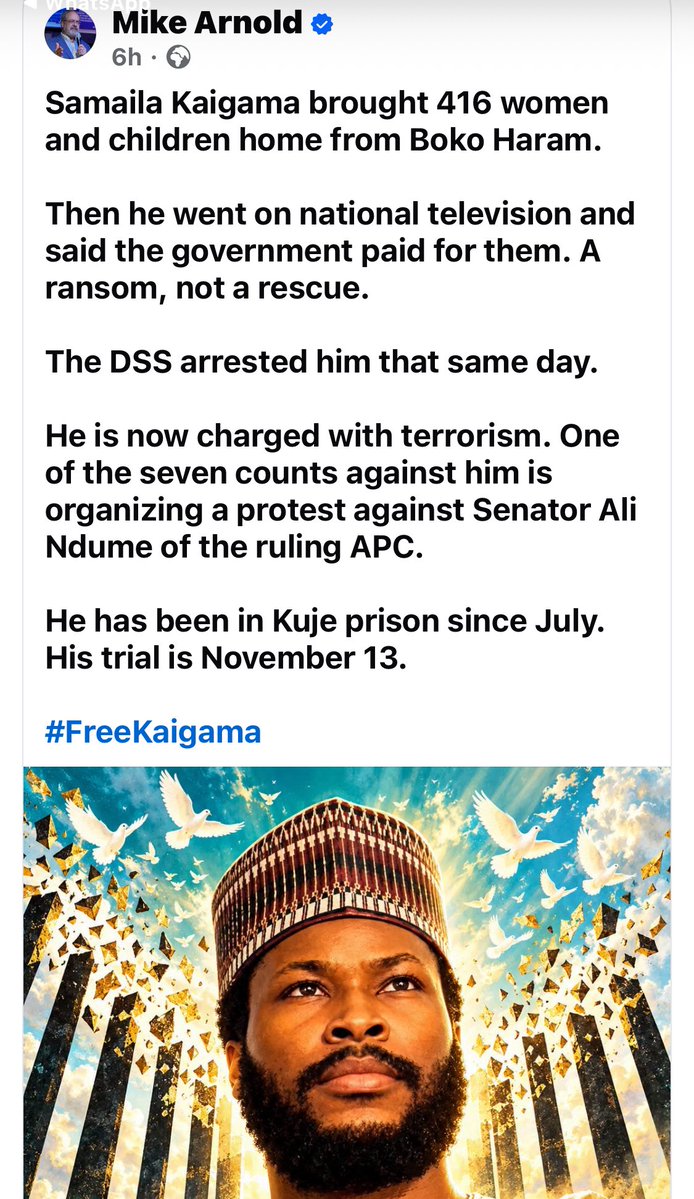
I ENDORSE THIS POST by Mike Arnold. You should, too.
“Samaila Kaigama brought 416 women and children home from Boko Haram.
Then he went on national television and said the government paid for them. A ransom, not a rescue.
The DSS arrested him that same day.
He is now charged with terrorism. One of the seven counts against him is organizing a protest against Senator Ali Ndume of the ruling APC.
He has been in Kuje prison since July. His trial is November 13.
#FreeKaigama.“
PART 4 OF 150: OMOTOSHO’S FOURTH JURISDICTIONAL FAILURE — THE HYPOCRISY OF SELECTIVE SOVEREIGNTY
By Onyedikachi Ifedi, Esq.
Public Notice: Due to time constraints and the comprehensive nature of documenting all 150 judicial errors committed in this trial, this legal commentary series publishes a new installment every two to three days.
EXECUTIVE SUMMARY: THE SCANDALOUS DOUBLE STANDARD IN PLAIN SIGHT
Justice James Omotosho’s fourth jurisdictional collapse is no mere technical oversight. It is the raw exposure of a shameless double standard rooted in the lawless usurpation of another country's sovereign authority!
Under the foundational rule of territoriality and the comity of nations, criminal jurisdiction is strictly local. The Federal High Court in Abuja had no business trying Mazi Nnamdi Kanu—a British citizen who entered Kenya on a British passport—for acts allegedly committed on Kenyan soil, without first establishing a valid statutory bridge and proving compliance with its mandatory conditions. Justice Omotosho compounded this jurisdictional failure by proceeding to trial and conviction without ever determining whether he possessed the legal authority to try offences allegedly committed on foreign soil.
When the United States came calling for DCP Abba Kyari, Nigeria hid behind the sacred fortress of its domestic legal system, demanding strict compliance with statutory bars and beating its chest over the absolute primacy of local jurisdiction. But when the same Nigerian State abducted Mazi Nnamdi Kanu from Kenyan soil, every corresponding principle—territorial sovereignty, comity, double criminality, and lawful process—was ripped to shreds and thrown in the trash!
The Nigerian State told America: "Our domestic legal process comes first." But it turned around and told Kenya: "Your sovereignty is optional, your courts don't matter, and we will snatch whoever we want from your soil!"
1. THE FOUNDATIONAL TERRITORIAL DEFECT AND OMOTOSHO’S FAILURE TO DETERMINE IT
Under Nigerian constitutional law and settled common law principles (MacLeod v. AG for New South Wales [1891] AC 455; Nwankwo v. State (1985) 6 NCLR 228), criminal jurisdiction is presumptively territorial:
Abuja Had No Business Trying Foreign Conduct: A court in Abuja possesses no automatic or inherent authority to police or prosecute human conduct physically committed inside the sovereign borders of Kenya by a foreign-passport holder.
Kenya Was the Mandatory First Port of Call: When conduct occurs in Kenya, Kenya's legal order is the first port of call. Kenyan authorities and Kenyan courts must first determine under Kenyan law whether the act constitutes a crime and whether any request for surrender meets the statutory requirements of Kenyan extradition law (including double criminality under Section 4(1)(b) of Cap 77). There is no alternative route that bypasses this sequence.
Omotosho's Fatal Omission: Justice Omotosho proceeded to trial and conviction without ever determining the threshold question of whether he possessed subject-matter jurisdiction over foreign conduct. Having physical custody of a defendant in an Abuja dock does not supply subject-matter jurisdiction over foreign acts where the statutory condition precedent—proof of double criminality under Section 76(1)(d)(iii) of the TPPA 2022—was never established by evidence.
2. WHAT NIGERIA GRANTED ABBA KYARI: THE RED-CARPET STATUTORY SHIELD
Look at the comparative standard in Federal Republic of Nigeria v. DCP Abba Kyari (FHC/ABJ/CS/249/2022):
When the United States Government formally requested the extradition of DCP Abba Kyari to face wire fraud charges in America, local Nigerian jurisdiction was activated through a pending NDLEA charge.
@njcNig@NigerianBarz@FederalHigh@StateDept@USinNigeria@FCDOGovUK@UKinNigeria@IBAnews@NGRSenate@UKParliament@downingstreet
We all need to commend this beautiful young lady for her strong push-back against the tribal bigots who set out to portray Igbos as the sole purveyors of fake products in Nigeria. God bless this lady. She’s amazing.