CGM may have an important role in type 2 diabetes even for people who are not using insulin.
@NEJM
In this 26-week primary care RCT of 283 adults:
📉 HbA1c: 7.2% with CGM vs 8.0% with routine care
⏱️ Time in range: +21 percentage points
✅ No severe hypoglycaemia reported
For patients: seeing glucose responses in real time may help connect food, activity and treatment with glucose levels.
Need robust data on cost-effectiveness and in which patient population with T2 diabetes
@AskDrShashank
💉 Once-weekly basal insulin is here. MHRA has authorised Onswik (efsitora) for #T2D
🏛️NICE: an option, but use the least expensive suitable basal, NPH included. Likely role: people who need help to inject.
UK price confidential. Awaiting final TA + ICB pathways.
🔗https://t.co/NWqFJzuDrt
🔗https://t.co/4DDmgmz7Oq
🧓 Can GLP-1 RAs help preserve function in people with diabetes?
In 73,592 propensity-matched pairs, GLP-1 RA initiation vs DPP-4 inhibitors was associated with:
📉 Less frailty progression
🚶 13% lower fall rate (IRR 0.87, 95% CI 0.84–0.91)
⚠️ Associations were weaker in severe baseline frailty.
Real-world evidence, not proof of causality.
#Diabetes #Frailty #GLP1RA #Geriatrics
https://t.co/IFi5QDrjKE
@AskDrShashank
🩺 HbA1c vs fasting glucose: Which better predicts cardiometabolic multiple long term conditions (multimorbidity) in people without diabetes?
Our study led by @scelee1 & Setor
In 2,233 adults in England followed for 12–15 years, both markers were associated with future cardiometabolic multimorbidity—but HbA1c was the stronger predictor.
📈 Each 1% higher HbA1c: ~2× higher odds
🔬 HbA1c improved risk discrimination more than fasting glucose.
HbA1c help identify long-term cardiometabolic risk earlier?
#Diabetes #CardiometabolicHealth #Prevention #PublicHealth
https://t.co/wfRhO8NKxw
@AskDrShashank@LDC_tweets@uniofleicester
GLP-1 are a life changing and possibly a humanity changing group of medications. The fact that insurance will not cover them should cause patients to be extremely angry.
Obesity is the mother of chronic disease.
Successful obesity treatment should not be discriminated against.
Colleagues, we need your help -
We're seeking nephrologists' perspectives on management of iron deficiency in CKD. The survey takes <5 minutes & will help shape the design of a new international randomised trial
https://t.co/T9G4ILLL70
Thanks for sharing with your networks
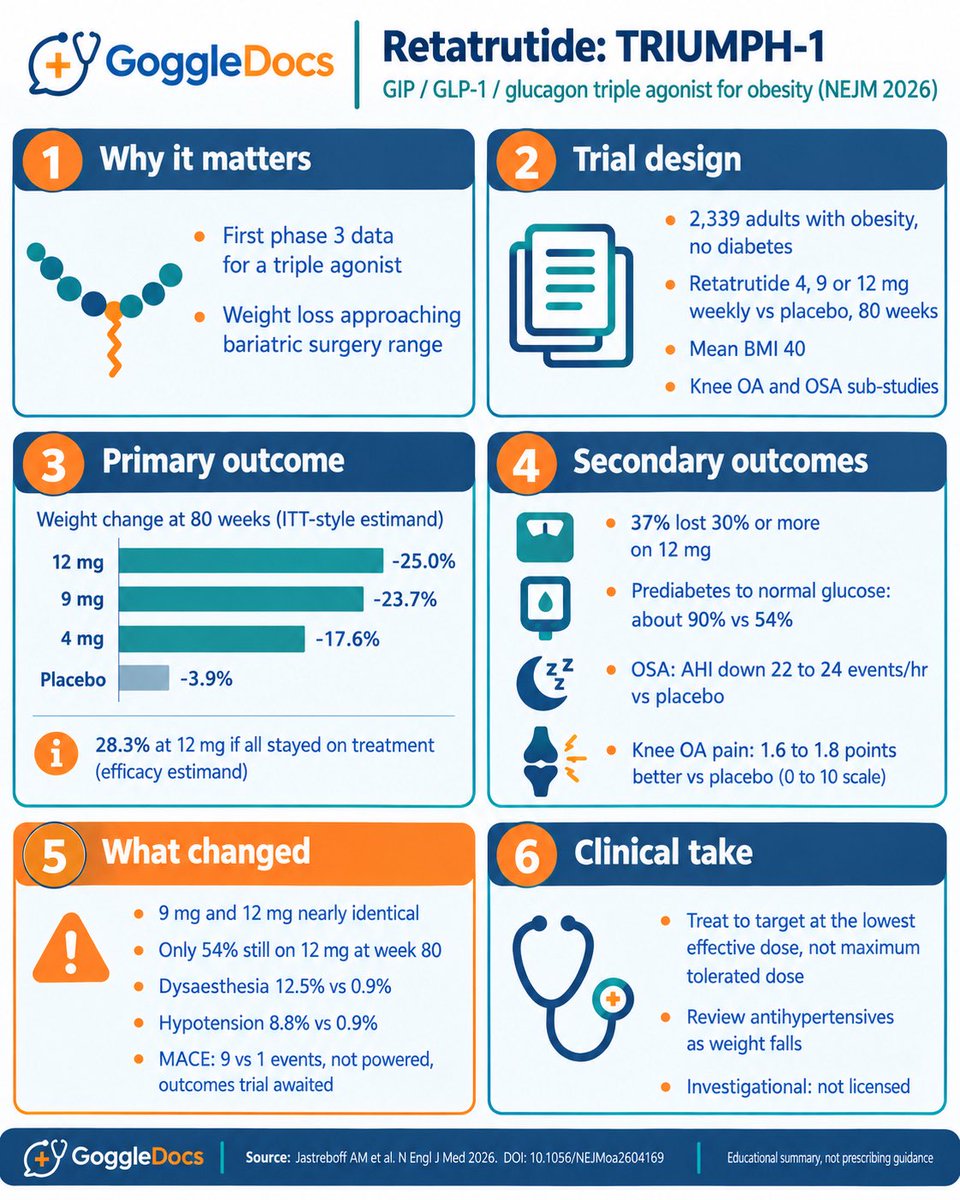
🚨Retatrutide TRIUMPH-1 (NEJM)
80 wk weight: ⤵️25% on 12 mg vs -3.9% placebo.
⤵️28.3% headline = efficacy estimand.
👉9 vs 12 mg near identical; only 54% still on 12 mg at wk 80
⚠️⚡️Dysaesthesia, hypotension, MACE 9 v 1 (small n)
Treat to target, not max dose❓
🔗 https://t.co/EzUfsILnYI
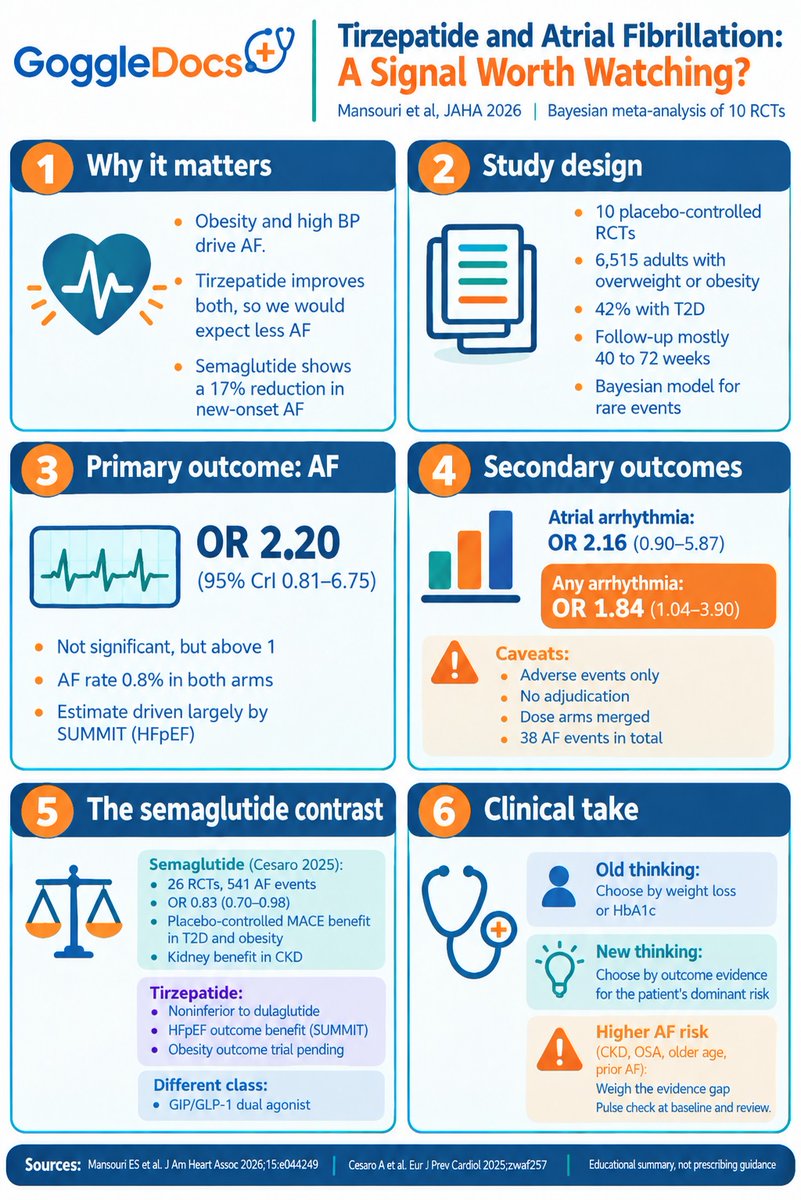
🚨#Tirzepatide and AF: signal or noise? 🫀
🆕 JAHA meta-analysis (10 RCTs, n=6,515): AF OR 2.20 (0.81–6.75), any arrhythmia OR 1.84 (1.04–3.90)
🔹Only 38 AF events, mostly from SUMMIT
🔸Semaglutide: 541 events, OR 0.83 (0.70–0.98)
👉Different class, different signal❓
🔗https://t.co/9fPvdiHoph
🔗https://t.co/Awmqqp7NwM
Dear @Ofcom
Please can you clarify to the nation why this is allowed under your current broadcasting rules?
A sitting MP [sometimes] on a TV channel he part owns, delivering a party political broadcast on behalf of Reform UK?
Seriously ... WTF?
🆕NICE guidelines
Arguably the biggest shift in #type2diabetes care in over a decade.
Phenotype first. HbA1c second.
@drkevinfernando & I are running a free hour on what it actually changes in clinic.
Thu 10 Sept, 7-8pm BST
No industry funding
🔗https://t.co/hkZ3HZwPzv
Excited to work with @ATTDconf
👉🏽Management of older adults, technology & diabetes👈🏽
❓How do we manage older adults with diabetes
❓How do we balance intervention with support and QOL
❓What is the role of technology & how can we simplify/facilitate
https://t.co/Twp9ju8U4B
“CKD is not really a disease… trials don’t necessarily translate to living longer”
Not really sure where to start here. But trials in the last 20 years in which CKD therapies extend survival:
#DAPACKD HR 0.69 (0.53-0.88)
#FIDELITY HR 0.89 (0.79-1.00)
#FLOW HR 0.80 (0.67-0.95)