🚀 Introducing GoldEdge
GoldEdge is a professional Value Betting platform built for bettors who care about mathematics, not predictions.
Here's how it works:
• Uses Pinnacle as the sharp reference market
• Removes bookmaker margin (No-Vig)
• Calculates Fair Odds
• Compares prices across multiple bookmakers
• Detects Positive Expected Value (+EV) opportunities
• Kelly Criterion
• CLV Tracking
• Bet History
• Telegram Alerts
We don't predict winners.
We identify value.
👉 https://t.co/afsC2oYvFS
#ValueBetting #SportsBetting #EVbetting #Pinnacle
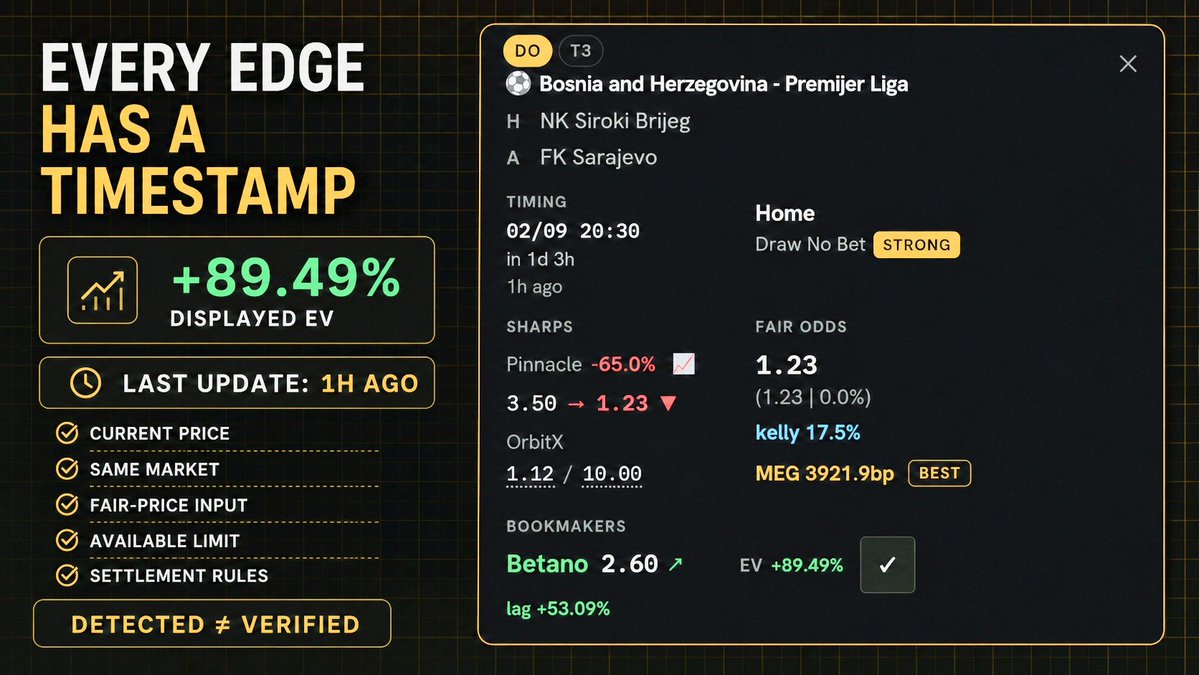
Execution lesson 📊⏱️
Every calculated edge has a timestamp.
A price that appeared valuable moments ago may no longer be actionable after new information, market movement or a change in available limits.
Before execution, recheck:
🔹 The current price
🔹 The model inputs
🔹 The market and settlement rules
🔹 The executable stake
Finding an edge is step one. Confirming that it still exists is part of the decision. 🔍
Explore Value Betting and Arbitrage tools on GoldEdge 👇
https://t.co/YYPtv1G43H
@BetBankAI A losing sample doesn’t automatically invalidate the process. At 200 bets, edge size and odds profile can still leave a wide range of possible outcomes.
@secretbettin This could make a valuable case study. Separating betting bankroll, betting P&L and living or production expenses will be essential for judging whether the betting itself is sustainable.
Value betting note 📚
Early markets may offer:
🔹 Larger pricing errors
🔹 Less efficient prices
🔹 Lower liquidity and limits
🔹 Greater information uncertainty
Later markets may offer:
🔸 More information
🔸 Higher liquidity and limits
🔸 More efficient and potentially less valuable - prices
Neither timing is automatically better. The real trade-off is between potential edge, confidence and executable size.
When you enter the market can matter as much as the price you identify. 🔍
@BetBankAI Automating the qualification checks can save a lot of time. Users should still confirm the current promo terms, available prices and settlement rules before execution.
@spanky For professional bettors, the relevant comparison isn’t price alone. It’s whether the information arrives early and accurately enough to generate more incremental value than the service costs.
@EdgeDeskSports A gap that large is a reason to investigate, not automatically bet. Even independently built models can share similar inputs or miss the same roster, matchup or information adjustment.
@JustinKGambles The useful part would be defining “sharp” consistently: verified long-term P&L, entry versus closing price, market type, liquidity and repeatability.
@BetHeroSports Win rate alone can’t answer this. Profitability depends on the odds paid versus the true probability, but consistently taking valuable prices is the better long-term process.
Professional mindset 🧠
Market movement is information, not a verdict. 📈
Context matters: timing, liquidity, news, limits, and which market moved first.
🔎 Read the context, not just the move.
Betting math 📚📈
Odds move continuously as new information, money and risk enter the market.
If the price moves in your favor after you place a bet, that doesn’t prove you caused the move or that the bet will win. ⚠️
But across a meaningful sample, consistently securing better prices than the later or closing market can provide useful evidence about the quality of your entries. ✅
Line movement measures price, not outcomes. One bet proves very little. А repeated pattern tells you more. 🔍
@TheBetDesk We built GoldEdge to bring no-vig fair odds, +EV opportunities, odds comparison and arbitrage into one workflow. It’s currently free while we continue expanding bookmaker coverage.
Risk reminder 📊
A spreadsheet might display an edge of +0.73%.
That doesn’t mean the true edge is known to two decimal places.
More decimals improve the precision of the calculation, not the accuracy of the probability estimate behind it.
Before trusting a thin edge, test the assumptions, sensitivity, fees and execution costs. 🔍
@sharpedgelv A painful loss isn’t evidence of manipulation. Judge the decision by the price, probability and process, not by how unlikely the final outcome felt.
Curious how you handle this 👇
When an available price is above your estimated fair odds, how do you decide whether the edge is actionable?
🔹 One fixed minimum edge
🔸 A different threshold for each market
📊 A buffer based on model confidence
🔍 No formal threshold
The same displayed edge may not deserve the same level of trust in every situation.
Explore current +EV opportunities with GoldEdge 👇
https://t.co/3NnYr6P38n
@FarleyBets Independent thinking matters, but trust should be earned through testing. Track your prices, CLV and assumptions, then let the evidence validate the process.
Price lesson 📚
Suppose you’re offered odds of 2.00.
🔹 At an estimated probability of 52% → +4% theoretical EV
🔸 If the true probability is 49% → -2% EV
The calculation can be exact while the probability input is wrong.
Before trusting an edge, test how the result changes across a reasonable probability range. If a small adjustment turns +EV into -EV, the edge may be too fragile to trust.
Evening takeaway 📊
Price shopping doesn’t require predicting the match better.
It simply means avoiding a worse price when the market, selection and settlement rules are identical.
The outcome probability stays the same. The price you accept determines the potential and expected return.
You don’t always need a better prediction, sometimes you just need a better price. 🔍
There’s no universal minimum edge.
A reasonable threshold depends on the confidence in your estimate, market liquidity, available limits, fees and execution risk.
A small edge supported by reliable inputs may be more attractive than a larger edge built on uncertain assumptions.
Decision time 👇
Which approach do you prefer?
🔹 Taking more opportunities with smaller estimated edges
🔸 Waiting for fewer opportunities with a larger cushion
Or does it depend on the market, limits and confidence in your probability estimate?
What minimum edge do you require before considering a bet? 📊