SpaceX was founded to make life multiplanetary. We’ve been able to expand that mission with our Starlink constellation and AI solution
Learn more → https://t.co/PSCyWrMUYI
New NVIDIA physical AI agent-ready skills are changing how robotics researchers work. 🤖
With NVIDIA robotics skills, researchers can automate the most common development steps from scene preparation to simulation and learning with Omniverse libraries, Isaac frameworks, and physical AI open datasets.
Specialized skills like Isaac Mobility extend that even further.
Learn more ➡️ https://t.co/WwGv2XYpEi
In 1984, Apple tried hiring “professional management.”
Steve Jobs: “It didn’t work at all.”
“Most of them were bozos.”
“They knew how to manage. But they didn’t know how to do anything.”
He spent 4 minutes explaining what actually works:
"The greatest people are self-managing. They don't need to be managed."
"Once they know what to do, they'll go figure out how to do it. They don't need to be managed at all."
"What they need is a common vision. And that's what leadership is."
"Having a vision. Being able to articulate it so the people around you can understand it. And getting a consensus on a common vision."
So who should manage?
"If you're a great person, why do you want to work for somebody you can't learn anything from?"
"You know who the best managers are?"
"They're the great individual contributors who never ever want to be a manager."
"But decide they have to be a manager because no one else is going to be able to do as good a job as them."
Apple hired two professional managers from outside the company. Fired them both.
Then Jobs gambled on Debbie Coleman. A member of the Macintosh team. 32 years old. English literature major with an MBA from Stanford.
A financial manager with no experience in manufacturing. Put in charge of manufacturing.
Debbie Coleman: "There's no way in the world anybody else would give me this chance to run this kind of operation. I don't kid myself about that."
"It's an incredible high risk. Both for myself personally and professionally. And for Apple as a company. To put a person like myself in this job."
"We're betting that my skills at organizational effectiveness override all lack of technology, lack of experience, lack of time in manufacturing."
"I'm just an example. Almost every single person on the Mac team, you could say that about."
"This is a place where people were afforded incredibly unique opportunities to prove they could write the book again."
Hiring was the most important job.
"I consider the most important job of someone like myself is recruiting."
"We agonized over hiring."
"Interviews would start at 9 or 10 in the morning and go through dinner."
"A new interviewee would talk to everybody in the building. At least once. Maybe a couple times."
"Then come back for another round of interviews. Then we'd all get together and talk about it."
"And then they'd fill out an application."
He laughs.
"No. They never filled out an application."
Here's how they knew someone was right.
"The critical part of the interview, at least to my mind, was when we finally decided we liked them enough to show them the Macintosh prototype."
"We sat them down in front of it."
"If they were just kind of bored, or said 'this is a nice computer,' we didn't want them."
"We wanted their eyes to light up. For them to get really excited."
"Then we knew they were one of us."
Once you get the right people, something changes.
"When you get a core group of ten great people, it becomes self-policing as to who they let into that group."
"Everybody just wanted to work. Not because it was work that had to be done."
"But because it was something we really believed in. That was going to really make a difference."
"We all wanted exactly the same thing. Instead of spending our time arguing about what the computer should be, we all knew what the computer should be."
"And we just went and did it."
Inside the casing of every Macintosh, unseen by the consumer, are the signatures of the whole team.
Apple's way of affirming that their innovation is a product of the individuals who created it. Not the corporation.
This 4 minute video will teach you more about hiring, leadership, and why professional managers fail than every business book combined.
Bookmark & give it 4 minutes today, no matter what.
Someone built an entire bot farm of fake live streams making $5K daily from viewer donations.
The infrastructure alone is impressive.
Never underestimate a grifter's work ethic😂
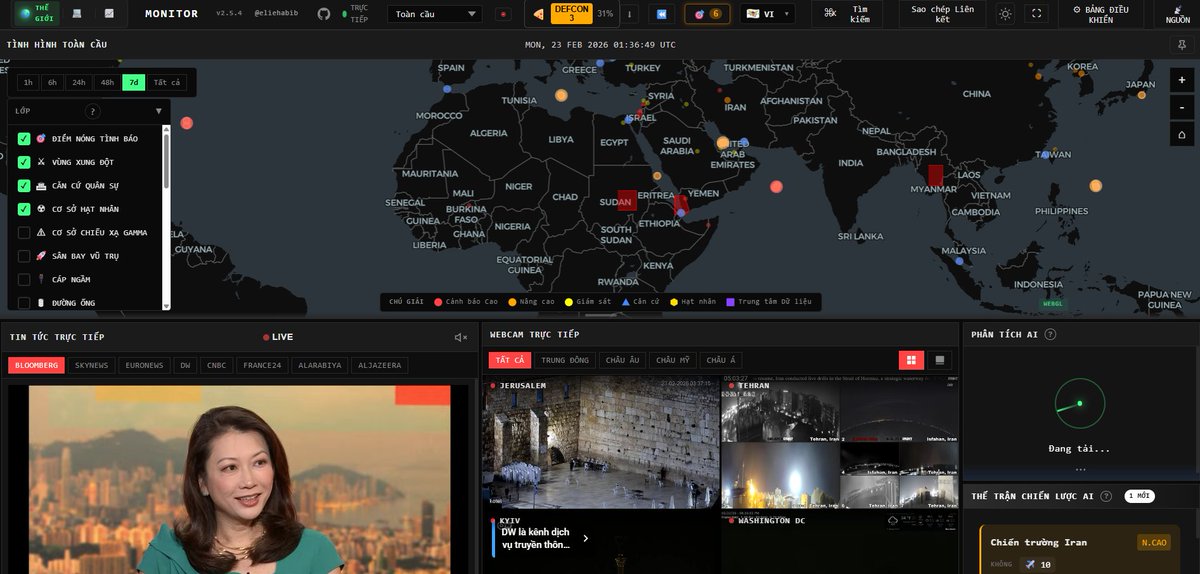
Hôm qua mình vừa đề cập tới việc một developer mang tên @bilawalsidhu kết hợp giữa Gemini 3.1 + Claude 4.6 tạo ra web theo dõi thế giới theo thời gian thực. Hôm nay thì tình cờ biết thêm một dev khác có tên là @eliehabib cũng build cái gọi là "World Monitor"
Đây là một bảng điều khiển tình báo toàn cầu thời gian thực, hoàn toàn miễn phí và có thể sử dụng ngay trên trình duyệt mang. Được thiết kế như một hệ thống giám sát địa chính trị tiên tiến, kết hợp khả năng tổng hợp thông tin từ nhiều nguồn tương tự các trung tâm phân tích chuyên sâu, nhưng dành cho mọi người sử dụng mà không yêu cầu chi phí hay quyền truy cập đặc biệt.
Các tính năng chính được cập nhật theo thời gian thực bao gồm:
- Các khu vực xung đột và mức độ leo thang căng thẳng.
- Hơn 220 căn cứ quân sự thuộc 9 quốc gia lớn.
- Theo dõi trực tiếp hoạt động của máy bay quân sự (qua tín hiệu ADS-B).
- Giám sát tàu chiến hải quân, bao gồm cả các tàu không phát tín hiệu (tàu “ẩn”).
- Vị trí các cơ sở hạt nhân trên toàn thế giới.
- Hệ thống cáp quang ngầm dưới biển, đường ống dẫn dầu/khí, và các trung tâm dữ liệu AI quan trọng.
- Các cuộc biểu tình, biện pháp trừng phạt kinh tế, gián đoạn kết nối internet, và các vụ cháy rừng/phát hiện từ vệ tinh.
- Dữ liệu từ thị trường dự đoán (prediction markets) như tín hiệu cảnh báo sớm.
Điểm nổi bật nhất là hệ thống trí tuệ nhân tạo tích hợp: AI tự động theo dõi và phân tích hơn 100 nguồn tin tức uy tín, phân loại các mối đe dọa ngay lập tức, đồng thời tạo báo cáo tình báo tự động.
Mỗi quốc gia được gán Chỉ số Bất ổn (Instability Index) từ 0 đến 100, tính toán dựa trên:
- Hoạt động quân sự.
- Mức độ biểu tình và bất ổn xã hội.
- Tốc độ lan truyền thông tin.
- Các yếu tố rủi ro cấu trúc cố hữu.
Khi có từ ba tín hiệu trở lên cùng tăng đột biến tại một khu vực (ví dụ: hoạt động quân sự gia tăng + biểu tình lan rộng + phát hiện cháy từ vệ tinh), hệ thống sẽ tự động kích hoạt cảnh báo hội tụ.
Đây là loại công cụ mà các cơ quan chính phủ thường phải đầu tư hàng triệu đô la để phát triển (tất nhiên là phiên bản siêu cấp vip pro, còn bản này vẫn đang phát triển). Hiện tại, World Monitor chạy hoàn toàn trong trình duyệt, chỉ cần một lệnh cài đặt đơn giản. Dự án được cấp phép MIT (mã nguồn mở 100%, tự do sử dụng, chỉnh sửa và phân phối).
Và đây mới chỉ là đầu năm 2026, mình ko dám tưởng tượng vài năm nữa những dạng AI kiểu này còn phát triển tới đâu nữa, có lẽ y như các bộ phim khoa học viễn tưởng: "Bất cứ nơi đâu có camera, nơi đó đều bị theo dõi" 😌😌😌
#AI, #BTC
Elon Musk on how to recruit the best talent in the world:
"For the really best people in the world, they'll want to know: is what they're doing going to matter? If they spend 10 years doing this, will it make a difference to the world? Will people notice? Will it matter?"
Elon breaks down recruiting talent into three core things.
As he puts it:
"If you want to recruit people that are really talented and driven, you have to state what's the mission, what's the problem we're trying to solve, and just be clearly willing to pour a lot of Blood, Sweat, and Tears into it. And have a convincing argument for why it matters."
The three major things for motivation:
"First of all, somebody's got to look forward to coming to work in the morning. Are they enjoying the work itself intrinsically? That's very important. And the right work environment can really make a big difference there."
Second:
"They also feel like they'll receive fair financial compensation. The financial rewards are good and fair."
And third, the one that separates good from exceptional:
"For the really best people in the world, they'll want to know—is what they're doing going to matter? If they spend 10 years doing this, will it make a difference to the world? Will people notice? Will it matter?"
The best talent wants impact, not just income.
🇺🇸🇻🇪 HOW U.S. FORCES TRACKED AND CAPTURED MADURO: THE INSIDE DETAILS
U.S. intelligence located Maduro through meticulous "pattern of life" surveillance conducted by CIA teams on the ground in Caracas for months before the raid.
Agents mapped his daily routines—what he ate (specific meals and times), how he dressed, who he met, and exactly where he slept each night inside his fortified residence at Fuerte Tiuna military base.
A high-level insider source provided real-time updates, combined with signals intelligence and physical tracking.
The CIA knew his bedroom location behind heavy steel doors designed like a panic room or bank vault.
To prepare, Delta Force built an exact replica of the compound (including the steel-doored bedroom) at a U.S. training site.
Operators rehearsed the assault repeatedly, breaching, clearing rooms, extraction, until perfected.
The team carried high-powered thermal cutters (blowtorches) specifically for those steel doors. In the actual raid, speed was key: operators burst in so fast that Maduro and Cilia Flores were caught before they could fully seal the panic room.
They were zip-tied near the entrance as they scrambled toward safety.
No major resistance inside; the decisive edge was precise intel and overwhelming velocity.
Sources: @freddyzur, NYT Times
i've read this paper that analyze the accuracy of prediction markets, the interesting bits about manipulation:
- "Prediction markets risk constructing rather than reflecting political realities; prices that are presumed to reveal collective wisdom may actually amplify perceptions, momentum, and bias."
- "These results matter because prediction market prices are not merely reflections of belief, they can also shape belief. When journalists, donors, campaigns, and voters treat market prices as authoritative forecasts, they may influence how the public understands what is probable or possible. Market movements can drive horse-race media coverage, donor activity, and even voter participation..."
- "The 2024 'French Whale' episode illustrates this dynamic: a single, well-financed trader on Polymarket substantially altered prices and dominated press coverage, demonstrating how market visibility can amplify individual influence"
- "...some traders may attempt to manipulate prices to shape media coverage or public perceptions of electoral strength"
Larry Ellison $ORCL explains that all AI models — ChatGPT, Gemini, Grok, Llama, whatever you name — are trained on publicly available internet data.
It’s becoming clear that large language models are turning into a commodity.
What really matters is that, to reach their peak value, these models must be trained on privately owned data.
We are moving toward a world where a few winners take it all.
The companies that will benefit the most are those that can combine their proprietary data and networks with AI models that are now commodity.
Marc Andreessen: “The best entrepreneurs of the future will be quite skilled at 6-8 things”
Marc is asked how being a founder changes in the age of AI, to which he responds:
“I think there are two ways to have a differentiated edge in general — go deep or go broad.”
Going deep means becoming a specialized expert in your domain.
“There are domains where that really matters,” Marc explains. “In biotech and working on AI foundation models, the deeper you are the better.”
But as AI gets more powerful, Marc would bet that “going broad” will be the winning strategy for most fields. He recommends knowing a lot about many different fields and how the world works — then use AI tools to go deep whenever you need to.
“If you talk to any of the great CEOs, you see this.” Mark explains. “The really great CEOs are great at product, sales, and marketing people, they’re great legal thinkers, and they’re great at finance and with investors and the press. It’s a multidisciplinary kind of approach.”
He continues:
“The best entrepreneurs of the future will probably be quite skilled at 6 or 8 things and then will be able to cross-pollinate and combine them.”
Video source: @tbpn (2025)
Founders cannot outsource recruiting.
“Recruiting is the most important thing because you need creativity; you need motivated people. Ideally, the early people are all geniuses. They’re self-managing, low-ego, hardworking, highly competent, builders, technical—maybe one or two sellers—but you can’t watch everything. You can’t micromanage everything.
The early people are the DNA of the company. When you outsource recruiting, when you have other people hiring and interviewing and making hiring decisions without your direct involvement and veto, that’s a sad day. That’s the day that the company’s no longer being driven directly by you.
There’s now a fly-by-wire element in between. There’s some mechanical linkage going through another human, often at a distance. And other people are not going to have the same level of selectivity that you will as a founder.
The important size at which a company starts changing is not some arbitrary number, like 20 or 30 or 40. It’s the point at which the founder is not directly recruiting and managing everyone. The moment that there are middle layers of management, then you are somewhat disconnected from the company, and your ability to directly drive a product team that can take the company from zero to one goes away.
So we really cannot outsource recruiting. People think you can. They hire recruiters, for example. Maybe you can outsource a little bit of sourcing, but I would even argue that’s difficult. The reason recruiting is so, so, so important—and a lot of it is obvious, I’ll skip the obvious reasons—but one non-obvious reason is that the best people truly only want to work with the best people.
Working with anyone who’s not at their level is a cognitive load upon them. And the more people they’re surrounded by who are not as good as they are, the more keenly they’re aware that they belong somewhere else, or they should be doing their own thing.
The best teams are mutually motivated. They reinforce each other. Everyone’s trying to impress each other.
One good test is when you’re recruiting a new person, you should be able to say to them, “Walk into that room where the rest of the team is sitting. Take anyone you want—pick them at random—pull them aside for 30 minutes, and interview them. And if you aren’t impressed by them, don’t join.”
When you do that test, you will instinctively flinch at the idea of them interviewing randomly a certain person that’s kind of in the back of your mind. That’s the person you need to let go. Because that’s the person keeping you from having this high-functioning team that all wants to impress each other.”