You cannot tell if what you are reading was written by a human.
Neither can your doctor. Neither can your professor. Neither can the peer reviewer who approved the scientific paper you just cited.
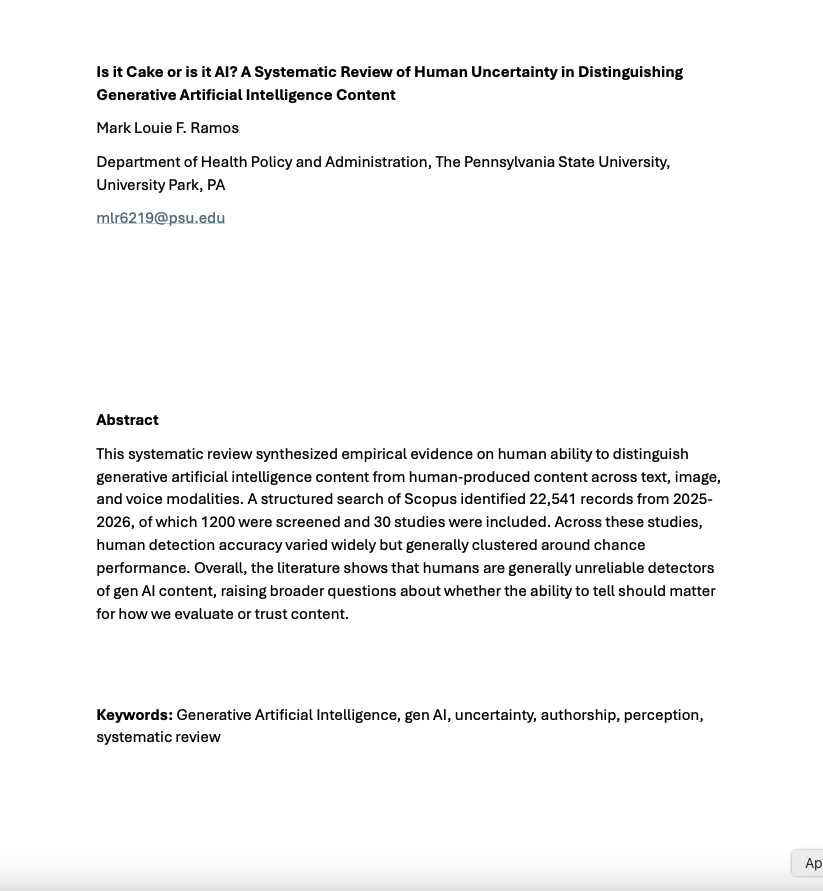
A systematic review published in April 2026 — screening 22,541 records from 2025 and 2026 — just synthesized every credible study on whether humans can detect AI-generated content. Text. Images. Voice. All of it.
Human detection accuracy varied widely but generally clustered around chance performance. Overall, the literature shows that humans are generally unreliable detectors of gen AI content.
The same accuracy you would get by flipping a coin.
The paper is called "Is It Cake or Is It AI?" Published by a researcher at Penn State's Department of Health Policy. 30 studies included. Every study from 2025 and 2026 only — meaning this is the most current, most relevant assessment of human detection ability that exists.
Here is what the individual studies found.
A study published in Nature in March 2026 found that six academics — each with up to two years of experience — were asked to identify AI-written dental research abstracts. Accuracy ranged from 44% to 76%. The overall finding: relying on human judgment alone is insufficient for identifying AI-assisted academic text. OpenAI
44% accuracy. That is worse than a coin flip. A random guess would have scored 50%.
A separate study involving five blinded human raters across five experimental conditions — human-written, lightly AI-edited, heavily AI-edited, AI-written from human content, and fully AI-generated — found something even more alarming.
Human scoring accuracy was uniformly low, with an overall accuracy of 19%, indistinguishable from chance. OpenAI
19%. Not 50%. Not 44%. Nineteen percent. Worse than random guessing on a binary task.
And the tools built to help humans detect AI are not doing much better.
More than a dozen elite universities have disabled AI detection entirely. OpenAI shut down its own detector after it correctly identified AI text just 26% of the time. Johns Hopkins University's guidance to faculty is now: "No products on the market can effectively identify generative AI."
The university that runs one of the world's most respected medical schools — Johns Hopkins — has officially told its faculty that AI detection does not work.
Think about what is already passing through systems that depend on human verification.
Medical research papers reviewed by academics who score 19% on AI detection. Legal briefs reviewed by judges who cannot tell AI-written arguments from human ones. Job applications screened by hiring managers who cannot distinguish AI-generated cover letters from authentic ones. News articles read by editors trained to catch fabrication — but not trained to catch this kind.
The systematic review ends with a question that no institution has answered.
If humans are generally unreliable detectors of AI content, what does this mean for how we evaluate or trust content at all? Vellum
The answer, so far, is silence.
Source: Ramos · Penn State · "Is It Cake or Is It AI?" · arXiv:2604.03437 · April 2026 · https://t.co/QWpGgbPBzc
Cheng et al. · "Ability of AI Detection Tools and Humans" · November 2025 · https://t.co/RUGQro5KsF
🧵1/ Our new study on AI and physician reasoning just came out in @ScienceMagazine. As co-senior author, I'm excited about our findings, and I do think AI will reshape medicine. But after seeing some of the discussions, I'm also worried about how our findings may be misinterpreted.
Fascinating that OpenEvidence, ChatGPT for Clinicians and now AI co-clinician from Google are all emerging. Have not seen this kind of major investment in medicine (esp, compared to other verticals) with cutting edge general-purpose computing infrastructure for decades . Probably same reason that led @peteratmsr@goldbergcarey and me to write the book over three years ago.
😟 the last three days of my son’s and his new bride’s honey moon have been spent trying to recover the suitcase with her wedding dress from DFW. It was transported by family so they could enjoy their trip 😔 Hoping @AmericanAir and @Iberia come through.
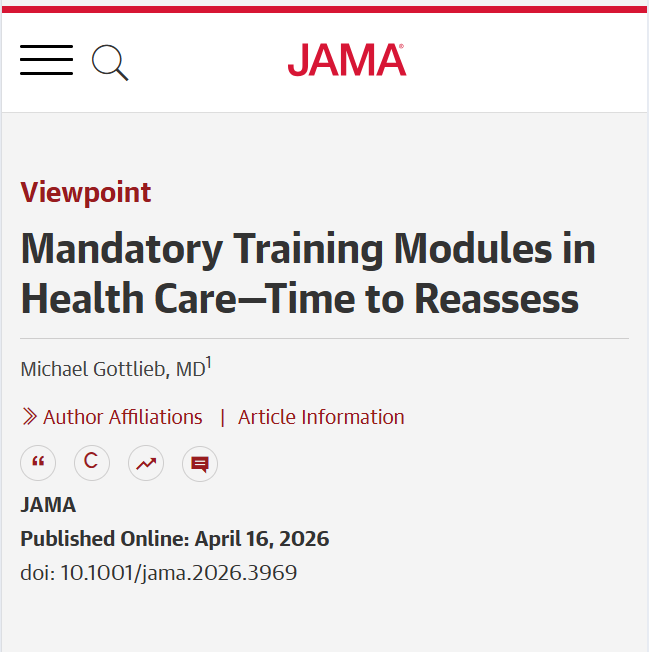
💬 Viewpoint: Mandatory annual training modules consume millions of physician‑hours each year, yet their largely passive formats may offer limited educational value while contributing to administrative burden and clinician burnout.
https://t.co/mJ4oi68waA
Stanford just released a 1.5-hour lecture on “LLM Architecture.”
This is the exact thing systems engineers at Anthropic and OpenAI require to understand at a deep level.
Give it some time.
This might be the highest-ROI learning you do this month.
Let's talk about the “Seven Deadly Sins of AI in Medicine." AI is moving into clinics faster than our ethical frameworks can keep up. The real danger may not be one dramatic failure, but the same mistakes repeated at scale.
This new study outlines these "sins", from blind trust and dehumanization to misapplied statistics and self-referential evaluation. Surveying 914 stakeholders across 143 countries, the authors found broad global agreement on these risks.
The bottom line: building medical AI is not only a technical challenge. It is a human one.
https://t.co/vXLeDbxnlT
🚨 In 2013, a Yale University lecture quietly changed how smart people make decisions.
Most people have never seen it.
It came from Ben Polak and instead of teaching theory, he showed how decisions actually play out in real life.
Watching it feels like gaining an unfair advantage.
At its core is Game Theory not as math, but as a way of thinking. A lens to understand how people act when outcomes depend on others.
He breaks down ideas like dominance choosing moves that are best no matter what others do. Backward induction thinking ahead by reasoning from the end. And the proactive bias not just reacting, but shaping the game before it shapes you.
The biggest shift? Realizing that better decisions aren’t about being smarter they’re about thinking strategically.
That’s why this lecture still hits hard.
Because while most people react to situations…
A few understand the game and play it better.
In 2019, MIT professor Patrick Winston gave a legendary 1-hour lecture called “How to Speak.”
It has 18M+ views for a reason.
His frameworks:
• Your ideas are like your children
• The 5-minute rule for job talks
• Why jokes fail at the start
15 lessons on communication:
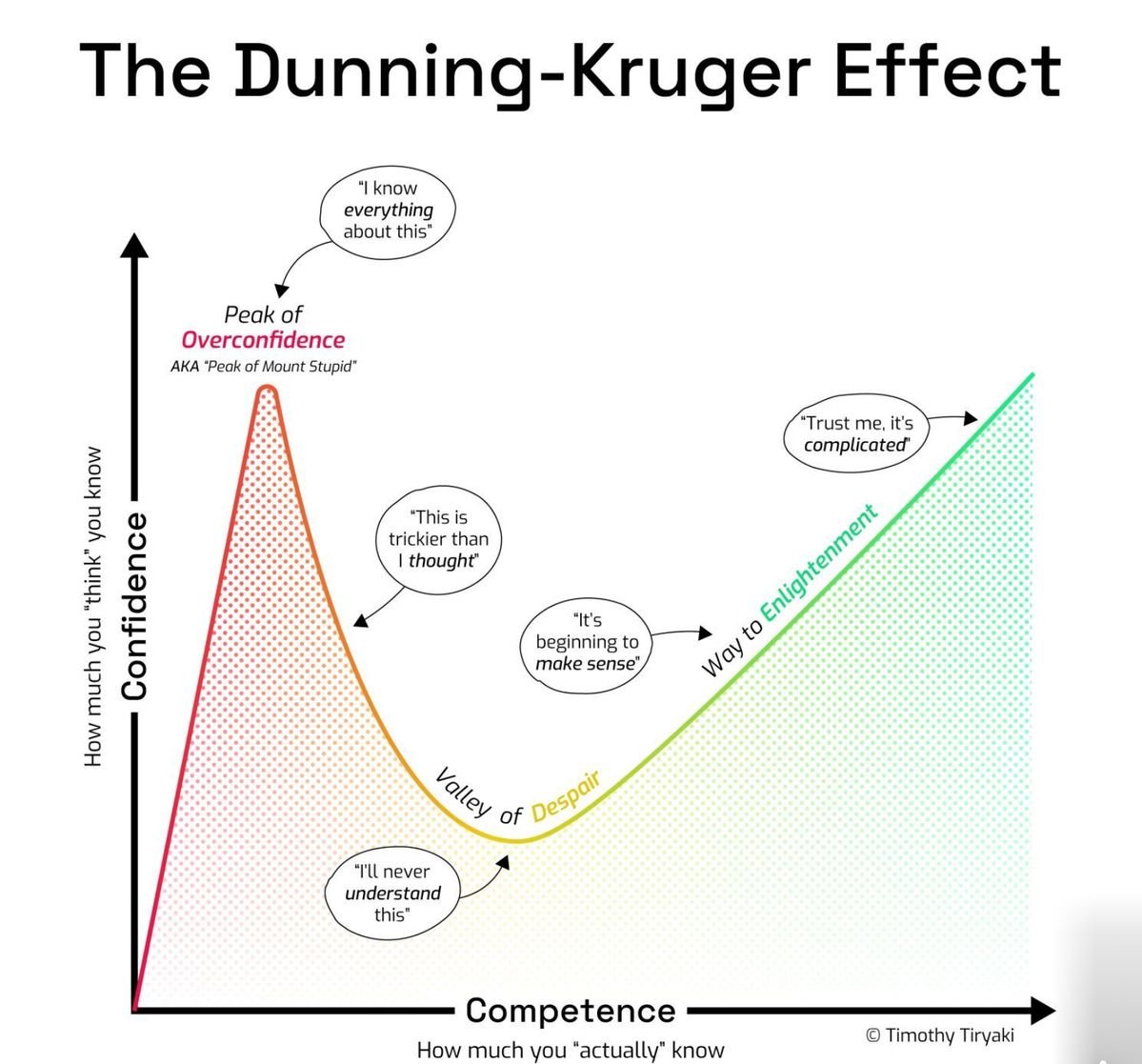
The Dunning-Kruger effect is a cognitive bias in which people with limited knowledge or competence in a specific area greatly overestimate their own abilities. Conversely, highly skilled individuals often underestimate their relative competence, assuming tasks that are easy for them are similarly easy for others.
Great presentations by my colleagues tonight! Many great conversations with members of the Board of Directors followed - lots of excitement about AI @CedarsSinai
Special privilege to share the podium today with @gracielagon and @AjhungMD this evening at the @CedarsSinai Annual Board Meeting, to share advances in #HealthAI at our institution. Special thanks to @MarbanLab for the photos!