We're super excited to join Base Batches 004!
We're providing tokenized options for any asset allowing users to earn, hedge and leverage. And we're fired up to be building this on Base.
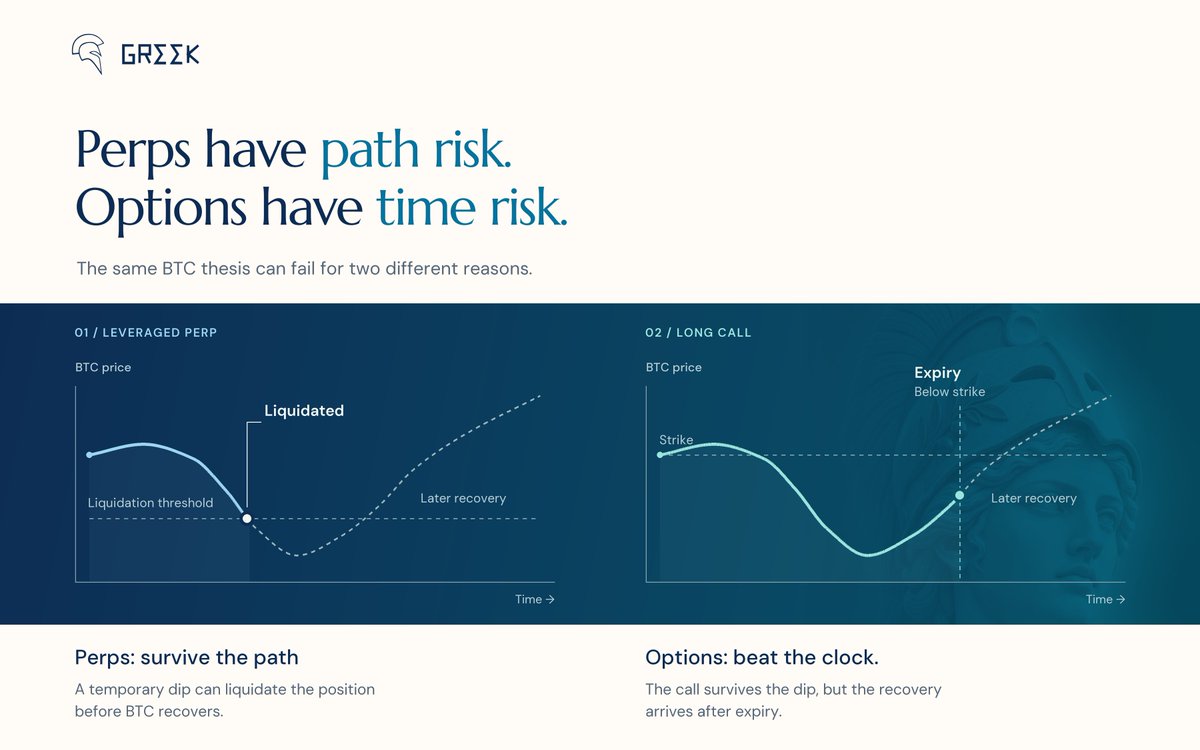
Perps and options can both give you leveraged exposure. But they make you take very different risks to get it.
Say you’re bullish on $BTC over the next six months. You could open a leveraged long perp and hold it until your thesis plays out.
The problem is that the market doesn’t care about your six-month thesis on the way there.
$BTC can drop 15% next week, liquidate your position, and then spend the next five months rallying exactly where you thought it would go. You were eventually right on direction, but your position didn’t survive long enough for that to matter.
That’s the liquidation problem with leverage.
Once your leveraged position crosses that liquidation level, there is no bouncing back. The trade is closed.
A long call has a different problem.
You pay the premium upfront, and that premium can lose a lot of value if BTC moves against you. But there is no liquidation price on the option itself.
$BTC can dump next week and your call still exists.
If you bought an option that expires six months from now, you still have those six months for the thesis to play out. As long as the option has not expired, a temporary move against you does not automatically close the position.
Of course, that protection isn’t free.
Options replace liquidation risk with time risk. If $BTC takes seven months to make the move and your option expires after six, being right eventually doesn’t help you either.
That’s probably the cleanest way to think about the difference:
- Perps: your thesis can be right eventually, but you need to survive the path
- Options: you can survive the path, but your thesis needs to play out before expiry
Both can express the same bullish view.
The real question is which risk you want to take to express it.
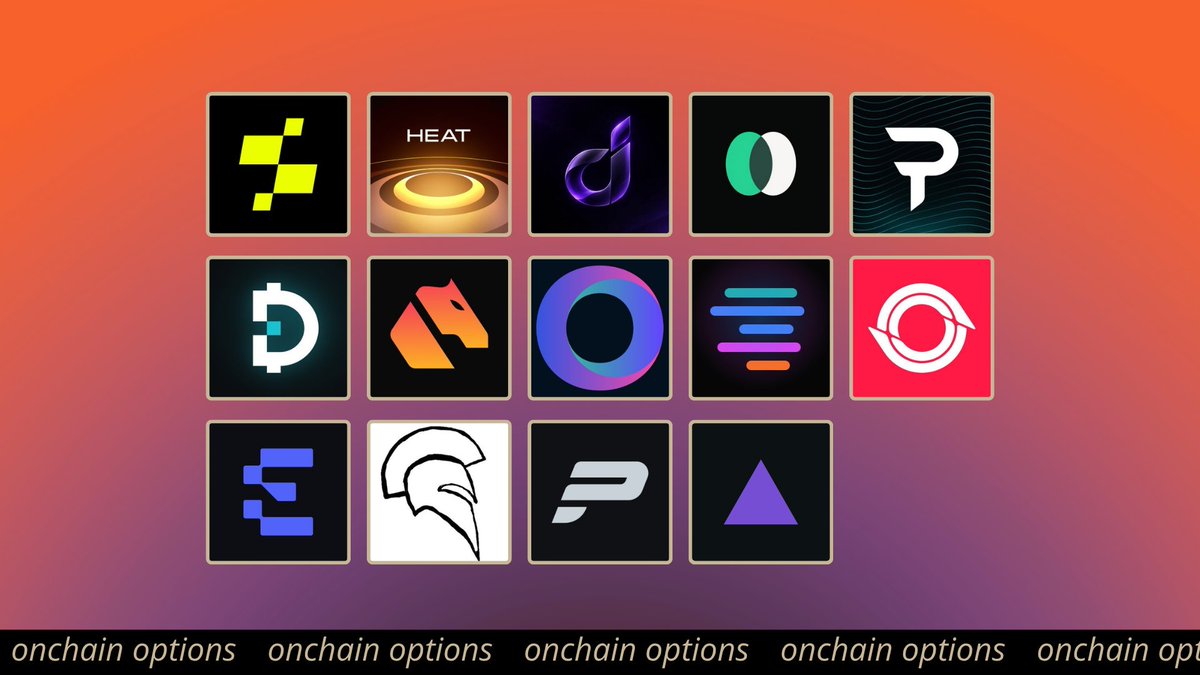
onchain options ecosystem 6
@stryke_xyz is an onchain options platform launching on Robinhood (RH) with a native toolset and routing across CLAMM, orderbooks, and RFQs.
The platform allows you to trade tokenized-stock options, sell covered calls and cash-secured puts for 100%+ APRs, as well as act as a liquidity provider (LP) across CLAMM and Premarket. In addition, the project offers rebates on realized losses in $sykAsh and is preparing to launch new options-powered primitives.
looks like the launch is very soon
@degrop_ trade onchain options like a degen… launching soon….
hm, something very early? degens are here
@Scenarios_fi a simpler interface for turning a market view into an options trade. Powered by @SynapseProtocol , dev: @0xEvinho@heat_fi - social trading platform for options.
@options_monitor - Global block trade monitor for options by @paradex@DimeTerminal - your personal 24/7 quant to help analyze your options trades and portfolio
@DeriveTradeTape - Live options trade tape from
@DeriveXYZ@optionly_ - trader intelligence for Derive: who is trading, what they hold, who is good, and what the rules say is mispriced. Built from public fills and quotes, refreshed every few minutes. dev @EthBoi_@OctavFi - is a Portfolio Intelligence Platform for tracking crypto portfolios and managing derivative and DeFi positions
@tacticallsXYZ - The social app for options trading. Powered by @DeriveXYZ@GreekDotFi - tokenized options infrastructure for generating yield from passive token holdings and enabling flexible onchain hedging
@enhanced_defi is a structured-product infrastructure for onchain assets, including real-world assets (RWAs). In v1, the system allows users to write options such as covered calls and cash-secured puts onchain, as well as a vault infrastructure that enables the rolling of these strategies.
@premarket_xyz is a trading platform for assets and outcomes before they exist or resolve anywhere else. You can take positions on token launches, pre IPO valuations, real world events, options on existing assets, and tokenised real world assets.
https://t.co/zH3v00RzED - Onchain Options Analytics platform. dev @momilio
good platform, I constantly come across dashboards from there on my timeline
We think composability is what can make onchain options a killer product.
And in our opinion, it is also the piece the market has overlooked so far.
Once options, collateral and settlement claims live onchain as standard assets, they can plug into the rest of DeFi instead of existing inside a closed derivatives venue.
A market maker can write an option, receive a tokenized claim on the collateral, and potentially use that claim elsewhere as collateral. A vault can build strategies on top of the same options. A lending market can underwrite against the collateral layer.
None of those systems need to live inside the options protocol itself.
That's the part we think matters for market structure.
In TradFi, the options venue, margin system, broker, custodian and structured product wrapper are tightly bundled together.
Onchain, they can be separate.
The options protocol can focus on creating and settling the option correctly. Lending protocols can handle financing. Vaults can handle strategy management. Aggregators can handle execution.
Each layer can specialize, and builders can combine them in ways the original protocol never had to design for.
That also changes how innovation happens.
You don't need to rebuild an entire derivatives stack every time you want to test a new strategy or capital model. You can build one new piece and plug it into what already exists.
Transparency is a nice property of onchain options.
Composability is what can make them fundamentally different.
@ThetanutsFi Lot of these more advanced strategies will be abstracted away by vaults, run by professional option traders. Makes it much easier for everyone, and especially to onboard new users.
@kdotcrypto The infrastructure is finally ready to build truly great financial apps on top.
Quite exciting to see the explosion of apps and that the market finally is excited about them, rather than just infra plays.
@_JakeEaton Will all happen sooner rather than later, but getting makers for these assets that have not yet seen massive demand can be a bit of a challenge.
Buying and selling options can solve completely different problems.
Say BTC is trading around $85,000 and you already own it. You’re still bullish long term, but you’re worried about a specific risk event over the next few months.
That’s where buying a put can make sense. If BTC drops, the put gains value and can offset some of the loss in your underlying position. You’re paying for protection without having to sell the BTC you actually want to keep holding.
Buying a call solves a completely different problem.
Maybe BTC is at $85,000 and you think there’s a good chance it moves much higher over the next few months, but you don’t want to buy more spot or take leveraged perp exposure.
A call gives you asymmetric upside exposure. Your maximum loss is the premium you paid, while the upside can grow significantly if BTC moves far enough above the strike before expiry.
Then there’s selling options.
Say you already own BTC at $85,000 and you’d be happy to sell it at $100,000. A covered call lets you monetize that price target.
Instead of just placing a limit order at $100,000 and waiting, you sell someone the right to buy your BTC from you there and collect a premium upfront.
All three are options strategies, but they’re doing very different jobs:
Buy put → protect an existing BTC position
Buy call → get asymmetric BTC upside exposure
Sell covered call → earn premium on BTC you already own
That’s why saying “options are for speculation” or “options are for yield” misses most of what makes them interesting.
The instrument is the same. What changes is the job you’re hiring it to do.
Covered calls are one of the simplest ways to earn yield on an asset you already own.
Say ZEC is trading at $1,500 and you already know you’d be happy to sell at $1,800. You could just place a limit order there and wait.
Or you can sell someone the right to buy your ZEC from you at $1,800 before a certain date.
They pay you for that right upfront. That payment is the option premium.
That’s the covered call.
It’s called “covered” because you already own the ZEC you might have to deliver. You aren’t making some naked leveraged bet — you’re basically committing an asset you already hold to a future sell price.
Why would anyone do this?
Because if you’re already happy selling ZEC at $1,800, you might as well get paid while waiting for it to get there.
That’s where the yield comes from. Not from inflation, incentives or some protocol subsidy, but from the person buying the option from you.
They’re paying for flexibility.
If ZEC rips higher, they get the right to buy it from you at $1,800 even if the market price is much higher. If ZEC doesn’t move enough, they may never use that right at all.
And that’s also why the premium isn’t free yield.
Say ZEC ends up at $1,650 when the option expires. Nobody is going to buy your ZEC for $1,800 when the market price is only $1,650, so the option expires worthless.
You keep your ZEC and you keep the premium.
Pretty good outcome.
But if ZEC rallies to $2,200, the situation changes.
The option buyer can now exercise and buy your ZEC for $1,800. You still get your $1,800, and you still keep the premium, but you miss the extra $400 of upside above the strike.
That’s the trade.
You are getting paid today in exchange for giving someone else the upside above a price you already chose.
So covered calls are not magic yield. The premium is compensation for taking on an obligation.
The simplest mental model is probably this:
ZEC stays below $1,800 → keep ZEC + premium
ZEC goes above $1,800 → sell at $1,800 + premium
What you give up → upside above $1,800
Which is why I like the shorthand:
Covered calls are limit orders that pay you.
With Perps you can be right on your trade, but still lose it all by being liquidated before the market goes where you anticipated.
Options are the solution to that problem!