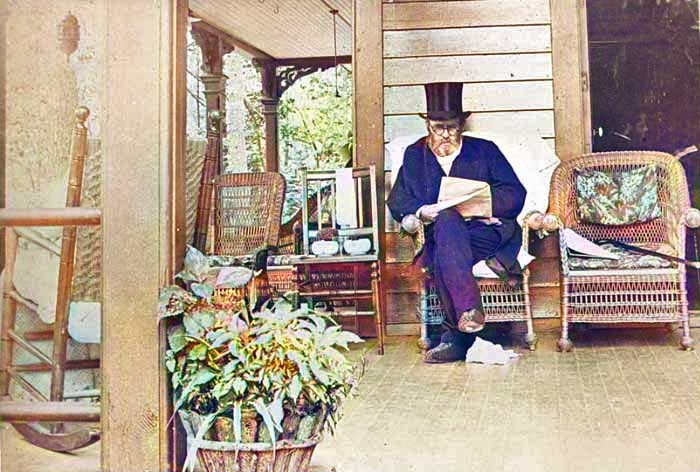
In 1884, Ulysses S. Grant was dying of throat cancer and was dead broke.
His money was wiped out by a swindler who stole his fortune.
Desperate to leave something for his wife, he agreed to write his Civil War memoirs and was close to signing a contract for a meager 10% royalty.
Mark Twain stepped in, called the deal robbery and offered Grant 70% of the profits through his own publishing company.
Grant raced death to finish the book, completing it just days before he died in July 1885.
It became one of the greatest memoirs ever written.
The royalties left his widow nearly half a million dollars, about $16 million today, and the book has never gone out of print.
In 1942, an American shipyard built a 441-foot cargo ship in 4 days, 15 hours, and 29 minutes.
Not started. Not assembled from a kit. Built, from the laying of the keel to sliding into the water.
At the time, German U-boats were sinking Allied ships faster than Britain could replace them.
So America responded by building ships on a scale the enemy could never match.
This is the story of the Liberty ships..🧵1/6
This scene had my heart racing from start to finish. The loyalty, the sacrifice, the determination to never leave anyone behind this is why war movies hit so hard.
The cost of equipping a single American GI in World War II amounted to roughly $180.38 at the time—about $3,300 in today’s dollars.
Key items included:
- M1 Rifle: $85.00
- Field jacket: $3.05
- Combat boots: $6.82
- Helmet: $3.63
- Backpack/field pack: $15.50
- Entrenching tool: $1.60
- Canteen and cover: ~$0.82
- Mess kit components: a few cents to about $1.00 each
- Clothing and personal gear (socks, belts, pouches, etc.): typically $0.04–$6.19 per item
At first glance, the prices seem extremely low by modern standards, but that reflects the massive scale of wartime production. By the end of the conflict, the United States had mobilized over 16 million service members and converted vast portions of its economy into a military production system, turning factories that once made consumer goods into assembly lines for weapons, vehicles, and uniforms.
Standardization and mass production made it possible to equip millions of soldiers with nearly identical gear across every theater of the war. A fully loaded American infantryman often carried between 60 and 90 pounds of equipment—sometimes exceeding 100 pounds during major operations—something many veterans later described as nearly as grueling as combat itself.
🚨 BREAKING: Arkansas combat veteran Aaron Spencer just won the Republican primary for Lonoke County Sheriff after previously being arrested for killing the man accused of r*ping his 14 year old daughter. He just defeated the very sheriff who put him in cuffs. Voters sent a loud message and now he says he’s ready to clean up the county.
I visited Fort Carson to see firsthand how the Army is transforming military nutrition through its Campus-Style Dining Venue modernization program, with the help of celebrity chef @RobertIrvine.
The results speak for themselves: healthier meals, higher morale, and lower costs. Fort Carson is proving that real, nutritious food can strengthen military readiness while saving taxpayer dollars.
🇺🇸 Double Shot of Badass Americans: William J. Crawford
He was a janitor at the Air Force Academy for many years. The cadets who passed him every day had no idea they were walking among a living legend.
Born in Pueblo, Colorado in 1918, Crawford was drafted into the Army in July 1942.
By September 1943 he was serving as a Private and squad scout with Company I, 3rd Platoon, 142nd Infantry Regiment, 36th Infantry Division in southern Italy.
On September 13, 1943, his platoon attacked German positions on Hill 424 near Altavilla.
After reaching the crest, they were immediately pinned down by machine gun and small arms fire from multiple enemy positions.
Without orders and completely on his own, Crawford moved forward alone under heavy fire.
He first located one machine gun dug in on a terrace directly in front of the platoon.
He crawled through open ground under fire, closed to within a few yards of the emplacement, destroyed the gun with a hand grenade, and killed three of the crew.
He kept going.
Crawford spotted a second machine gun position firing on his men.
Again moving alone and exposed, he advanced on the crew under fire. When he got close enough, he threw a grenade, destroyed the gun, and eliminated the crew.
He still wasn't finished.
He located a third German machine gun that was continuing to pin down his unit.
Once more he advanced alone through enemy fire, closed on the position, killed one of the Germans with rifle fire. Two other Germans who were there fled.
Crawford, the badass he was, grabbed the German machine gun, turned it around, and fired on them as they were running down the hill.
Crawford had single handedly taken out all three machine gun nests that were holding up his entire platoon.
A few days later he was captured by the Germans. His fellow soldiers thought he had been killed.
He would spend the next 19 months as a prisoner of war.
Because the Army believed he was KIA, the Medal of Honor for his actions was awarded posthumously and presented to his father in 1944.
When the war ended and Crawford was returned home, he had technically already received the nation’s highest award, but he was never formally presented with it.
He would stay in the military until the 1960's, retiring as a Master Sergeant.
He then took a quiet job as a janitor at the U.S. Air Force Academy.
For many years he mopped floors and cleaned the cadet squadrons without ever mentioning his service. Thousands of cadets passed by him over the years without the slightest clue.
Then, in the late 1970s, a cadet was reading a book about the Allied campaign in Italy and stumbled upon his name. He asked the janitor about it.
Crawford simply replied, “That was one day in my life and it happened a long time ago.”
They were shocked to find out their janitor was that same person.
The cadets spread the word and helped arrange for him to have the recognition he deserved.
On May 30, 1984, nearly 41 years after his actions, President Reagan personally awarded Master Sergeant William J. Crawford his Medal of Honor during the Air Force Academy graduation ceremony.
William J. Crawford is an American Badass 🇺🇸
This rendition by Dan & Shay is fantastic, but credit to the sound guy who absolutely nailed this mix. It's perfect. The blend between the harmonies and the live mics in the stadium is what makes the hair on your arm stand up.
She Wore a Yellow Ribbon
1949
Veteran cavalry commander Captain Nathan Brittles on the verge of retirement takes on a final mission to prevent an Indian uprising. John Wayne believed it was his best acting role.
The entire movie of Black Hawk Down (2001) is essentially one massive firefight. The brutal street battles, nonstop gunfire, and documentary-like realism make it one of the most intense war films ever made.
June 11, 1944. D-Day plus 5.
A 29-year-old lieutenant colonel stood up on an exposed causeway in Normandy, drew his pistol, picked up a rifle with a bayonet attached, and screamed at his men to follow him.
Then he ran straight at the German machine guns.
This is the story of Robert Cole, the Carentan causeway, and one of the most remarkable acts of leadership in American military history.
And why he never lived to hold the medal they gave him for it.
---
Five days after D-Day, the invasion was in trouble in a way that doesn't get talked about much.
Utah Beach and Omaha Beach were separated by a seven-mile gap. Between them lay the town of Carentan, a crossroads city connecting the two landing zones through the low, flooded marshlands of the Cotentin Peninsula. Until Carentan was taken, the Utah beachhead was effectively isolated. If the Germans could concentrate their forces and push through that gap, they could cut the Americans in half, drive to the sea, and potentially roll up Utah Beach from the south.
General Eisenhower knew this. General Bradley knew this. The men trying to take Carentan knew this.
Defending Carentan was one of the most dangerous officers in the German army: Oberst Friedrich von der Heydte, commander of the 6th Fallschirmjäger Regiment. Rommel himself had issued the order: hold Carentan to the last man. Von der Heydte's paratroopers, most of them seventeen-year-old volunteers, had already been fighting the 101st Airborne for five days and were not done.
---
To reach Carentan from Utah Beach, you had to cross the causeway.
It was a narrow elevated road surrounded on both sides by flooded marshes. No cover. No flanking routes. No way to bring armor forward until the road itself was clear. Any force trying to move down it was completely exposed to anyone shooting from the other end.
The Germans had lined the far end with machine guns, mortars, and artillery. They had dug into hedgerows within 150 yards of the causeway's exit. Every man who moved forward was visible against the sky.
By June 11, Lt. Col. Robert Cole had been moving his 3rd Battalion, 502nd Parachute Infantry Regiment down this causeway for two days. He had started with roughly 400 men. After nights of continuous fire in fixed positions, he had about 265 left in fighting condition.
On the morning of June 11, those 265 men were completely pinned down.
For over one hour, they lay flat on the causeway while German machine guns, mortars, and artillery fire swept across them. Men were dying beside Cole and he could not move. The German positions were 150 yards away. They might as well have been 150 miles.
---
Cole ordered smoke grenades thrown toward the German lines.
Then, with utter disregard for his own safety, he stood up.
He had a pistol in one hand. He had grabbed a rifle with a fixed bayonet from a fallen soldier with the other. He turned to what remained of his battalion and shouted for them to follow him.
Then he charged.
Not many men followed immediately. Most were flat on the ground under fire and a human brain does not simply stand up into a machine gun because someone tells it to. But they saw Cole running. They saw him not getting shot. And then something happened that officers spend entire careers trying to understand: the battalion got up and charged with him.
What followed was hand-to-hand combat in the hedgerows. Rifles used as clubs. Bayonets used as bayonets. Americans and Germans fighting at arm's length in the mud and smoke.
The charge worked. The German line broke.
Of the roughly 265 men who charged, approximately 130 became casualties.
Cole was not among them. He walked back from the hedgerows, bleeding from minor wounds, his clothes torn. He had not been seriously hit.
The road to Carentan was open.
---
Carentan fell the next day.
For the first time since June 6, the Utah and Omaha beachheads were connected. The gap was closed. The invasion had a continuous front.
Cole was immediately recommended for the Medal of Honor. His commanders described what he had done with language that rarely appears in formal military reports: they said it was extraordinary. That without it, the causeway might not have been taken that day. That he had personally turned a pinned battalion into an attacking force through nothing but the force of his own example.
Cole was 29 years old.
---
He never stopped leading from the front.
After Normandy, the 101st returned to England to rest and refit. Cole wrote letters home, trained replacements, and waited for the next jump. In September 1944, that jump was Operation Market Garden, the massive airborne assault into the Netherlands designed to cross the Rhine and end the war before Christmas.
It did not end the war before Christmas.
On September 18, 1944, Cole's battalion was pinned down again, this time near the Wilhelmina Canal in Best, Netherlands. American aircraft were firing on his men by mistake. Cole ordered recognition panels placed in front of the lines to redirect the planes.
When it wasn't happening fast enough, he ran out himself in front of his men to place the panels.
He was looking up at the planes when a German sniper's bullet hit him in the head.
He was killed instantly.
Robert Cole was 29 years old. He had been in almost continuous combat since the night of June 5.
---
Two weeks later, on October 30, 1944, the Medal of Honor was presented at Fort Sam Houston in San Antonio, Texas.
Present at the ceremony: Cole's widow, Allie. And his son, also named Robert, who was two years old.
The little boy had been born after Cole shipped out. There are photographs of them together from one leave. Cole had never seen his son walk. He had never heard him talk.
The citation read by the general that day described the causeway charge in precise, formal language. It described how Cole had risen under fire. How he had led the assault with a pistol and a bayonet. How the charge had broken the German position.
It did not describe what his son looked like when they pinned the medal to his mother's dress.
---
Cole is buried at Netherlands American Cemetery in Margraten.
The causeway he charged down still exists outside Carentan. It looks much the same as it did in 1944. Flat. Exposed. A narrow road above the marsh with nowhere to hide.
Every year, the town of Carentan holds a ceremony for the men who took it. Among the names always spoken is Robert Cole's.
He ran into the machine guns so the invasion could continue.
He was 29 years old.
His son was two.