Selon @libe, un seul essai fait mieux que le dernier volume du Grand Continent chez Gallimard : l’encyclique du pape.
Merci à toutes les lectrices et à tous les lecteurs qui se sont déjà rendu en librairie pour *l’Ennemi qui nous désigne : apprendre à résister aux prédateurs*.
Coatue's Thomas Laffont on a "Power Law Paradox": a business valued between $100B and $1T (a "Centacorn") has a higher statistical likelihood (31%) of multiplying its value by 10x compared to smaller, earlier-stage unicorns (8%).
It's not a coincidence Jamie Dimon, Elon, Jensen, and Barry Diller all share the same management philosophy: getting the truth from the source
Dara on what he learned from Barry Diller in his 20+ years working with him:
"I was an analyst at Allen & Company working on the LBO model for Paramount.
Barry didn't want to talk to the MD or the VP or the associate.
He'd say, 'Who built the model? I'm going to talk to that guy.'
He wanted to hear straight from the source.
It's the filtering that gets the edge out of the situation, and it's often the edge that gives you an edge. It's not the average."
@GavinSBaker in our conversation from 2024 explained how Elon, Jensen, and Jamie work:
"Wherever in the company the problem is, that is who Jensen and Elon go to work with — the subject matter expert, whether they're 23 or 50, there's no hierarchy.
When JPMorgan was buying Bear Stearns, the best modeler in the company was 24 years old.
They set up a desk for him side-by-side with Jamie. Jamie would say, "Change that, change this."
He didn't ask for that guy's boss. He said, 'This guy is the best, I want to work with him.'"
Polsia just raised $30M at a $250M valuation.
Approaching $10M annual run rate.
One Founder + AI. Zero employees.
Polsia runs companies autonomously.
It also ran its own fundraising.
I just showed up for signatures.
My conversation with Dan Sundheim (@dsundheim).
He is the founder and CIO of D1 Capital Partners, which manages over $30B across public and private markets.
There's no one as passionate about investing as Dan.
We had a really wide-ranging conversation and discuss:
- Public vs. private markets in 2026
- Anthropic, OpenAI, and SpaceX
- How Dario reminds him of Jeff Bezos
- The future of hyperscalers
- The software selloff and what comes next
- GameStop and the LP dinner that followed
- China vs. US: the risk of Taiwan
Enjoy!
Timestamps:
0:00 Intro
1:05 Public vs. Private Markets
9:10 LLMs as a Business Model
23:23 The Future of Hyperscalers
27:45 AI's Impact on Traditional Software
36:31 Surviving the GameStop Short Squeeze
49:54 Big Private Bets: Rivian and SpaceX
54:26 The Art of Short Selling
1:04:28 Early Career
1:17:11 Geopolitics and the Semiconductor Collision Course
1:22:05 Traits of Great Leadership
1:23:20 The Kindest Thing
La nouvelle présentation de Benedict Evans est canon, blindée de datas pertinentes, bref à lire absolument pour quiconque dirige une entreprise en 2026.
Son propos en fil rouge : si internet avait changé la manière de vendre, maintenant l'IA change la manière de faire.
La plupart des entreprises continuent pourtant de traiter l'IA / la genAi comme un sujet d'outils. ChatGPT à droite, Claude à gauche, un comité IA qui se réunit tous les quinze jours pour s'auto-féliciter d'avoir lancé deux POC. C'est probablement l'erreur stratégique majeure de la décennie.
La question centrale désormais :" à quoi ressemble une entreprise reconstruite autour de l'IA ?"
Les organisations, les workflows, les modèles économiques, les hiérarchies de marché, et accessoirement les agences, vont y passer. C'est en cours.
Evans pointe l'écart qui va se creuser. La plupart des dirigeants surestiment les démos et sous-estiment la difficulté de transformer une organisation. Et les consultants qui vendaient hier de la "transformation digitale" recyclent déjà leurs slides sans avoir compris ce qui se passe sous le capot.
L'avantage des cinq prochaines années ne viendra pas de l'accès aux modèles. Tout le monde y aura accès. Il viendra de la vitesse, de la gouvernance, et de la capacité à changer plus vite que les autres.
https://t.co/GdJhR6h5dO
Jensen Huang just described something that should keep every worker in America awake tonight.
Not because AI is coming for their job.
Because most of them never understood what their job actually was.
Huang: “The task of our job and the purpose of our job are related, not the same.”
Most people think their job is the thing they do with their hands for eight hours a day.
Write code. Fill spreadsheets. Draft emails. Push pixels.
That was never the job.
That was the task.
The job was always the thinking underneath it.
Huang: “If you apply that to me, you would come to the conclusion what Jensen does for a living is tap on phones and talk. And tapping on phones and talking, AI has done that just fine. And therefore my job should be gone. But I’m busier than ever.”
This is the part nobody wants to sit with.
The people panicking about AI aren’t afraid of losing their work.
They’re afraid of finding out they never had any.
They had a routine. A repetitive motion. A series of keystrokes that felt like purpose.
Now a machine does it in four seconds.
Huang: “AI has created more than half a million jobs in the last couple of years.”
The data says one thing.
The fear says another.
Because the fear was never about employment numbers.
It was about identity.
We spent fifty years hunched over keyboards, convinced the hunching was the work.
Huang: “The idea that being human means to hunch over on this little thing, typing all the time… 50 years before that, people didn’t do that.”
Fifty years.
That’s all it took to build an entire identity around a posture.
We don’t type for a living. We think for a living. We imagine for a living.
The keyboard was always just the delivery mechanism. Never the product.
Huang: “It is a fundamental flaw that we only need a billion lines of code written. We need a trillion lines of code written.”
The demand was always infinite.
The bottleneck was always our fingers.
AI doesn’t shrink the workforce. It removes the cap on what the workforce can actually build.
Huang: “Companies that use AI have demonstrated the ability to grow faster. When they grow faster, they hire more people.”
Growth doesn’t eliminate people. It pulls them in.
Every industrial revolution triggered the same panic. Same headlines. Same wrong conclusion.
And every single time, the economy didn’t contract.
It expanded into territory that didn’t exist before.
The real question was never whether AI takes your job.
It was whether you were ever anything more than the motions you repeated.
Because somewhere in the last fifty years, we stopped asking what the work was for.
We just kept typing.
And now the typing is done.
And millions of people are about to meet themselves for the first time.
With nothing to hide behind.
Some of them won’t survive what they find.
« The storytellers are the kings of the world. »
— Steve Jobs
Il y a un mensonge qu'on raconte aux jeunes qui rentrent dans la tech : que c'est la maîtrise technique qui fait les grands entrepreneurs.
C'est faux.
Les meilleurs founders que je connais ne sont pas les meilleurs ingénieurs. Ce sont les meilleurs storytellers. Ceux qui ont compris deux choses : la psychologie humaine, et l'art de raconter.
La tech, c'est le muscle. Le storytelling, c'est le cerveau.
Et une fois que tu vois ça, tu vois plus le monde de la même manière.
Parce que tout ce qui t'entoure — TOUT — est du storytelling.
La religion est du storytelling. Des récits transmis sur des millénaires qui font tenir des civilisations debout, qui font lever des armées, qui font construire des cathédrales.
La monnaie est du storytelling. Un bout de papier ne vaut rien. Un chiffre dans une base de données ne vaut rien. Ce qui leur donne de la valeur, c'est une fiction collective à laquelle 8 milliards de gens croient en même temps.
Les pays sont du storytelling. Des frontières imaginaires, des drapeaux, des hymnes, des mythes fondateurs. Tu meurs littéralement pour des histoires qu'on t'a racontées enfant.
Les marques que tu aimes sont du storytelling. Apple, Nike, Hermès. Tu ne payes pas le produit. Tu payes le récit attaché au produit.
Tes idoles sont du storytelling. Musk, Jobs, Napoléon. Des humains comme toi, sublimés par la narration.
Même ta propre identité est du storytelling. L'histoire que tu te racontes sur qui tu es, d'où tu viens, où tu vas. Change l'histoire, tu changes la personne.
Une fois que tu vois la matrice, tu peux plus la dé-voir.
Et là, tu comprends pourquoi les humanités sont les vraies compétences de pouvoir : la psychologie pour comprendre les ressorts, la philosophie pour comprendre les fondations, la théorie des jeux pour comprendre les interactions, l'histoire pour comprendre les patterns.
C'est ça, le vrai stack.
Le tech-only finit CTO d'une boîte qu'il n'a pas créée.
Le storyteller-only finit consultant qui parle bien mais ne construit rien.
Mais celui qui combine les deux — celui qui sait construire ET raconter, coder ET convaincre, livrer ET vendre une vision — celui-là devient indestructible.
C'est lui qui lève des fonds. C'est lui qui recrute les meilleurs. C'est lui qui plie le réel.
Les storytellers sont les rois du monde.
Les storytellers-builders en sont les empereurs.
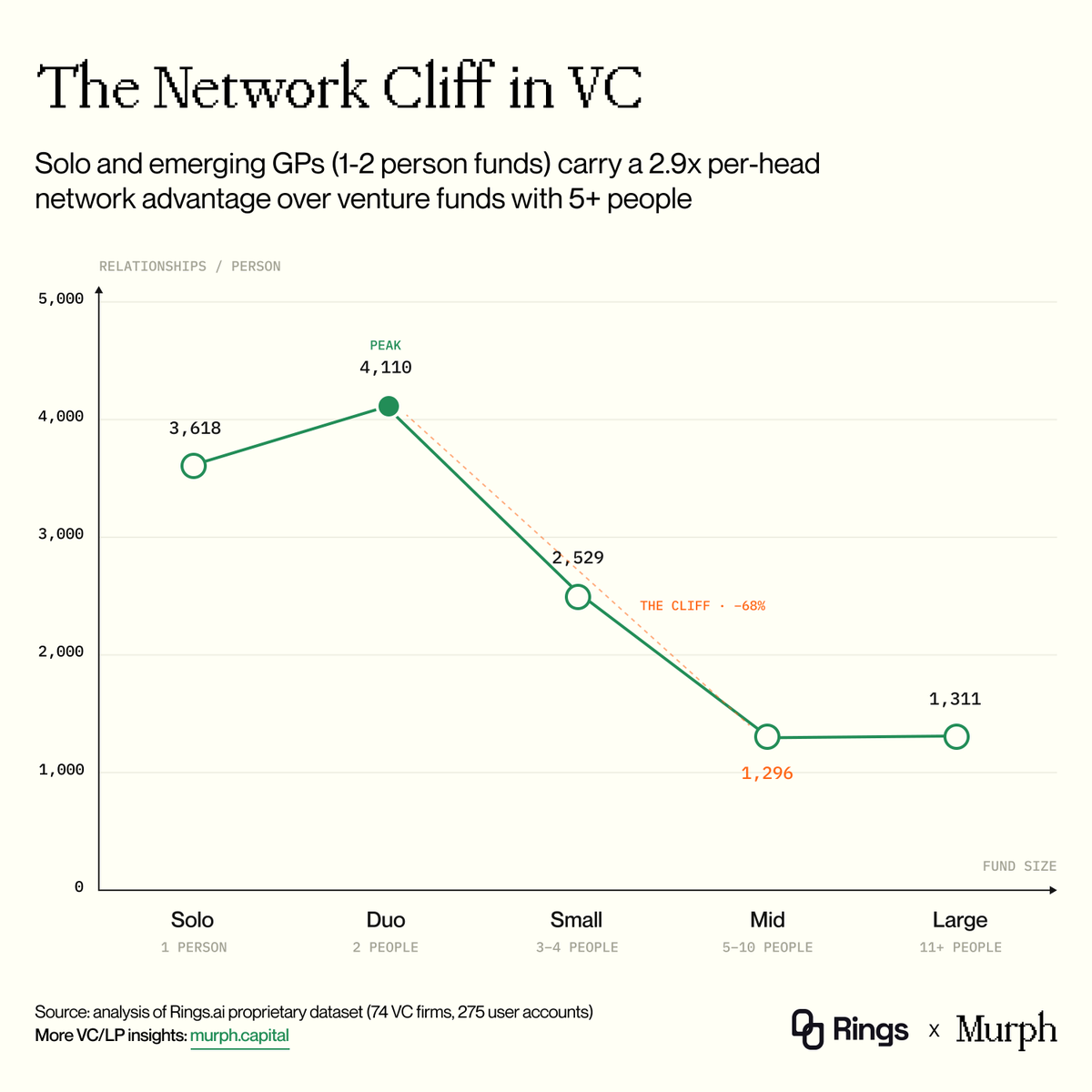
Do solo and emerging GPs actually have a network edge?
I've been speaking with a lot of emerging VCs lately, and every second one leads with the same narrative: "we have a broad, defensible network."
So I looked at the @RingsApp dataset (74 funds, 275 user accounts) to check whether that's actually true. And a few numbers stood out to me:
- Solo and duo GPs carry 2.9x more relationships per person than funds with 5+ people
- The peak is at 2 people – 4,110 relationships per person. Solo GPs sit at 3,618
- Cross into 3-4 people and you're already at 2,529
- At 5-10 people the median drops to 1,296. That's a 68% decline from peak
- Mid and large funds are essentially identical – 1,296 vs 1,311. Adding headcount at that point changes nothing
And yeah, it seems that the edge is real, but based on my experience talking to GPs across fund sizes, I don't think it's because solo GPs are unusually well-connected people.
I think it's structural and a few things explain it:
1/ Survival pressure. At a larger firm you can be an average networker and still get deal flow through the brand, through partners, through inbound. Solo GPs don't have that buffer. You build relationships or you don't see deals. That's an existential pressure, and it produces genuinely different behavior.
2/ Time allocation. Every growing firm pays "a scale tax" – internal meetings, team management, etc. Solo GPs don't pay it. Every hour a partner at a larger firm spends on internal alignment is an hour a solo GP spends on a call with a founder or LP.
3/ Relationship quality. When you're one person, you can't delegate relationships, so you do the intro yourself, the follow-up yourself, you remember the details. At larger firms relationships often become institutional (like "we know that founder!"), but nobody specifically knows them well. Solo GPs build connections that are personally held, which makes them informationally richer and harder to replicate.
4/ Signal clarity. At a big firm people come to you because of where you work. The brand amplifies deal flow – but it also distorts it. When someone calls a solo GP, it's because they know that specific person. I think this makes a real difference in the quality of the relationship, not just the quantity.
And the part I find most interesting (and maybe a bit uncomfortable for EMs to sit with) is that this advantage is time-limited by design.
Based on the data, it starts compressing not when you raise Fund III, but when you make your 3rd hire. The cliff happens between 2 and 5 people, not between 10 and 50.
I think the funds that preserve the edge are the ones that build infrastructure early enough to turn individual relationships into something the firm actually owns (automated CRM enrichment, shared context, real visibility into who knows whom), because without it the network doesn't belong to the firm, it belongs to a person.
For LPs this reframes the DD question, because team size is commonly used as a proxy for network breadth, but the data says it's almost the opposite — the right question isn't how big the network is, it's where it lives, who owns it, and what happens to it if the key person walks out the door.
Anthropic acaba de lanzar el empleado más barato y eficaz del mundo.
Se llama “Claude for Small Business”.
Y esto es lo que puede hacer:
• Gestionar facturas, pagos y finanzas
• Crear campañas, diseños y contenido
• Organizar ventas y clientes automáticamente
• Leer, resumir y redactar documentos
• Gestionar emails, calendarios y archivos
• Ejecutar tareas entre múltiples apps
Todo desde Claude.
Cómo funciona:
→ Conectas las herramientas que ya usa tu empresa
→ Claude entiende el contexto de todo tu negocio
→ Ejecuta flujos de trabajo automáticamente
→ Incluye automatizaciones ya preparadas
→ Funciona con Microsoft 365, Google Workspace, Canva, DocuSign, QuickBooks y más
Anthropic no quiere que Claude sea “otro chatbot”.
Quiere convertirlo en el sistema operativo de millones de pequeñas empresas.
La idea es simple:
En vez de abrir 10 herramientas distintas, hablas con Claude y él hace el trabajo por ti.
Everyone's building AI that thinks for you.
That's the wrong bet.
The Expert Influencer didn't win by making things easier. She won by making people smarter.
Introducing Oboe, the easiest way to learn anything, with magical courses made just for you.
We’re heading toward a future where humans only exist to feed AI. AI gets smarter, we get stupider. But what if AI’s purpose was to feed us? That’s the future we hope Oboe can help nudge us all towards.
Oboe is the world’s first AI-powered generalized learning platform. With a single prompt you can generate a personalized course about anything. From the history of AI to contract law, from ordering wine in France to understanding how mortgages work. And the more you use it, the better it gets at teaching you.
Oboe is available now, for everyone in the world, for free.