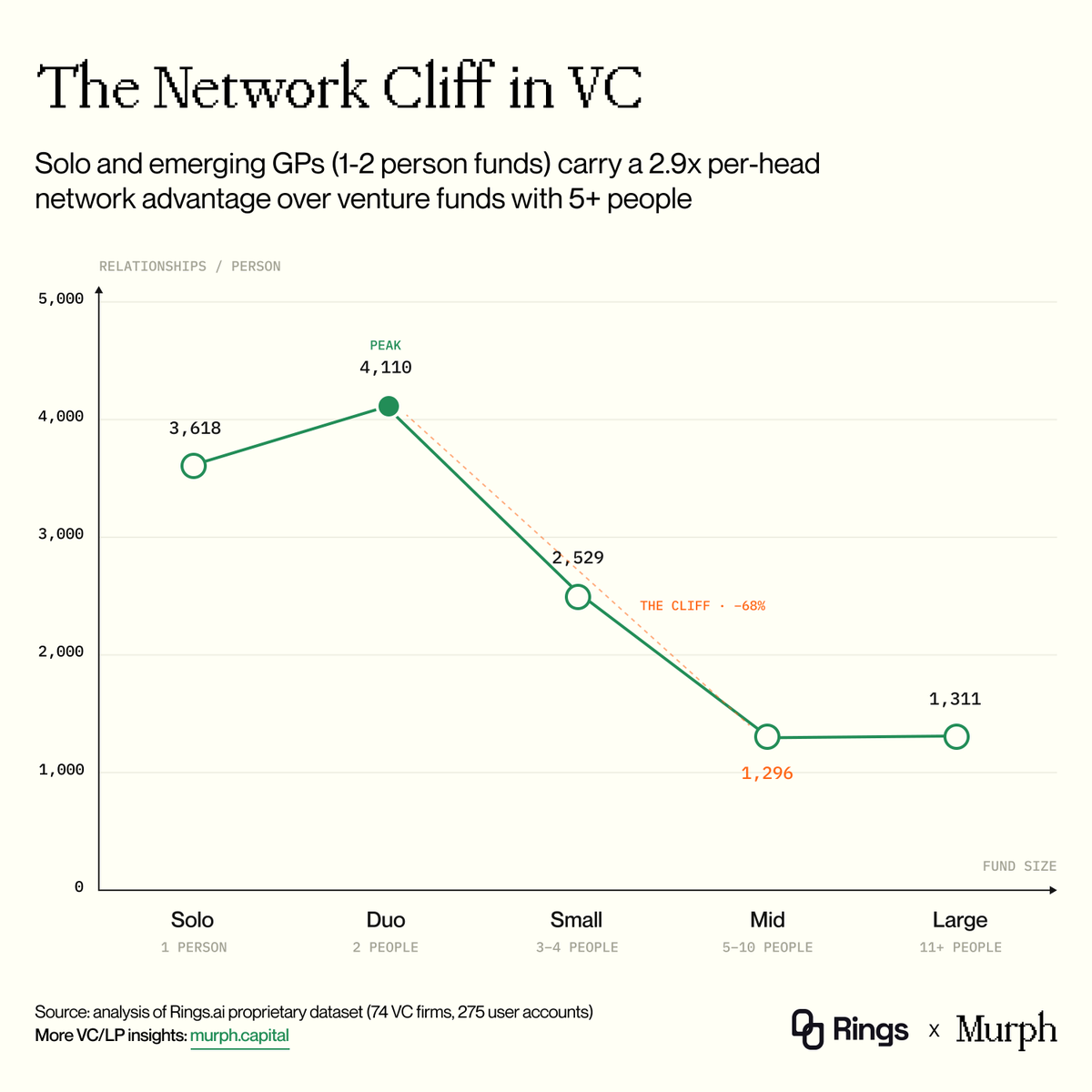
Do solo and emerging GPs actually have a network edge?
I've been speaking with a lot of emerging VCs lately, and every second one leads with the same narrative: "we have a broad, defensible network."
So I looked at the @RingsApp dataset (74 funds, 275 user accounts) to check whether that's actually true. And a few numbers stood out to me:
- Solo and duo GPs carry 2.9x more relationships per person than funds with 5+ people
- The peak is at 2 people – 4,110 relationships per person. Solo GPs sit at 3,618
- Cross into 3-4 people and you're already at 2,529
- At 5-10 people the median drops to 1,296. That's a 68% decline from peak
- Mid and large funds are essentially identical – 1,296 vs 1,311. Adding headcount at that point changes nothing
And yeah, it seems that the edge is real, but based on my experience talking to GPs across fund sizes, I don't think it's because solo GPs are unusually well-connected people.
I think it's structural and a few things explain it:
1/ Survival pressure. At a larger firm you can be an average networker and still get deal flow through the brand, through partners, through inbound. Solo GPs don't have that buffer. You build relationships or you don't see deals. That's an existential pressure, and it produces genuinely different behavior.
2/ Time allocation. Every growing firm pays "a scale tax" – internal meetings, team management, etc. Solo GPs don't pay it. Every hour a partner at a larger firm spends on internal alignment is an hour a solo GP spends on a call with a founder or LP.
3/ Relationship quality. When you're one person, you can't delegate relationships, so you do the intro yourself, the follow-up yourself, you remember the details. At larger firms relationships often become institutional (like "we know that founder!"), but nobody specifically knows them well. Solo GPs build connections that are personally held, which makes them informationally richer and harder to replicate.
4/ Signal clarity. At a big firm people come to you because of where you work. The brand amplifies deal flow – but it also distorts it. When someone calls a solo GP, it's because they know that specific person. I think this makes a real difference in the quality of the relationship, not just the quantity.
And the part I find most interesting (and maybe a bit uncomfortable for EMs to sit with) is that this advantage is time-limited by design.
Based on the data, it starts compressing not when you raise Fund III, but when you make your 3rd hire. The cliff happens between 2 and 5 people, not between 10 and 50.
I think the funds that preserve the edge are the ones that build infrastructure early enough to turn individual relationships into something the firm actually owns (automated CRM enrichment, shared context, real visibility into who knows whom), because without it the network doesn't belong to the firm, it belongs to a person.
For LPs this reframes the DD question, because team size is commonly used as a proxy for network breadth, but the data says it's almost the opposite — the right question isn't how big the network is, it's where it lives, who owns it, and what happens to it if the key person walks out the door.
As a longtime investor and founder at @LumiaCapital , I've felt firsthand how difficult it is to manage relationships at scale.
I'm excited to introduce what my team at Rings AI (@RingsApp) have been building over the last few years to solve this.
If you're evaluating CRM decisions for 2026 or would like to explore how to add relationship intelligence to your current stack, let's chat:
https://t.co/h5yPazNaXf