Professional investor who (still) believes in rigorous research and analysis. Views, opinions, mistakes are my own - and not investment advice. JD/MBA.
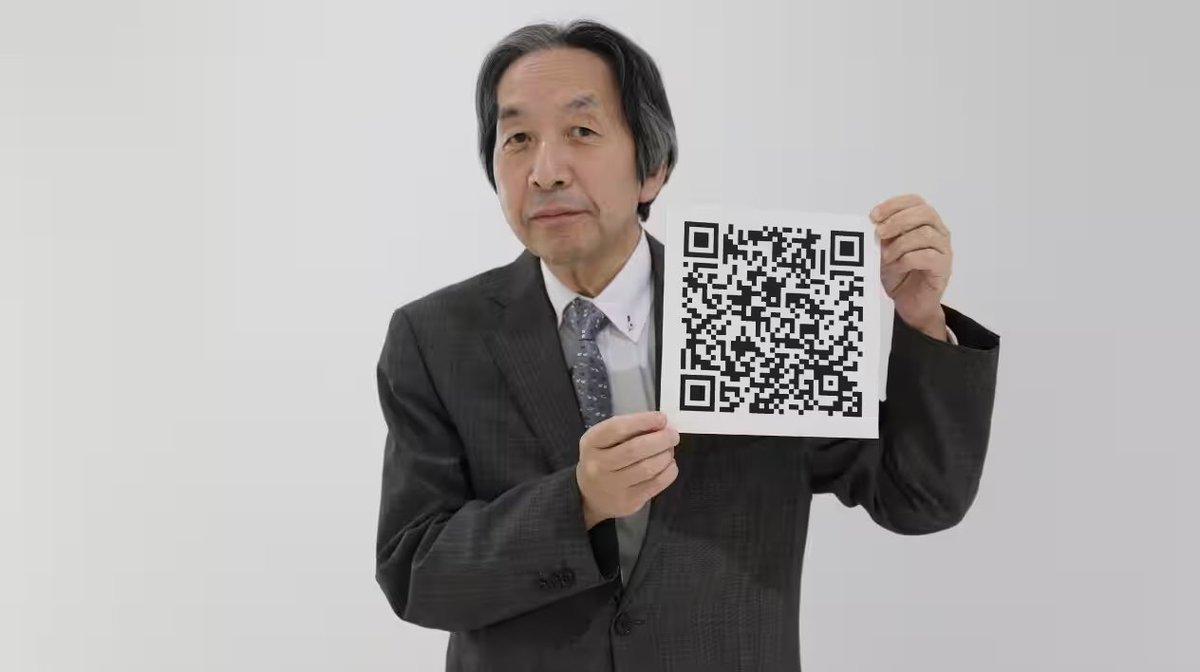
A Japanese engineer invented the QR code for one job, tracking car parts on a Toyota line, then his company chose to give the patent away for free, which is the only reason it ended up on every restaurant table on Earth.
His name is Masahiro Hara. The company was Denso Wave, a parts supplier owned by Toyota.
In 1992 the problem landed on his desk, and it was not glamorous. Workers on the factory floor were drowning.
Every car part had a barcode, but a barcode can only hold about twenty characters, so to track one component they had to stick five or ten barcodes on it.
A worker would stand there scanning a single part ten times in a row. Some of them were scanning close to a thousand barcodes a day. The job had stopped being about building cars and turned into pointing a scanner at stickers all day long.
And there was a second problem nobody upstairs cared about. This was a factory. Oil got on everything. A smudge of grease across a barcode and the whole thing became unreadable, and the line stopped.
Hara was asked to make the scanner faster. He looked at it for a while and realized the scanner was not the problem. The barcode itself was the ceiling. A line of black bars can only hold information going one direction, left to right.
He decided to build something that held information in two directions, up and down as well as across, so it could store hundreds of times more in the same little square.
Then came the part that sounds made up but is not.
Hara played Go on his lunch breaks, the old board game with black and white stones sitting on a grid. He was staring at the board one day and it clicked.
The grid of black and white stones was already a way to store information in two directions. That was the shape of his code.
But building the code was the easy half. The hard problem was speed, because the whole point was to be fast, and a scanner wastes most of its time just trying to figure out where the code is and which way it is turned.
The fix came to him on a train. He was looking out the window at buildings, and one building stood out from all the others because of its shape against the sky. That was the idea.
He put three little square targets in three corners of the code. The moment a scanner sees those three squares, it knows instantly where the code is and how it is rotated, even upside down, even at an angle.
Now here is the detail that shows how far he was willing to go. Those three corner squares only work if nothing else on the page looks like them.
If a magazine ad or a cardboard box happened to have the same black and white pattern nearby, the scanner would get confused and grab the wrong thing.
So Hara and his tiny two-person team went and surveyed printed material. Magazines. Flyers. Cardboard boxes. Piles of it, for days, reducing every picture down to its ratio of black to white area, hunting for the one ratio that almost never shows up in print anywhere. They found it. One to one to three to one to one.
That exact rhythm of black and white is baked into every corner square of every QR code on Earth, and it is there because it is the pattern the printed world almost never produces by accident.
Then he solved the oil.
He built the code so it carries a backup of its own information, spread mathematically across the whole square. You can tear off, smudge, or scratch out up to thirty percent of a QR code and it still scans perfectly, because the code rebuilds the missing piece from the copy it kept of itself.
A worker could get grease on a third of the label and the line would keep moving. This is the same math that lets a scratched CD still play and lets a spacecraft send data back across the solar system without asking to repeat itself.
He finished in 1994. He named it Quick Response, after what it does for the person using it, not after what it is.
And then Denso made the decision that actually mattered.
They held the patent. They could have charged a fee on every single scan, and given how many billions happen now, that would have made someone unimaginably rich.
Instead they announced they would not enforce their rights to collect royalties, and they published the specification openly so anyone could use it. Hara later said it was not even a big argument inside the company.
That one choice is the whole story. A code that costs nothing to use is a code everyone builds on. Airlines put it on tickets. Phone makers built readers into cameras.
Then a pandemic hit and the world needed a way to hand someone information without touching anything, and the free little square that a Toyota engineer built for greasy factory workers was suddenly on every menu, every payment, every door.
Hara still works there. He has said, more than once, that he never imagined it would spread this far, and that the part he is proudest of is that it got used to keep people safe.
The man built it to survive oil on a factory floor. It ended up surviving everything else too.
You have scanned his work a hundred times this year. Now you know whose it was.
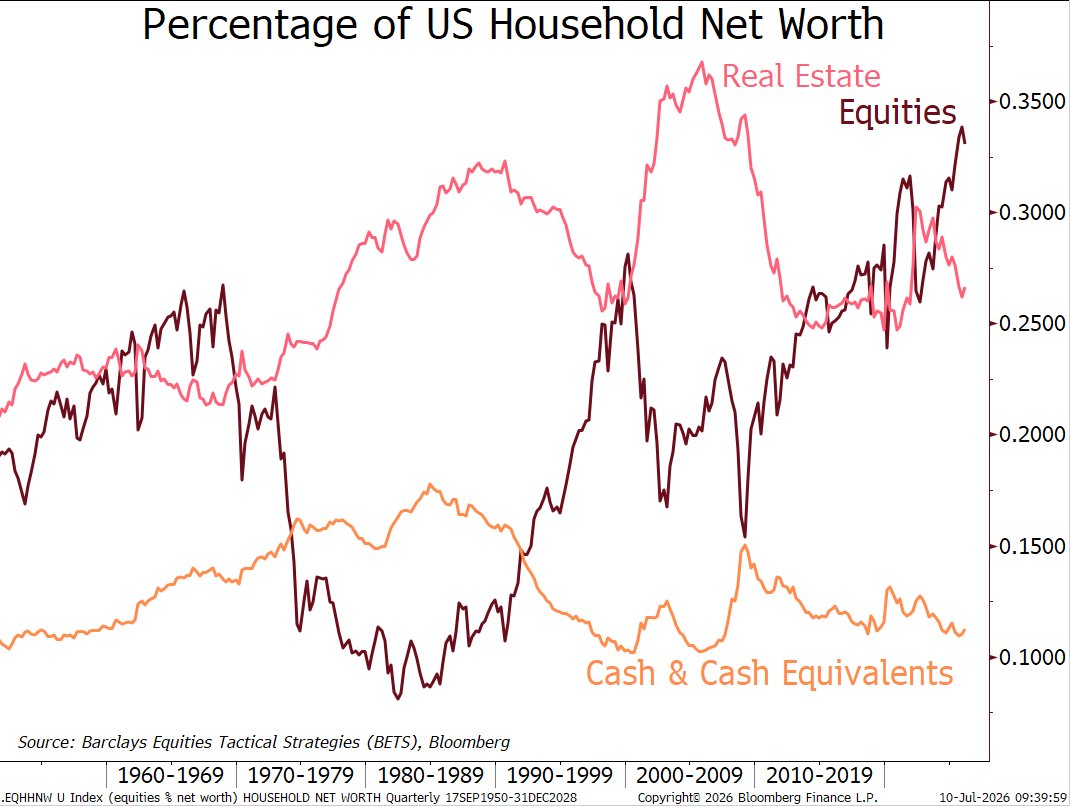
It's worth noting the leverage embedded in household equity exposure. With margin debt relative to GDP now ~4.1%, we're running noticeably hotter than peak dot-com. Highly recommend reading @MacroEdge1 for analysis of that period. https://t.co/GOyfEvSDqh
Amazing chart from today's episode:
It's not just that US household exposure to equities is at a record high, but that the stock market is a SIGNIFICANTLY greater component of total household net worth than real estate now, which blows my mind.
The stock market is the economy.
“𝗧𝗵𝗲𝘆’𝗿𝗲 𝗿𝗲𝗮𝗹𝗹𝘆 𝗴𝗼𝗼𝗱 𝗮𝘁 𝘀𝗼𝗺𝗲𝘁𝗵𝗶𝗻𝗴 𝘁𝗵𝗮𝘁 𝗶𝘀 𝗴𝗼𝗶𝗻𝗴 𝗼𝘂𝘁 𝗼𝗳 𝗳𝗮𝘀𝗵𝗶𝗼𝗻 𝗳𝗮𝘀𝘁."
As the author writes:
The long-term dilemma for Volkswagen and other German automakers is that their complete mastery of internal combustion engine technology does not count for much in a global market that is racing toward electrification.
Read @KeithBradsher's excellent @nytimes article here: https://t.co/dRtXlrio4h
#investing #stocks #stockmarket #bonds #EVs #electricvehicles #tesla #cars #autos #automakers #china
"...in the current momentum-driven market buying shares in companies which have hit a glitch is like trying to catch the proverbial falling knife. All we are getting is cut fingers as their downward share price spiral is exacerbated by the index momentum enhancement effect. It is worth noting that Mr Buffett executed this strategy in a closed fund which he controlled; not an open-ended fund.”
It is also worth noting that Mr Buffett didn't have to contend the described index momentum enhancement effect.
A 33-year-old woman at MIT wrote the code that ran inside the Apollo 11 lunar lander, and 20 seconds before Neil Armstrong touched the moon, her program made a decision the astronauts didn't know was happening that was the only reason the mission didn't crash.
Her name was Margaret Hamilton.
She led the team writing every line of code that would fly humans to the moon and back. The part almost nobody knows is that she had to fight to be allowed to do the work at all.
Code in 1965 was not treated as real work.
Rockets were serious. Circuits were serious. Writing code was something the men at NASA thought secretaries could do on the side. Hamilton was told this to her face more than once.
So she started calling what her team did "software engineering."
She used the phrase on purpose. In meetings. In memos. To force people to treat it as a discipline instead of a chore. Colleagues laughed at her the first few times she said it out loud.
That phrase is now the name of the biggest engineering profession on earth.
The story of what her code did on July 20, 1969 is the one every kid should be taught.
Neil Armstrong and Buzz Aldrin were 3 minutes from touching down when the computer inside the lunar module started flashing an alarm.
1202.
Then again. Then 1201. Five alarms in four minutes. The computer was telling the astronauts it could not finish everything it had been asked to do.
The computer they were flying with had less memory than a modern microwave.
Someone on the checklist had left a switch in the wrong position, and a radar the astronauts did not even need right then was flooding the computer with data. It was eating around 13% of the machine's brain at the exact moment every second mattered.
In almost any other system, that overload would have frozen the machine.
A frozen machine 30,000 feet above the moon means a crash. It means two dead astronauts and a third one orbiting alone above them, waiting for a signal that would never come.
Hamilton's code did something else.
She had built the software with a rule almost nobody in her field was using at the time. When the machine ran out of room, it would not treat every task as equally important. It would look at the list of jobs it had been asked to do, throw out the ones that could wait, and keep running only the ones keeping the crew alive.
The radar was the low priority job.
The landing was the highest.
So the computer did what she had told it to do. It dumped the radar. It kept flying. The alarm was not a failure. It was the machine reporting that it was handling the overload exactly the way she had designed it to.
Down in Houston, a 24-year-old engineer named Jack Garman recognized the alarm from a test his team had run months earlier. He shouted "Go" to the flight controller. The controller shouted it up to the crew. The landing kept going.
Armstrong touched the surface with 25 seconds of fuel left.
The part that gets lost in every retelling is why Hamilton had built that safety net in the first place.
NASA had not asked for it.
She had added it on her own, years earlier, because her 4-year-old daughter Lauren had once crashed the simulator by pressing a button during a test. The button was one the astronauts had been told they would never press.
Hamilton wanted the code to survive that button press anyway.
Her bosses told her it was a waste of time. Astronauts do not make mistakes.
She insisted. The safety net went in.
Two years later, on the way to the moon, an astronaut left a switch in the wrong position. The exact class of mistake she had been told would never happen.
There is a photograph of her from that period.
She is standing next to a stack of paper as tall as she is. Every page in that stack is the code her team wrote for the mission. She is smiling at the camera like she knows something the rest of the aerospace industry has not figured out yet.
In 2016, Barack Obama put the Presidential Medal of Freedom around her neck and said the astronauts did not have much time, but thankfully, they had Margaret Hamilton.
Every autopilot in every plane you have ever flown on uses a version of what she invented. Every pacemaker. Every self driving car. Every satellite in orbit.
The idea that a machine should know which job matters most and drop the rest when it runs out of room is now the foundation of almost every safety system on the planet.
She wrote it because a 4 year old crashed a simulator and nobody else thought it was worth fixing.
The men in the room laughed at her for calling it engineering.
Then her code was the only thing in the sky that did not fail.
For Those Playing the Hardware Angle of AI
China’s LineShine supercomputer just won the #1 spot on the latest Top500 supercomputer ranking released this week by calculating a full 22% faster than the #2 contender, El Capitan at California’s Lawrence Livermore National Laboratory.
LineShine relies on domestically developed central processing units, instead of graphics processing units, or GPUs, which power most of the leading supercomputers today. The machine also uses other homegrown technologies behind its memory, networking and cooling systems.
Washington curtailed Chinese supercomputer developers’ access to Intel chips and other American hardware in 2015.
The Biden administration later blocked the country from accessing powerful GPUs, mostly developed by American chip giant Nvidia, and the tools required to produce them.
In response to these foreign technology restrictions, China built an independent hardware and software ecosystem.
AI of doesn't require supercomputing capacity, but many have been assuming that it does depend upon cutting-edge GPUs.
But if China can build the world's fastest computer without GPUs, what does that mean for GPU demand going forward?
Read Raffaele Huang's excellent @WSJ article here:
https://t.co/XkjSQhUoEl
#compute #supercomputer #GPU #AI #artificialintelligence #investing #stocks #bonds #china
Can someone explain to me why $PS, Pershing Square’s management company at a $12B mkt cap, trades at 50% of fee-paying AUM, 40x revenues and 150x Operating Earnings, when its closed-end funds($PSH.LN and $PSUS) trade at massive 20-30% discounts to NAV…?!
126 years of market history tell a simple story...
Stocks and earnings move together with a 98% correlation.
The short run is all about noise.
The long run is all about profits.
Speculators chase noise. Investors follow profits.
On the night the Titanic sank, a 21-year-old college student watched his father die.
Hours later, doctors told him both of his legs would have to be amputated.
Instead, he got up and started walking.
His name was Richard Norris Williams.
And surviving the Titanic was only the beginning of his story.
In April 1912, Richard and his father, Charles Duane Williams, boarded the Titanic as first-class passengers in Cherbourg, France.
They were traveling to America so Richard could continue his studies at Harvard.
When the ship struck the iceberg on April 14, father and son made their way to the deck together.
Then disaster struck again.
As the Titanic sank, one of its massive funnels collapsed.
The falling structure hit Charles Williams and killed him instantly.
Richard was standing beside him.
He narrowly escaped the same fate.
Moments later, he was in the freezing North Atlantic.
The water temperature was around 28°F (-2°C).
Most people survived only minutes.
Richard spent roughly six hours in the water or clinging to one of the partially submerged collapsible lifeboats before rescue arrived.
When the RMS Carpathia finally picked up survivors at dawn, his condition was severe.
His legs were frozen from the knees down.
The ship's doctor examined him and delivered a grim verdict:
Both legs would need to be amputated.
In 1912, severe frostbite often meant gangrene, infection, and death.
Amputation was considered the safest option.
Richard refused.
He reportedly told doctors that he was going to need his legs.
Then he got out of bed.
Against medical advice, he began walking the deck of the Carpathia every two hours.
Day and night.
Step after painful step.
For four days.
By the time the ship reached New York, his condition had improved enough that amputation was no longer necessary.
He walked off the ship on his own.
Most people would consider that the defining story of a lifetime.
For Richard Williams, it wasn't.
A few months later, he enrolled at Harvard.
Then he returned to tennis.
In 1914, he won the U.S. National Championship, the tournament that would later become the U.S. Open.
In 1916, he won it again.
Over the following years, he became one of the best tennis players in the world, winning multiple major doubles titles and representing the United States internationally.
Then came World War I.
Williams served in the U.S. Army and distinguished himself in combat.
France awarded him both the Croix de Guerre and the Legion of Honor for his service.
After the war, he returned to tennis once again.
At the 1924 Paris Olympics, he badly sprained his ankle during the mixed doubles tournament and considered withdrawing.
His partner, Hazel Wightman, refused to let him quit.
Williams played much of the tournament barely able to move.
Together, they won Olympic gold.
Over the years, he became a Davis Cup captain, a respected figure in American tennis, and eventually a member of the International Tennis Hall of Fame.
Yet people who knew him rarely heard him talk about any of it.
Not the Titanic.
Not the championships.
Not the war.
Not the medals.
Not the Olympic gold.
In fact, he disliked attention so much that later in life he had approximately 160 tennis trophies melted down into a single silver serving tray.
He used it to serve drinks to guests in his Pennsylvania home.
Most visitors had no idea what it was.
Or what it represented.
A Titanic survivor.
A two-time national champion.
A decorated war veteran.
An Olympic gold medalist.
A Hall of Famer.
All hidden inside an ordinary tray sitting quietly on a side table.
Richard Norris Williams died in 1968 at the age of 77.
If you had met him, he probably wouldn't have told you any of this.
And that may be the most remarkable thing about him.
𝗛𝗲𝗱𝗴𝗲 𝗙𝘂𝗻𝗱𝘀 𝗥𝗲𝗼𝗽𝗲𝗻 𝗣𝗿𝗲-𝗪𝗮𝗿 𝗣𝗹𝗮𝘆𝗯𝗼𝗼𝗸
Last night I had a very interesting exchange with Ruth Carson at @Bloomberg re. the market response to the #US-#Iran agreement.
It was inarguably good news, but at the same time it would clearly be premature to start hanging the bunting. Arriving at a final, functional agreement will be fiendishly complex, and maintaining the ensuing peace won't be any easier.
If we have indeed entered a post-war phase, the investment opportunity set doesn't look all that different than it did pre-war.
US equity valuations are stretched, and as I discussed with Ruth, “𝘄𝗶𝘁𝗵 𝘁𝗵𝗲 𝟭𝟬-𝘆𝗲𝗮𝗿 𝗻𝗼𝘁𝗲 𝗼𝗳𝗳𝗲𝗿𝗶𝗻𝗴 𝗼𝗻𝗹𝘆 𝗮𝗯𝗼𝘂𝘁 𝟰𝟬 𝗯𝗮𝘀𝗶𝘀 𝗽𝗼𝗶𝗻𝘁𝘀 𝗺𝗼𝗿𝗲 𝘁𝗵𝗮𝗻 𝘁𝗵𝗲 𝘁𝘄𝗼-𝘆𝗲𝗮𝗿, 𝘄𝗲 𝘀𝗲𝗲 𝗻𝗼 𝗿𝗲𝗮𝘀𝗼𝗻 𝘁𝗼 𝗿𝗲𝗮𝗰𝗵 𝗳𝘂𝗿𝘁𝗵𝗲𝗿 𝗼𝘂𝘁 𝗶𝗻 𝘁𝗵𝗲 𝗰𝗮𝗹𝗲𝗻𝗱𝗮𝗿 — 𝗼𝗿 𝗳𝘂𝗿𝘁𝗵𝗲𝗿 𝗱𝗼𝘄𝗻 𝗶𝗻 𝗰𝗿𝗲𝗱𝗶𝘁 𝗾𝘂𝗮𝗹𝗶𝘁𝘆 — 𝗳𝗼𝗿 𝘆𝗶𝗲𝗹𝗱.”
𝗜𝗻 𝗼𝘂𝗿 𝘃𝗶𝗲𝘄, 𝘄𝗲'𝘃𝗲 𝗲𝗻𝘁𝗲𝗿𝗲𝗱 𝗮 𝘀𝘁𝗮𝗴𝗲 𝘄𝗵𝗲𝗿𝗲 𝗶𝗻𝘃𝗲𝘀𝘁𝗺𝗲𝗻𝘁 𝗼𝘂𝘁𝗽𝗲𝗿𝗳𝗼𝗿𝗺𝗮𝗻𝗰𝗲 𝘄𝗶𝗹𝗹 𝗱𝗲𝗽𝗲𝗻𝗱 𝘃𝗲𝗿𝘆 𝗺𝘂𝗰𝗵 𝗼𝗻 𝘄𝗵𝗮𝘁 𝘆𝗼𝘂 𝙖𝙫𝙤𝙞𝙙 𝗼𝘄𝗻𝗶𝗻𝗴.
Moreover, we think 𝙩𝙝𝙚 𝙤𝙥𝙩𝙞𝙤𝙣𝙖𝙡𝙞𝙩𝙮 𝙤𝙛 𝙘𝙖𝙨𝙝 𝙞𝙨 𝙦𝙪𝙞𝙩𝙚 𝙪𝙣𝙙𝙚𝙧𝙥𝙧𝙞𝙘𝙚𝙙.
Investors with the liquidity to pounce when dislocations occur will be glad they had the financial freedom to do so. And per my comments on yield spreads above, with so little additional compensation for stretching further out in the calendar, why wouldn't you stay at the short end of the curve?
Here's the link to the article written by Ruth, @winnieuu0316, and Abhishek Vishnoi - read it, it's very good:
https://t.co/4EfBBu9ZJo
#investing #interestrates #stocks #bonds #IranWar #stockmarket #FX #currencies #yieldcurve
Curious about the U.S. Treasury Market?
This podcast from @TheEconomist is an excellent, very in-depth but accessible overview of how the UST market functions (and occasionally falters).
It features Jay Barry, head of global rates strategy at JPMorgan, Nellie Liang, senior fellow at the @BrookingsInst, and @Birdyword, @AliceFulwood, and @EthanYWu, co-hosts of the “Money Talks” podcast.
https://t.co/ltokqYrRIF
#investing #stocks #bonds #governmentbonds #interestrates #USTreasury #sovereigndebt #basistrade
𝗜𝗣𝗢𝘃𝗲𝗿𝗯𝗼𝗮𝗿𝗱?
@Spencerjakab shared some interesting observations in his letter today (I encourage you to get on his distribution list - link below).
It's a statistical fact that 𝗲𝘃𝗲𝗻 𝘄𝗵𝗲𝗻 𝗶𝘁 𝗰𝗼𝗺𝗲𝘀 𝘁𝗼 𝘁𝗵𝗲 𝗺𝗼𝘀𝘁 𝘁𝗿𝗮𝗻𝘀𝗳𝗼𝗿𝗺𝗮𝘁𝗶𝘃𝗲 𝘁𝗲𝗰𝗵, 𝗮 𝗳𝗲𝘄 𝗼𝗳 𝘁𝗵𝗲 𝗲𝗿𝗮’𝘀 𝗵𝗶𝗴𝗵𝗳𝗹𝗶𝗲𝗿𝘀 𝗺𝗶𝗴𝗵𝘁 𝗯𝗲 𝘄𝗼𝗿𝘁𝗵 𝗼𝘄𝗻𝗶𝗻𝗴, 𝗯𝘂𝘁 𝗮𝗹𝗺𝗼𝘀𝘁 𝗰𝗲𝗿𝘁𝗮𝗶𝗻𝗹𝘆 𝗻𝗼𝘁 𝗺𝗼𝘀𝘁 𝗼𝗳 𝘁𝗵𝗲𝗺.
It's also a fact that 𝘁𝗵𝗲 𝘃𝗮𝘀𝘁 𝘀𝘂𝗺𝘀 𝗯𝗲𝗶𝗻𝗴 𝗶𝗻𝘃𝗲𝘀𝘁𝗲𝗱, 𝘄𝗵𝗶𝗰𝗵 𝗮𝗹𝗿𝗲𝗮𝗱𝘆 𝗲𝘅𝗰𝗲𝗲𝗱 𝘁𝗵𝗲 𝗿𝗮𝗶𝗹𝗿𝗼𝗮𝗱 𝗼𝗿 𝗶𝗻𝘁𝗲𝗿𝗻𝗲𝘁 𝗯𝗼𝗼𝗺𝘀, 𝗮𝘀𝘀𝘂𝗺𝗲 𝘀𝗮𝗹𝗲𝘀 𝗴𝗿𝗼𝘄𝘁𝗵 𝘂𝗻𝗹𝗶𝗸𝗲 𝗮𝗻𝘆𝘁𝗵𝗶𝗻𝗴 𝗶𝗻 𝗵𝗶𝘀𝘁𝗼𝗿𝘆.
OpenAI’s projection last year that its revenue would rise to $145 BN by 2029 requires compound annual growth of 108% for five years. That’s never happened before (based on a sample of almost 19,000 large companies).
@PalantirTech, @Broadcom, @nvidia, @intel and Alphabet / @Google were among nearly 70 U.S.-listed companies that fetched a multiple of at least 10 times trailing revenue at the start of this week.
According to GMO, 𝗮𝘁 𝘁𝗵𝗲 𝗲𝗻𝗱 𝗼𝗳 𝗹𝗮𝘀𝘁 𝘆𝗲𝗮𝗿 𝗮 𝗵𝗶𝗴𝗵𝗲𝗿 𝘀𝗵𝗮𝗿𝗲 𝗼𝗳 𝘁𝗵𝗲 𝗨.𝗦. 𝗺𝗮𝗿𝗸𝗲𝘁 𝗳𝗲𝘁𝗰𝗵𝗲𝗱 𝗮𝗯𝗼𝘃𝗲 𝘁𝗵𝗲 𝟭𝟬-𝘁𝗶𝗺𝗲𝘀 𝘁𝗵𝗿𝗲𝘀𝗵𝗼𝗹𝗱 𝘁𝗵𝗮𝗻 𝗮𝘁 𝘁𝗵𝗲 𝗽𝗲𝗮𝗸 𝗼𝗳 𝘁𝗵𝗲 𝘁𝗲𝗰𝗵 𝗯𝘂𝗯𝗯𝗹𝗲.
Looking at the performance of stocks that traded above that threshold across 40 years, buying just that group would have left an investor with 80% less money than an S&P 500 index fund, taking inflation into account.
Here's the link to Spencer's article: https://t.co/UcMSFryA1y
Sign up for Spencer's Markets A.M. newsletter here: https://t.co/P9IAZS1tlG
#investing #stocks #bonds #stockmarket @SpaceX
𝗙𝗼𝗼𝗹𝘀 𝗥𝘂𝘀𝗵 𝗜𝗻?
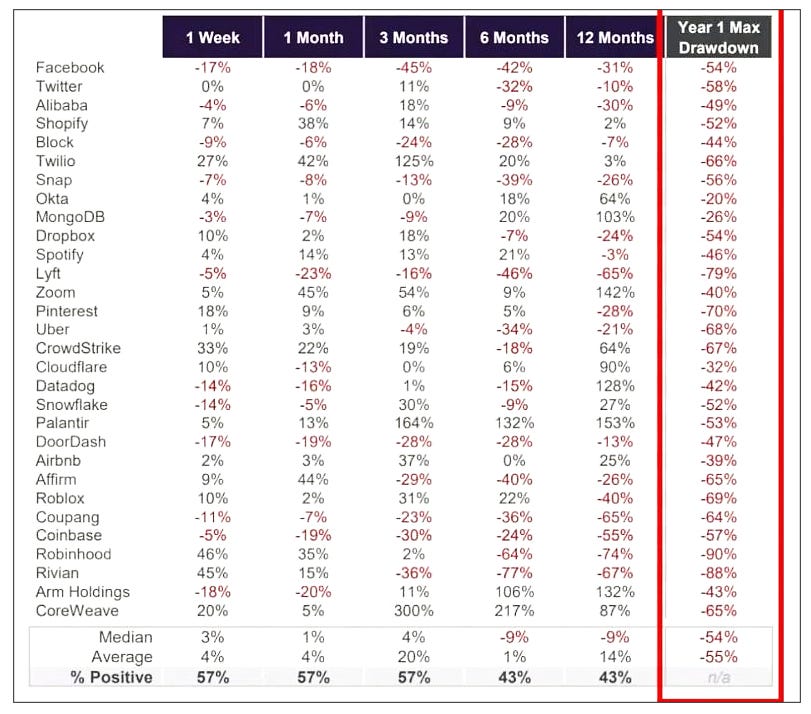
Those considering the @SpaceX IPO might want to consider the figures below, courtesy of @donnelly_brent of @Spectra_Markets.
They show the post-IPO performance of the companies listed by the indicated interval, with the final column (red box) providing the maximum drawdown experienced during the first 12 months of trading.
Note how many lauded companies got cut in half (or 𝘮𝘶𝘤𝘩 𝘮𝘰𝘳𝘦 - Robinhood dropped 90%).
#investing #stocks #bonds #stockmarket