We're #hiring! The Faculty of Engineering and IT are seeking a Research Fellow to contribute to a groundbreaking project on developing antiviral therapeutics for respiratory pathogens with pandemic potential using CRISPR-Cas13 gene-editing tools.
https://t.co/0Ry8S19qDf
I truly thank Chase and love this collaboration, it was an amazing experience.
Note that in the analysis, we also estimate the fraction of nonsynonymous mutations that is beneficial in SARS-CoV-2, shown in Table 1. Hope these will also be helpful to related studies.
In a Matters Arising at @NatureComms, we discuss πN/πS for detecting within-host natural selection.
We also estimate the fraction of nonsynonymous mutations that is beneficial in SARS-CoV-2.
Grateful to @GuHaogao & @world_epidemic for the collab. 1/12 https://t.co/Odkej52wB2
Research Fellow opportunity @UniMelb, @engunimelb, to work on computational methods/platforms to design next-gen vaccines & study viral evolution.
Collab with @TheDohertyInst, @UniMelbMDHS, @GarvanInstitute, Prof. @Row_Bull at @KirbyInstitute.
https://t.co/ircJUIRQ79
We deep sequenced >2800 Covid-19 patients, including those with a breakthrough infection, to study minor variants.
We observe that:
1. VOCs tend to generate more minor variants.
2. Vaccination does not increase non-silent mutations.
Now in Nat Comm.
https://t.co/nonbD3uywX
Does targeted travel restriction really work?
My experience: For the 50 imported omicron cases (random sampling) we sequenced in Nov/Dec 2021, only a few cases were from S. Africa. Many of them were from other counties in Asia, Africa, Europe, N. America.
Description of the methods can be found in this [blog post] (https://t.co/9UQtCspa8m), Basically it accepts a BAM file (reads alignment) and a GFF file (region of interest) and returns Shannon entropy and Nucleotide diversity at haplotype level.
When deep sequencing data is available, sometimes it is interesting to check the mutation diversity of reads within a specific genomic region (e.g., epitope region). I developed a light-weight tool for this purpose and usage can be found in https://t.co/lO9wepv6a7.
Perhaps most interesting observations for us were (1) the weaker T cell responses to a third dose in those primed with BNT162b2, and (2) the disparity between neutralizing antibodies (much higher with BNT162b2 booster) versus vaccine efficacy (seems similar between arms) (13/14)
@richardneher Hi Richard, thanks for the very interesting analysis. I noticed on page 3 "The probability that offspring genomes are identical to their parents is u = 1 − e−μt", is it a typo? I thought the u should be just e−μt when there is zero mutation.
We investigated within-host evolution of SARS-CoV-2 using HK deep sequencing data from 2020 to 2022 in this study. Potential lineage-specific and vaccination-specific effects were discussed. https://t.co/PUamvKKqrR
Does vaccination affect intra-host SARS-CoV-2 diversity? Do different variants have different abilities to explore sequence space?
Here is our @HKU_SPH@GuHaogao@ahmedaquadeer PREPRINT to answer these questions:
https://t.co/f4UL4rN289
Glad to be involved in this excellent #Omicron study from Hui-Ling Yen @HKU_SPH.
Looks omicron variants behave differently from the ancestral #SARSCoV2 in hamsters.
https://t.co/mxXyzwqtWT
Priming conditions for broadly neutralizing SARS antibodies- a great collaboration from HK @MalikP46697504@nancyleung_hk, China and Singapore @linfa_wang@CheeWahTan2. A fav figure I could study all day by @GuHaogao @Janice22461665 https://t.co/ViF9z7o18l
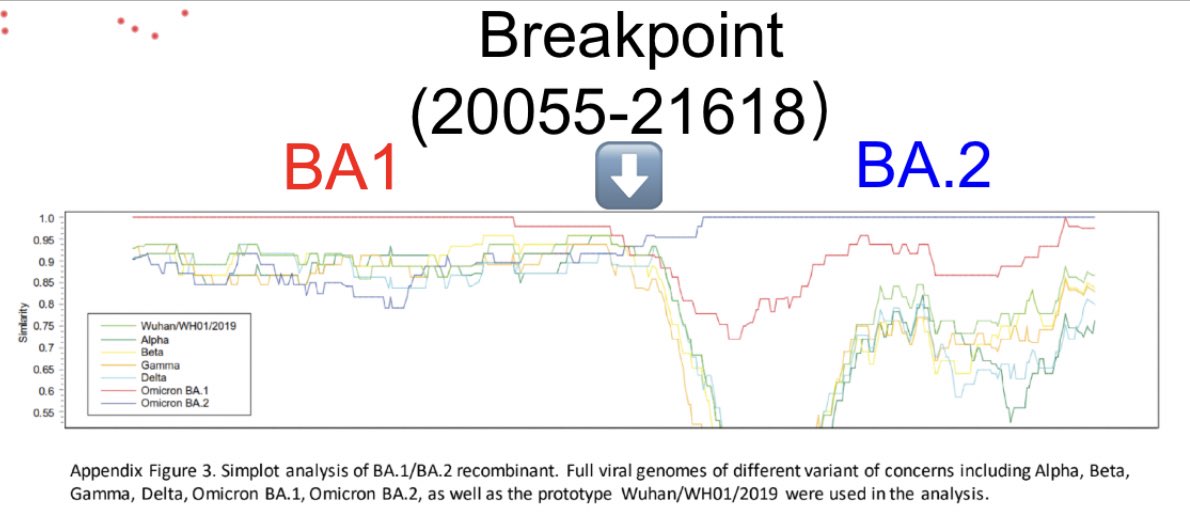
Our BA.1/BA.2 is now published in EID.
@GuHaogao
Early Release - Recombinant BA.1/BA.2 SARS-CoV-2 Virus in Arriving Travelers, Hong Kong, February 2022 - Volume 28, Number 6—June 2022 - Emerging Infectious Diseases journal - CDC https://t.co/1pDTPb6Esr
So happy to see this work with @svalko3, @world_epidemic, and @GuHaogao from my PhD project at @hkumed published! We examined the effects of T cell pressure on the flu genome in the context of Next Gen vaccination 🧬 https://t.co/0Pp1PKgbMv
We @world_epidemic identified a BA.1/BA.2 recombinant virus in incoming travellers in Hong Kong. The recombinant virus was confirmed by both repeated NGS sequencing and clone of RT-PCR product. We have just submitted it for Pango designation, see below:
https://t.co/hB301tknm6
We detected a recombinant between #Omicron subvariants BA.1 and BA.2. It was detected in early Feb from two epidemiologically linked cases. This recombinant has a breakpoint at around the 5' end of spike. We cannot find this viral genome in commonly used sequence database. /1