$NFLX five years ago: $69
• Revenue $29.7B
• EPS $1.15
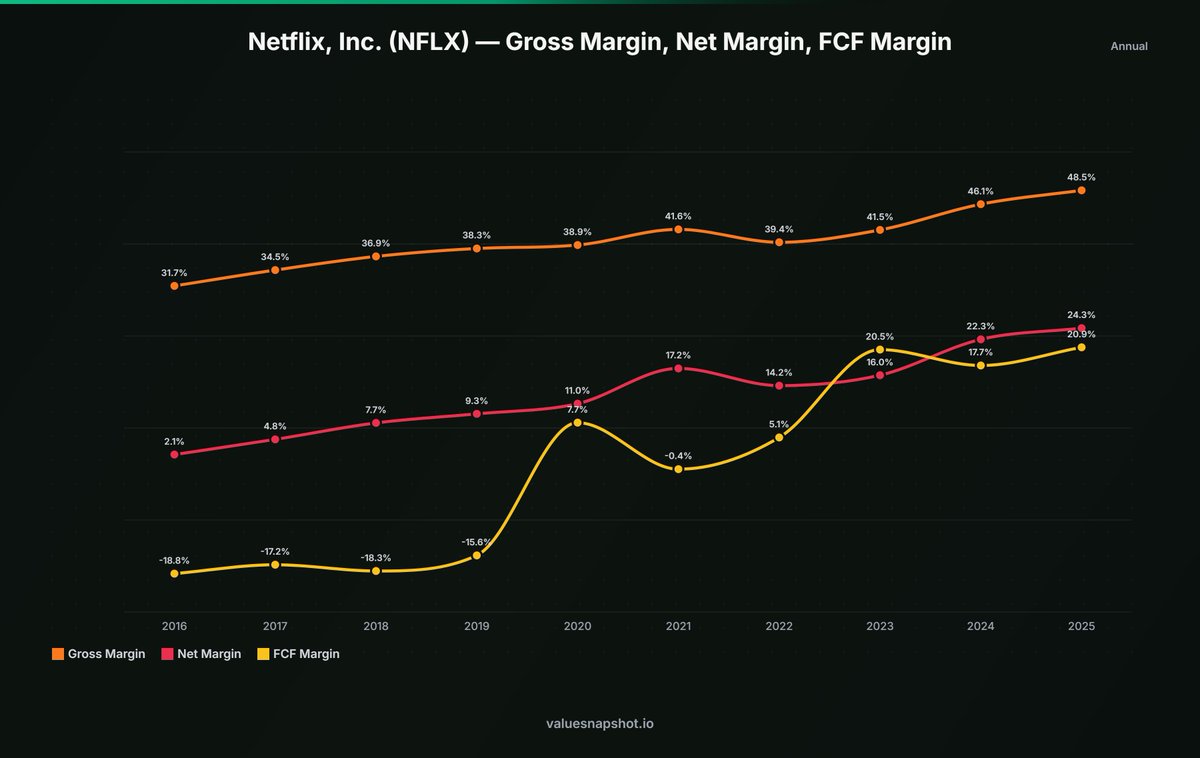
• Gross Margin 41.6%
• Caught in Streaming race
• Subscriber growth was the story
• Margin expansion was still developing
$NFLX today: $69
• Revenue $45.1B
• EPS $2.60
• Gross Margin 48.5%
• Won the Streaming race
• Advertising business
• Record profitability & FCF
• Global entertainment platform
Price fluctuates.
Businesses evolve.
$MU is looking for a higher low after the recent pullback.
Using linear Gann multiples, here are the key potential support zones:
Best case:
- $829 (8 level)
- $733 (7 level)
Mid-case:
- $637 (6 level)
Worst-case (highest risk/reward):
- $541 (5 level)
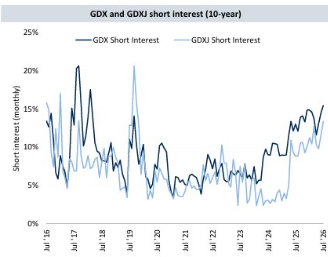
Gold miners are now cheaper relative to the S&P 500 than at any point in history.
This is the uncomfortable accumulation phase.
Fundamentals remain intact, but prices continue to test investors' conviction.
https://t.co/nXbkmVaOWR
The most important economist of the 20th century is mostly ignored by both politicians and academia – and there is a good reason for that: Ludwig von Mises destroyed the idea that they should be in charge of the economy.
While much of the economics profession fell in love with socialism and central planning, Mises stood virtually alone in defending reason, liberty and the free market – and he did so with unmatched clarity and courage.
Mises made three revolutionary contributions that reshaped economic thought:
Praxeology: He developed a deductive science of human action based on the self-evident truth that humans act purposefully. This method produces timeless, certain economic laws rather than fragile statistical correlations.
The Economic Calculation Problem: He proved that socialism cannot work. Without private property and genuine market prices, rational resource allocation cannot occur. Central planners have no way to know what should be produced or in what quantities.
Business Cycle Theory: Mises showed how central banks create artificial booms through credit expansion, which must end in recession. This theory remains the strongest explanation for financial crises and the boom-bust cycle.
Beyond these technical achievements, Mises offered a powerful philosophical defence of capitalism as the only system consistent with human freedom and prosperity. He trained and inspired thinkers like Friedrich Hayek and Murray Rothbard, and his work provided the intellectual backbone for the post-war revival of classical liberalism.
In an age when intellectuals were convinced that central planning represented the future, Mises insisted that only free markets, private property and sound money could sustain civilisation. Time has repeatedly vindicated him.
Make that 300 days in a row the S&P 500's 200-day MA has pointed higher.
Many times over this timeframe we've been told how bad it'll get, but it wasn't ever true and this longer-term trendline was a big clue.
Nice one from @granthawkridge in his AM note today.
BREAKING: The odds of the Fed hiking rates at the July 29th meeting crash to 8% after CPI inflation unexpectedly posts its biggest monthly decline since April 2020.
Socialism is a psychological disorder that puts on ideological clothing to hide what it actually is.
At its core is a specific kind of irrational resentment, that is the inability to accept that in a free society, some people will be simply be more, make more, have more.
And instead of competing or accepting that reality, the disordered mind creates the ideology that demands the system be changed so no one is allowed to rise “too high”.
So they would rather live under a system of enforced mediocrity that limits everyone’s freedom including their own than accept a world where some people can create visibly better outcomes.
They can’t help but eliminate the conditions that make other people’s success possible.
And since freedom produces unequal results and that inequality is unbearable to this mindset, then freedom itself must be attacked.
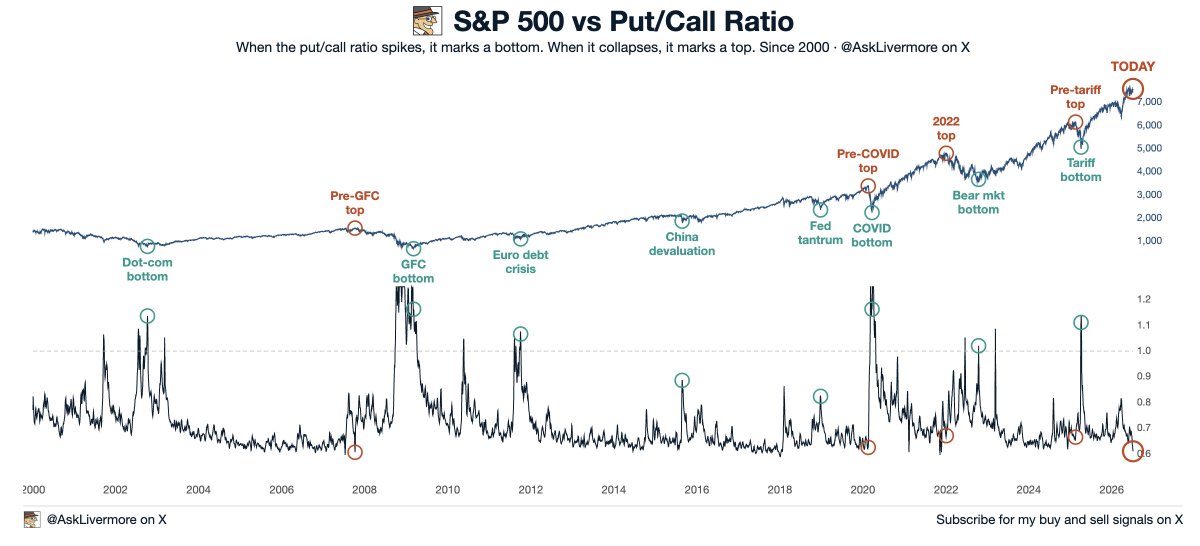
This is all you need to time the stock market. Save this. Screenshot it. You will need it.
The put/call ratio tells you when everyone is panicking and when everyone is too comfortable.
Every single time the put/call ratio spiked above 1.0 since 2000, it marked a generational buying opportunity:
- Dot-com bottom (2002)
- GFC bottom (2009)
- COVID bottom (2020)
- Tariff crash (2025)
Every single time it collapsed below 0.70, a pullback followed:
- Pre-GFC top (2007)
- Pre-COVID top (2020)
- 2022 top
- Pre-tariff top (2025)
Right now? The put/call ratio just hit 0.61, the lowest since December 2020. That means options traders are the most bullish they've been in nearly 6 years.
Does that mean sell everything? No.
But it means this is the time to stay balanced, not all-in into one sector. The best buying opportunities will come soon, stay patient.
When everyone is greedy, be cautious.
When everyone is fearful, be aggressive.
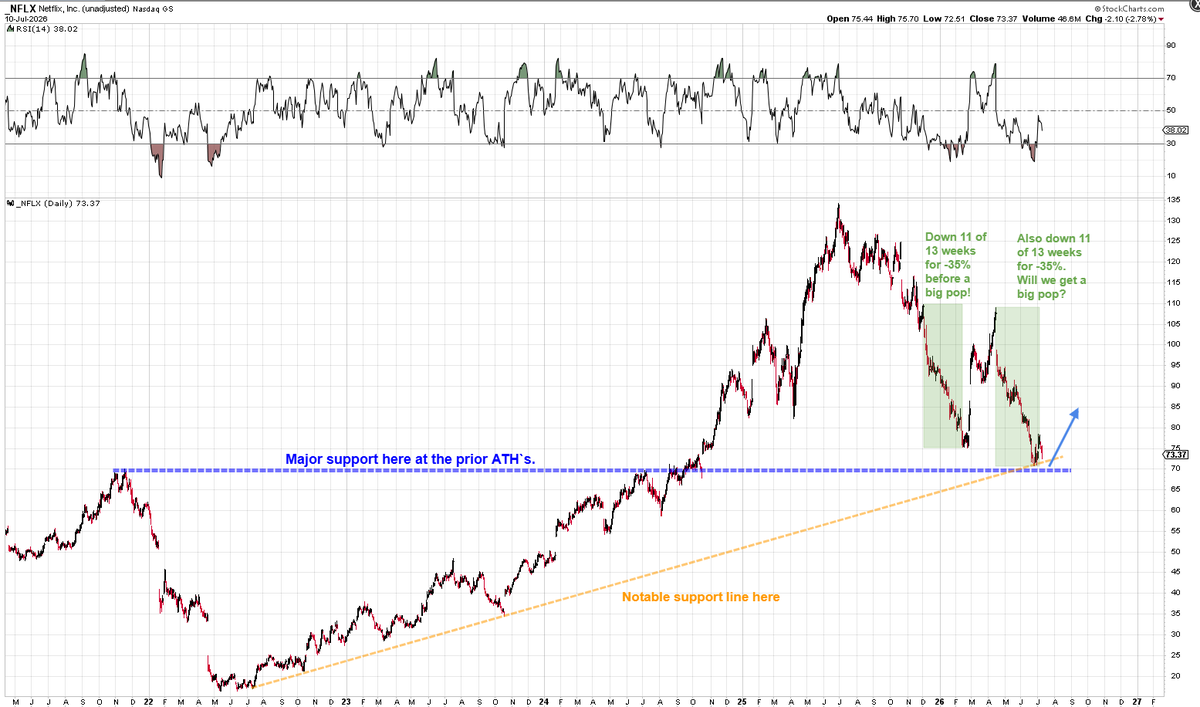
$NFLX Chart Update:
Earnings this Thursday! Options market is implying a move of roughly +/- 8.3%.
There's a couple huge confluence of supports very nearby in the blue and orange lines.
Also, for simulative purposes, we are now down 11 of the last 13 weeks good for -35%. Literally mimicking the last time where we also went down 11 of the last 13 weeks for -35%. But then after, it popped bigly (on news, but still!).
So do we get that same big pop?! Name is oversold to death. I wouldn't be surprised if we did. I like this name headed into ER.
-Heis