What Does Tsemdo (ጽምዶ) Mean for the Afar? Demanding Action, Not Symbolism.
1. For many Afar, even pronouncing the word Tsemdo (ጽምዶ) is a challenge, let alone grasping the layers of meaning it claims to carry. Rooted in Highland Eritrean culture, Tsemdo has been transplanted into the Afar context without any effort to anchor it in local culture or language. The result is confusion, not connection.
2. If Tsemdo is supposed to mean the free gathering of people across borders, through open crossings and the removal of barriers, then let it be clear: this is exactly what the Afar have been demanding for decades. Communities are eager, even impatient, to see Tsemdo materialize in practice rather than remain a distant notion or a hollow slogan.
3. If Tsemdo is framed as reconciliation and forgiveness, then it is misplaced. The Afar have repeatedly emphasized that there are no grievances, wrongdoings, or atrocities between Afar communities across borders that require reconciliation or forgiveness. The real issue lies within Eritrea itself, specifically, the ongoing marginalization and mistreatment of the Afar people.
4. To take Tsemdo seriously, beyond social media campaigns and political rhetoric, the first steps must be concrete. Open the border crossings. Guarantee the rights of Afar fishermen, who today risk being shot at sea or having their boats seized. Stop treating Afar livelihoods as disposable.
5. In truth, many Afar in Eritrea do not feel safe enough to live with dignity in their own homeland. Many convincingly argue that Eritrean government must first reconcile with its own Afar citizens before talking about alliances across borders. Thousands of Afar refugees in neighboring countries, alongside countless others scattered across the globe, stand as living testimony to this reality. For the first time in their history, the Afar have been forced into global dispersion, living in countries they had never even heard of, driven not by choice, but by systemic exclusion and repression.
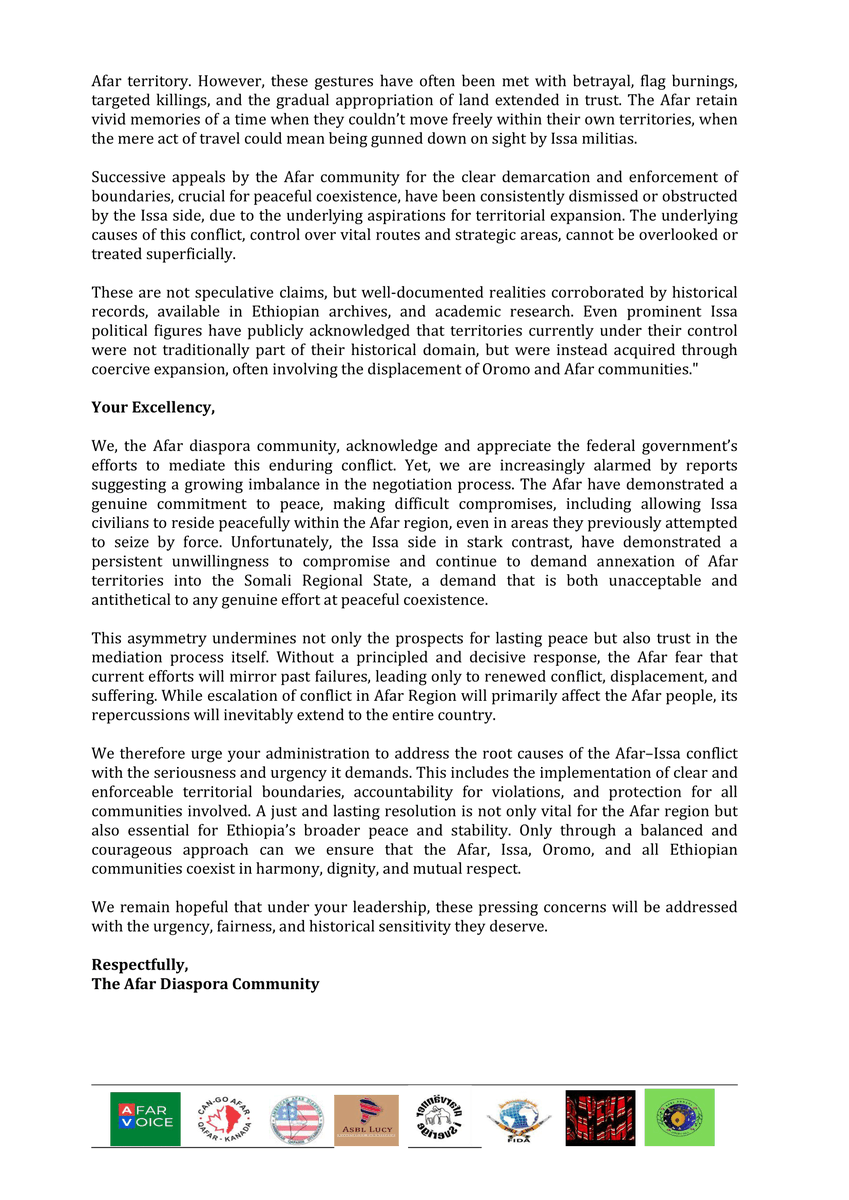
📢 Open letter to PM Abiy Ahmed: The Afar diaspora raises alarm over Issa incursions, land grabs, and failed mediations. Lasting peace requires clear borders, justice, and mutual respect. #Afar#Ethiopia#PeaceNow
ETHIOPIA ― The Sultanate of 🇪🇹Afar, under the leadership of Sultan Ahmed Alimirah Hanfare, issues a stern warning: [the Abiy Ahmed] government is playing a reckless and dangerous game, and the Afar people refuse to be used as pawns, or see their land turned into a war zone, in this delusional bid of «turning Ethiopia into a maritime state by invading a neighboring country». This is not our war, and it serves no interest of the Afar people.
He adds that if this were about defending our territory from an invasion or incursion, it would be understandable. But anything beyond a peaceful resolution, one grounded in the principles of the UN and AU charters, is not in the interest of the Afar people. The Afar people and their land cannot endure another war. I’ve said this many times before, and I’ll say it again: the people of Afar have no stake in this fight, he concludes.
Briefing Document: Afar's Salty Politics: Monopolization and Marginalization in Afdera's Salt Business
Source: Excerpts from "Afar's Salty Politics: Monopolization and Marginalization in Afdera's Salt Business" by Dereje Feyissa and Abubeker Yasin, Peace
Research https://t.co/YryWDZXR28: Current (based on source content, last cited date is November 2022, with mentions of events up to April 2023)Key Themes and Important Ideas/Facts: This report meticulously examines the political economy of the salt industry in Ethiopia's Afar region, particularly around Lake Afdera, which is the country's primary source of salt, accounting for 80% of the national market. The central argument is that despite the Afar region being the origin of this crucial resource, the Afar people have been consistently marginalized in the salt value chain, with non-Afar investors, particularly those from the political and economic center ("highlanders"), dominating the sector since extraction began in 1998. This marginalization persists despite political changes and promises of inclusion.
1. Historical Context and Strategic Significance of Afar Salt: Salt from the Afar region has a long history, serving as a medium of exchange (amole) until the mid-20th century. "In fact, the source of all the amole in circulation was the salt plains of the Afar lowlands located in the Danakil Depression."
Successive Ethiopian governments have viewed the Afar region as a source of strategic resources, shifting from salt to cotton and back to salt, along with other minerals.
Following the Ethio-Eritrean war (1998-2000), Ethiopia began heavily exploiting salt in Afdera, replacing Eritrean sources. "Today, salt produced from Lake Afdera constitutes around 80 per cent of Ethiopia’s salt market..."
Beyond consumption, Afar salt and its derivatives have industrial and export potential.
2. The Rise of Monopolies and the Marginalization of the Afar: Initially, uncoordinated salt extraction led to overproduction and depressed prices. The Afar Salt Producers Mutual Support Association (Kadaba) was formed in 2006 to regulate production and pricing, but eventually evolved into a shareholding company with a majority stake held by a non-Afar investor.
The reintroduction of compulsory iodization in 2011, while aiming to address iodine deficiency, inadvertently favored large, politically connected investors with the capital to establish Central Iodization Facilities (CIFs), further excluding smaller Afar producers.
By 2018, four companies, predominantly joint ventures between highlanders and foreign entities, dominated Afdera's salt business, with Afar communities playing a "marginal role, generating a strong sense of exclusion".
3. Post-2018 Promises and the Emergence of SVS/TTR Monopoly:Prime Minister Abiy Ahmed's ascension in 2018 raised hopes for Afar economic inclusion, with promises made to address their marginalization. "PM Abiy also concurred with our assessment and he declared greater inclusion of the Afar into the salt business and the regional economy more broadly. It appeared a new time dawned."
Salt land previously held by Tigrayan-linked businesses was redistributed to Afar individuals and entities (youth, elders, regional institutions, politicians). "One of the key measures taken by the regional government was redistribution of salt land. Thus, all land previously owned by highlanders—especially Tigrayans—was confiscated and reallocated to the Afar..."
However, the report argues that a new monopoly, led by SVS Salt Production Plc (SVS) and its sister company TTR, has emerged. "Currently, SVS Salt Production Plc (SVS) and its sister company TTR hold a monopoly over Afdera’s salt sector."
This monopoly was facilitated by the regional government, with SVS gaining control over processing and distribution. The former head of the regional Bureau of Mining stated, "...we asked SVS [how] we can support them. They mentioned legal protection for them to work freely. They promised they would not take Afar salt land; only a legally protected supply by the producers."
SVS/TTR now account for an estimated 56% of Ethiopia's iodized salt production and supply raw salt to other processors, making them highly dependent.
4. Consequences of the Monopoly: Increased Salt Prices: The SVS/TTR monopoly is identified as a major reason for the dramatic increase in salt prices.
Setbacks in Iodization Efforts: By controlling the supply of raw salt, SVS has contributed to setbacks in Ethiopia's national iodization program as other processing factories struggle to obtain supplies. "This is one of the main reasons why the price of salt has increased dramatically in recent years and is also partly responsible for setbacks in Ethiopia’s iodization efforts..."
Artificial Scarcity: Despite abundant salt reserves, SVS appears to be creating artificial scarcity by processing under-capacity, further driving up prices and benefiting the company. "It is worth emphasizing here that SVS’s monopolistic practices involve hoarding salt to increase prices, forcing the country/tanneries to turn to imports despite the ‘mountains of salt’ in Afdera that have piled up over the years."
Undermined Regional Governance: "The status quo in the salt value chain has undermined regional governance and domestic accountability, with salt rents prompting the Afar regional leadership to cater to political and business elites in Addis Ababa, rather than bolstering its domestic..." Salt revenues are used to buy support and silence dissent ("salty politics").
Limited Economic Benefit for Afar: Despite land redistribution, most Afar remain marginalized, lacking capital and skills for large-scale production and often entering into unfavorable sharecropping arrangements. "Apart from some in the region’s new political leadership, Afar society still largely remains restricted to production, with profit margins fast decreasing."
Suppressed Resistance: While there have been acts of resistance and attempts to form alternative producers' associations, these efforts have faced obstruction from the regional government and pressure from SVS. "SVS and the regional government put pressure on Afdera woreda not to recognize the new association under formation."
5. The 2023 Salt Directive:The new salt directive (March 2023) aimed at regulating the salt value chain is viewed with concern as it could further reinforce the existing monopoly.
Specifically, an article restricting salt processing to the region of extraction could force numerous salt processing factories outside the Afar region to close. "The 2023 directive to regulate the salt value chain could further reinforce the current monopoly, especially an article in the new bill that restricts salt processing to the region where the resource is located and extracted. This could knock dozens of salt processing factories operating outside of the Afar region out of business."
The directive is seen as prioritizing public health (iodization) over addressing monopolization and equity, potentially due to SVS's lobbying efforts.
6. Recent Developments (April 2023):The owner of SVS was accused of supporting Amhara extremist forces and the company was accused of illegal hoarding and tax evasion.
The federal government intervened, ordering banks to block SVS-linked financial transactions and dispatching a special military unit to close down SVS's operations in Afdera.
The House of People's Representatives is investigating SVS's monopolization, raising hopes for restructuring the sector to benefit the Afar.
7. Afar Perspectives:Afar youth and producers express disillusionment, feeling that the promised "salt reform" has not materialized into meaningful economic inclusion. "We were cheated, believing the story of salt reform was for real."
They highlight the shift in dominance from Tigrayan to Amhara businesses, with the SVS monopoly being a central grievance.
Even members of the government-established salt association (Lula) critique the lack of real benefit for Afar producers due to the existing monopoly and excessive salt surplus controlled by SVS.
8. Recommendations for More Equitable Natural Resource Utilization:The report concludes with several policy recommendations aimed at achieving just and peaceful governance of Afdera's salt:Reconfigure the salt value chain by facilitating more producers' associations, processing companies, and distributors.
Explore international markets for salt exports.
Balance public health concerns (iodization) with equity in the national program.
Reconsider the restriction on processing factories in the new salt directive to avoid reinforcing monopolies and creating artificial scarcity.
Center Afar youth in any economic inclusion agenda through legal and financial support for alternative initiatives.
The regional government should prioritize Afar communal interests and empower local investors.
Salt companies should operate ethically, institute genuine CSR, and avoid political manipulation.
Investment in Afar should align with national development needs and prioritize the common interests of the local population.
Quote Highlighting the Core Issue: "Ethiopia’s Afar region, especially around Lake Afdera, is the country’s main source of salt, accounting for 80 per cent of the national market. The salt sector in the region has been dominated by non-Afar investors from neighbouring regions—so-called ‘highlanders’ from the country’s political and economic centre—since extraction started in 1998, with the Afar playing only a marginal role. @AbiyAhmedAli, @PMAbiy@WilliamsRuto, @WilliamsMkenya, @IGADsecretariat@DrWorkneh@KagutaMuseveni, @hassansheikhmo, @PresSalvaKiirM1, @aftaburhan , @antonioguterres. @awolarba
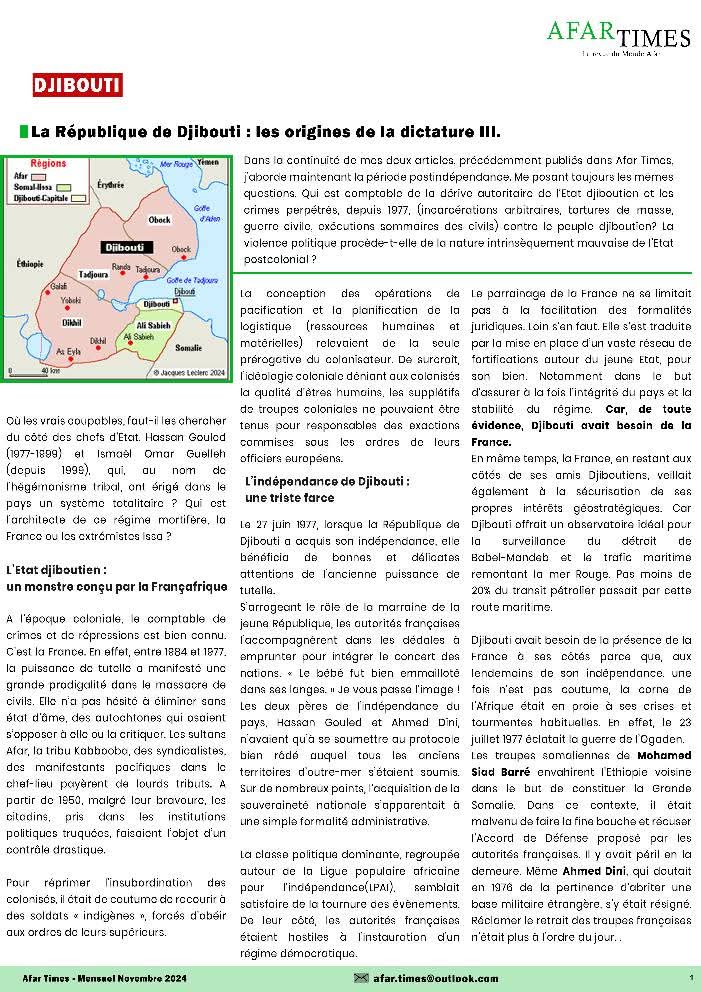
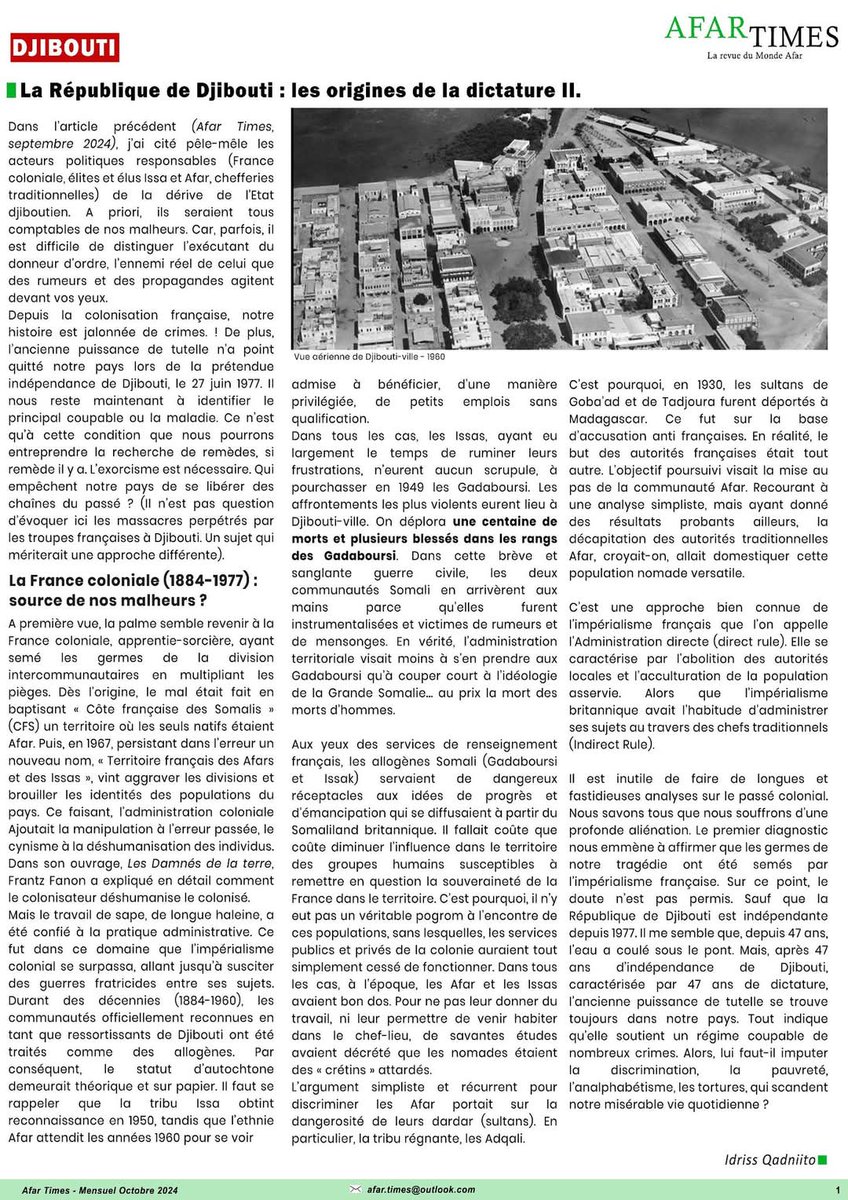
Ce témoignage date d'octobre 2021, cette année près de 300 familles vivant entre Garabtisane et Siyyarou ont été contraint à un exil forcé. L'armée de #Djibouti harcèle, persecute et commet des exactions sur cette population
#StopAfarMassacre