Are people with obesity and HFpEF getting better with glp1 drugs because their hearts are better, or is it just feeling better from wt loss? Two companion papers @NatureMedicine from placebo controlled RCT show that their HF really is better with pcwp and LA strain by MRI.
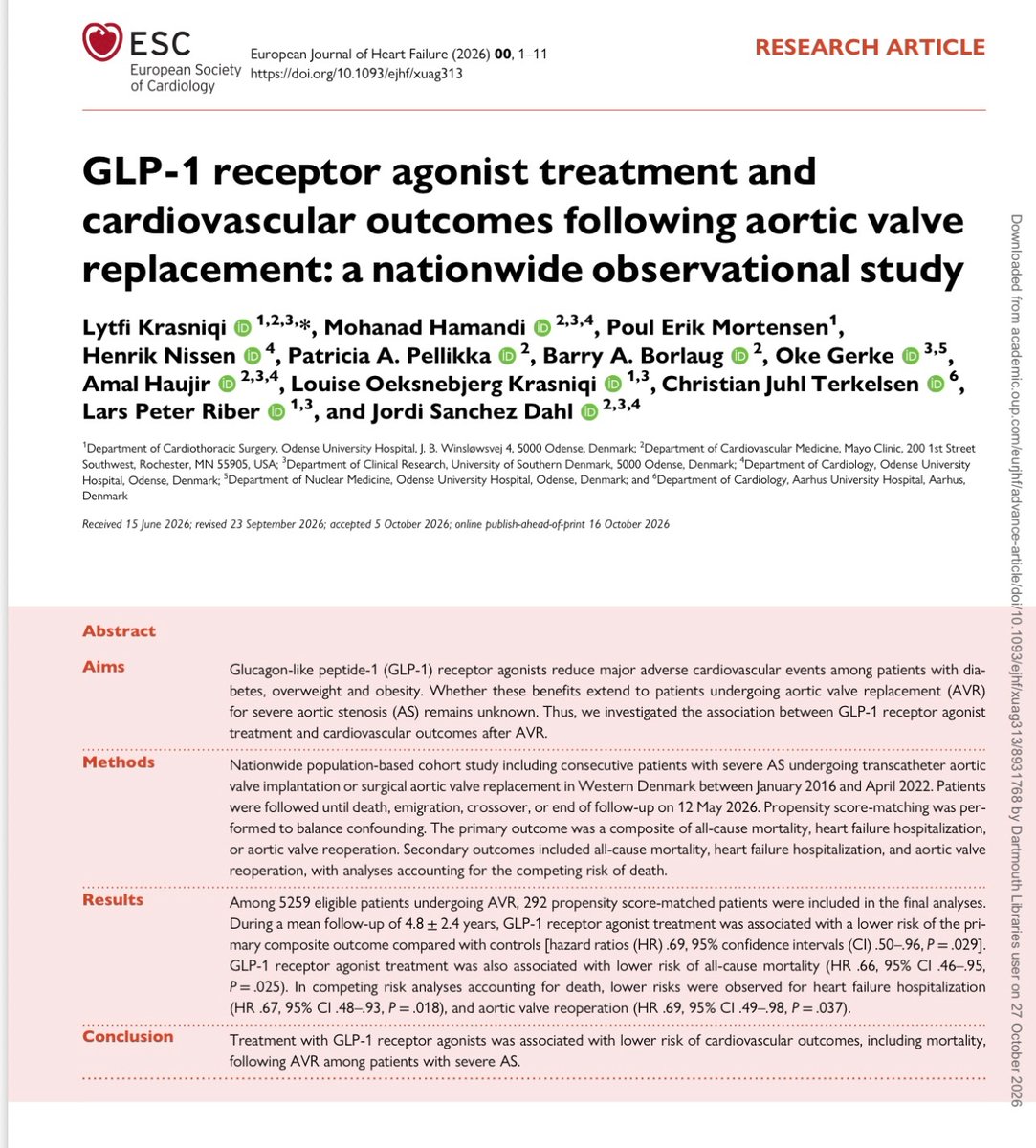
GLP-1 receptor agonist treatment and cardiovascular outcomes following aortic valve replacement: a nationwide observational study
https://t.co/vCG0DcJRl7
@HanCardiomd@AmrAbdin10@GiuseppeGalati_#EJHF
We had the district honor to host Dr O’Gara as visiting professor twice in fellowship. He’s such an incredible leader, clinician and educator. A very well deserved award. @MayoCVFellows
We found that GLP-1 RA was associated with a lower risk of composite of all-cause mortality, heart failure hospitalization, and AV reoperation in patients undergoing SAVR or TAVI.
Grateful to Drs Dahl, Pellikka, Borlaug and Krasniqi. @MayoCVFellows
https://t.co/pmdP2N4cS9
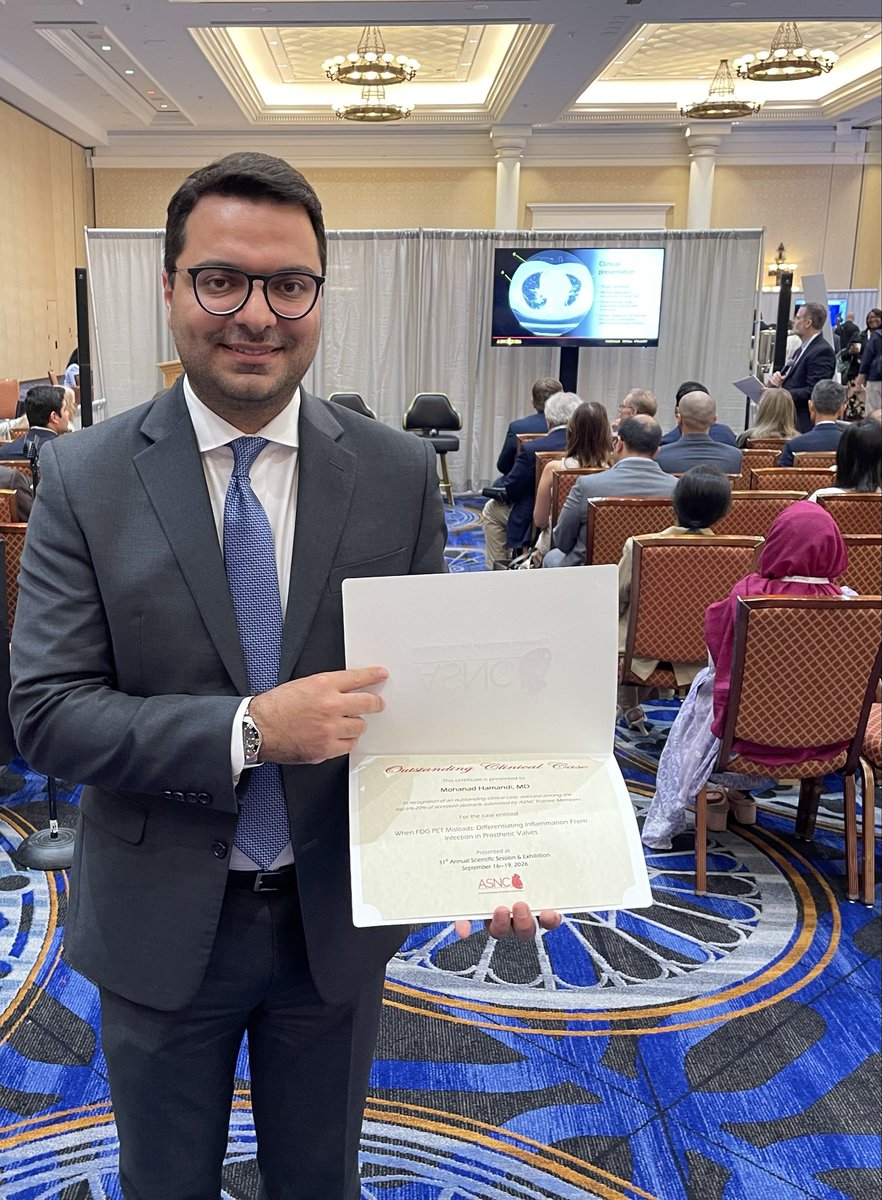
Had a great time presenting at ASNC in Las Vegas and was excited to receive the Outstanding Case Award. Huge thanks to @PanithayaC for the support. @MayoCVFellows@nandananavekar
Today's the 49th anniversary of Andreas Gruentzig doing the 1st coronary angioplasty. Watch this extended version of the story, told by those who were there: Adolph Bachman (1st patient) Bernhard Meier (his doctor) & Maria Schlumpf (Gruentzig's assistant). Next year's the 50th: surprises coming! #AngioHistory
The Rise of the Solo TAVR Operator: Alone, Unarmed, and Unafraid https://t.co/dOUnTHkKYl
Written before CMS finalized its new TAVR NCD - I think CMS got some of it right, and one big thing wrong.
Braasch et al looked at 400K Medicare TAVRs, 2016 to 2024. Surgical bailout in 0.56%, falling from 0.92% to 0.40%. Hospital SAVR volume, whether low, intermediate, or high, was not associated with mortality among patients requiring salvage surgery.
The absence of an on-site surgeon is not the absence of rescue. Transfer systems exist. A growing share of catastrophic complications, including contained annular injury, tamponade, and device embolization, are now rescued in the cath lab, far from the OR.
We have run this experiment before - PCI required on-site surgery on the same theory. CPORT-E: over 18k patients, 6-week mortality 0.9% vs 0.8%. MASS COMM: emergency surgery in 0.1% to 0.3%. PCI without on-site surgery became standard. Systems of care exists across the spectrum of CV care: cardiogenic shock, PE care etc.
What CMS got right in the final NCD: TAVR may be performed by a single operator. The mandated dual-specialty evaluation is dropped and only the operator's visit is required. Hospital procedural volume requirements are removed. Asymptomatic severe AS is now covered under CED.
Where CMS got it wrong: on-site cardiac surgery is retained. It compels the backup that is so rarely needed. A system of care with straightforward TAVRs being performed by ICs in non-surgical sites with affiliations for complex/transfers would've balanced access.
However, CMS & cardiac societies chose politics over patients in the end.
Proof: no requirement for on-site EP, though permanent pacing is the most common service after TAVR. No requirement for vascular surgery - much more valuable to a TAVR operator than CV surgery. The mandate is kept to protect physicians not patients.
Morevover, medicare imposes no minimum-volume condition on SAVR, despite a median annual surgeon volume of 16 cases. Volume, staffing and heart team requirements get framed as safeguards of quality. But they are absent for the surgical equivalent.
Let's be honest - that framing is a pretext for protecting case volume, referral patterns, and established programs. Legitimate interests, just not the ones a public payer is charged with protecting.
CMS exists to serve beneficiaries. Its mandate is to protect patients, not programs or professions. Where a requirement principally constrains competition, restricts access, or entrenches incumbents without corresponding patient benefit, it should be removed. Politics over patients.
The solo TAVR operator is not a threat to patients. It is the means of reaching them. Hardly unarmed: percutaneous rescue, disciplined case selection, a defined transfer network.
CMS came some of the way. They didn't have the courage to do the right thing and patients will pay the price.
https://t.co/RgGxvM5L5g
@JACCJournals@SCAI@ACCinTouch@TCTMD@CRFheart@STS_CTsurgery@MayoClinicCV@rajivxgulati@SVRaoMD@drroxmehran @AjayKirtaneMD @mmamas1973@rwyeh@adnanalkhouli@mirvatalasnag@jaygirimd@tjsimard@PietroDiSantoMD@OmarARazek@mandeep_mayo@willsuh76@EleidMack@ChetRihal@MayraGuerreroMD@AbdullahAlabcha@aelsab@evandrofilhobr@Mahmoud_Ismayl@lamelaspablo #TAVR #TAVI
We’re pleased to announce Dr. Mohamad Alkhouli (@adnanalkhouli) as the next editor-in-chief of #JACCINT. He brings global expertise in interventional cardiology, CV research, and 10+ years of editorial leadership. 👏👏👏
Learn more about him here: https://t.co/knsHdQLAMd
We honor the life and legacy of ACC Past President Robert L. Frye, MD, MACC, whose contributions as a physician, investigator, educator and leader helped shape modern cardiovascular medicine.
Read more about his remarkable career and lasting impact: https://t.co/qrCIPY6DIT
Had a wonderful 1:1 meeting with one of Mayo Clinic Cardiology’s legends, Dr. Robert Fry. Listening to his stories working with Drs. Swan and Kirklin, academic wisdom and career advice, was truly inspiring. Grateful for this opportunity. @MayoClinicCV@angioplastyorg