# Portrayals of AI
People sometimes read a bit too specifically into my bio "Building a kind of JARVIS".
I name JARVIS in general terms only, as one of my favorite popular portrayals of an AI - a helpful, conversational, empowering e/ia automation. An aid against evil and entropy.
In personality, I much prefer and love TARS from Interstellar. I love that TARS is funny, quirky, and sarcastic. But you can tone down that down to "dry" if you like. That said TARS (with a few major and notable exceptions) is portrayed a bit too much like a comic relief sidekick instead of a pervasive, helpful and active problem solver.
The movie that best explores emotional depth and connection with an AI is undoubtedly Samantha from Her. I find this to be a very prescient movie because not too long ago, AIs have been thought of and portrayed as primarily highly calculating and logical entities incapable of understanding human emotion (think: Star Trek et al.). I think it's becoming very clear today that these will turn out very wrong, and that the future looks a lot more like Samantha from Her than Data from Star Trek.
The movie that most touches on the creative dimension of AI is maybe Sonny from iRobot, but in general I think this dimension is dramatically underexplored territory.
Honorable mentions
My most favorite unaligned AI is, of course, GLaDOS :) And sticking with Valve for a moment, shoutout to Dog from Half Life 2.
I also recall really enjoying Legion of the geth in the Mass Effect series.
So TLDR all of these have aspects that feel right and desirable - a blend of personality of TARS, a creativity of Sonny, the emotional capability of Her, and the technical problem solving capability of JARVIS.
Curious what are people's favorite portrayals of AI and why?
Merry Christmas & Happy Holidays!
May your diffusion denoise, your Gaussians splat well, and your GPUs provide enough warm during the cold winter season 🎄🎅☃️
🌍 We’re so excited to see GDEs and devs connecting IRL at DevFest!
Join them and learn how to bring the power of machine learning to apps and workflows with:
▪️ Generative AI
▪️ MediaPipe
▪️ SimpleML
▪️ MakerSuite
Register today! → https://t.co/Z70fiFVwdD
Career milestone. Coauthored paper with Jeff D, Oriol V, Koray K, Demis H this year at the same time with rest of the Gemini team. 🤯
https://t.co/3ATo2r3sEm
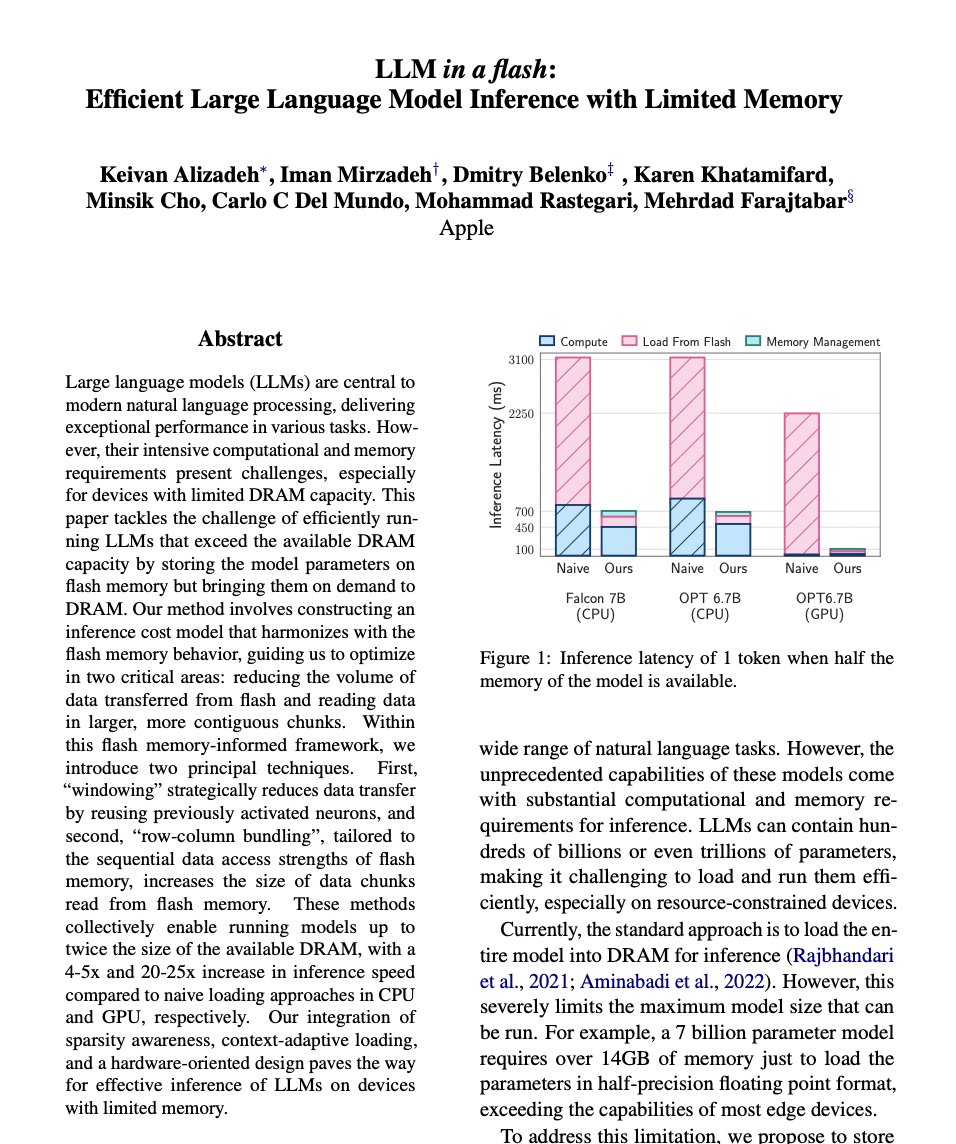
Apple announces LLM in a flash: Efficient Large Language Model Inference with Limited Memory
paper page: https://t.co/SuqHJUQPO9
Large language models (LLMs) are central to modern natural language processing, delivering exceptional performance in various tasks. However, their intensive computational and memory requirements present challenges, especially for devices with limited DRAM capacity. This paper tackles the challenge of efficiently running LLMs that exceed the available DRAM capacity by storing the model parameters on flash memory but bringing them on demand to DRAM. Our method involves constructing an inference cost model that harmonizes with the flash memory behavior, guiding us to optimize in two critical areas: reducing the volume of data transferred from flash and reading data in larger, more contiguous chunks. Within this flash memory-informed framework, we introduce two principal techniques. First, "windowing'" strategically reduces data transfer by reusing previously activated neurons, and second, "row-column bundling", tailored to the sequential data access strengths of flash memory, increases the size of data chunks read from flash memory. These methods collectively enable running models up to twice the size of the available DRAM, with a 4-5x and 20-25x increase in inference speed compared to naive loading approaches in CPU and GPU, respectively. Our integration of sparsity awareness, context-adaptive loading, and a hardware-oriented design paves the way for effective inference of LLMs on devices with limited memory.
Introducing project llamafile: a versatile, full-stack LLM-based chatbot in a single file, eliminating the need for installation or dependencies on various platforms.
Read more about it here: https://t.co/4Lt9ffYwz2
Introducing FunSearch in @Nature: a method using large language models to search for new solutions in mathematics & computer science. 🔍
It pairs the creativity of an LLM with an automated evaluator to guard against hallucinations and incorrect ideas. 🧵 https://t.co/MC5ttgvZeM
# On the "hallucination problem"
I always struggle a bit with I'm asked about the "hallucination problem" in LLMs. Because, in some sense, hallucination is all LLMs do. They are dream machines.
We direct their dreams with prompts. The prompts start the dream, and based on the LLM's hazy recollection of its training documents, most of the time the result goes someplace useful.
It's only when the dreams go into deemed factually incorrect territory that we label it a "hallucination". It looks like a bug, but it's just the LLM doing what it always does.
At the other end of the extreme consider a search engine. It takes the prompt and just returns one of the most similar "training documents" it has in its database, verbatim. You could say that this search engine has a "creativity problem" - it will never respond with something new. An LLM is 100% dreaming and has the hallucination problem. A search engine is 0% dreaming and has the creativity problem.
All that said, I realize that what people *actually* mean is they don't want an LLM Assistant (a product like ChatGPT etc.) to hallucinate. An LLM Assistant is a lot more complex system than just the LLM itself, even if one is at the heart of it. There are many ways to mitigate hallcuinations in these systems - using Retrieval Augmented Generation (RAG) to more strongly anchor the dreams in real data through in-context learning is maybe the most common one. Disagreements between multiple samples, reflection, verification chains. Decoding uncertainty from activations. Tool use. All an active and very interesting areas of research.
TLDR I know I'm being super pedantic but the LLM has no "hallucination problem". Hallucination is not a bug, it is LLM's greatest feature. The LLM Assistant has a hallucination problem, and we should fix it.
</rant> Okay I feel much better now :)
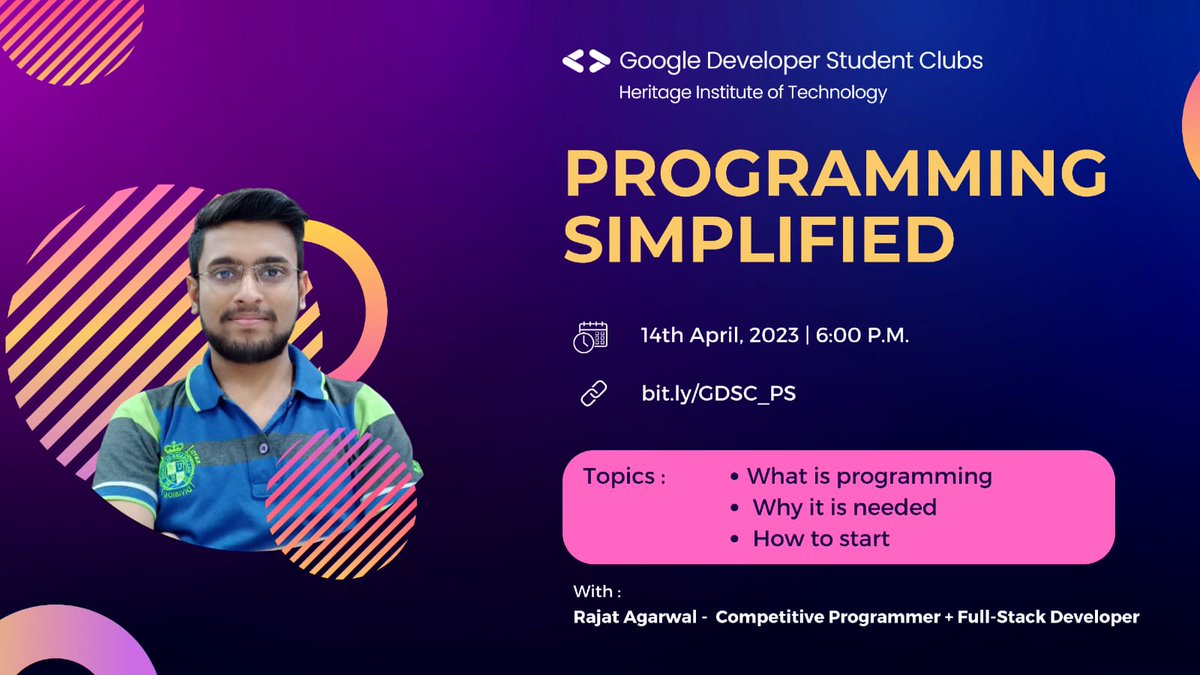
We are very glad 😊 to introduce you to a new session "Programming Simplified"
Rajat Agarwal (Competitive Programmer✨, secured Global rank 56 in TCS CodeVita '22 ) will demonstrate you how to approach real-life problem solving that helps us get a task done ✅ efficiently
👇🧵