people who stored their btc on coldcard got drained because of entropy.
the seed generation was reproducible, anyone could recompute their keys.
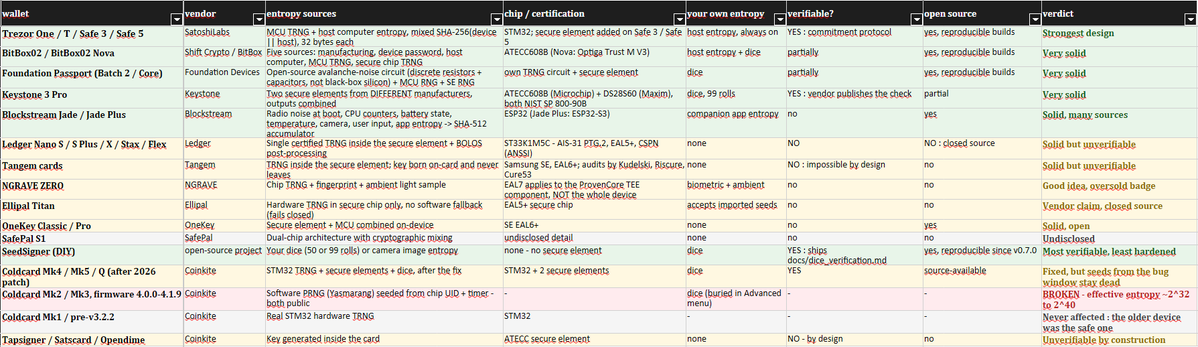
so i went through every other hardware wallet to see how they make your seed, and whether the same thing can happen again.
@Trezor: mixes the device's randomness with randomness from your computer, and the device has to prove it used both. even if its chip is fully broken, you're still fine. the best design here by far.
@BitBoxSwiss: 5 separate sources of randomness combined. one bad source can't sink you. open source, reproducible builds, dice supported.
@FoundationHQ: built their own randomness circuit out of plain resistors and capacitors, open source, on top of two other sources. no black-box chip to trust. supports dice.
@KeystoneWallet: 2 secure chips from 2 different manufacturers, combined. also lets you roll 99 dice and publishes how to check the result yourself.
@Blockstream: jade pulls from 7 things: radio noise, cpu counters, battery, temperature, camera, your input, the app. very hard to break all of them.
@SeedSigner: your dice are the only source. no chip to trust at all. and they ship a guide teaching you to verify their own math. weakest hardware, strongest proof.
@OneKey: secure element plus mcu combined on device, open source firmware. solid, but you can't add your own randomness.
@Ledger: one certified chip (AIS-31, EAL5+). good randomness. but it's a single source, closed source, and you cannot verify any of it. you're trusting them completely.
@Tangem: key is born inside the chip and never comes out. audited by three firms. same trade: strong, and impossible for you to check by design.
@ngrave_official: mixes chip randomness with your fingerprint and room light. clever. but the "EAL7" badge covers one software component, not the whole device.
@ELLIPAL: single certified chip, no software fallback, fails closed instead of guessing. closed source, so take it on faith.
@SafePal: 2 chips mixed. they've never published the details.
@COLDCARDwallet: patched now, and dice on coldcard were always verifiable. but every seed made between 2021 and 2026 is permanently burned.
one source = ledger, tangem, ellipal. that one source fails, everything fails. their answer is to make it excellent and certified. that's exactly the bet coldcard lost.
many sources = trezor, bitbox, passport, jade, keystone. one broken source never reaches your key.
and every one of these claims 128 or 256 bits.
coldcard did too. certification doesn't help either, coldcard's chip was fine, the code just stopped calling it.
the only thing that saves you is being able to check.
roll your own dice. verify the words yourself.
It's actually not that complicated.
1. Printing money is easy and fixes things short term. So governments always do it. Left or Right.
2. The printed money grows faster than the economy, so it ends up in hard assets.
3. Until Bitcoin, that meant houses, stocks and gold. But these are all not easily movable. You can't zip some shares of Apple to your cousin in Mexico. Or your condo in NYC. Or your 3 gold bars.
4. Bitcoin is actually the perfect product market fit for the money printing problem. And it's working . Perfect Power Law. 1,000,000x since Oct 2010.
5. The power law comes with 80% vol. That means big corrections. But massive returns if you HODL.
6. All other crypto can't compete and are peddling false narratives ("greener", "world computer", "more quantum safe"). Ignore.
$BTC (1M) – When to buy Bitcoin
One of the cleanest long-term indicators in Bitcoin’s history: realized price.
This indicator tells us if the average network participant is in a state of profit or loss.
Every cycle tells the same story.
When BTC traded below the realized price (purple line), it marked a clear discount zone for long-term buyers. No exceptions.
Price is now moving back toward that zone again.
A bounce back up is still possible, but once Bitcoin enters it, I’ll start DCA’ing back in, adding to my long term bag.
Every now and then I share charts people usually charge money for.
Turn on notifications, this can genuinely be life-changing.
I wanted to give everyone something meaningful, a gift…
This comes from Global Macro Investor (GMI) and a deep, long-running body of research developed by @RaoulGMI and myself.
Many of you already know The Everything Code, which is our framework for understanding the macro landscape and why major central banks are debasing their currencies to manage aging demographics and overwhelming debt loads.
I call this a gift because these four charts, while only scratching the surface of The Everything Code, give you the big-picture context you actually need in moments like this.
They stop you from getting lost in every Bitcoin pullback and explain why Raoul and I never panic, even when, to borrow one of his expressions, everyone’s acting like monkeys throwing poo at each other.
Once you understand The Everything Code, you stop trading short-term noise and expand your time horizon. You cannot unsee it.
The starting point is what we call The Magic Formula:
GDP growth = population growth + productivity growth + debt growth.
Population growth and productivity growth have been falling for decades. Debt growth is the only thing filling the gap.
The private sector has been deleveraging since 2008, mainly households, but debt levels are still around 120% of GDP. The public sector sits at roughly the same level.
Here’s the problem…
If the government is running debt at 100% of GDP and the private sector is sitting on another 100%, and for simple math we call rates 2% even though they are really closer to 4%, then the entire 2% trend growth of the economy is being consumed by servicing private-sector debts. That is a completely unproductive use of GDP. And then there’s the issue of public-sector debts. There’s just not enough organic growth to service the existing debt load.
To understand why this dynamic persists, you need demographics.
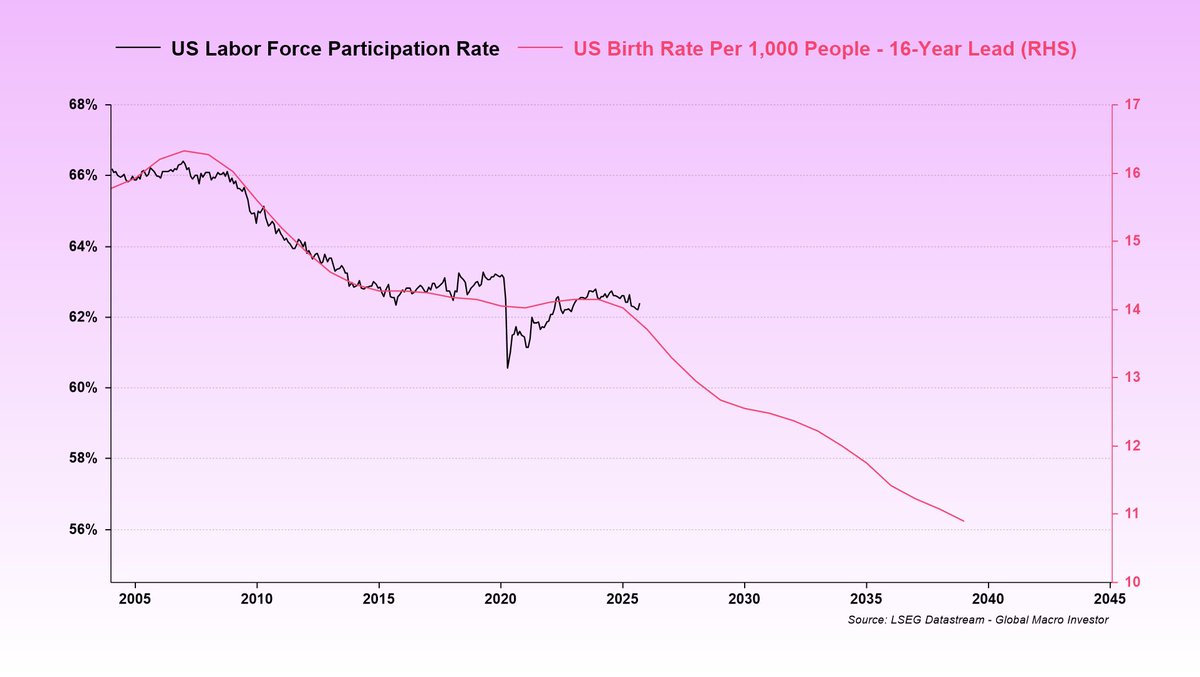
Birth rates peaked in the late 1950s and have been declining ever since. This shows up about sixteen years later in the labor force participation rate as each generation enters the workforce (chart 1).
That means the labor force participation rate is not going to rise any time soon. It is set to keep drifting lower. This is a structural problem.
Aging populations, falling birth rates, and rapidly expanding automation make the backdrop even more deflationary. AI and robotics are replacing humans at scale, and we are only at the beginning. This reinforces the need for ongoing stimulus to keep the system functioning.
With weak population growth and sluggish productivity, the only way to keep GDP expanding is through debt.
Now here’s where it gets interesting…
Government debt growth is completely offsetting the demographic decline and policymakers know exactly what they are doing (chart 2).
And what happens next?
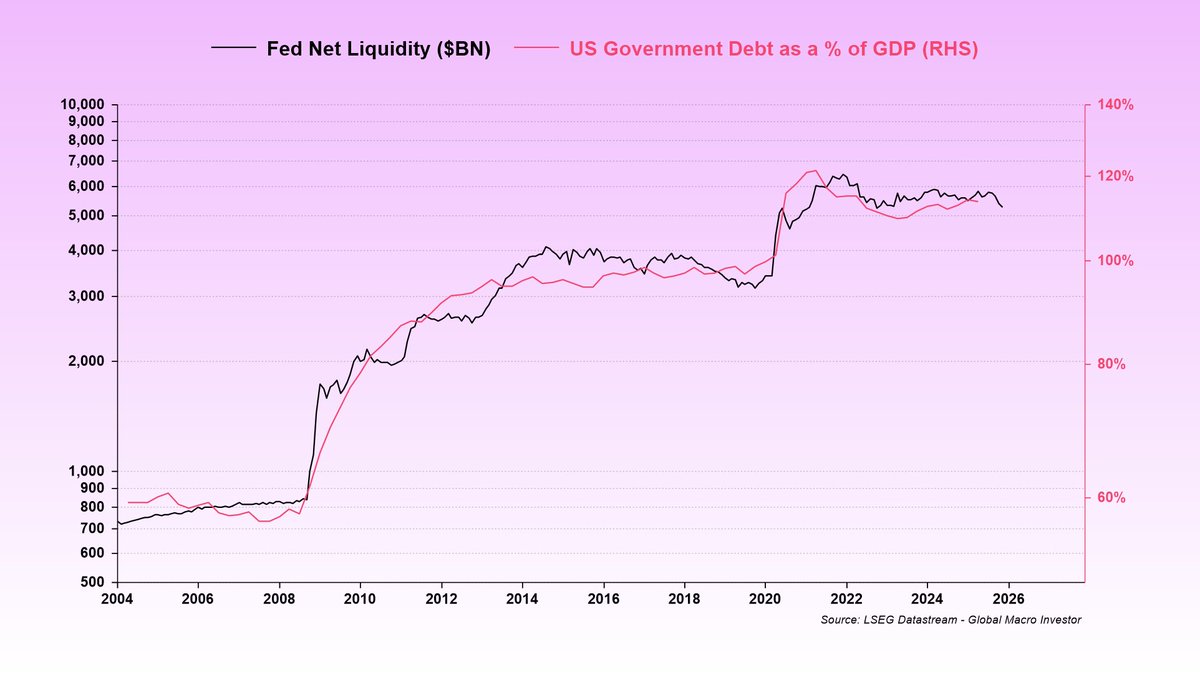
All debt growth in excess of GDP gets monetized (chart 3).
Basically, since 2008, magic money has effectively been paying the interest. Governments issue new debt to cover old interest, and once rates fall enough, central banks absorb it onto their balance sheets.
So to wrap this up, demographics drive the decline in the labor force. Governments offset that decline with more debt. That debt eventually gets monetized through quantitative easing (QE) style operations, not always directly by the Fed, but through the coordinated ecosystem of the Fed, the Treasury, and the banking system. And the bottom line is that there’s still a massive wall of interest that needs to be monetized, far more than GDP can ever cover. Liquidity is literally the only game in town.
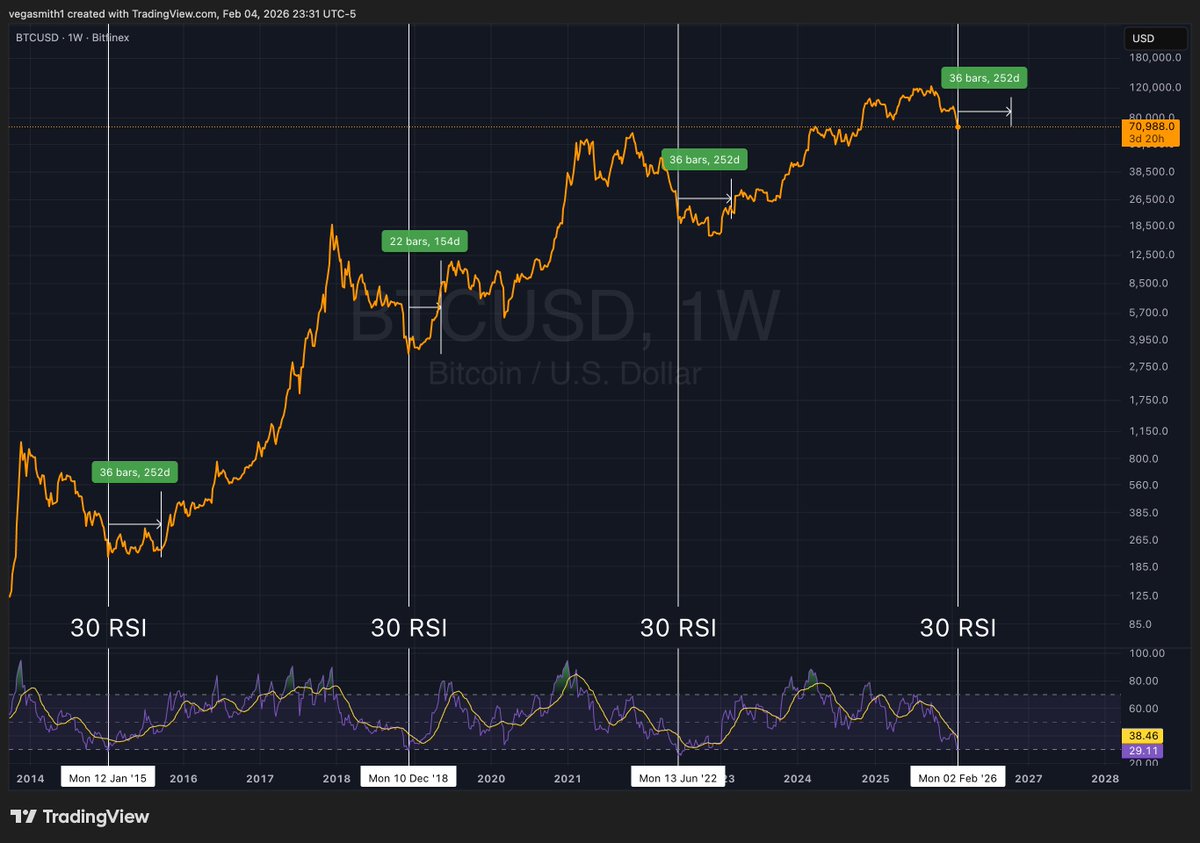
And what thrives in a world of perpetual debasement? Bitcoin (chart 4).
I know this correction has been painful, but it’s all part of the journey. These periods feel brutal in the moment, then they fade and the trend resumes. This too shall pass…
To quote Walter White from Breaking Bad, later echoed by @LynAldenContact, nothing stops this train.
MOAR COWBELL (liquidity) = number go up over time. Zoom out and be more bullish…
History shows us that having too much debt during an economic downturn leads to a classic, self-reinforcing cycle where:
1) The empire can no longer borrow the money to repay its debts
2) It prints a lot of new money, which devalues the currency and raises inflation
3) Living standards decline, leading to the rise of political extremism
4) Turbulent economic conditions undermine productivity and there is conflict about how to divide the shrinking resources
5) Populist leaders emerge pledging to take control and bring about order
September is going to be historic month for Metaplanet 🇯🇵
Let's just say I'm expecting share price to be higher by the end of the month.
I'm going to destroy my sleeping routine for a Japanese Hotel company I had no idea existed 18 months ago.
Tokyo is 8 hours ahead of London so they'll just be waking up for a big day ahead.
日本の友人の皆さん、おはようございます!
Just a reminder of some of the major things happening this month for Metaplanet:
-Today will be the EGM whereby the proposals for the Preferred's and issuance of new shares will be approved ✅
-I'm also expecting a Bitcoin purchase and possibly the clearing of the remainder of the debt to make extra room for the Preferred's ✅
-The Moving Strike Warrants are being suspended from the 3rd of September, this means less shares on the market and more upward pressure on the stock. The suspension is until the end of the month ✅
-The 9th-11th will be the pricing dates for the International Offering. This is a massive raise that could reach up to $3-4bn which is at least an additional 27,000 Bitcoin for the company ✅
-The 16th-18th of September is when the money from the International Offering is received by the company. Expect a massive Bitcoin buy shortly after ✅
Massive names are going to be getting involved and investing into Metaplanet, as the offering is only open to Institutional Investors.
All in all, I'm expecting fireworks.
If you're 37. Instead of regretting that you can't wake up age 18 again, pretend to yourself that you're 90 and you've woken up age 37 again, and that you get to magically, wonderfully have the next 50 years again.
Lyn Alden gave one of the clearest breakdowns of why the U.S. is on an unstoppable fiscal path—and why Bitcoin matters more than ever because of it.
@LynAldenContact walks through the numbers behind the federal deficit, interest expenses, Social Security, and the structural changes that happened post-2008. The short version? We’re in a new era. One where the government can’t slow down even if it wanted to.
The debt is compounding. The interest expense is rising. The trust funds are running dry. And the political will to do anything about it doesn’t exist.
Her phrase: “Nothing stops this train.” Not because of ideology, but because of math—and human nature.
This isn’t hyperinflation doom-talk. It’s a sober look at what happens when a system built on ever-growing debt reaches its limits—and why Bitcoin, with its fixed supply and transparent rules, is the opposite of that system.
Highly recommend watching this one all the way through.
People - I told you QT will end last month, its the same every cycle. The Fed is paid to lie and deflect you from buying risk on assets but is quietely starting QE in stealth mode. Ive listed the reasons they need to inject liquidity many times. They dont have a choice. Dont be the idiot who waits for Jerome Powell to announce. Thats too late. Frontrun it now.
Fed Minutes say it clearly. Debt ceiling will be raised, balance sheet reduction will be halted. That means QT ends. Then there will be a month of quite nothing followed by Jerome telling us 3% is the new 2% inflation, economic stimulation, rate cuts, and QE for 2 years. IMO: Estimating total of $70 trillion before 2030. At least $5 trillion will go into US Dollar debt backed Stable Coins, $5 trillion into Bitcoin, $5 trillion into alt coins. $20 trillion into Equity markets. $10 trillion into US infrastructure and manufacturing buildout and repair. The balance into debt reduction and backstopping the bleeding.
Bookmark this post.
@MatthewHyland_ Hidden divergence differs from regular divergence because it suggests the trend will continue rather than reverse. In a hidden bullish divergence, the price makes a higher low, but the RSI makes a lower low, usually indicating that the market is still strong despite the pullback.