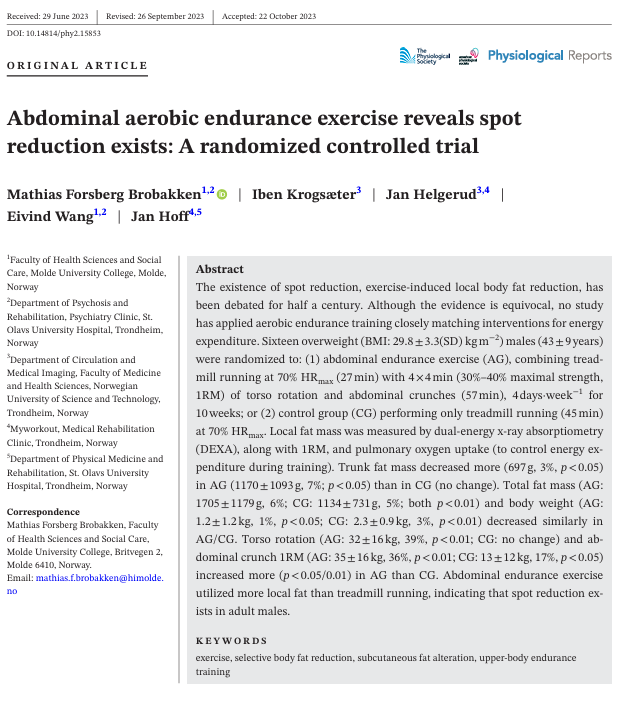
Spot fat reduction, targeting belly fat, is possible, according to this study.
The problem?
It required an hour of ab exercises, 4 days a week, for 2 and a half months.
They lost about 2.5lb of belly fat.
So if it's REALLY stubborn you can give that a shot.
This review aims to clarify what distinguishes the concept of exercise mimetics from broader pharmacology by proposing a systems-informed framework and a pathway hierarchy that connects exercise mimetics to molecular programs, biological functions, and clinically actionable outputs.
People used to drive without seatbelts and smoke indoors
Future generations will look back at us the same way for things like:
- waiting for disease before taking action
- living in chronic air pollution
- having circadian rhythm disrupting lights as the default
- not targeting aging in preventive medicine
- thinking of junk food as normal
Being the world's best player at 38 in a sport where the average retirement age is 35.
I can't help but wonder if Messi's growth hormone deficiency as a kid made him age more slowly biologically.
In animals and humans, growth hormone receptor deficiency does appear to slow down aging, although it comes with additional health risks later.
Average U.S. lifespan is about 79 years. Average health span is closer to 64. That’s roughly a decade‑plus of life spent managing chronic illness and rising medical bills.
This is why my goal is to help people across the world live healthy lives.
Why Epigenetic Rejuvenation Won't Give Us Radical Life Extension: Lessons from Serial Mouse Cloning
Lessons from probably the most important longevity study in a decade
By Peter Fedichev PhD @fedichev
https://t.co/Y3Tbqs8xhK
Dramatic “age reversal” claims are often the result of removing what was accelerating aging in the first place
Obesity, smoking, inflammation, diabetes, sedentary behavior, and nutrient deficiencies can push aging clocks in the wrong direction
When those problems are corrected, epigenetic age can fall sharply because the body is no longer being driven into accelerated aging
So when someone claims to reverse their biological age by multiple years, it usually reflects removing a major accelerator (like obesity), not a miracle protocol
Most men treat ED as a bedroom problem and low testosterone as an inevitable part of aging. Both assumptions are wrong and both are costing men a decade of health. A 35-year-old with ED carries roughly a 15 percent risk of heart attack or stroke within 7 years, 3.5 times the risk of depression, and 30 percent odds of diabetes or prediabetes. ED is a check engine light, not a standalone condition. Testosterone is the single best blood marker of a man's overall health, and almost no man receives annual screening for it. The TRAVERSE trial led the FDA to remove testosterone's cardiovascular warning in 2025, dismantling the prostate cancer and heart attack fears that shaped clinical practice for years.
In this roundtable with Dr. Mohit Khera, Dr. Larry Lipshultz, and Dr. Tobias Kohler, we cover what declining testosterone is actually signaling, when therapy is the right intervention, and what every man should be doing monthly to catch testicular cancer when it is still 99 percent curable.
- Based on behavioral economic theory, a commonly used experimental paradigm to measure change in the reinforcing value of food is to present individuals with a choice between a food and a non-food reward for which to work and the amount of work completed for both rewards allows for the relative reinforcing value of food to be objectively measured.
In this study, consuming dietary protein distributed evenly across three meals/day resulted in reduced motivation to obtain food and lower consumption of energy-dense, highly palatable snack foods during weight loss when compared with a skewed distribution pattern with the majority of protein consumed in the evening.
Gray hair at 28 isn't genetics running ahead of schedule.
It's hydrogen peroxide accumulating in the follicle and bleaching the hair shaft from within.
Melanocytes (the cells that produce pigment) are destroyed by hydrogen peroxide. Catalase, the enzyme that breaks it down, declines with oxidative stress and chronic inflammation.
Premature graying is an oxidative and inflammatory signal presenting at the follicle before it presents as metabolic syndrome or cardiovascular disease somewhere else.
The men going gray at 25 are not unlucky.
They're early.
Their hair is telling them something is wrong upstream (in the gut, in the mitochondria, in the antioxidant infrastructure) before anything more serious makes the same announcement.
5/5) But the story doesn’t stop there.
There are important nuances, plus other factors that may protect—or harm���your brain.
Today’s deep dive covers the full story and practical insights. https://t.co/rhaO0lXdTC
Supplementing with omega-3 fatty acids slows biological aging.
Combining omega-3s with vitamin D and exercise has an additive effect, translating to ~3 months of slowed biological aging.
These were the results of the 3-year-long DO-HEALTH study, which @prof_horvath believes is one of the strongest pieces of evidence that simple interventions (that also likely correct a deficiency) are powerful ways to slow or reverse the aging process.
We discuss this study and more in the latest episode of the FoundMyFitness podcast.
The success of cancer immunotherapy may begin in the gut. Growing evidence shows that diet shapes the gut microbiome and its metabolites, which in turn influence immune responses that can enhance—or hinder—the effectiveness of immune checkpoint blockade.
Understanding this diet–microbiome–immunity axis could unlock new strategies to improve cancer treatment outcomes through precision nutrition and microbiome-targeted therapies. #CancerResearch #Immunotherapy #Microbiome
https://t.co/FRXhvi9eHa
Yet another study shows a 24% reduced risk of dementia after the Shingles vaccine. This one in over 500,000 participants with a recent skilled nursing facility stay, adding to 4 huge natural experiments in 4 countries (US, Canada, Wales, and Australia)
https://t.co/TmYqwTB7IT @AnnalsofIM
In this study, greater contrast between daytime and nighttime light exposure (i.e., differences in time between daytime light exposure above 1000 lux versus nighttime light exposure above 1 lux) was associated with a lower risk of cardiovascular disease mortality in US adults.