@NutritionistKD@MinofHealthUG@DokitaSharon@skmusyoka@WHOUganda@PSIUganda@Living_Goods Nutrition is the gateway to self-care. You cannot truly claim to practice self-care while ignoring what you eat. Every bite you take either nourishes your body, strengthens your immune system, and protects your health, or it increases your risk of disease.
Nutrition is a gate way to Selfcare. You can not say you are promoting selfcare yet you ignore your mouth.
In this article, you will learn about proper Nutrition and how your mouth is powerful to control disease.
#NutritionistKD | #NutritionCommandCentre | #YourPlateOurBusinessCampaign
Nutrition is a gate way to Selfcare. You can not say you are promoting selfcare yet you ignore your mouth.
In this article, you will learn about proper Nutrition and how your mouth is powerful to control disease.
#NutritionistKD | #NutritionCommandCentre | #YourPlateOurBusinessCampaign
How should you portion your plate ?
Despite it being a Sunday, we are on Day 11 of the 20 Days in #YourPlateOurBusinessCampaign.
Let the nutrients balance according to the needs of the body, not the needs of the eyes.
#NutritionistKD | #NutritionCommandCentre | #YourPlateOurBusinessCampaign
How should you portion your plate ?
Despite it being a Sunday, we are on Day 11 of the 20 Days in #YourPlateOurBusinessCampaign.
Let the nutrients balance according to the needs of the body, not the needs of the eyes.
#NutritionistKD | #NutritionCommandCentre | #YourPlateOurBusinessCampaign
Ealier this week @guguddetvuganda Health Program, with Ms Euniky, @uscrfuganda, we had a wonderful conversation around SCD.
Sickle cell disease remains a major public health challenge in Uganda, with an estimated 20,000 babies born with the condition every year.
The disease is particularly common in eastern and northern Uganda, where the sickle cell trait is more prevalent. Many children are diagnosed late, leading to preventable complications and deaths.
Uganda has made significant progress in tackling sickle cell disease, @uscrfuganda . The government, through the Ministry of Health, has expanded newborn screening, @MinofHealthUG , @DianaAtwine , strengthened diagnostic services @Microhaem , improved access to comprehensive care clinics, and increased public awareness about genetic counseling.
Partnerships with hospitals, universities, and development organizations have also supported research, training of health workers, and improved patient care.
Despite these efforts, challenges remain. Limited access to screening services, shortages of essential medicines, inadequate specialized clinics, low public awareness, and financial constraints continue to affect quality care. Many families also face stigma and misconceptions about the disease.
To address these gaps, Uganda needs to expand nationwide newborn screening, strengthen community education, improve availability of medicines and specialized services, and promote premarital and preconception genetic counseling.
Increased government funding and stronger partnerships with stakeholders are essential to improve the quality of life for people living with sickle cell disease and reduce its burden on families and the health system.
@sicklecell101@SCWarriorsInc@Stabex_Ug@Educ_SportsUg@mukulaa@WHOUganda
Ealier this week @guguddetvuganda Health Program, with Ms Euniky, @uscrfuganda, we had a wonderful conversation around SCD.
Sickle cell disease remains a major public health challenge in Uganda, with an estimated 20,000 babies born with the condition every year.
The disease is particularly common in eastern and northern Uganda, where the sickle cell trait is more prevalent. Many children are diagnosed late, leading to preventable complications and deaths.
Uganda has made significant progress in tackling sickle cell disease, @uscrfuganda . The government, through the Ministry of Health, has expanded newborn screening, @MinofHealthUG , @DianaAtwine , strengthened diagnostic services @Microhaem , improved access to comprehensive care clinics, and increased public awareness about genetic counseling.
Partnerships with hospitals, universities, and development organizations have also supported research, training of health workers, and improved patient care.
Despite these efforts, challenges remain. Limited access to screening services, shortages of essential medicines, inadequate specialized clinics, low public awareness, and financial constraints continue to affect quality care. Many families also face stigma and misconceptions about the disease.
To address these gaps, Uganda needs to expand nationwide newborn screening, strengthen community education, improve availability of medicines and specialized services, and promote premarital and preconception genetic counseling.
Increased government funding and stronger partnerships with stakeholders are essential to improve the quality of life for people living with sickle cell disease and reduce its burden on families and the health system.
@sicklecell101@SCWarriorsInc@Stabex_Ug@Educ_SportsUg@mukulaa@WHOUganda
A child sits in front of an empty plate, waiting for something that may not come. We call it a crisis, yet a child somewhere in East Africa, calls it everyday life. 😢
Conflict and climate shocks can disrupt food systems overnight, leaving families without access to the nutrition they depend on to survive.
In these moments, rapid response is critical. World Vision East Africa works alongside communities and partners to deliver life-saving nutritional support where it is needed most.
Our emergency feeding interventions focus on three priorities:
✧Therapeutic feeding
✧School feeding programmes
✧Supplementary feeding
These approaches are designed to reach children quickly, reduce the risk of severe malnutrition and support recovery in fragile settings. In humanitarian contexts, timely access to nutrition can determine survival outcomes.
Every step taken to deliver food, support families and strengthen systems contributes to a child’s immediate wellbeing and long-term recovery.
#Nutrition #HumanitarianResponse #WorldVisionEARO
Community trust and engagement are essential to an effective #Ebola response.
@WHO’s Risk Communication and Community Engagement teams are working alongside communities in #DRC, listening, addressing concerns and building trust to support a more compassionate, inclusive and effective response.
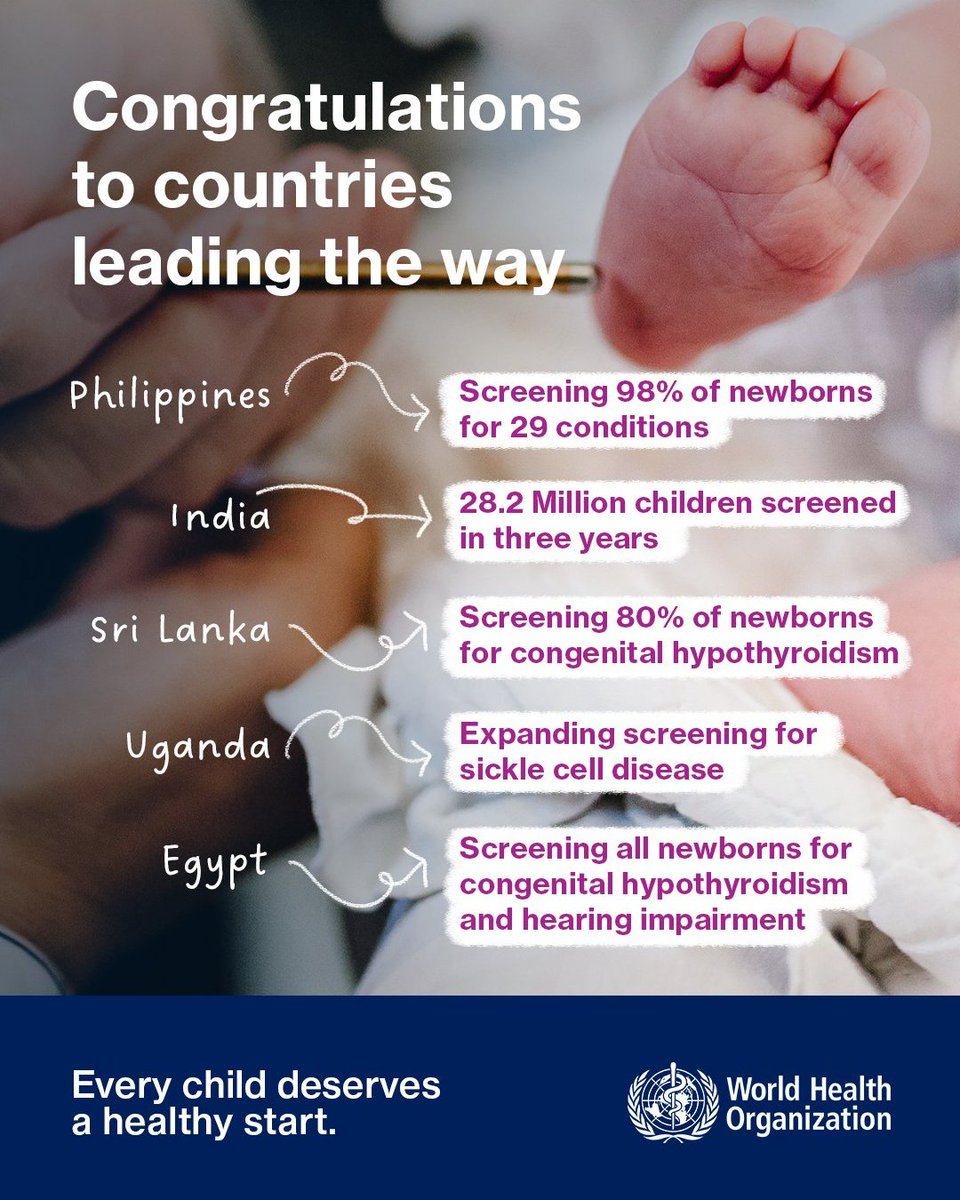
Congratulations to the Philippines 🇵🇭 – one of the countries leading the way in newborn screening and helping babies have the healthiest possible start in life. 👏
What began as a programme in 24 hospitals now screens newborns for 29 conditions through more than 7,000 facilities across the country.
All conditions tested have clear ways to diagnose and manage them within the national health system. Newborn screening is covered by national health insurance and mandated by law in the Philippines.
Newborn screening for birth defects saves lives and reduces lifelong disability for millions of children.
#EveryBabyCounts
Your body clock is doing more for your brain than you think.
2026 research shows older adults with stronger, consistent daily rhythms had less brain shrinkage in memory/emotion areas over time and significantly lower dementia risk compared to those with weak or fragmented patterns.
1. Get bright outdoor light within 30–60 min of waking
2. Move your body (even a brisk walk helps re-entrain rhythms)
3. Keep meal times relatively consistent
4. Dim lights + wind down 1–2 hrs before bed
Your 24-hour rhythm isn’t just about sleep — it’s one of the most under-appreciated levers for long-term brain health.
What’s one habit you’re already using (or want to try) to keep your body clock strong?
Reference:
Stronger circadian rest-activity rhythms linked to less brain atrophy and lower dementia risk (Johns Hopkins 2026; Neurology 2026).
#CircadianRhythm
#BrainHealth
#Longevity