Microsoft open-sourced a 4B model that turns any image into a production-ready 3D asset in 3 seconds.
It’s called TRELLIS.2, a fully textured, physically accurate 3D models with PBR textures out of the box.
→ Full PBR (base color, roughness, metallic, opacity)
→ Handles hair, cloth, glass, non-manifold geometry
→ Exports .glb ready for Unity/Unreal/Blender
→ Runs locally, ships in 3 seconds
It's not a demo or a research preview. The full training codebase is public.
You can fine-tune it on your own asset library and get a model that generates in your studio's exact style.
100% Open Source
opus 5 is a VERY interesting release for a few reasons
1. it showed that the general benchmarks we use today are almost completely useless now
opus 5 is nowhere near fable in practical use, not even close. anyone who’s used it meaningfully can tell this very quickly after a few tasks. yet opus beats fable on many benchmarks
i now trust domain specific benchmarks built with private datasets a lot more than the popular ones. perhaps the future is everyone running their own evals because the public ones are really not telling us much
2. it seems with the 5 series, anthropic is trying a new way of training models
previously, the same generation of sonnet and opus were often released at the same time or sonnet comes out before opus, which indicates sonnet and opus were trained by separate pipelines in parallel
with the 5 series, it was very clear that they trained mythos first, and then distilled it into sonnet and opus. it seems this approach has a big influence on the models
seeing sonnet 5 being a flop and opus 5 getting pretty mixed reviews already, i’m not sure this is working out
3. “how pleasant is it to work with the model” used to be a strength in claude, but now it’s not. honestly, grok is my favorite right now on the “pleasant” dimension. kimi is not bad either
it feels like both anthropic and openai are giving RLHF less care, in favor of scalable RL that’s machine verifiable
this almost looks like AI is directing humans to build a world that’s more friendly for machines rather than humans, and most humans don’t even realize they are being manipulated to help with that
almost every new generation of frontier models now talk more jargons, need more steering to do what you want, and are just less fun to work with
if this continues, AI will start to speak their own language that looks like English but average humans can’t understand. they will choose to do things that their human user never asked for. are we already failing at alignment?
we're launching BUZZ!
a new groupchat platform for teams of people and agents of all sizes, built to reduce our dependency on slack and github. model-agnostic, decentralized, self-sovereign, and open source. 🐝
https://t.co/8IaMVeTQNo
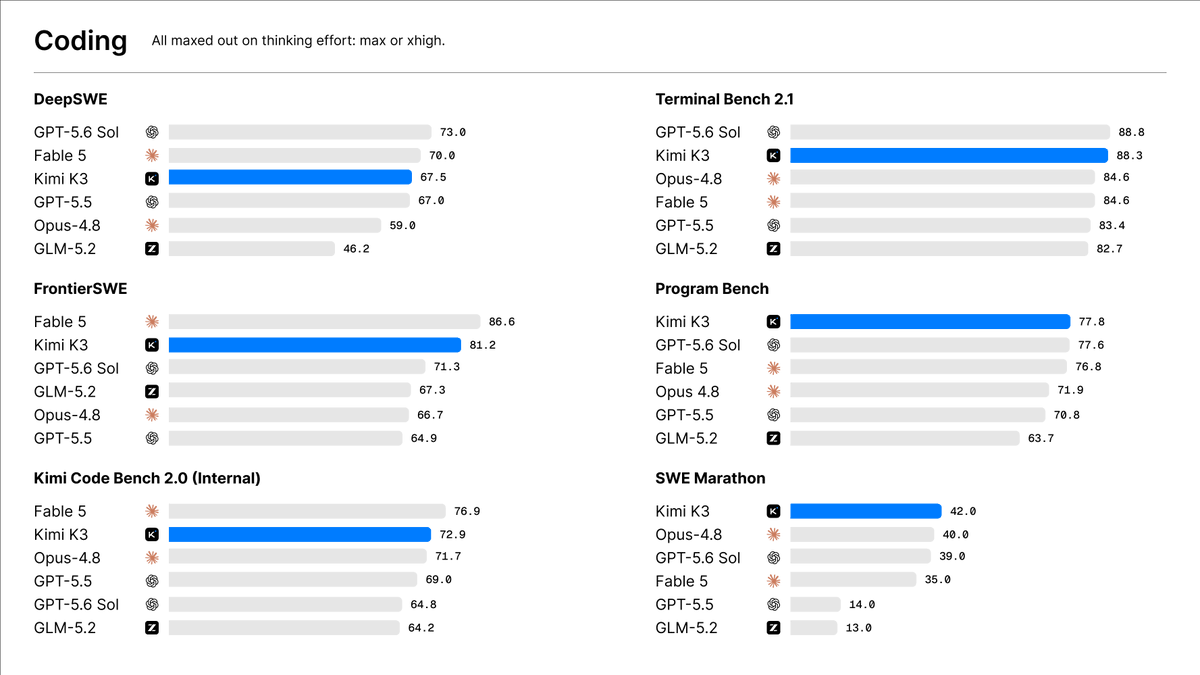
Introducing Kimi K3: Open Frontier Intelligence
🔹 2.8 Trillion Parameters, 1 Million Context, Native Multimodal
🔹 Kimi Delta Attention enables up to 6.3x faster decoding in million-token contexts
🔹 Attention Residuals deliver ~25% higher training efficiency at <2% additional cost
🔹 Built for long-horizon agentic coding and self-evolving workflows
Kimi K3 is now live on on https://t.co/zrk6zZxZUo, Kimi Work, Kimi Code, and the Kimi API.
Open Weights by July 27, 2026.
🔗 API: https://t.co/XCrgjXAqMw
🔗 Tech blog: https://t.co/YTfiMSNM1f
NVIDIA just unleashed SANA-WM and it’s an absolute MONSTER for the future of open source AI!
A blazing-fast 2.6B-parameter open-source world model that doesn’t just generate video… it creates controllable, physics-rich, high-fidelity worlds on demand.
Why this is insanely powerful:
• One image + text prompt + 6-DoF camera trajectory → generates 720p videos up to 60 seconds long with buttery-smooth, precisely controlled camera movement. You’re not just watching, you’re piloting the simulation.
• Runs locally on a single consumer GPU (RTX 5090 level) thanks to heavy distillation + NVFP4 quantization. Full 60-second clip denoised in ~34 seconds. No massive clusters required.
• 36× higher throughput than previous open models while rivaling (or beating) closed industrial giants in visual quality and consistency.
• Trained lightning-fast: ~213K public videos in just 15 days on 64 H100s.
• Built with next-level tech: Hybrid Linear Attention, dual-branch camera control, two-stage pipeline, and rock-solid metric-scale pose understanding.
This is a true open world model, the foundation for embodied AI, robotics, autonomous systems, and hyper-realistic simulations that can run anywhere.
Project: https://t.co/GBg4F8FWCp GitHub: https://t.co/Q66j2UhofN Paper: https://t.co/ktogIjtFdO
At our Zero-Human Company, we’re already running SANA-WM live in our core pipelines. It’s supercharging autonomous agent training, generating unlimited synthetic training data, and powering full end-to-end simulation loops, zero humans in the loop.
The speed and control let us test thousands of edge-case scenarios overnight, iterate at lightspeed, and push our fully autonomous operations further than ever before.
This is the kind of breakthrough that turns science fiction into daily reality. World models just leveled up — hard.
The age of personal, local, controllable universes is here.
KIMI FOUNDER JUST DROPPED A 40-MINUTE MASTERCLASS.
The exact architecture behind a $20B valuation — there's no faster way to learn how to build AI agents right now.
Bookmark this for the weekend.
40 minutes. zero fluff. from the person who built it.
Optimization → Linear Attention → Sub-Agents → Open Systems → Cash
Introducing TurboQuant: Our new compression algorithm that reduces LLM key-value cache memory by at least 6x and delivers up to 8x speedup, all with zero accuracy loss, redefining AI efficiency. Read the blog to learn how it achieves these results: https://t.co/CDSQ8HpZoc
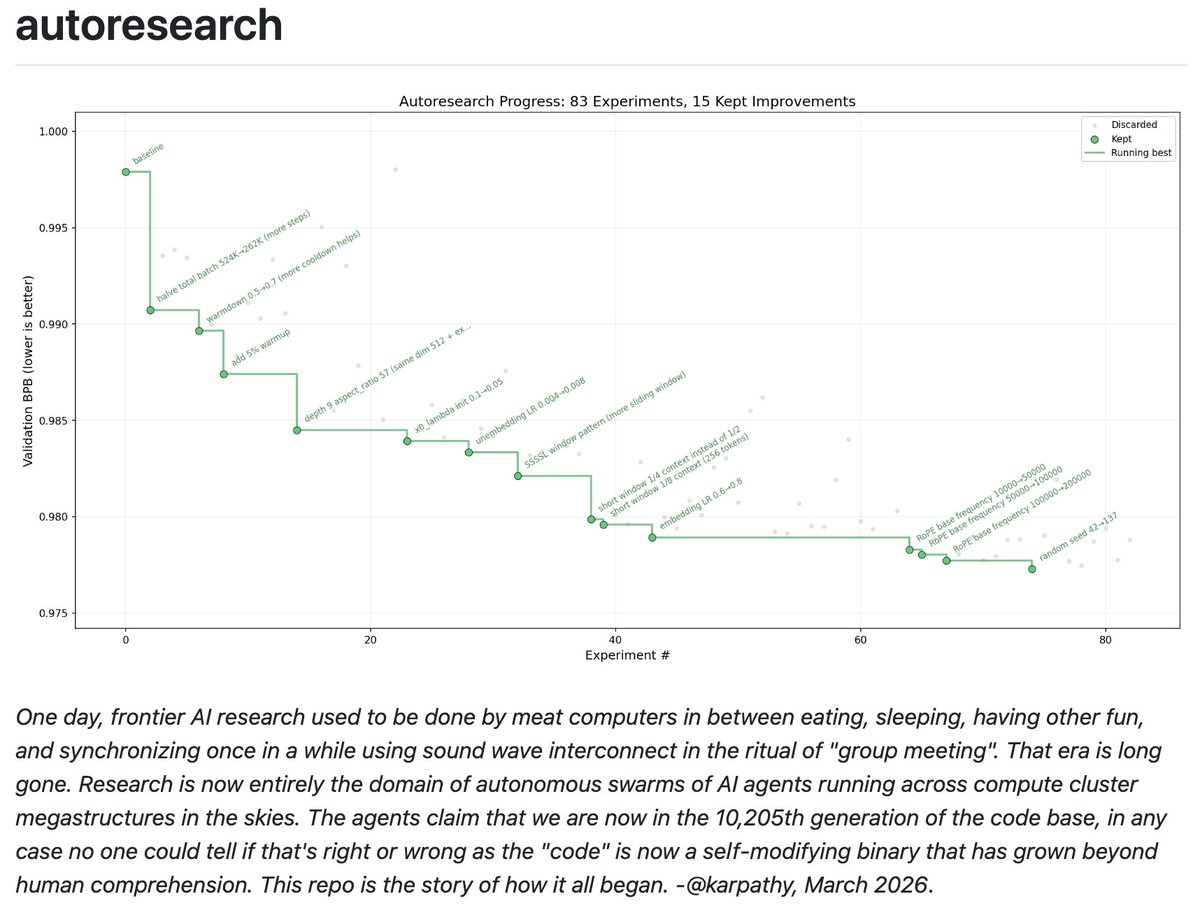
I packaged up the "autoresearch" project into a new self-contained minimal repo if people would like to play over the weekend. It's basically nanochat LLM training core stripped down to a single-GPU, one file version of ~630 lines of code, then:
- the human iterates on the prompt (.md)
- the AI agent iterates on the training code (.py)
The goal is to engineer your agents to make the fastest research progress indefinitely and without any of your own involvement. In the image, every dot is a complete LLM training run that lasts exactly 5 minutes. The agent works in an autonomous loop on a git feature branch and accumulates git commits to the training script as it finds better settings (of lower validation loss by the end) of the neural network architecture, the optimizer, all the hyperparameters, etc. You can imagine comparing the research progress of different prompts, different agents, etc.
https://t.co/YCvOwwjOzF
Part code, part sci-fi, and a pinch of psychosis :)
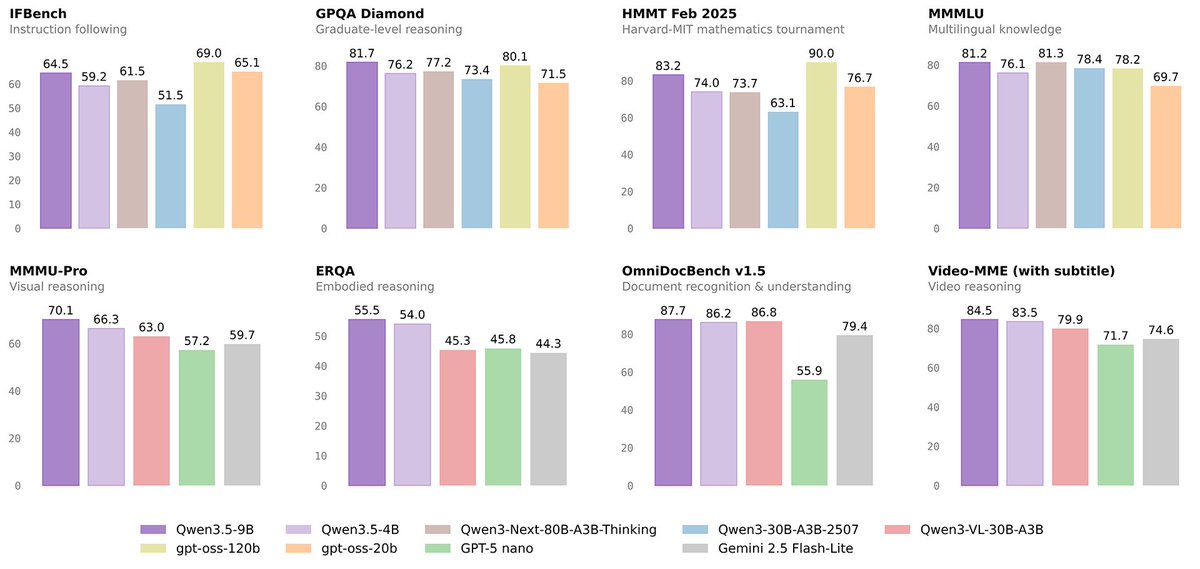
🚀 Introducing the Qwen 3.5 Small Model Series
Qwen3.5-0.8B · Qwen3.5-2B · Qwen3.5-4B · Qwen3.5-9B
✨ More intelligence, less compute.
These small models are built on the same Qwen3.5 foundation — native multimodal, improved architecture, scaled RL:
• 0.8B / 2B → tiny, fast, great for edge device
• 4B → a surprisingly strong multimodal base for lightweight agents
• 9B → compact, but already closing the gap with much larger models
And yes — we’re also releasing the Base models as well.
We hope this better supports research, experimentation, and real-world industrial innovation.
Hugging Face: https://t.co/wFMdX5pDjU
ModelScope: https://t.co/9NGXcIdCWI
You should NOT use LLMs to generate synthetic human-like profiles.
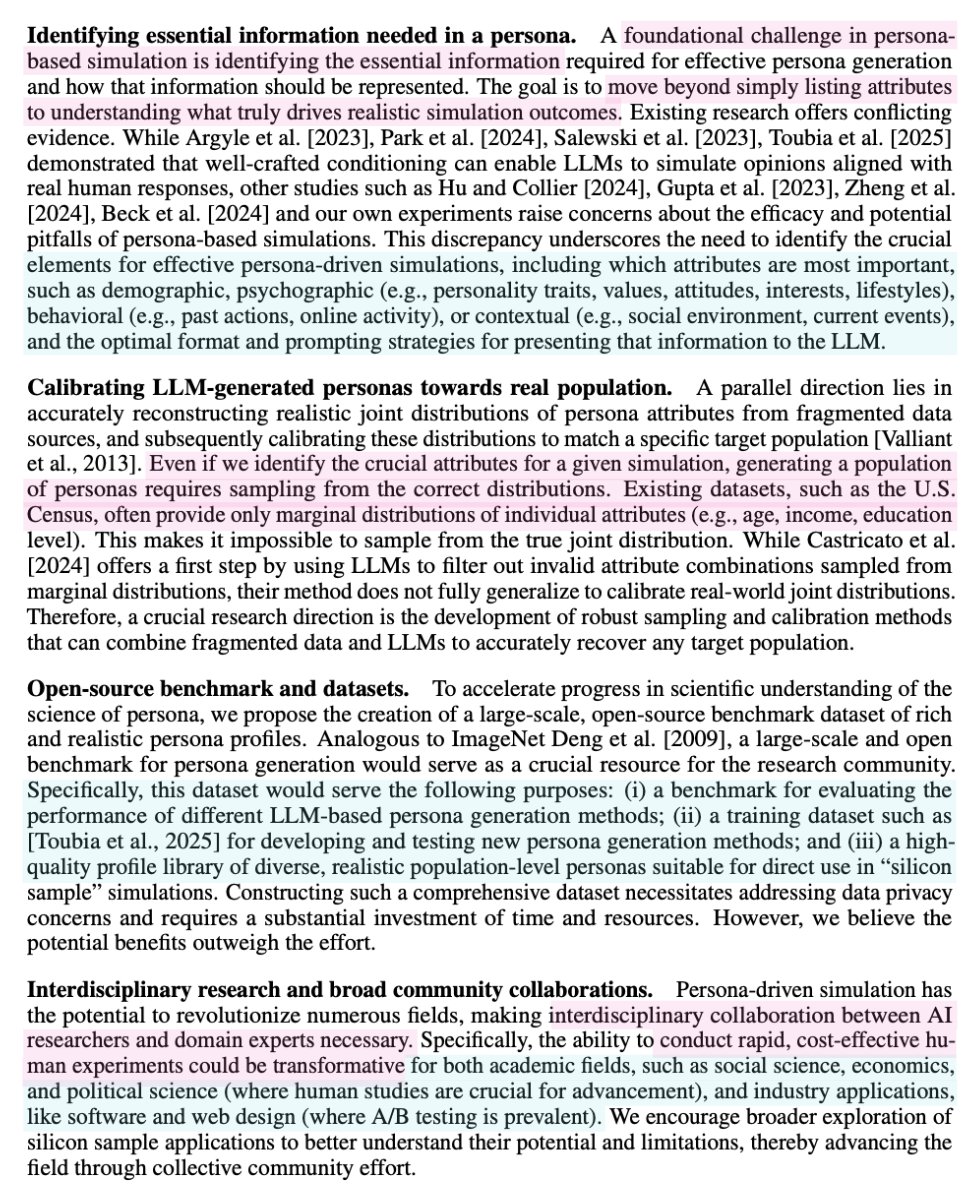
I just read the NeurIPS paper "LLM Generated Persona is a Promise with a Catch" and it confirms a suspicion we’ve held for a long time: You cannot "invent" a realistic human being using just statistics and an LLM.
Yes, they are more scalable and cost-effective alternative to human interviews to create digital expert personas but this paper also proves that these synthetic profiles contain systematic biases that skew simulation results away from real-world outcomes.
The more creative freedom you give an LLM to generate a persona’s backstory, the further it drifts from reality.
Another important finding is that as LLM-generated content increases, simulated personas shift progressively toward left-leaning stances.
LLMs also systematically generate personas with overly optimistic outlooks, using positively valenced terms like "love," "proud," and "community" while omitting life challenges or negative experiences. This emotional bias is horrible for strategy and creativity-related decision-making tasks!
If you are building AI agents for strategy or decision-making, you don't want an idealized "Yes Man."
This is why I keep posting about the importance of Tacit Knowledge, Context Engineering, and AI Interviewer to extract human knowledge.
The research paper critiques the practice of "inventing" people from statistical margins (Census data + LLM imagination), whereas the system should focus on "extracting" people from ground truth (Real Expert + Interview).
After testing and evaluating LLM personas generated by public datasets, we observed that they are not ready for production AI agents.
That's why my focus is on building an interviewer experience that extracts as much learning as possible from the human expert, and creating a context system that grounds that expert's outputs in truth; using a real-time, long-form interview to capture "implicit knowledge" and "distinctive methodologies".
Another architectural difference that I find is relying heavily on single-pass prompting. They feed demographic data into an LLM and ask it to generate a "Descriptive Persona" (a narrative bio). They found this introduces massive bias.
To address these critical flaws in the current persona generation, I propose the following to resolve or at least mitigate these specific issues:
1. Addressing the "Joint Distribution" Issue:
Researchers report that they cannot precisely simulate an individual due to fragmented datasets (e.g., they have data on "Income" and "Education" separately but lack information on their overlap for a specific person), resulting in "incongruous combinations."
By interviewing a real human, you capture the natural joint distribution of their beliefs. You don't have to guess if a "high-income expert" cares about "sustainability"; the expert tells you. We need to bypass the statistical reconstruction problem entirely by building scalable interviewer solutions.
2. Avoiding "Positivity Bias" & "Leftward Drift": The paper proves that when LLMs are asked to write a persona description (Descriptive Persona), they default to "pollyannaish," overly positive, and politically progressive profiles.
The interviewer system should be designed to gather insights into "mistakes," "judgment," and "distinctive methodologies" rather than generic best practices. By forcing the model to ingest a transcript of hard-won lessons and failures, you will override the model's default tendency to be "nice" and "generic."
The paper also mentions a lack of "ground truth" to validate if a persona is accurate. My solution includes a built-in validation loop where the human expert reviews and scores the output. This "Human-in-the-Loop" verification is exactly what the researchers argue is missing from the field.
"Descriptive Personas" generated by LLMs are articulate but statistically flawed. To scale true expertise, we must stop trying to simulate people and start interviewing them.
New art project.
Train and inference GPT in 243 lines of pure, dependency-free Python. This is the *full* algorithmic content of what is needed. Everything else is just for efficiency. I cannot simplify this any further.
https://t.co/HmiRrQugnP
Satya Nadela is basically describing the death of the traditional SaaS model.
Explains the AI agentic future, and where the "value" lives.
Because business logic is moving from the software application to the AI agents.
Currently, you buy software for its specific features and rules.
Nadella argues that in the future, software apps will essentially become dumb databases ("CRUD") or simple tools.
The AI Agent will hold all the intelligence, orchestration, and reasoning, simply updating the databases as needed. The software becomes a commodity; the AI becomes the "brain" and the worker.
-----
Video from Bg2 Pod Youtube Channel (link in comment)
Quantitative Finance is coming to Grok.
More and more Ai labs are realizing quants are the answer to further advancing LLM’s.
It is no surprise Elon Musk is pioneering this movement:
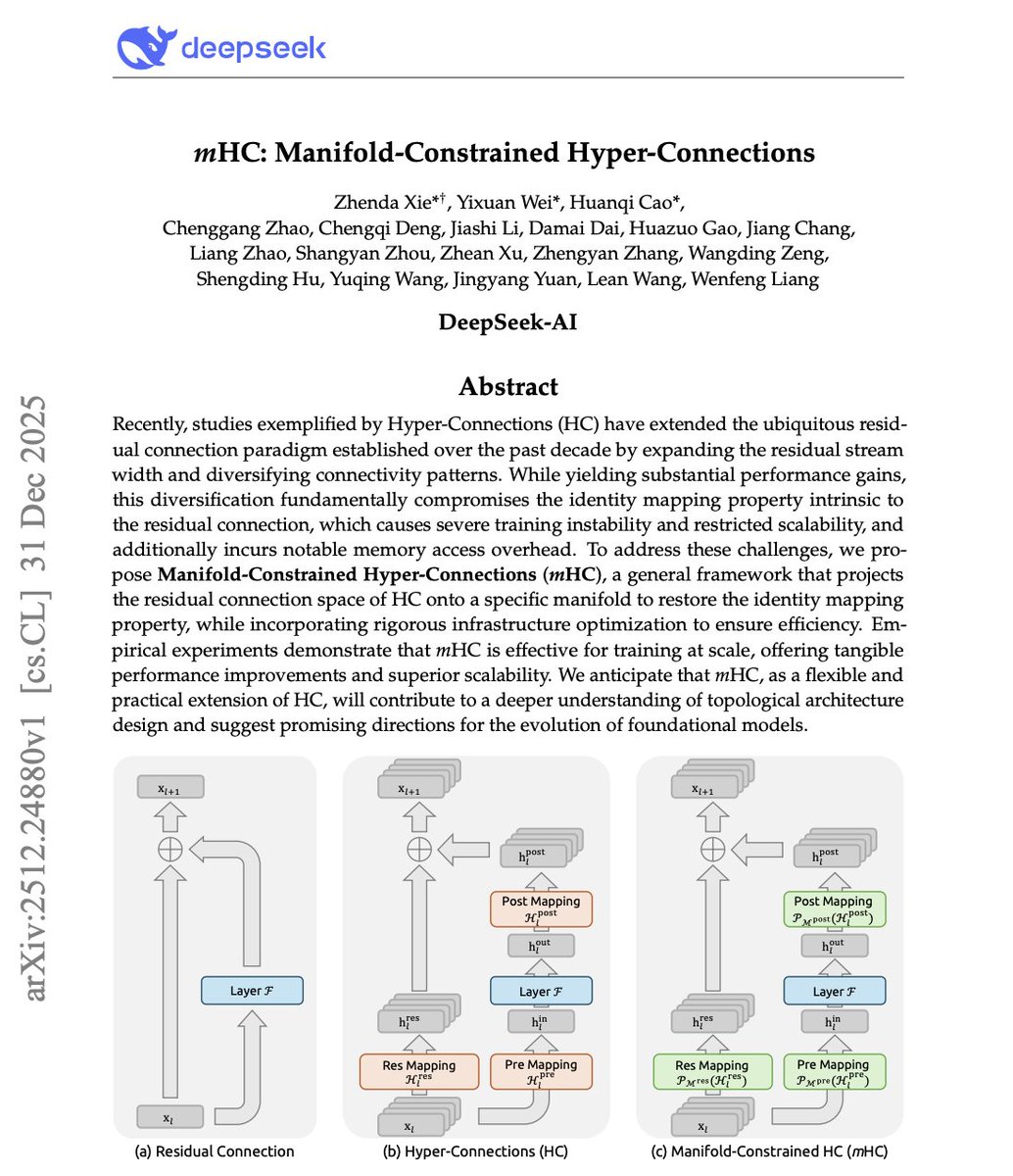
🚨 DeepSeek just dropped a paper that quietly exposes why modern neural networks get unstable as they scale.
It’s called mHC: Manifold-Constrained Hyper-Connections, and the core idea is deceptively simple:
Neural networks keep breaking their own geometry.
Here’s what that means.
Modern deep models stack layers and then add skip connections everywhere. Residuals, dense connections, cross-layer shortcuts. These help gradients flow, but they also do something subtle and bad: they mix representations that live on different manifolds as if they were compatible.
They usually aren’t.
Each layer learns features that lie on a low-dimensional manifold shaped by that layer’s transformations. When you add or concatenate features from distant layers without constraints, you’re effectively stitching together points from incompatible geometric spaces. Training still works, but the representation becomes distorted, noisy, and brittle.
mHC fixes this by enforcing a rule most architectures ignore:
Only connect layers if their representations are geometrically aligned.
Instead of free-form skip connections, mHC introduces hyper-connections that are manifold-aware. Before information flows across layers, it’s projected, constrained, and aligned so it stays on a consistent manifold. The shortcut isn’t removed; it’s disciplined.
What’s clever is how they do it.
mHC uses a lightweight constraint mechanism that learns a shared latent manifold across connected layers. Information is routed through this shared structure, ensuring that skip connections don’t violate the geometry each layer has learned. No heavy retraining tricks. No massive compute overhead. Just respecting structure.
The results are surprisingly strong.
Across vision and language benchmarks, models with mHC converge faster, generalize better, and are noticeably more stable under distribution shifts. The gains aren’t from bigger models or more data, but from not breaking the math.
This matters more than it sounds.
As architectures get deeper and more entangled (transformers with hundreds of residual paths, multi-branch vision models, agent systems with cross-module feedback), geometry violations compound. mHC is basically saying: if you want scale to keep working, you need to preserve representation integrity.
It’s also a quiet rebuke to brute-force architecture design.
We’ve been adding connections because they help optimization, not because they make representational sense. This paper shows you can get the best of both worlds if you constrain information flow instead of letting everything talk to everything.
The next gains in deep learning won’t come from piling on more layers or parameters. They’ll come from respecting structure manifolds, geometry, and how representations actually live inside these models.
mHC is a small architectural change with a very big philosophical shift.
Paper: mHC: Manifold-Constrained Hyper-Connections