President Trump on the Axios show this morning
'You know we have a situation with Anthropic. And we didn't like what they were doing. And so far I think they behaved very responsibly to our request.'
Axios: 'Do you view Anthropic, and to a degree its CEO Dario Amodei, as a threat to national security?'
President Trump: 'Well, not now, but a week ago maybe. I was with him yesterday. He made a speech. I made a little speech. We were in the room on the G7, and seems like a nice guy, smart guy. But he responded to us very quickly. Because you know it's tremendous liability. People get put in prison immediately for that. You know. You can't play games with that. And he responded very responsibly, I thought. So far. I think he will.'
Answering a question on if he would use the Defense Production act to control national AI:
'I would, but I'm not sure I have to do that. I think so far it's been very responsible. Actually it was a competitor, and a part owner, that turned Anthropic in. They didn't like what they were doing. They were very concerned. Think of it, it's a part owner, and I think it worked out very well. I think.'
New episode: Advanced packaging for AI chips, from wire bonds to TSMC CoWOS and Intel EMIB.
Packaging is no longer an afterthought. It is the chip, and Intel's EMIB challenges TSMC's CoWOS.
- Three CoWOS flavors: silicon, organic RDL, local bridges
- EMIB embeds tiny bridges into the substrate, no interposer
- EMIB-T and EMIB-M add through-silicon vias and power capacitors
- Google is booking 3M TPUs on EMIB via MediaTek by 2028
- Package sizes keep climbing: 5.5x reticle today, 40x ahead
Chapters:
(0:00) "There Is No Chip Without the Packaging"
(0:28) Intro and SpaceX IPO Day
(5:15) What We're Covering: CoWOS, EMIB, Google
(7:40) Simple Packaging: Wire Bonds to Flip Chip
(17:07) What Makes Packaging "Advanced"
(33:44) CoWOS: Three Flavors Explained
(45:30) EMIB: Intel's Embedded Bridge Approach
(52:47) EMIB-T and EMIB-M
(57:31) CoWOS vs. EMIB Trade-offs
(1:02:18) Google's 3M TPU EMIB Order
@austinsemis@vikramskr
Weekly|Anthropic ARR Nowcast, Transceiver Overbuild ≠ Reality, Anthropic Restriction & China LLM Wave, UMC Initiation, MU Preview, Chinese Laser Supply Concern Overdone
The week was mostly fueled by various bearish chatter on AI, including China’s model wave hollowing out the frontier, the Anthropic export restriction, a supposed optical transceiver overbuild, and new Chinese laser suppliers disrupting the market. We have published relevant reports addressing these concerns, as well as a thorough commentary on Chinese laser companies, which you can read below. In brief, we read these are mostly noise layered on an AI-infrastructure story that remains supply-constrained, not demand-constrained. On the research side, we published a deep dive into UMC’s upside potential from the mature-node price hike, SiPho opportunities, and the Intel partnership. We also previewed MU’s quarterly earnings next week, which should be another milestone in this memory super cycle.
On the other hand, on our https://t.co/M9Dj67uuef platform, we’d like to highlight the launch of Anthropic ARR Nowcast - an AI Play that maintains a running, independent estimate of Anthropic’s annualized revenue derived entirely from public adoption signals. Given that Anthropic’s ARR growth trend is now arguably one of the most-watched metrics, we have developed this Play that continuously updates the monthly ARR estimate using publicly available data. Back-testing of this model demonstrates outstanding accuracy. If you are interested in learning more about this Play and our other AI functions, please reach out to [email protected].
This Week’s Reports
LLMs — the Anthropic restriction is a policy signal, not a crackdown, and China’s model wave validates Jevons. We see the order to suspend foreign-national access to Fable 5 and Mythos 5 as manageable and Anthropic-specific for now, and read it alongside reported government equity stakes as evidence that AI is moving toward strategic-asset status. GLM-5.2, Kimi K2.7 Code, and MiniMax M3 keep closing the coding-agent gap, but they still sit behind the US frontier and expand inference demand rather than threaten capex.
https://t.co/B3KuFWrbCU
Optics — the transceiver “overbuild” is the opposite of the real problem. The bear case counts ~90–100m 400G+ transceivers against ~14–15m XPUs for a 6:1 attach and calls it oversupply. Backend attach actually runs near 1:3.5; adding frontend and peripheral links, China’s buildout, and the 400G-to-800G IDC upgrade gets to roughly 100m units of real demand. We see undersupply, not oversupply.
https://t.co/EqlF5QLnLg
UMC — the mature-node trough is behind it, with optics and advanced-node optionality on top. Utilization climbs toward 90% in 2H26, with a ~5% ASP hike in 3Q26 and two more queued for 2027 as TSMC phases out mature capacity. The imec 12-inch SiPho license and the Intel 12nm/3nm tie-ups add growth beyond the price war; we model 2027/28 EPS of NT$9.8/NT$12.1.
https://t.co/8EsdoPM3xk
Premium Report Snapshot
Preview|MU FY26Q3: Supercycle Pushes to New Heights – LTA, HBM Price Hikes, and Agentic AI
...
Key Events Commentary
Concerns about Chinese laser companies intensifying competition
...
Detailed Report
https://t.co/x7zoW02dwi
Gerstner @altcap and Altimeter are modeling $300B of combined AI Lab ARR exiting 2027 (the large majority of which is OpenAI + Anthropic)..
Have to think their forecast is as good as anyone's given Altimeter just led Anthropic's most recent round and have participated in OpenAI's last 3 rounds..
$300B would be ~10x growth over the course of just 2 years as OpenAI and Anthropic were at ~$25B in aggregate entering 2026. Mind-blowing..
Retail's risk appetite is skyrocketing:
Retail investors bought +$150 billion of the 100 largest US equity ETFs over the last month, the 2nd-highest reading on record.
This is only below the +$170 billion posted in December last year.
Retail monthly purchases have more than quadrupled since March.
Furthermore, individual investors purchased over $20 billion of the 110 largest US corporate bond ETFs over the last month, near the highest on record.
Similar levels of purchases were also seen in February and October 2024.
Retail continues to pile into this market.
"Some neo-clouds worry that they can’t stray from buying Nvidia’s full stack of hardware for fear of being put in “Jensen jail,” meaning they might lose their allocations of Nvidia chips, said Adam Fisher, a partner at Bessemer Venture Partners."
It seems Jensen Huang is effectively threatening neo-clouds implying that Nvidia could cut their chip allocations if they don’t buy Nvidia’s full stack.
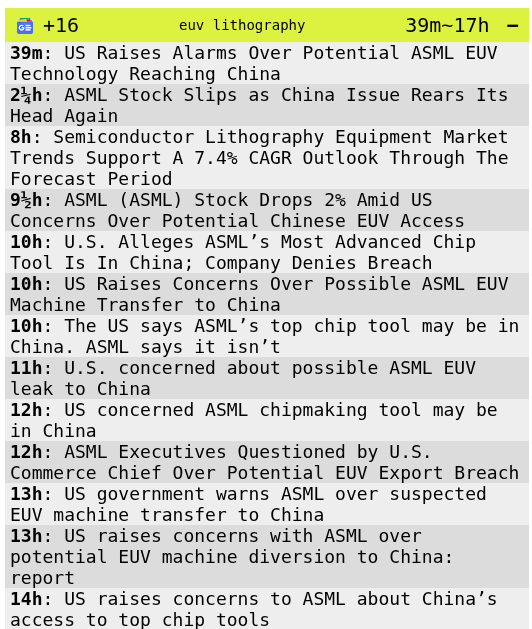
Commerce Secretary Howard Lutnick told ASML tonight that the US government believes that one of its ultraviolet lithography (EUV) machines may have somehow made its way into China. Senior administration officials said they have evidence that ASML is not acting in good faith.
To reduce European dependence on American technology firms, the European Parliament has replaced Google with a French search engine, Qwant.
Qwant generates its search results by querying the Microsoft Bing API.
What caught my eye in the WSJ's Tim Cook interview was not so much Apple signaling that it will raise device prices, but rather its declaration that it intends to put its enormous cash pile to work.
Contrary to how the WSJ read it, I interpret this differently. Just as Nvidia cut SOCAMM2 capacity because of an LPDDR supply shortage, LPDDR is likely to grow even scarcer going forward, to the point where Apple may have to cut iPhone production. This will demand bolder spending from Apple and pressure it to unwind its previously disciplined spending practices.
Here is my core point. If even Nvidia cannot secure supply, will Apple be able to get enough? If you have already run channel checks, you will know that even Chinese smartphone makers are paying premiums to grab LPDDR.
In the end, Apple will pay prepayments to the memory makers to expand its memory supply, and that is how I read Cook's remark: "We're willing to use our balance sheet to help be a part of the solution."
I do not think this is impossible. Apple paying prepayments is not unprecedented. It has done so before, paying Samsung an advance for OLED. If anything, you could say Tim Cook is the originator of the Nvidia style approach to seizing the supply chain.
tbh, there is no guarantee that NAND prices will go down after 1Q27
Hynix won't be expanding capacity
NAND prices will be largely dictated by how much YMTC expands capacity in the next 18 months