The issue of statins and Lp(a) increases has raised quite a bit of discussion. I think its instructive to see the context how I and my colleagues @UCSDCardiology got interested in this issue as it has several interesting aspects, including what is taken as medical dogma, how evidence is gathered and interpreted and how controversies are sustained or addressed. So, for those interested, read this long post: Arthur Schopenhauer said: "All truth passes through three stages. First, it is ridiculed. Second, it is violently opposed. Third, it is accepted as being self-evident." On this topic, it's not an orderly progression, but all 3 are currently occurring at same time, depending on the audience and level of engagement.
The story: Starting aout 20 years ago, we were measuring Lp(a) with our Lp(a) assay in many statin trials and publishing many papers. And I noted that Lp(a) frequently increased when a statin was "first" initiated, which seemed incongruent with medical teaching. So I went back to the literature to see what the evidence was.
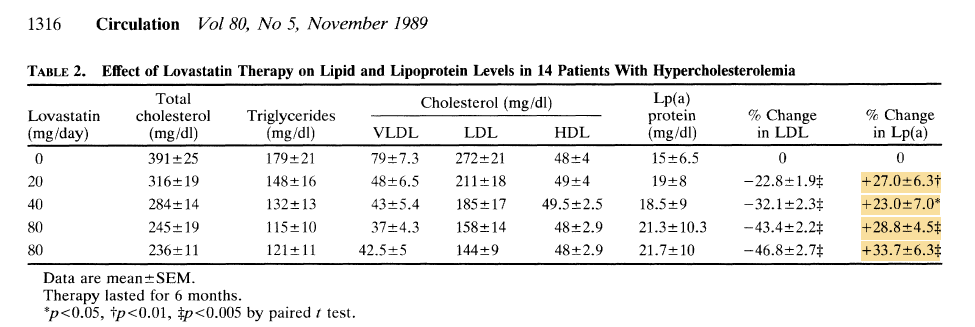
I first realized this was a potentially important issue clinically when I saw the title of this paper in 1989: "HMG CoA reductase inhibitors lower LDL cholesterol without reducing Lp(a) levels. Circulation. 1989;80:1313-9."
So what is the issue with this paper? The issue is both the title and the interpretation are incorrect. In fact, the first statin to be used clinically in US actually increased Lp(a) by 23-34%. A more appropriate title should above been "HMG CoA reductase inhibitors lower LDL cholesterol but raise Lp(a) levels. Circulation. 1989;80:1313-9."
This was apparently either not appreciated or more likely ignored by the authors, the peer reviewers or the editors of the most eminent cardiology journal at the time, Circulation. So, coming from esteemed authors, the field basically concluded statins have no effect on Lp(a), starting in 1989. So many people lectured and taught this and it became a medical dogma, but with false evidence. And the teaching was "you don't need to worry about Lp(a) if you treat the LDL-C". Of course, we now know this not true- with multiple sources of evidence, including these 2 large statin studies, where statins reduced LDL-C mediated risk but did not affect Lp(a)-mediated risk- https://t.co/IHrYyotT1E
https://t.co/7R3Jxkq2hi
At this time we were all working on @OxPL_apoB biomarkers to understand Lp(a) biology and also on antisense therapies to treat Lp(a), but the rest of the field was not interested at this time. So, we came to the conundrum that if Lp(a) is a genetic and independent risk factor, and an effective therapy that treats LDL-C raises Lp(a), is this real and if so what is the implication?
So we put together a meta-analysis with rigorous methodology, unlike all other studies: individual patient data (vs pooled data from trials), first initiation of a statin, same assay, same lab to minimize confounding bias. This is critical in Lp(a), as the values can be 100x different among patients and if one uses pooled for studies, one gets regression to the mean and difficult to make conclusions. Our meta-analysis in 5256 pts (vs 14 pts in the Circulation study) confirmed that several statins raise Lp(a), on average ~20%, but in a few patients over 100 mg/dL increase was noted. We did not have outcome data per se to see if the rise in Lp(a) was clinically relevant.
So, what is the overall interpretation: statins lower LDL-C and are associated with less risk of first or subsequent CVD events. So they should be used to treat LDL-C. Unfortunately, in people with elevated Lp(a), in the majority, but not all patients, they lead to a rise in Lp(a). Overall, they are better off than not taking a statin, but the rise can only be neutral or lead to less benefit. So, if there is an alternative way to lower LDL-C without a rise in Lp(a), it seems preferable. One can do this with PCSK9i (if it can be approved) and ezetimibe currently.
Those of us taking care of patents have a deeper responsibility than to simply say ignore it as we dont know what the clinical implication is. We have to use the art of medicine for now to fill the gaps of knowledge until we get better data or specific way to treat elevated Lp(a).
Here is a typical case from my clinic. Everyone that orders Lp(a) pre and post statin will see this: 45 male presents to UCSD Lp(a) CLINIC with LDL-C 89, Lp(a) 101 mg/dL, father died of MI age 44, no other risk factors. Placed on rosuva 10, repeat labs in 6 weeks: LDL-C 67, Lp(a) 141 mg/dL. Typical discussion- if my main problem is Lp(a), why is a statin used that raised it 40%?. It's hard to ignore this. Taken off rosuva, Lp(a) decreased to 100 mg/dL in 3 months. Ultimately treated with Repatha and Zetia with LDL-C in 60s and Lp(a) in 80s. Is this the correct approach?.
When we lack data, medicine is not easy and there are many well-informed patients who've seen the issue of Lp(a) in their family and are appropriate concerned. For many years, the issue of Lp(a) was "if I cant do anything about it, why measure?". This is defeatist, you can do lots about it even now, and one can read this in my experience in the Lp(a) Clinic. https://t.co/REnpnAbk3d
Let's not treat the relationship of statin and Lp(a) the same way, but meet it head on and learn more about it.
I have always said no one should stop their statin if they need it to keep LDL-C low. That is not the point here. The point is use a combination of drugs that optimize both LDL-C and Lp(a) levels.
Lots of intrigues here, and hopefully we will have evidence on how to manage these issues better in future.
In 1967, a surgeon stopped a beating heart—on purpose.
It was the first human heart transplant, but behind the history was risk, controversy, and an ethical gray zone.
For the patient, it was his only chance.
Here’s the story behind the first heart transplant ever:🧵
Let’s twist!
On-call ST elevation procedure started looking simple: 2 wire, 1 DES provisional strategy but…mind the gap!
Rupture of jailed wire so… 3 WHwire and twist!! That’s all!
Are you going to treat those patients with a Calcium score > 300 as aggressively as someone with known atherosclerosis (prior MI or revascularization) ?
Why or why not?