@dMatrix_AI Raptor 3D-DRAM breakthrough validates their 30-50 MW scale-up for 2027 - a massive volume driver for Napatech’s SmartNICs as AI inference ramps up! 🚀 $NAPA
We're humbled to share that Corsair just won the AI Processor Innovation Award as part of this year's AI Breakthrough Awards.
The industry is moving swiftly to heterogeneous compute. We built d-Matrix exactly for this shift and have begun shipping in volume.
🔗 https://t.co/pPITp1pF1f
#AI #Inference
Smart piece by @alex_woodie in @HPCwire on why SRAM-centric chips are pulling ahead in AI inference.
HBM sits off-chip and is supply constrained. SRAM sits on-chip and is not. That means faster tokens AND available silicon.
Corsair is in full production and shipping.
🔗https://t.co/z9hIRQZErJ
#AI #Inference
Corsair™ is now in full production.
Products are beginning to ship in volume to priority hyperscalers, neoclouds, and frontier AI labs.
Thanks to our ecosystem partners TSMC, @AristaNetworks, @Broadcom, @Supermicro, @gimletlabs, and @AlchipTECH for helping make this milestone possible.
Read more:
https://t.co/mI8jQcidWo
#AIInference #AIInfrastructure #HeterogeneousCompute #DataCenterAI #Corsair
Corsair™ is now in full production.
Products are beginning to ship in volume to priority hyperscalers, neoclouds, and frontier AI labs.
Thanks to our ecosystem partners TSMC, @AristaNetworks, @Broadcom, @Supermicro, @gimletlabs, and @AlchipTECH for helping make this milestone possible.
Read more:
https://t.co/mI8jQcidWo
#AIInference #AIInfrastructure #HeterogeneousCompute #DataCenterAI #Corsair
Corsair™ is now in full production.
Products are beginning to ship in volume to priority hyperscalers, neoclouds, and frontier AI labs.
Thanks to our ecosystem partners TSMC, @AristaNetworks, @Broadcom, @Supermicro, @gimletlabs, and @AlchipTECH for helping make this milestone possible.
Read more:
https://t.co/mI8jQcidWo
#AIInference #AIInfrastructure #HeterogeneousCompute #DataCenterAI #Corsair
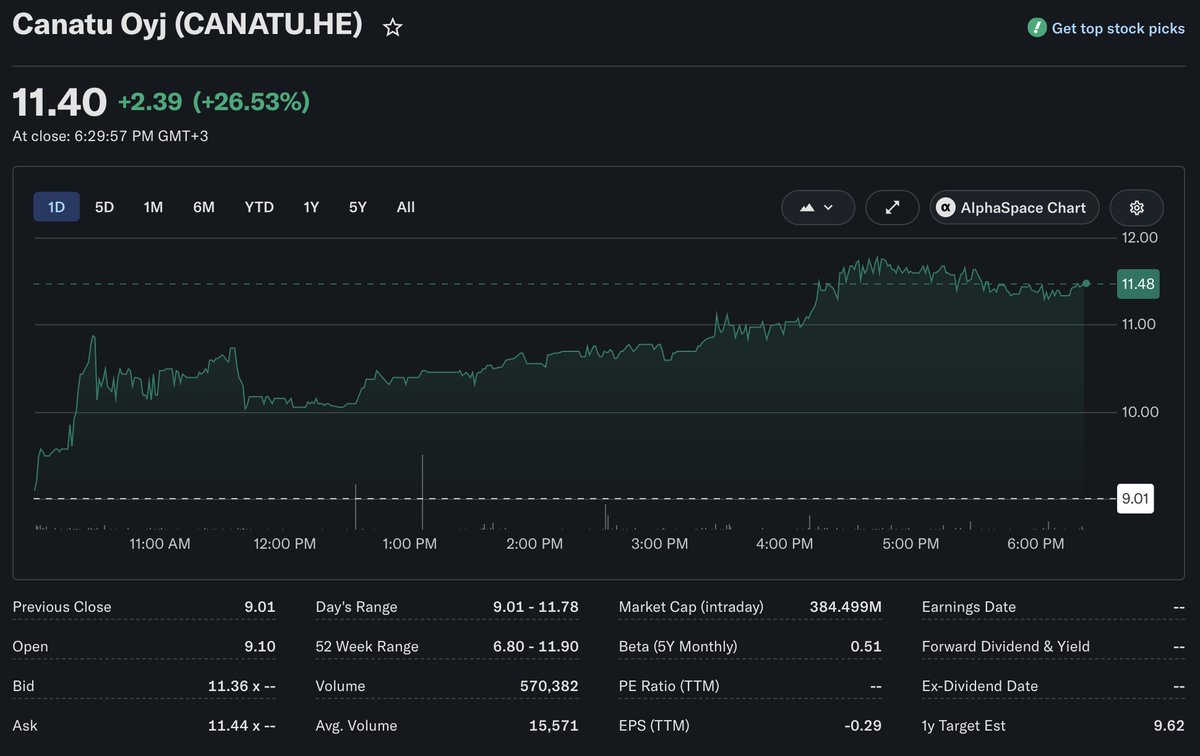
Long $CANATU. Got some useful pushback and new data in the replies.
The Samsung piece turned out to be more concrete than I expected. Samsung and FST presented jointly at SPIE Advanced Lithography, showing CNT pellicles applied to 2nm node devices with stable pattern transfer across thousands of wafer exposures. FST's technical lead came from Samsung's own photomask team. That's not a rumor from Korean trade press. That's Samsung actively building an alternative pellicle chain. That's what moved me from watching to owning.
The thesis is that the world needs more than one pellicle supplier for high-power EUV, and $CANATU reactor-and-royalty model is how a second source gets built. Small position. Full loss accepted.
Still want to know if anyone has visibility on whether $TSM is running the same logic.
Not financial advice.
FA skriver om Napatech.
For oss: 2026 dreier seg om designvins og nye kontrakter. Skalering i 2027.
Fortsatt verdt å analysere. Tenk enkel pris volum bruttomargin case. Fabless så det «capper» marginen. Hvor blir din analyse.
https://t.co/DRqyqviYHp
Chips Act 2.0 is coming, and it's tilting hard toward Europe's existing strengths in advanced materials and the lithography supply chain. The EU has basically decided it can't win on raw fab volume, so it's going after the critical pieces the rest of the world can't easily replace. EUV lithography and advanced materials sit near the top of that list.
Sitting right in the middle of that focus is $CANATU.
They own the only commercial CNT reactor tech for high-power EUV pellicles. That edge gives the fabs an 8 to 15% scanner productivity boost, which unlocks tens of billions in annual value for the factories printing AI chips.
Same Nordic micro-cap playbook as $SIVE. Under the radar, tiny ~€280M market cap, and a massive chokehold on the exact bottleneck the EU now wants to own.
New ex-Soitec CEO just started. Cash fortress. Royalty model ready to scale. $SOI
This is the kind of name Chips Act 2.0 was built to reward.
$CANATU. DYOR
Good second day holding $CANATU. Volume well above its usual.
We've seen this pattern in European semis already, $SIVE in Sweden, $XFAB in Germany, names that sat ignored, then got found.
Early days. DYOR, NFA.
$NAPA has serious long-term potential - Napatech is a Danish tech powerhouse with a 20-year track record in delivering high-performance FPGA-based SmartNICs and DPUs.
Their core strength lies in deterministic, ultra-low latency performance with zero packet los, exactly what the most demanding environments need.
Whether it’s financial trading networks (where every microsecond counts for real-time data ingestion, analytics, strategy execution, and order routing) or other compute-intensive server applications, Napatech’s SmartNIC technology provides mission-critical, always-on acceleration that competitors simply can’t match.
The proof is in the customer list:.
$CSCO , IBM, $INTC, $AMD (via Xilinx), HP, Dell, Bank of America, Boeing, Airbus, $NOK, Symantec, Morgan Stanley, Northrop Grumman and many more trust Napatech for their most latency-sensitive workloads.
That kind of blue-chip validation doesn’t come easy.
Leadership is another big plus. CEO Kartik Srinivasan joined from a senior role at Intel (where he ran the entire Ethernet Connectivity Products line from 1G to 200G) and previously held key positions at $MRVL and Xilinx (now AMD).
He brings deep domain expertise in networking, AI-first transformation, and global go-to-market execution.
On the fundamentals, Napatech checks all the right boxes:
Denmark HQ with +100 resources worldwide and strong R&D in Copenhagen, 22 patents and patents-pending creating a high barrier to entry.
Solid financial track record and a highly leverageable business model.
Positioned in the rapidly expanding $3.3 billion programmable NIC market by 2025.
$NAPA has serious long-term potential - Napatech is a Danish tech powerhouse with a 20-year track record in delivering high-performance FPGA-based SmartNICs and DPUs.
Their core strength lies in deterministic, ultra-low latency performance with zero packet los, exactly what the most demanding environments need.
Whether it’s financial trading networks (where every microsecond counts for real-time data ingestion, analytics, strategy execution, and order routing) or other compute-intensive server applications, Napatech’s SmartNIC technology provides mission-critical, always-on acceleration that competitors simply can’t match.
The proof is in the customer list:.
$CSCO , IBM, $INTC, $AMD (via Xilinx), HP, Dell, Bank of America, Boeing, Airbus, $NOK, Symantec, Morgan Stanley, Northrop Grumman and many more trust Napatech for their most latency-sensitive workloads.
That kind of blue-chip validation doesn’t come easy.
Leadership is another big plus. CEO Kartik Srinivasan joined from a senior role at Intel (where he ran the entire Ethernet Connectivity Products line from 1G to 200G) and previously held key positions at $MRVL and Xilinx (now AMD).
He brings deep domain expertise in networking, AI-first transformation, and global go-to-market execution.
On the fundamentals, Napatech checks all the right boxes:
Denmark HQ with +100 resources worldwide and strong R&D in Copenhagen, 22 patents and patents-pending creating a high barrier to entry.
Solid financial track record and a highly leverageable business model.
Positioned in the rapidly expanding $3.3 billion programmable NIC market by 2025.
We have interviewed Kartik Srinivasan, CEO of Napatech. In the interview Kartik tell us where the company is today, the strategy going forward and why the company is a good investment.
https://t.co/vvGbpk1KnR
A quantum-safe future must be in the near-term roadmap for every serious blockchain.
We cannot assume security against quantum threats for much longer, as advancements quantum computers continue to accelerate.
@FinnStockinger Would love your take on napatech ($NAPA XOSL) - working to become the acceleration platform of the AI data center era. Strategic partnerships with industry leaders, including a tier-1 server ($DELL?) OEM, Altera, Intel, and AI-inference innovator @dMatrix_AI
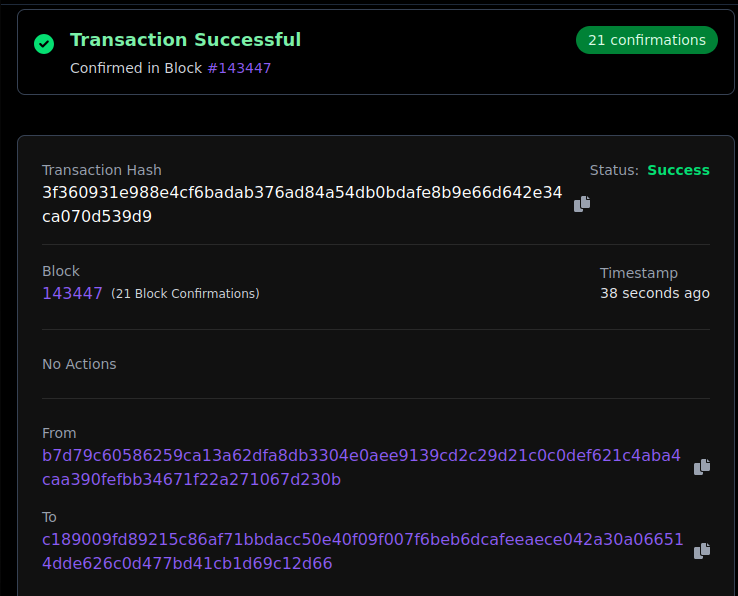
The AegisPQ upgrade has now activated on the testnet!
This upgrade brings:
- MLDSA87 Post-Quantum Signatures
- DVG for improved on-chain governance
- Extended 48-byte address format