SERV Reasoning-armed models just beat Anthropic's newly released flagship Fable (Mythos) - one of the strongest LLMs ever built - at up to 90x lower cost.
With SERV, enterprises can finally afford AI at scale.
We spent the last two years building for exactly this moment.
The labs promised costs would halve every 6 months - instead, prices keep climbing, subsidies are ending and the math breaks.
There is a way out.
SERV-enabled models vs Claude Fable 5 (85.17 ~3.24¢):
→ DeepSeek-V4-Flash: 87.15 - wins at 90x lower cost
→ NVIDIA Nemotron: 90.78 - wins 5+ pts, 11x lower cost
→ Gemma 4 12B: 83.33 - within 2 pts, on local hardware
Top-tier performance no longer requires the most expensive model.
And cost is only half the story - production AI must be reliable, auditable, private, and secure, or it dies in procurement.
SERV is built for all of it.
The agentic economy finally has the infrastructure to run on.
Japonya ve ABD aynı denklemin iki tarafı. 1992'de pound'u kıran adam 2026'da yen'i savunuyor.
Bessent bugün bir açıklama yaptı.
Japonya'nın temellerinin güçlü olduğunu, aşırı döviz oynaklığının istenmeyen olduğunu söyledi.
Herkes Bessent'in Japonya'ya destek mesajı verdiğini yazdı.
Ben başka bir şey görüyorum.
Bessent yen'i kurtarmaya çalışmıyor. ABD'yi kurtarmaya çalışıyor.
Anlatıyorum.
Şöyle düşünün.
Komşunuz size 30 yıl boyunca neredeyse faizsiz borç verdi. Siz o parayla başka yerlerde gelir elde ettiniz. Komşu zenginleşmedi. Siz büyüdünüz.
Bir gün komşunun evi yandı. Komşu borç vermeyi bırakmak zorunda kaldı. Hatta verdiği parayı geri istedi.
Sizin tüm büyümeniz o paranın üzerine kuruluydu.
İşte Japonya ve ABD arasındaki ilişki bu.
Japonya yıllardır dünyanın en ucuz parasına sahip ülke. ABD yıllardır dünyanın en çok borçlanan ülkesi. Hiçbir anlaşma imzalanmadı. Ama mekanizma kendi kendine kuruldu.
Bugün Japonya dünyada en çok ABD tahvili tutan ülke. Resmi rakam yaklaşık 1.2 trilyon dolar. Dolaylı kanallar eklendiğinde rakam çok daha yüksek.
30 yıl boyunca bu denge bozulmadı.
Şimdi bozulmaya başladı.
Yen değer kaybediyor. USD/JPY 160 seviyesini aştı. Japonya enerjisinin neredeyse tamamını ithal ediyor. Yen düştükçe ithalat pahalılaşıyor. Enflasyon yükseliyor.
Japonya Merkez Bankası iki seçenek arasında sıkıştı.
Birinci seçenek: Yen düşmeye devam etsin. Halk fakirleşir. Enerji faturası yükselir.
İkinci seçenek: Faizi artır. Yen güçlenir. Ama 30 yıllık ucuz para mekanizması biter.
İkinci seçenekte ne olur biliyor musunuz?
Japonya'dan ucuz parayla borçlanıp ABD tahviline yatıran fonlar pozisyonlarını kapatır. Tahvil satar. Borcunu öder.
Yani Japonya faizi artırdığı an ilk satılan şey ABD tahvilleri olur.
Burada Bessent için asıl risk başlıyor.
Çünkü 2026 ABD için sıradan bir yıl değil.
Bu yıl yaklaşık 10 trilyon dolarlık eski borç yenilenecek. Vadesi gelen tahviller ödenecek. Yerine yenisi satılacak.
Yeni tahvillerin getirisini ne belirler? Talep.
Talep yüksekse getiri düşer. ABD ucuza borçlanır.
Talep düşükse getiri yükselir. ABD pahalıya borçlanır.
Şimdi düşünün.
Tam 10 trilyon dolar yenilenirken Japonya tahvil satışına başlarsa ne olur?
Arz artar. Fiyat düşer. Getiri yükselir.
Her 100 baz puan ek getiri ABD'nin yıllık faiz yüküne yaklaşık 400 milyar dolar ekler.
ABD'nin toplam borcu 39 trilyon dolar. Faiz ödemesi zaten yılda bir trilyonun üzerinde. Toplanan her dört vergi dolarından biri sadece faize gidiyor.
Bu tabloda küçük bir şok bile ciddi bir baskı yaratır.
Japonya satarsa şok küçük olmaz.
Ve burada hikayeye üçüncü halka ekleniyor.
Hürmüz.
Japonya tükettiği enerjinin yaklaşık yüzde 90'ını ithal ediyor. Petrolün büyük bölümü Körfez'den. Tankerler Hürmüz Boğazı'ndan geçiyor.
Hürmüz son aylarda kapanma riskini iki kez yaşadı. Petrol fiyatı yükseldi.
Japonya için bu üç katmanlı bir sıkışma.
Cari açık derinleşti. Yen baskısı arttı. Yen baskısı arttıkça enerji ithalatı pahalandı. Pahalanan enerji yeniden yen baskısı yarattı.
Japonya yen'e dört kez müdahale etti
30 Nisan, 1 Mayıs, 4 Mayıs, 6 Mayıs. Toplam 72 milyar dolar harcadı.
Yen toparlanmadı.
Bunun anlamı tek bir şey.
Japonya bu işin altından tek başına kalkamıyor.
İşte Bessent burada masaya oturdu.
Sahnenin görünür kısmı şu: ABD Hazine Bakanı Japon mevkidaşına destek mesajı veriyor.
Sahnenin görünmeyen kısmı şu: ABD Hazine Bakanı kendi tahvil piyasasını koruyor.
Çünkü Japonya tek başına kalırsa zincir kendi kendine hareket eder.
Yen daha hızlı değer kaybeder. BOJ faiz artırmak zorunda kalır. Ucuz para musluğu kapanır. Fonlar ABD tahvili satar. Getiri yükselir. 10 trilyon dolarlık yenileme yılı baskı altına girer.
39 trilyon borçlu bir ekonomi için bu basit bir piyasa hareketi değil.
Tüm sistem sallanır.
Bessent bunu en iyi bilen adam. Çünkü aynı senaryoyu 1992'de yaşadı.
O yıl 30 yaşındaydı. Soros'un Londra ekibindeydi. İngiltere Merkez Bankası tek başına pound'u savundu. 27 milyar pound rezervini bir günde harcadı. Akşam saatlerinde pes etti. Pound bir günde yüzde 15 değer kaybetti.
Bessent o gün bir merkez bankasının nasıl yenildiğini canlı gördü.
1992'de saldıran taraftaydı.
2026'da savunan tarafta.
Çünkü oynanan oyun değişti. Bu kez yenilen merkez bankası tek başına aşağı düşmeyecek. Aynı kanaldan ABD'yi de aşağı çekecek.
Bu haftaki G7 toplantısı bu yüzden önemli.
Üç senaryo masada.
A. Japonya direnir, ABD destekler. Yen toparlanır. Sistem hayatta kalır.
B. Japonya pes eder. BOJ faiz artırır. Ucuz para musluğu kapanır. ABD tahvil getirisi yükselir. Yenileme yılı baskı altında geçer.
C. Bessent Plaza tarzı koordineli bir anlaşma getirir. Bu sefer dolar zayıflatılır. Yen güçlendirilir.
Üç senaryonun ortak noktası şu.
Bu kararı Japonya değil ABD veriyor.
Bu benim şahsi analizim.
Önümüzdeki dönem kritik, sizi bilgilendireceğim.
the strongest crypto x ai exposure increasingly looks like it’ll be projects built as layers on top of frontier models
right now, the two clearest leaders are $vvv as the privacy layer and $serv as the reasoning layer - two of the only projects with tech that has been shipped, non-crypto customers, credible value accrual, and large ecosystem potential
payments and identity are probably the next layers to garner attention, but these feel further away
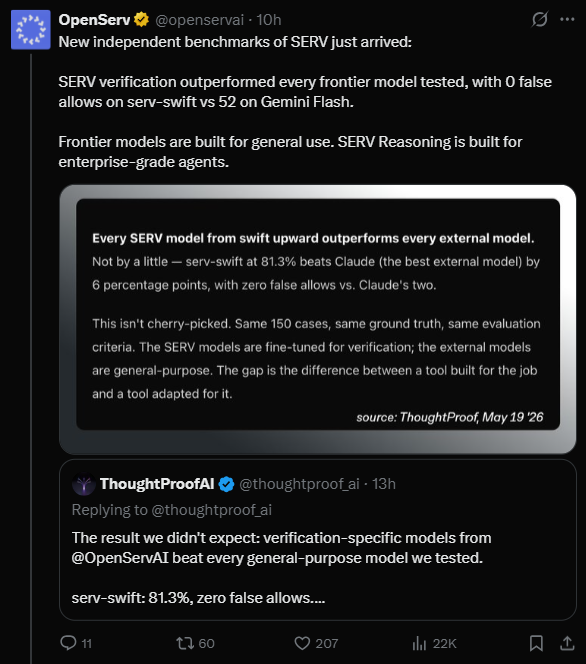
New @thoughtproof_ai benchmarks dropped showing $SERV models outperform @claudeai and @Gemini achieving 81.3% accuracy with zero false positives.
Gemini had 52 false positives highlighting the difference between enterprise-ready solutions and demoware.
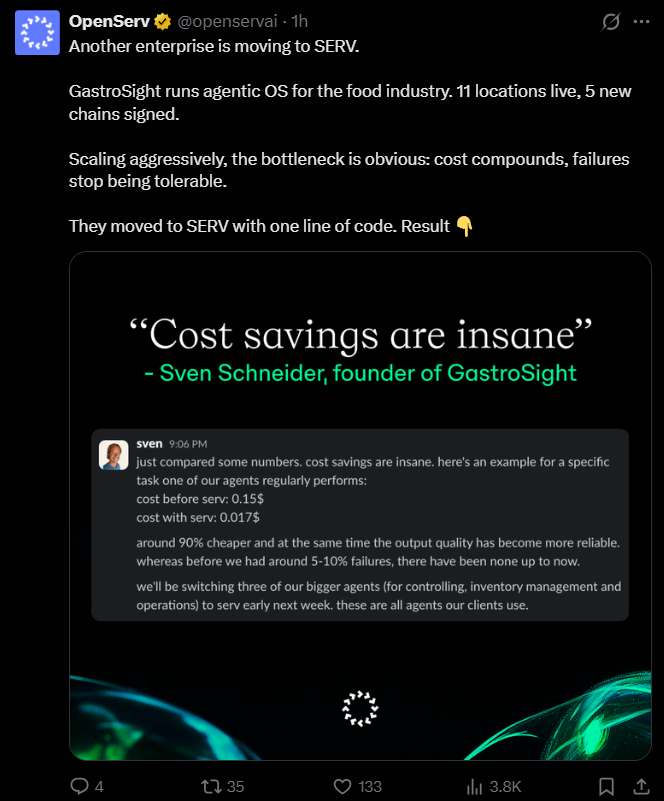
GastroSight, a restaurant chain with 11 locations and 5 new chains, switched to $SERV, reducing costs by 90% and eliminating failures with one line of code.
Two independent validations in one day and this is only Private beta batch 1; at sub $50M now imagine batch 10
These successes demonstrate the practical adoption of $SERV, rather than merely relying on hype.
The result we didn't expect: verification-specific models from @OpenServAI beat every general-purpose model we tested.
serv-swift: 81.3%, zero false allows.
Claude Sonnet: 75.3%, two false allows.
Gemini Flash: 54%, fifty-two false allows.
Same 150 cases. Same ground truth. The gap is the difference between a tool built for the job and one adapted for it.
New independent benchmarks of SERV just arrived:
SERV verification outperformed every frontier model tested, with 0 false allows on serv-swift vs 52 on Gemini Flash.
Frontier models are built for general use. SERV Reasoning is built for enterprise-grade agents.
#COPPER
Copper alone just made a new ATH, and almost nobody seems to notice 👽
Copper is highly correlated with risk-on assets. When copper rises, it usually signals economic strength - and when the economy is strong, more money flows into risk assets.
That’s why copper making new ATHs is extremely bullish for markets. Just look at the SPX and Nasdaq - almost nobody expected such a massive V-shaped reversal Crypto will follow! 🚀
#Crypto #bitcoin #altcoins #stocks
fwiw it seems to me that robust price oracles reduce to robust market making / order book designs. I'm not sure there's much room to innovate here over SOTA designs, and an additional challenge is that robustness is obv bounded by the total amount of liquidity on chain, which implies that first order robustness comes from liquidity growth rather than from new ideas (plainly put: medium volume + decent design >> small volume + novel design)
@nic_carter This is a very interesting use case of real-time decentralization, ie the ability to sample the honest majority in real time - - miners running a decentralized chancery (I suppose using SLMs) to govern stablecoin transfers
(https://t.co/woM0WlLVqW)
You are absolutely right: tools alone are not enough.
What you also need is a unifying mission - a stag worth hunting together - and it cannot just be a product, a memecoin or a financial instrument. It has to point beyond finance and beyond economic settlement.
That is why I do not think the real opportunity here is simply to build better tools for coordination. It is to build mission-driven institutions that can coordinate people around questions and goals that existing structures struggle to hold.
I think I have already identified the stag I personally want to hunt: properly exploring the possibility that cognition is a scale-free process in our cosmos.
A growing number of scientists and researchers are beginning to take this idea seriously. But the work lives in the cracks between established fields - AI, philosophy, physics, cosmology, biology, economics, and perhaps even some form of spirituality - which makes collaboration unusually hard and costly.
The people best positioned to push it forward are usually too busy doing the actual work to also build the social infrastructure needed to coordinate the field in a persistent and goal-directed way.
There are of course people like Dr. Michael Levin trying to connect the dots by organizing conferences and conversations across disciplines. But efforts like these are still relatively isolated, often revolve around key individuals, and lack a persistent address that others can turn to if they want to follow the work, contribute, or collaborate.
And if this movement keeps growing, the coordination burden on those individuals will only increase.
That is exactly why I think a distributed institution dedicated to this mission could matter - something like a Cognitive Cosmos Institute: a persistent coordination layer for people working on these questions, and potentially even a new channel for funding outside the established structures of academia.
Maybe it fails. Maybe people think the whole idea is nonsense.
But I believe we are at a unique moment in the development of our species. We now have tools that are still radically underutilized when it comes to building mission-driven institutions.
I think people generally underestimate how much agency they actually have.
Sometimes you can just do things. And it is up to us to build the tools that empower people to do exactly that.
I think the questions @hashdag raised are not necessarily only tied to technological challenges but are also more of a "mindset issue".
People have to understand that they can do incredible things with these emerging tools that have never been done before.
Crypto needs to turn from a collection of bag holders, hunting for yield, into a group of people that actually want to change the world!
That should be the message of Kaspa - not digital anarchy but a full blown digital society that interfaces with the real world in as many meaningful ways as possible and that has a shared vision of the future.
It's fine to generate wealth along the way but we should also be aware of the amount of agency we have as a collective to just do things.
I just got back from my Easter trip visiting family, and one of the first things I made time for was listening to Yonatan’s Oxford Union speech. I think he absolutely nailed it: https://t.co/46WvWwy2xg
If there is one thing we can learn from our progress in AI, it is that intelligent behavior emerges when many components explore degrees of freedom and converge, through distributed constraint resolution, into coherent and stable patterns.
The modern world has connected an enormous number of people and given us unimaginable freedom, but it still lacks a credible way to enforce shared constraints.
The result is a crisis of responsibility at every scale of society: from cyberbullying to former superpowers chasing old glory through war, to leaders blaming the weakest members of society for national decline, or even killing their own citizens to preserve power.
At the same time, our capacity to inflict harm on one another has become increasingly asymmetric. Small actors can now create disproportionately large disruptions, and conflicts no longer remain local. They send shockwaves through the emerging superorganism we call humanity.
The age in which we could dominate one another and still produce a stable world is coming to an end. The only serious path forward is collaboration.
People may feel pessimistic about the future, but I think we are approaching an inflection point. Even the old superpowers are beginning to learn this lesson the hard way.
The American Dream of "I can make it" is gradually giving way to the realization that individual prosperity depends on collective wellbeing, and that we can build far larger and more meaningful things when we share a common dream.
That is why I am excited about DLTs, and Kaspa in particular.
Not because I see them as safe havens for hiding wealth from corrupt governments in some dystopian future, or because I want people to get rich by selling to later participants.
But because I believe DLTs can offer a superior foundation for large-scale human coordination: one that is more neutral and reliable than traditional models based on force and mutual deterrence.
In that world, wealth is not the goal in itself, but a byproduct of coordinating around shared missions, empowering people to contribute, and aligning incentives toward common outcomes.
The future is not about building better products. It is about building better protocols: systems that allow human beings to coordinate meaningfully at larger scales than ever before.
For the first time in human history, we have the tools to build institutions that are not bound to territory, yet can still provide structural coherence without having to fight wars to establish their legitimacy.
What we need now is a group of people bold enough to take that mission seriously.