@0xPolygon partnerships with Meta, Visa, and Modern Treasury were followed by one key integration:
Hinkal for private stablecoin payments
Inside the Polygon wallet.
For Polygon’s institutional clients, privacy remains the primary blocker. Hinkal is the protocol solving this gap.
Details 👇
@righteous_fires If Chainalysis flags an address, the transaction is blocked off-chain and the app/server refuses to proceed, so the proof is never built or submitted.
The stablecoin stack is almost complete.
Issuance, custody, wallets, liquidity, compliance, interop - every layer has mature infra you can plug into.
Confidentiality should work the same way.
Right now, moving stablecoins on-chain means publishing your finances.
Payroll - who got paid, how much Treasury - balances and cash flow
Suppliers - counterparties and history
The hard part isn't the problem. It's adding privacy without a new wallet, a new custody model, or a migration. Hinkal plugs into the wallet infra you already run - @privy , @turnkeyhq , DFNS, and others.
Your existing signature unlocks a confidential balance.
- Sender, recipient, amount hidden on-chain
- A relayer broadcasts, so the wallet isn't the public sender
- ZK proofs, no custody of funds or keys
- Privacy toggled per transaction, inside your product
Still auditable: viewing keys disclose specific transactions to auditors or compliance. @chainalysis screening runs alongside.
Confidential ≠ opaque.
0x123 - 50,000 USDC - 0x456 becomes private sender - private amount - private recipient Same wallet stack underneath. Works on @ethereum , @arbitrum , @0xPolygon , @base , @BNBCHAIN, @tempo , @Solana, @trondao .
Don't want to build the UI? Hinkal Prime ships it - confidential treasury, payroll and batch payouts with roles and approvals.
The missing layer doesn't get filled by migrating your money somewhere else. It gets filled by adding one more piece to the stack you already run.
Every crypto payment you make is a public disclosure. Salaries, invoices, treasury moves anyone with a block explorer sees who paid whom, how much, and what's left. No business would accept this from a bank. On-chain it's the default.
Hinkal Pay fixes it.
Connect the wallet you already use. @MetaMask , @WalletConnect , @Ledger , @phantom or others. One signature, nothing to install. Hinkal never holds your keys or your funds.
Then pay privately. Funds move into your shielded balance → a zero-knowledge proof confirms the payment is valid without revealing sender, amount or recipient → the recipient gets paid, unlinkably.
Private ≠ unaccountable. Viewing keys let you prove any payment to an auditor, partner or regulator whenever you choose.
Private by default. Transparent on demand. Send almost any token - USDT, USDC, DAI, ETH, SOL, BNB, POL - across @ethereum , @arbitrum , @0xPolygon , @base , @BNBCHAIN , @tempo , @solana , @trondao and @arc testnet.
Start here: https://t.co/pEx4L2NFXH
@nikkideyy@solana@benchdotmarkets imagine what you transact, where, and how much - all private, still compliant. isn't that crazy? well- you don't have to imagine it anymore. just explore 😇
@Tottomokoo@ethereum Most security practices start as features and end as a necessity. The difference here is that going private on hinkal doesn't cost much.
July on @ethereum : $28.99M in private transaction volume through hinkal.
On a public chain, every transfer is a broadcast: who you paid, how much, what's left in your wallet. All of it is readable by anyone.
hinkal shields that by default, the transaction settles on-chain, the details don't. $28.99M in one month says the market wants it that way.
Transact privately: https://t.co/5TxHBDGRhF
@0xAmberCT@arc@circle Appreciate the mention ✊
What our users can do, to put it simply is moving USDC(and not only USDC!) without exposing amounts or counterparties, with selective disclosure for whoever needs to verify.
Testnet's open on Hinkal Pay and Hinkal Prime if you would like to test it!
Stablecoins solved the money part. Not the privacy part.
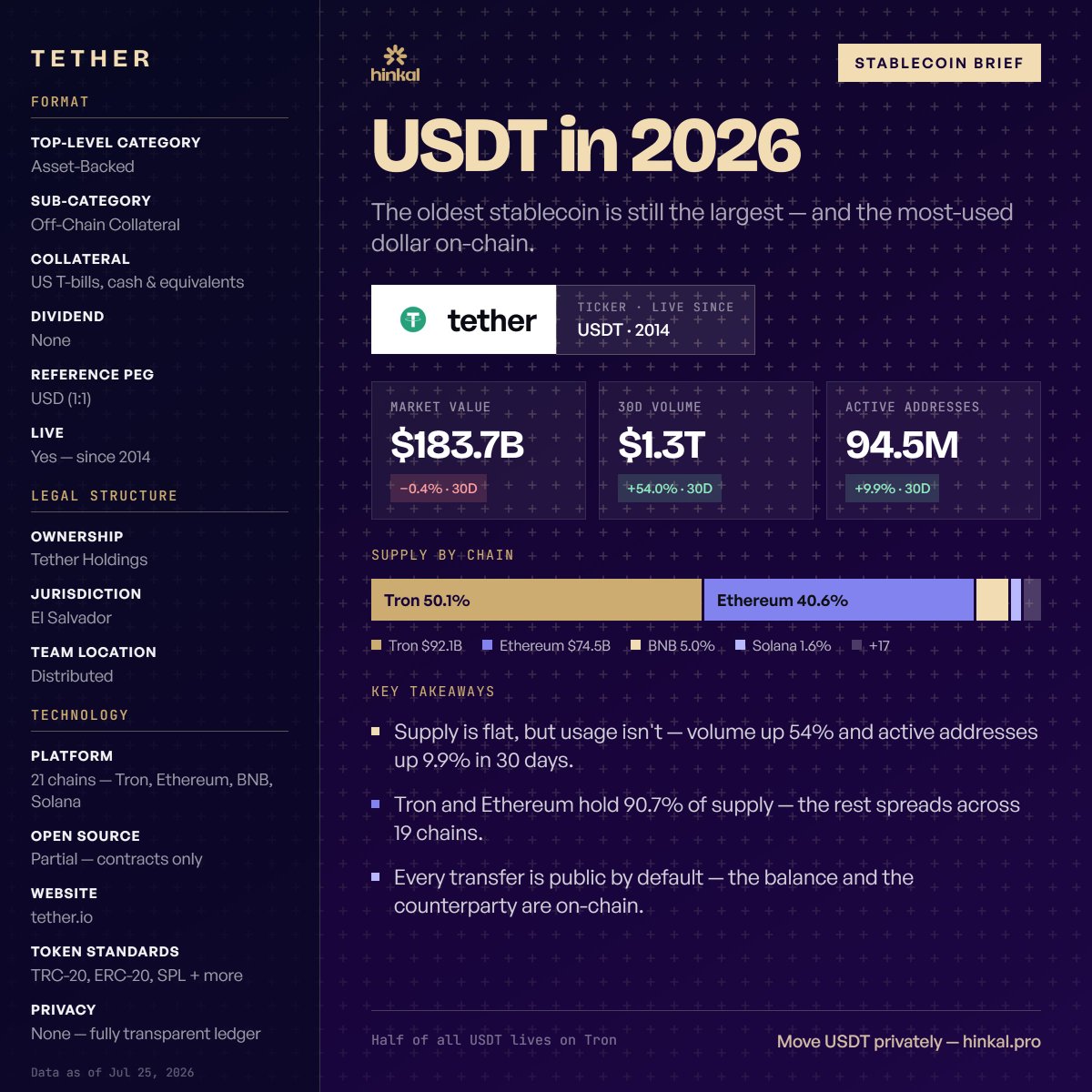
$183.7B of USDT is out there and $1.3T of it moved last month. All of it readable by anyone with a block explorer.
Pay a contractor in USDT and they see your treasury. Rebalance a fund on-chain and you get front-run. Pay suppliers and your competitor knows your volumes.
No one would accept that from a bank wire.
Hinkal fixes it. Same USDT, same chains, your own custody. The amounts just stop being public.
If your team moves size in stablecoins, DMs are open. No pitch. https://t.co/PUcTHcLal7
Hinkal is now native Go.
Until now, Go backends integrating Hinkal had to run a Node.js runtime just to access protocol-level privacy.
That’s gone.
go get https://t.co/U15U6fhWA9
Pure Go — no Node.js, no WebAssembly, no process bridge.
It enables private transfers, batch payouts, swaps, cross-chain transfers, balance, and recovery of stuck funds.
Signing stays in your infrastructure. Hinkal never holds your keys or funds.
Live across Ethereum, Arbitrum, Polygon, Base, BNB Chain, Tempo, Solana and Tron Nile and Arc testnet to build against first.
If your payment infrastructure runs in Go, privacy can now run there too.
Docs: https://t.co/489ayHYPdH