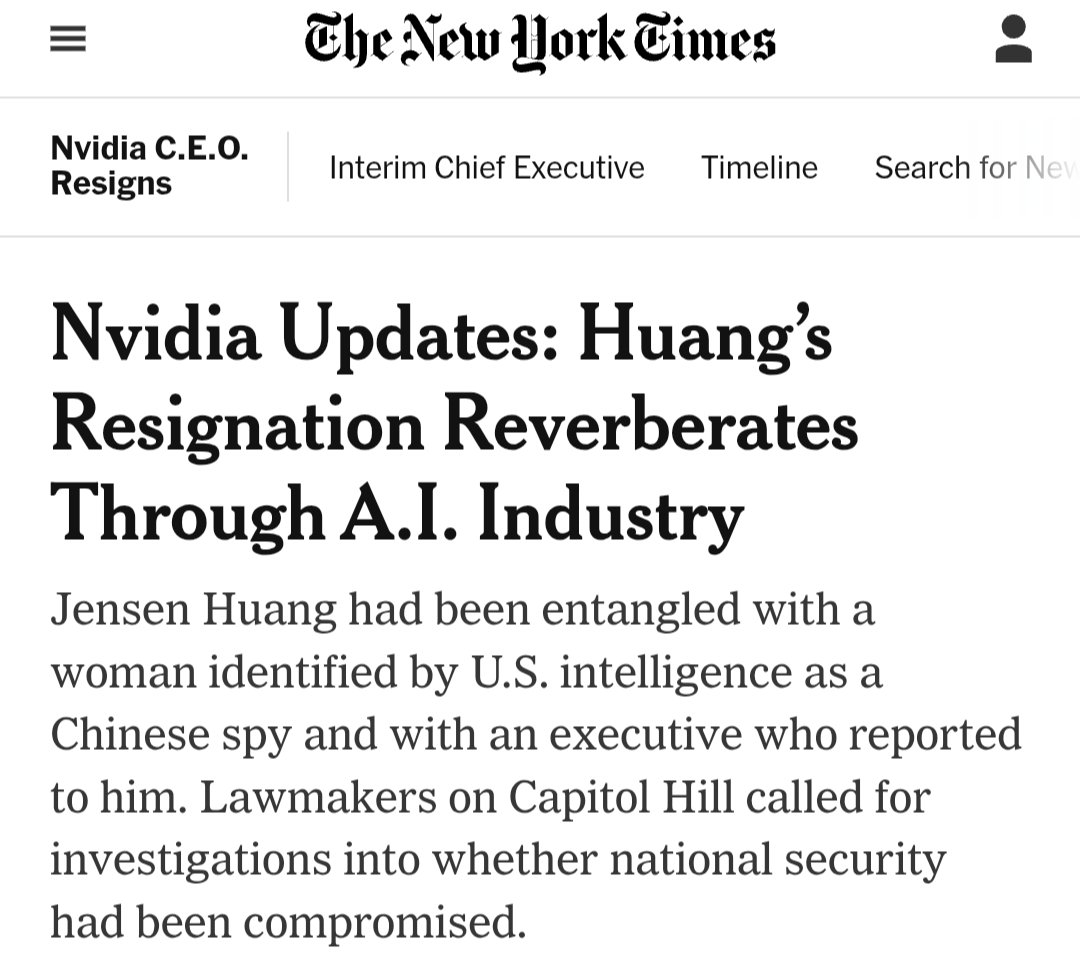
Why the boards cannot fire Mark Zuckerberg and Elon Musk but COULD fire Jensen Huang. More important, why DID they?
It is not about an extramarital affair. That is easily papered over. But American boards cannot tolerate an undisclosed relationship with an employee.
In the past CEOs of McDonald's, Intel and several others have had to quit for the same reason.
Plus just as hiding a romantic relationship with an employee (now there are two at least apparently) is a problem so is hiding a romantic relationship with a client - especially, when you have been favouring them with huge delivery of cutting edge chips.
Whether Alice Huang was acting for the Chinese military or not, the fact is that what was effectively a shell company got out of turn allotment of almost 5 billion dollars of cutting edge AI chips - something Jensen had the discretion to give.
The possible downside and even legal liability for the board would have been huge - that is why they acted.
They really had no choice, even though most of the directors have been there for decades and are Jensen's friends
Whether this would turn out to be great for the company's business or not is another story.
Risk mitigation was the board's job here, not really maximizing business interests.
Then we come to why Zuckerberg and Musk cannot be fired.
This is to do with what are called A/B shares, which means dual class shares where public shareholders have shares with different rights than the promoters.
It is no longer ‘one share one vote’ which has traditionally been the basis for good corporate governance.
In the US dual class shares reached a peak during the 1920s boom when family businesses went public while keeping the rights within the family. And we know how that boom ended!
These were then banned outright by 1940 by the New York Stock Exchange.
This mechanism was reinstated in the 1980s but the current boom mostly goes back to the Google/ Alphabet listing in 2004 which had a system to preserve founder control.
This template was then followed by many others in tech like Facebook/Meta. About 25 to 30% of recent IPOs in the US have featured dual class shares.
In the proposed Anthropic IPO for instance, the promoters propose to keep majority shareholding rights in spite of having only about 14% of the shares.
Nvidia went public in the 1990s before the revival of this mechanism, so Jensen's voting rights are in line with his single digit #shareholding, so he COULD be fired.
If you have learnt something here, share with your friends
#AI
#CorporateGovernance
@firstglobalsec@fghumsmallcase
Why buy a house before it's built?
I've been reading with great alarm the tweets of a gentleman who lives in an upmarket building in Gurgaon.
He seems like a sensible chap, but one who is deeply disappointed with his apartment in what is supposed to be a prestigious residential building.
I have no idea who's right or wrong, or whether his complaints are justified.
But his experience brings me back to a question I've always had.
Why would anyone buy a house before it's built?
Think about it.
You're committing crores of rupees to something that doesn't even exist!
Will the lifts work properly? Will the entrance be impressive? Will the amenities actually be delivered? Will the construction quality match the glossy brochures? Will the building be maintained well? Who will your neighbours be? How many dogs roaming around? How big is the parking space for your car? etc etc
Will you even have privacy in your bathroom? (This gent 'claims' that his bathroom is public view)
You cannot know hundreds of things until a building is completed and occupied.
And then there's the financial absurdity.
Check the pic (And the sheet) for a TYPICAL "just going to start" apartment project in South Mumbai.
The builder wants my Money in instalments over almost eight years, with possession promised in 2034.
So I did something interesting.
I created a spreadsheet comparing the builder's payment schedule with investing the same amounts, on the same dates, in mutual funds.
Even assuming handsome appreciation in the apartment's value, the alternative investment could leave me substantially better off.
Of course, investment returns aren't guaranteed. Neither is property appreciation!
But here's what bothers me.
Why should I finance a builder's construction, surrender control of my Money AND take on the risk of delays, poor construction, disappointing amenities and broken promises?
Why not invest that Money with discipline and buy a ready apartment when I actually need it? Invest money in MFs like you are paying EMIs!
I can then inspect the flat, test the lifts, walk through the entrance, experience the amenities, understand the maintenance and meet the neighbours.
I can buy what I SEE, rather than what I'm SOLD.
Yes, the apartment might cost more by then. But my Money could have grown too.
I'm attaching my spreadsheet for anyone who wants to experiment with their own assumptions. Please tweak as you please with your proposals! (Make a copy and use. If you run into trouble, ping me!)
I'm not suggesting that buying under construction is always a bad decision. Exceptional deals may be worth considering.
But for me, the fundamental question remains:
Why buy a promise when you can buy the finished product?
Am I missing something? I'd especially love to hear from people who prefer buying under-construction apartments.
#dhandhekibaat: Buy what you can see, use, keep or sell.
Sheet link in the comments! Please use it!
Mr. Musk, yes, no billionaire should dictate a nation’s policy - Indian or American.
India must welcome competition in satellite internet, from Indian and global providers, whoever offers the most practical and affordable last-mile solution for those in remote regions. In countries with lower per-capita incomes, satellite internet must be affordable too. High subscription fees and equipment costs risk putting it beyond the reach of ordinary households. Connectivity must bridge the digital divide, not create a new one.
India knows our networks and spectrum are strategic infrastructure, not merely commercial assets. India’s national security safeguards are non-negotiable.
Every country makes choices based on its own interests. Those in the West cannot preach free markets while practicing protectionism at home. USA imposed 100% tariffs on Chinese EVs to protect its domestic industry, just as India takes measures to protect its own domestic manufacturers. Both India and the US have restricted Huawei over security concerns. One cannot demand a level playing field from others only when it suits its own agenda.
Indians will internally debate, question and address our strengths and shortcomings as a democratic country.
Take BharatNet, India’s programme to bring broadband to village-level local bodies. We will question why, as the CAG’s 2026 audit report found, the programme is struggling to meet its original objectives. Why were only 33.2% of service-ready Gram Panchayats operational, despite ₹39,888 crore being spent? At the same time, we know to appreciate our telecom sector and regulations, which has made internet data among the world’s most affordable, bringing millions online.
India is a democracy, not a colony. We welcome the world, but we, the Indian people, will decide our own future - not Western vested interests, their double standards or any billionaire - Indian or American.
Today we finished the transfer and integration of the IITD system (v1) to the Ministry of Earth Sciences supercomputer. 10-day lead time riverine flood forecasts across the country generated in less than 15 minutes, powered by @ncmrwfmoes weather forecasts. All credit goes to my 2 PhD students (Ved and Priyam) who are "forward-deployed" to the official agency to ensure that our research doesn't die in a paper or report.
There is less than 0.1% probability of an Indian brand crossing ₹500 cr in 10 yrs
The maths is brutal:
(a) Approx. 1% of brands started in 2015 hit ₹100 cr in FY25 (per my own analysis of TRACXN data)
(b) Approx. 11% of brands started b/w 2015 & 2020 have crossed ₹500 cr in FY25 (per DSG’s analysis)
The Consumer Brands goldrush in India has created an incorrect perception that founders & investors can make easy money.
Let me explain the maths to you as a sector agnostic Seed VC:
An MIT Media Lab study used EEG to track what happens in the brain when people write with ChatGPT rather than on their own. Fifty four students completed essay tasks while wearing electrode caps. One group used ChatGPT, one used a search engine, and one used no tools. Across sessions, the ChatGPT group showed the weakest neural connectivity in networks linked to memory, attention, and analytical work. They also had more trouble recalling what they had just written and produced more generic prose. The authors describe this as a kind of cognitive debt: the tool does the synthesizing, and the brain stays quieter [1].
The same experiment points to a better order of use. Students who first wrote unaided and only later switched to ChatGPT showed stronger recall and more widespread brain activity than students who started with the model and then had to work alone. In other words, the model helped more when it scaffolded thinking that was already underway than when it replaced that thinking from the start. The practical lesson is not that large language models should be banned. It is that they work best as a second pass, after the writer has already done the hard part of forming and remembering an argument [1].
[Kosmyna, N., Hauptmann, E., Yuan, Y. T., Situ, J., Liao, X. H., Beresnitzky, A. V., Braunstein, I., & Maes, P. (2025). Your Brain on ChatGPT: Accumulation of Cognitive Debt when Using an AI Assistant for Essay Writing Task. arXiv. DOI: 10.48550/arXiv.2506.08872]
Been saying I was building something cool, and it’s finally here. I built it for my dadi.
She doesn't use multiple apps; she just uses WhatsApp. So I built an AI assistant that lives right there.
She sends a voice note in Hindi, and her groceries arrive. It never buys anything on its own. It reads the order back and waits for her confirmation. Cash on delivery only.
Voice by @ElevenLabs , orders via @Swiggy 's MCP tools, running on WhatsApp via @Meta . Agent is Nous Hermes 4 @NousResearch .
Watch it in action below 👇.
I’m writing a full technical deep-dive article on this architecture and will be dropping it soon.
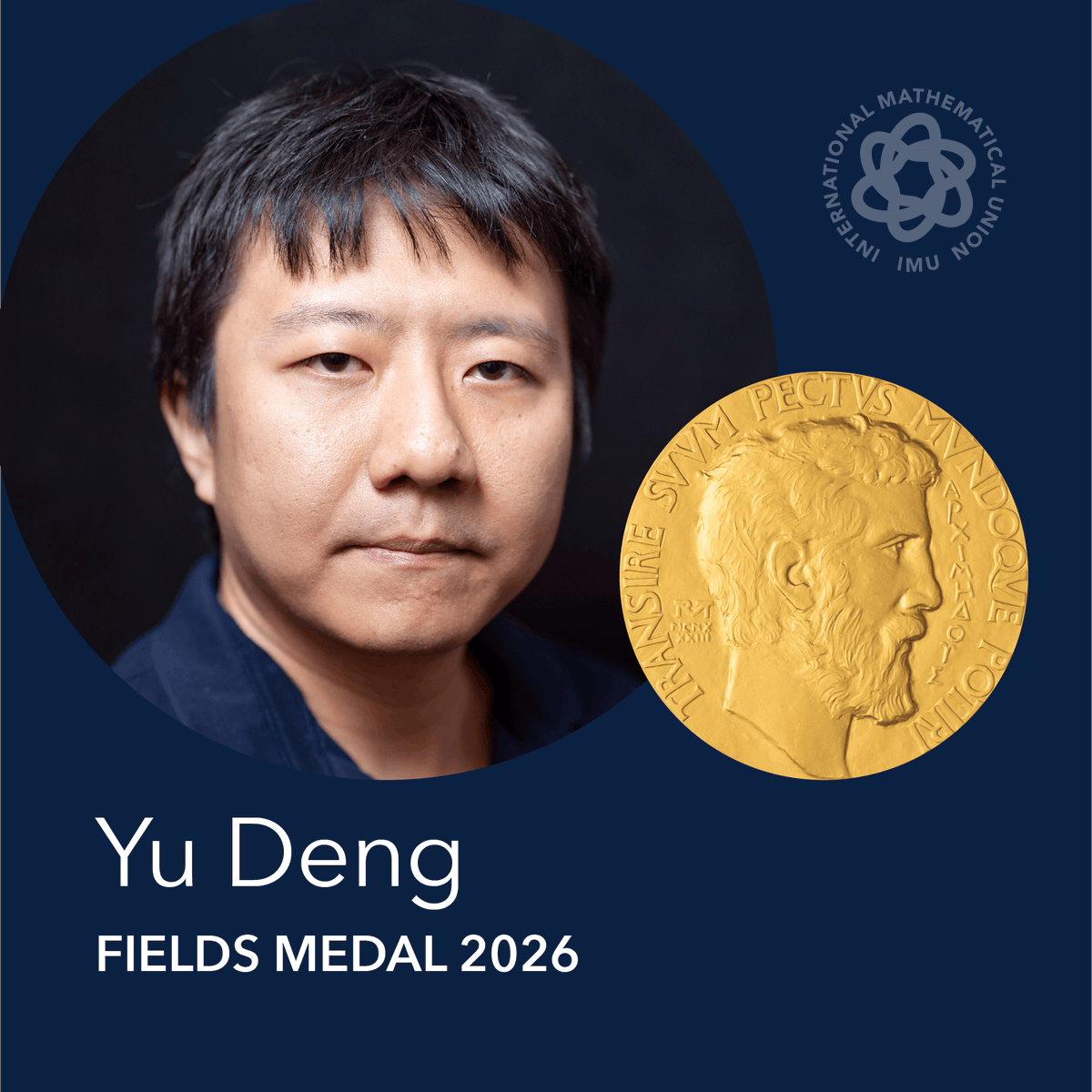
During today's #ICM2026 opening ceremonies, the IMU announced the 2026 Fields Medals recipients:
@UChicago's Yu Deng, @stonybrooku's John Pardon, @UofT's Jacob Tsimerman, and Hong Wang of @nyuniversity and @Institut_IHES.
Read more: https://t.co/oJARAI8I8j
Small side note: Influenzas are attempting to re-introduce goiter by hyping up iodine-free sendha namak and "himalayan pink salt". Don't be stupid. Use iodized salt
@beastoftraal I have been using AppBlock, an app, and it has an interesting mechanism to unblock. You can pause the lock but it takes about 5 seconds to pause. So, that's works as the first level memory loop break. There is a Strict Mode also, where you can't pause / stop for sometime.
In a very remote part of Nunavut, northern Canada, lies a seemingly unremarkable body of water. According to the map, it's just one of many mid-sized lakes in that area.
However, 45-mile (72 km)-long Yathkyed Lake contains something quite literally unique in the world.
1/n
It's a shame no major film has been made about Biju Patnaik. He lived a life that sounds almost fictional:
In 1938, he flew his entire wedding procession by aircraft to Rawalpindi for his marriage to Gyanwati Sethi (who became the first Indian woman to hold a commercial pilot’s license, and the couple later flew daring missions together.)
While serving in the Royal Indian Air Force (including as head of Air Transport Command), he secretly ferried freedom fighters like Jayaprakash Narayan, Ram Manohar Lohia, and Aruna Asaf Ali to their hideouts. He also airdropped 'Quit India' leaflets to Indian troops while evacuating British families.
The British once jailed him for transporting nationalist leaders and distributing anti-British literature but also honored him for bravery in evacuating civilians from Japanese-occupied Burma.
During WWII, he flew daring missions delivering arms and supplies to Soviet forces in Stalingrad, and over the treacherous 'Hump' route to China in
support of Chinese Nationalist forces against the Japanese.
In July 1947, he and his wife flew a Dakota into Indonesia, landed on an improvised airstrip while evading Dutch anti-aircraft fire, rescued Prime Minister Sutan Sjahrir, refuelled using abandoned Japanese fuel, and flew him safely to India via Singapore.
A couple of months later, during the Pakistani invasion of Kashmir, he airlifted one of the first Indian troops into Srinagar.
The same year he founded Kalinga Airlines, one of India's earliest private airlines.
As Odisha CM post-1962 India-China war, he secretly visited CIA headquarters at Langley to forge a covert India-US partnership against China, which led to the Aviation Research Centre (ARC) at Charbatia, which supported U-2 recon missions over Tibet.
He was also a legendary administrator and statesman, laying much of the foundation of Odisha's industrial empire (mines, ports, heavy industries etc).
When he passed away, Indonesia observed 7 days of state mourning. Russia observed 1 day. He remains the only person in Indian history whose body was draped in the national flags of 3 nations - India, Indonesia, and Russia.
Few public figures have left such a footprint.
His extraordinary life needs to be brought to the big screen.
The global aviation community was stunned. The Americans who built the plane were left speechless. Indian engineers & a fearless pilot had taken a foreign cargo plane, bolted a fighter engine to its roof & rewritten the rules of physics in the sky.
It is July 23, 1962. The jagged, barren wasteland of the Karakoram Range looks like the surface of the moon. In the valley below, a crude, unpaved strip of dirt & loose gravel sits frozen in the Karakoram Pass. This is Daulat Beg Oldie (DBO): the highest advanced landing ground on Earth.
Tensions with China are simmering to a boil. The Indian Army jawans stationed on this freezing frontier are completely cut off. They need men, they need ammunition & they need them yesterday. But conventional military wisdom says flying a massive, heavy transport plane into DBO is a suicide mission.
The air is too thin to create lift. The dirt strip is too short to stop.
The Western aviation world had already given its verdict: Impossible. They did not account for Indian ingenuity & they certainly did not account for Squadron Leader C.K.S. Raje.
On the tarmac at Jammu, a twin-boom Fairchild C-119G Packet transport plane affectionately known as the "Flying Boxcar" idles. But this is not a standard American-built cargo plane anymore. Perched precariously on top of its fuselage, like a rocket backpack, is a raw, unshielded British-designed Orpheus 701 jet engine, ripped straight out of a Folland Gnat fighter jet.
This mechanical chimera is the brainchild of Indian maintenance engineers & the fledgling GTRE. It is an unproven, terrifying gamble. If the jet engine fails/if its immense thrust rips the roof off the fuselage, the plane will disintegrate. Climbing into the cockpit is Squadron Leader Raje. Walking in right behind him are 32 battle-ready jawans loaded with full gear & Air Vice Marshal Erlic Pinto, the chief of Western Air Command, who refuses to let his men take a risk he will not take himself.
The props blur into motion. The piston engines roar. The modified Packet lifts off, heavily clawing its way toward the roof of the world. As Raje navigates the treacherous Himalayan peaks, the true nightmare begins. The air is so thin that the Packet’s twin piston engines begin to gasp for oxygen, losing power. The control columns vibrate violently. Below them, DBO appears, a tiny, dusty brown ribbon surrounded by lethal mountain walls.
There are no air traffic controllers, no radar, no paved runways. Just a strip of loose earth.
Raje throttles back. The massive plane drops like a stone through the thin air, bouncing violently as its tires slam into the gravel of DBO. Dust explodes around the fuselage. The brakes screech, fighting the loose rocks, throwing the passengers forward against their harnesses. Against all mathematical odds, they stop. The doors fly open. The icy Himalayan wind rushes in & 32 jawans step out onto the highest battlefield on earth.
But landing was only half the battle. The real terror is the takeoff. To get a heavy transport plane off the ground at 16700 feet, you need speed that the thin air physically denies you. The runway is too short. The mountain at the end of the strip is rushing closer by the second. Raje lines up the Packet. He pushes the piston engine throttles to the absolute wall. The plane starts rolling, but it is sluggish, heavy, dragging through the gravel.100 meters... 200 meters... the end of the strip is coming up at terrifying speed.
The plane is not lifting. It is a dead weight. Raje reaches for a custom-built switch on the panel. The Jet Toggle. He flips it. With a deafening, supersonic shriek that echoes across the Karakoram range, the Orpheus jet engine on the roof ignites. 20 kN of pure, unadulterated jet thrust punches the cargo plane from behind. A massive column of flame & jet wash erupts over the tail.
The Packet does not just accelerate, it rockets. The front wheel lifts off the gravel just as the runway runs out. The massive cargo plane claws, screams & blasts its way into the sky, clearing the jagged mountain peaks by a matter of yards. When Raje touched down back at base on July 23, 1962, he had not just completed a supply run. He had shattered a world record for the highest take-off & landing by a transport aircraft in aviation history.
No child is born able to read. The brain ships with no reading region at all. It builds one, and the construction runs on the exact effort AI removes.
Learning to read physically repurposes a patch of visual cortex. A spot in the left fusiform gyrus starts out tuned to objects and faces. Through months of effortful decoding, a 6-year-old converts it into the visual word form area, the region every literate adult uses to recognize words on sight. Stanislas Dehaene mapped it and called it neuronal recycling. Pre-literate kids show no special response to letters there. It shows up only as they struggle to read.
The struggle is the build signal. When a child strains to sound out a word or hold a sum in working memory, focus chemicals like acetylcholine and norepinephrine flag that circuit as worth keeping. Effort is how the nervous system marks which synapses to strengthen. Low effort, no marker.
Errors carry the same signal. The brain learns from the gap between what it predicted and what turned out true. Each wrong guess followed by a correction releases the dopamine that drives the rewire. Fluent, instant output produces almost none of it.
The wiring locks in later, during deep sleep, when the circuits tagged that day get consolidated. Only the ones that fired hard enough to get tagged. A child who never strained tagged nothing to keep.
Hand that child a model that returns the sentence or the answer on demand, and the strain, the errors, and the prediction gap vanish at once. The worksheet looks finished. The cortex that should have rewired underneath it never fired.
The window is the urgent part. The tissue reading recycles is where childhood plasticity peaks, and ages 6 to 13 are when that repurposing is cheapest. Miss the reps then and the same wiring costs far more to build later, if it builds at all.
Norway is the country that already ran the opposite experiment. In 2016 they gave a tablet to every 5-year-old, went all in on screens in class, and watched the results for a decade. Now they're pulling AI out for ages 6 to 13 and funding paper books again. A government reading its own data ahead of the curve.
The biology is identical in every country. Norway just moved on it first. Watch how fast others follow.
Elon Musk got rejected by Netscape. He walked into the lobby, was too shy to talk to anyone, and walked out. Never got the job.
At his first company Zip2, the board demoted him. Twice. They refused to let him be CEO.
He got fired from PayPal as CEO while flying to his own honeymoon. The board voted him out mid air.
He almost died of malaria in 2000. Ten days in intensive care. Lost 45 pounds. A day from death.
His first child died at 10 weeks old.
His first rocket exploded. Falcon 1, flight one. Burned on the pad.
His second rocket exploded.
His third rocket exploded. The last of his money was nearly gone.
Tesla nearly went bankrupt in 2008. The closest he ever came to a nervous breakdown.
Both companies almost died on the same Christmas Eve.
He was sued by investors. Mocked by the people who built cars before him.
His childhood heroes, the astronauts who inspired him, testified against his company to Congress.
The Cybertruck window shattered on live stage in front of the world.
He overpaid for Twitter by his own admission and watched its value collapse.
He was beaten unconscious as a child and thrown down a flight of stairs.
He has said he goes to sleep alone and it kills him.
He failed in public, over and over, for thirty years.
He is the richest man in the history of the world.
The difference was never the absence of failure. It was the refusal to stop after it.