@Fat_Electrician Would you recommend that pistol for my first time carry gun, I know on podcasts you were talking about wanting the new canik prime as well. Just wanted to get your thoughts on it
@jimsheater Everybody here is acting like if they got a chance to shoot a machine gun from a helicopter they wouldn't take it, thats bull shit and yall know it
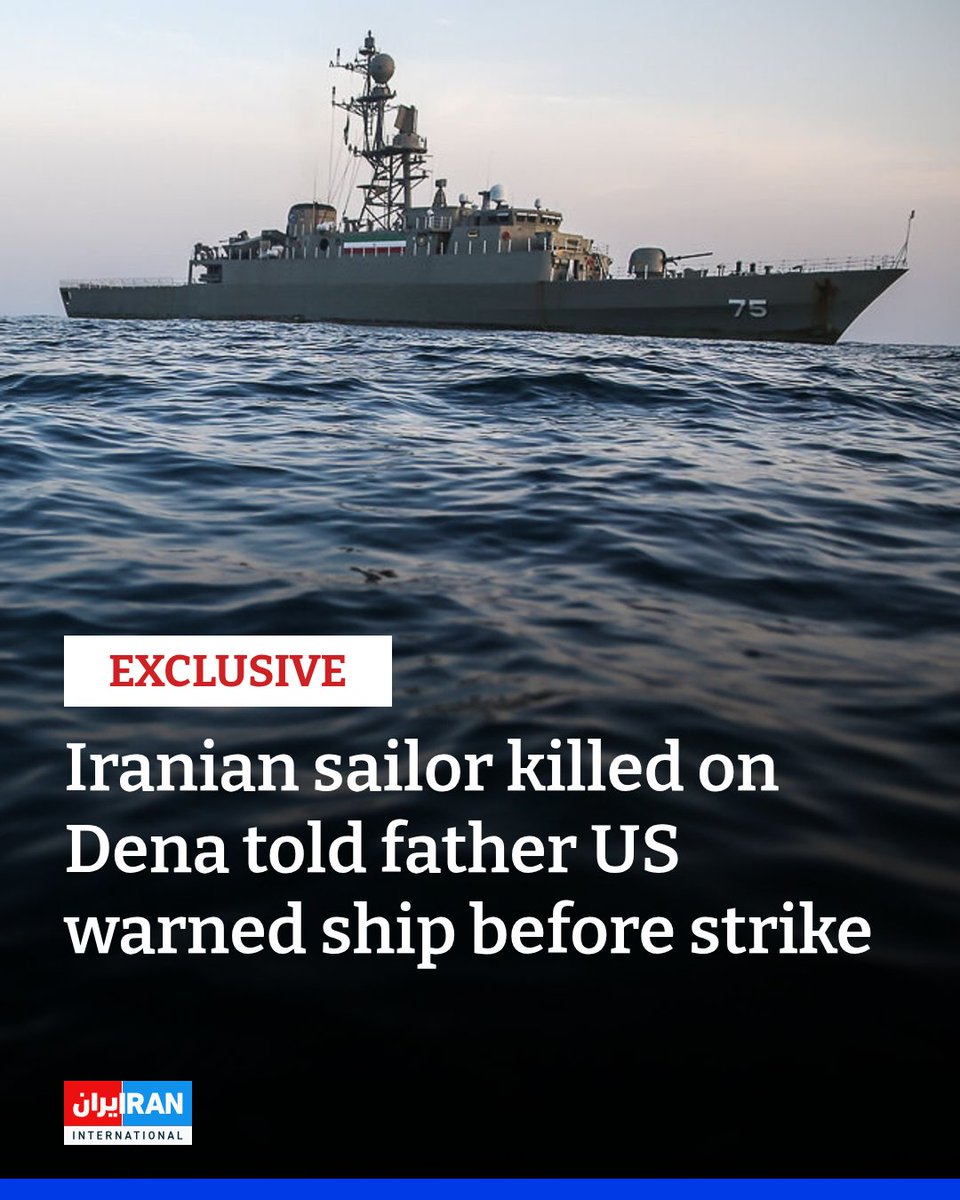
An Iranian sailor who was killed when the warship Dena was struck by the US near Sri Lanka had called his father shortly beforehand, saying American forces had issued two warnings for the crew to abandon the vessel, a source close to the family told Iran International.
The Iranian navy warship's commander refused to allow the crew to abandon Dena despite the imminent threat, the source added.
The sailor’s father said some crew members argued with the commander, and the 32 crew members who survived were mainly sailors who managed to escape on lifeboats, according to the source.
A US submarine torpedoed Dena in the Indian Ocean on Wednesday, about 19 nautical miles from the southern Sri Lankan port of Galle, killing dozens of sailors and significantly expanding Washington’s campaign against Iran’s naval forces.
The sinking of the Dena — described by US War Secretary Pete Hegseth as a “quiet death” — marked the first time since World War II that the United States had torpedoed an enemy warship.
https://t.co/QVJXGnF918
So this is about the US using a standard munition to sink an Iranian naval (combat, not supply or merchant marine) vessel that was returning to theater.
My phrasing is specific.
Several days ago, the occupying government of iran stated that they were closing their sea lanes...And all civilian traffic would be targeted.
I want to reiterate that. All civilian traffic.
So here we are four days later. This vessel, which is returning to theater from outside of theater and is in international waters, has had a half a week to communicate with anyone, seek a safe neutral port to wait out the conflict... Declare themselves non combatants and go elsewhere... Give up their munitions and ask to make way to port so that their dudes could go back to their families...
Anything.
This was a frigate, which is a fairly small warship. Basically the smallest thing that is a true blue water warship. They aren't very durable even when a first world navy is building and operating them.
So the video footage of the attack is... shall we say, dramatic. We don't routinely go into our ordnance and reduce the explosive payload by half or two thirds in order to give the enemy a fighting chance. Aside from the insane safety risk, there's just really no point to this.
And it's a true shame that their damage control environment was such that they lost, probably twice as many sailors as they should have.
And I mean, that it is really a shame. I'm a sailor. Both a US Navy veteran and an active "live on the water" sailor.
But the general opinion seems to be that we should have done something to allow this vessel to return to the theater of combat because sinking them was... bad.
I'm not even going to get into the insane risk and casualty ratio of boarding.
But kind of the big deal here is that they had days and days to say something- and it appears that they did not. Or if they did, they did not accept terms that were acceptable to us
So this is about the US using a standard munition to sink an Iranian naval (combat, not supply or merchant marine) vessel that was returning to theater.
My phrasing is specific.
Several days ago, the occupying government of iran stated that they were closing their sea lanes...And all civilian traffic would be targeted.
I want to reiterate that. All civilian traffic.
So here we are four days later. This vessel, which is returning to theater from outside of theater and is in international waters, has had a half a week to communicate with anyone, seek a safe neutral port to wait out the conflict... Declare themselves non combatants and go elsewhere... Give up their munitions and ask to make way to port so that their dudes could go back to their families...
Anything.
This was a frigate, which is a fairly small warship. Basically the smallest thing that is a true blue water warship. They aren't very durable even when a first world navy is building and operating them.
So the video footage of the attack is... shall we say, dramatic. We don't routinely go into our ordnance and reduce the explosive payload by half or two thirds in order to give the enemy a fighting chance. Aside from the insane safety risk, there's just really no point to this.
And it's a true shame that their damage control environment was such that they lost, probably twice as many sailors as they should have.
And I mean, that it is really a shame. I'm a sailor. Both a US Navy veteran and an active "live on the water" sailor.
But the general opinion seems to be that we should have done something to allow this vessel to return to the theater of combat because sinking them was... bad.
I'm not even going to get into the insane risk and casualty ratio of boarding.
But kind of the big deal here is that they had days and days to say something- and it appears that they did not. Or if they did, they did not accept terms that were acceptable to us
So this is about the US using a standard munition to sink an Iranian naval (combat, not supply or merchant marine) vessel that was returning to theater.
My phrasing is specific.
Several days ago, the occupying government of iran stated that they were closing their sea lanes...And all civilian traffic would be targeted.
I want to reiterate that. All civilian traffic.
So here we are four days later. This vessel, which is returning to theater from outside of theater and is in international waters, has had a half a week to communicate with anyone, seek a safe neutral port to wait out the conflict... Declare themselves non combatants and go elsewhere... Give up their munitions and ask to make way to port so that their dudes could go back to their families...
Anything.
This was a frigate, which is a fairly small warship. Basically the smallest thing that is a true blue water warship. They aren't very durable even when a first world navy is building and operating them.
So the video footage of the attack is... shall we say, dramatic. We don't routinely go into our ordnance and reduce the explosive payload by half or two thirds in order to give the enemy a fighting chance. Aside from the insane safety risk, there's just really no point to this.
And it's a true shame that their damage control environment was such that they lost, probably twice as many sailors as they should have.
And I mean, that it is really a shame. I'm a sailor. Both a US Navy veteran and an active "live on the water" sailor.
But the general opinion seems to be that we should have done something to allow this vessel to return to the theater of combat because sinking them was... bad.
I'm not even going to get into the insane risk and casualty ratio of boarding.
But kind of the big deal here is that they had days and days to say something- and it appears that they did not. Or if they did, they did not accept terms that were acceptable to us
So this is about the US using a standard munition to sink an Iranian naval (combat, not supply or merchant marine) vessel that was returning to theater.
My phrasing is specific.
Several days ago, the occupying government of iran stated that they were closing their sea lanes...And all civilian traffic would be targeted.
I want to reiterate that. All civilian traffic.
So here we are four days later. This vessel, which is returning to theater from outside of theater and is in international waters, has had a half a week to communicate with anyone, seek a safe neutral port to wait out the conflict... Declare themselves non combatants and go elsewhere... Give up their munitions and ask to make way to port so that their dudes could go back to their families...
Anything.
This was a frigate, which is a fairly small warship. Basically the smallest thing that is a true blue water warship. They aren't very durable even when a first world navy is building and operating them.
So the video footage of the attack is... shall we say, dramatic. We don't routinely go into our ordnance and reduce the explosive payload by half or two thirds in order to give the enemy a fighting chance. Aside from the insane safety risk, there's just really no point to this.
And it's a true shame that their damage control environment was such that they lost, probably twice as many sailors as they should have.
And I mean, that it is really a shame. I'm a sailor. Both a US Navy veteran and an active "live on the water" sailor.
But the general opinion seems to be that we should have done something to allow this vessel to return to the theater of combat because sinking them was... bad.
I'm not even going to get into the insane risk and casualty ratio of boarding.
But kind of the big deal here is that they had days and days to say something- and it appears that they did not. Or if they did, they did not accept terms that were acceptable to us
@mmpadellan You have claimed the Trump administration are nazis trying to be a dictatorship since he was sworn in. Do you know what prevents the government from becoming a dictatorship? Its the fear of a well armed populace that won't tolerate the government taking their rights.
@dan_vanman Canada is poorer than every U.S. state but one in GDP per capita - https://t.co/uiPI0bDh8K
The U.S. has a higher standard of living. The U.S. has a QoL score of 185.1, Canada's score is 161.3 - https://t.co/ClQuoenVpw