Microsoft just betrayed OpenAI and Anthropic, the two companies it helped build.
And it could break the entire AI trade...
Here's what happened:
Inside Excel and Outlook, two of the most used business apps on Earth, Microsoft has started routing tens of thousands of AI requests every week to its own in-house models instead of OpenAI and Anthropic.
Microsoft's own AI chief, Mustafa Suleyman, said himself: "We pay a lot of money to Anthropic, so our goal is to reduce and ultimately ELIMINATE that cost."
This is the company that poured $13 billion into OpenAI and effectively created the modern AI industry, and it just decided the most advanced models on the market are NOT worth paying for.
And here's the thing...
Microsoft is not just ripping out OpenAI everywhere - it is being surgical about it.
The hardest and rarest tasks can still go to OpenAI or Anthropic. What Microsoft is taking back is the boring, high-volume work, like the email replies, the thread summaries, and the simple spreadsheet formulas.
Why does that matter so much?
Because that boring, repetitive work is where the actual money lives.
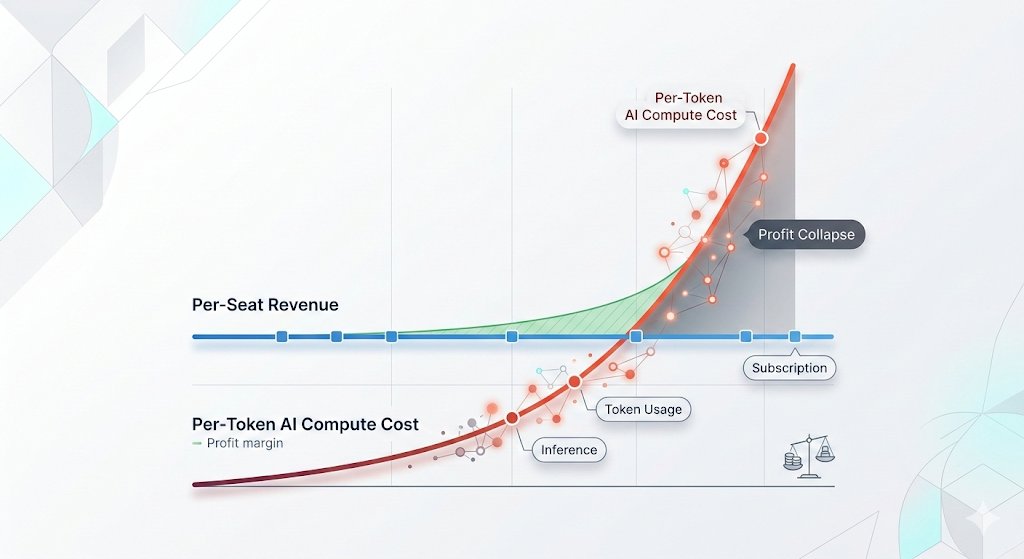
The frontier labs assumed businesses would push BILLIONS of these tiny requests through expensive models forever. That endless river of tokens is the entire reason OpenAI and Anthropic are valued in the hundreds of billions of dollars.
Microsoft looked at that river, decided it was massively overpaying, and rerouted it to models it owns outright.
So the single biggest customer in the industry just walked off with the most profitable part of the business.
And it is not only Microsoft:
That same week, CNBC reported that American companies have been escaping to Chinese AI models to dodge rising US prices.
Chinese models now handle more than 30% of US companies' AI usage on one major platform, peaking at 46%, up from an average of 11% a year earlier. They cost 60 to 90% less, and on some benchmarks they land within a single point of the best American model.
One US startup moved ALL of its AI traffic off Claude and onto China's DeepSeek, and expects to save millions.
Meanwhile Meta just admitted it has "excess" AI compute it wants to sell, becoming the first giant to concede it built far too much.
Do you see the pattern forming?
For two years, the entire AI story rested on one assumption: Every company on Earth would happily pay premium prices for the best model, forever.
That assumption literally died in a single week.
And the market noticed.
More than a trillion dollars has been wiped off AI and chip stocks in a matter of days, as Wall Street finally started asking whether all of this spending will ever pay for itself.
What this means for OpenAI and Anthropic:
Their models are extraordinary, and it may not matter because their own biggest customers have decided they do not NEED the best model in the world to answer an email, and "good enough" now costs a fraction of the price.
When even Microsoft refuses to pay full price for AI, the real question becomes who exactly IS left to pay it.
What do you think?
water scarcity problem is getting solved before even it started..
CHINA JUST UNVEILS SOLAR DESALINATION BREAKTHROUGH
- They developed a 3D photothermal material that converts seawater into freshwater using only solar energy, with no external electricity.
- This material absorbs 90.2% of sunlight, cuts evaporation energy nearly by 50% and achieves an 8.5× higher evaporation rate than previous designs.
- A 0.75 m² outdoor prototype produced over 20 liters of safe drinking water per day, enough for about 10 people, while meeting WHO water standards.
- New system also irrigated a 5 m² test farm growing spinach, corn, and Chinese cabbage, demonstrating potential for both drinking water and agriculture.
- Researchers estimate that after about 2 years of operation, the production cost of freshwater could become lower than commercial bottled water.
For many years, we’ve built the tech and the expertise to support teams across their entire onchain journey.
Here’s where that’s brought us and the framework we run: Conduit Stack, an OP Stack-compatible framework.
Conduit will continue to maintain and support numerous production OP Stack deployments and has deep expertise in operating the framework at scale.
The @Tempo mainnet launched 93 days ago. Quick summary of the current state:
• Run rate payment volume is around $3 billion. There's a long way to go, but it's cool to see real usage already emerging. (It took Stripe a lot longer than 93 days to get to $3 billion.)
• As a blockchain, we obviously don't know about all the different use-cases. (Please tell us if you're doing something cool with Tempo!) Larger companies using Tempo include @Deel, which is using Tempo to pay out to their vast network of contractors, and @Meta, which is using it via @Link for global payouts. There are a bunch of other large companies working on Tempo integrations that'll be announced soon.
• Internally, developing on Tempo has been fun, and Tempo is now Stripe's default blockchain for new features.
• On the AI side of things, there appear to be around 1,000 active services selling to agents via the Machine Payments Protocol (@mpp). There's a useful directory of available services at https://t.co/fAZ5iA5nZc. 570 unique agents, for example, seem to have purchased from @ExaAILabs, and 332 from @openweather. I don't know how long it'll take for this use-case to become big, but it seems all-but inevitable that it will within a few years.
• Today, @Stripe, @Visa, and @StanChart are running Tempo validators. Validation will become more decentralized over time.
• The Tempo team is building a lot of new protocol functionality. For example, privacy zones, receive policies, and virtual addresses. (Details for all on the Tempo blog: https://t.co/jE7ltNIaj2.) In general, our belief is that there's a lot of functionality to be built at the blockchain level to make higher-level applications easy and performant.
The original thesis behind Tempo was that both AI and stablecoins would stretch blockchains in new ways, with need for privacy, fees denominated/payable in stablecoins, batch transactions, microtransactions, faster confirmations, and so forth. Overall, this still seems like the right set of bets, and the agentic stuff is happening somewhat faster than I was expecting. "1M stablecoin TPS, with the vast majority from agents" still seems like the right north star.
This is why smart people rarely build businesses
Jensen Huang stood in front of a room of Stanford graduates and told them he hopes they suffer.
He wasn't being cruel. He was being precise.
His argument: people with very high expectations have very low resilience. And resilience, not intelligence, is what decides who actually makes it. A Stanford grad has spent their whole life as the smartest person in the room. They've rarely been tested by real failure. So when something finally breaks, they break with it.
Then he said the line every founder should sit with: "Greatness is not intelligence. Greatness comes from character. And character isn't formed out of smart people, it's formed out of people who suffered."
He would know. At nine, Huang was scrubbing toilets at a Kentucky boarding school his family hadn't realized was a reform school. As a teenager he bussed tables at Denny's. In 1993 he started NVIDIA in a Denny's booth, and nearly lost it more than once in the years that followed. The character was built decades before the valuation showed up.
This is why he uses the words "pain and suffering" inside NVIDIA with what he calls great glee. He isn't trying to shield his best people from the hard part. He's trying to give it to them on purpose.
Talent gets you into the room. The people who stay are the ones who were broken once and learned they could rebuild.
We’ve spent years building a suite of products and functional engineering expertise that has delivered industry-leading blockchains.
Conduit Enterprise Solutions allows the performance-focused enterprise teams to accelerate their onchain roadmaps.
The bar we hold ourselves to is simple: we don’t cap performance, we engineer past it.
Why enterprise teams trust Conduit:
- Currently powering 55% of chains on Ethereum
- Developed and maintained custom forks for teams across OP Stack and Arbitrum
- A team which has delivered 60+ mainnet deployments
- $4 billion in Conduit chains TVL and 3 billion transactions processed
- Led and delivered the largest chain migration for Ronin Network
Privacy Suite
Teams benefit from a bundle of products and integrations with ZK proving infrastructure via @boundless_xyz and @SuccinctLabs that meet compliance and operational requirements.
G3 Sequencer
8× the throughput of standard sequencer infrastructure.
Workload-optimized for high-level execution, which is underpinned by sub-second inclusion under sustained load.
Three product lines, operated as one platform supporting leading teams:
- G3 Sequencer
- Privacy Suite
- Professional Services
Performance, privacy and embedded engineering expertise that scales to enterprise needs.
Conduit Enterprise Solutions is a whole new chapter for the company. In the words of @KAndrewHuang, Conduit, Founder and CEO:
“We have the tech and expertise to support teams across their entire onchain journey. For Katana, Plume, and many others, that's running their chains.
For some customers, it's a custom-built chain or a fork. Whether it's an L1 or L2 chain, we can plug in wherever on a team's onchain roadmap.
We led and delivered the largest chain migration for Ronin, and we've advised Tempo on their broader products.
Teams use Conduit Enterprise Solutions to scale their products and businesses.”
Read more about Conduit Enterprise Solutions.
https://t.co/I99p6efiY4
Introducing Conduit Enterprise Solutions
The leading full-stack infrastructure platform and expertise to support enterprise demand.
Built for organizations bringing financial workloads onchain.
From chain solution design, deployment, to ongoing managed operations, Conduit is the partner at every stage of your onchain roadmap.
China’s Original Burger Tongguan Roujiamo ,Now Made at Scale 🇨🇳🍔
From traditional handcrafting to modern production lines, Tongguan Roujiamo is bringing a centuries-old flavor to more people than ever.
University of California professors are raising urgent concerns that widespread AI-assisted cheating has left many incoming students unprepared for college-level work, particularly in mathematics.
In a letter to university leadership, faculty reported that nearly one-third of students in UC Berkeley’s introductory calculus courses show “severe preparation deficits,” requiring instructors to spend valuable time reteaching middle-school level math concepts.
Educators point to the rapid adoption of AI chatbots like ChatGPT as a major contributor. These tools, they argue, have enabled rampant academic dishonesty, artificially inflated high school grades, and hindered the development of critical thinking and problem-solving abilities.
While top institutions such as MIT, Harvard, and Yale have recently reinstated standardized testing requirements (SAT/ACT) to better assess student readiness, the University of California system has maintained its test-optional policy, citing concerns over racial and socioeconomic inequities in standardized exams.
As remedial teaching strains university resources, the debate is intensifying: Are standardized tests a necessary tool to ensure students are prepared, or do they remain an unfair barrier? With AI now deeply embedded in education, universities face growing pressure to find effective ways to restore academic standards.
ABD’li bir yorumcunun paylaşımı:
23 yıl içinde bu 3 adam, 9 ülke işgal etti, 11 milyon insan öldürdü ve tüm bunlara rağmen onlara kimse 'terörist' demedi.
> The real story of this era will be who manages to avoid harming themselves in their AI psychosis.
this checks out and i see this in a few programmers and non-programmers i have met over the years. programmers feel they can do everything themelves. non-programmers suddenly feel they can program production code. LLM psychosis induces hybris, should be met with humility, IMO.
> Without fully endorsing all their ideas, I’m now in the LeCun/Marcus camp on LLMs. I don’t think models like this will ever be able to program, I think the process matters. I think that deep learning is still the solution, but real programming agents will need world models, not some RLVR shit that comments out the failing test and tells you all the tests are now passing.
i dont know enough about world models (but i will study up now!) but i think the part about "LLMs get 80% right and then screw up the polish" is consistent with my experience and i wonder if it's a fundamental limit
i don't know if i resonate so much with george's writings because we have the same name or believe similar things, or because i used limera1n as a kid but the last few writings hit the spot for me
https://t.co/Jj2fVQei1E
🦔Microsoft canceled its internal Claude Code licenses this week after token-based billing made the cost untenable, even for a company with effectively infinite cloud resources. Uber's CTO sent an internal memo warning the company burned through its entire 2026 AI budget in just four months. American AI software prices have jumped 20% to 37%, and GitHub (owned by Microsoft) is dropping flat-rate plans for usage-based billing across its products.
My Take
The AI subsidy era is ending in real time. The same company that put $13 billion into OpenAI and built the Azure infrastructure powering most of Anthropic's compute just looked at the bill from a competitor's coding tool and decided it was not worth paying. That is not a productivity failure on Anthropic's end. Token-based pricing is forcing every enterprise customer to confront the actual cost of running these models at scale, and the number turns out to be far higher than the flat-rate experiments suggested.
This ties directly to my Gemini Flash post yesterday. Anthropic, OpenAI, and Google all raised effective prices in the last six months. Enterprises that built workflows assuming AI costs would keep falling are now watching annual budgets evaporate in months. Two outcomes look likely from here. Either enterprises scale back AI usage to fit budgets, which slows the revenue ramp the labs need to justify their valuations ahead of IPOs, or the labs cut prices and absorb the losses, which makes the unit economics worse at exactly the wrong moment. Both paths land in the same place, the numbers stop working, and somebody has to take the writedown.
Hedgie🤗