Keep your wallet slimmer and easier to find. This bifold design has a tracker-ready spot, pop-up aluminum card case, money clip, and leather slots for everyday carry. Choose your color and order today.
Elon Musk says the AI boom hits a WALL this year when we run out of power to run the chips.
He says the whole industry is about to learn a hard lesson in hardware.
Chip output is exploding, but electricity is nearly flat everywhere outside China.
So the two lines cross this year.
He says by the end of the year, we will be making more AI chips than we can actually turn on.
Millions of them pile up with nowhere to plug in.
In his words, the bottleneck for the next year is not chips, it is raw power.
Whoever can turn on the most chips fastest wins the race.
In the end, the AI race comes down to one thing:
Raw electricity.
— Elon Musk (.@elonmusk) on Dwarkesh Patel's (.@dwarkesh_sp) podcast
Así se ve un sueldo de 750.000 dólares al año: un tipo en camiseta blanca, un pizarrón y 2 horas y media.
Stanford, CS336. Percy Liang construye un LLM desde cero. Lo que hay debajo de Claude y ChatGPT, y arranca por la parte que todos saltan: el modelo no lee tu texto, lee números.
Anthropic paga ese sueldo a los ingenieros que entienden esa capa.
Lo único que cobra Stanford son 2 horas y media de tu atención.
AI engineering is no longer just about knowing how to use an LLM.
The model is only one piece of the system.
Once you start building AI applications that actually need to work in production, the stack gets much bigger:
→ LLMs for reasoning and generation
→ RAG for grounding responses in your data
→ Embeddings + Vector DBs for semantic search
→ Agent frameworks for tool use and orchestration
→ MCP for connecting agents with external systems
→ Memory for maintaining context across interactions
→ Observability for understanding what went wrong
→ Security for protecting models, data and tools
→ Automation for turning workflows into actual actions
And then there are dozens of tools competing within each layer.
That's probably the most confusing part of learning AI engineering today.
You don't need to learn every tool in this ecosystem.
You need to understand what problem each layer solves - and then go deep on the tools that fit the systems you're building.
The shift from experimenting with an AI model to building a production-ready AI system is much bigger than most tutorials make it look.
This ecosystem map is a pretty useful reference for understanding what's happening beyond the LLM itself.
📌 Save this if you're exploring AI Engineering.
Bir Kere Girince Saatlerce Çıkamayacağınız 50 Site
1.) 'https://t.co/FDTmt38jKw' — Dünyayı canlı uydu görüntüsüyle izleme
2.) 'https://t.co/Tytazsp6y2' — Şu an gökyüzündeki her uçağı görme
3.) 'https://t.co/b8trMj1vUi' — Denizdeki tüm gemileri anlık takip
4.) 'https://t.co/EYzDYh0BqF' — Rüzgar ve fırtınaların canlı haritası
5.) 'https://t.co/tJHTnBvUBe' — Dünyaya düşen yıldırımları anlık izleme
6.) 'https://t.co/ePbstmUfab' — Son depremlerin canlı listesi
7.) 'https://t.co/G7cSydNKiO' — İnterneti taşıyan okyanus kabloları
8.) 'https://t.co/3KOx1uP05V' — Ormanların yok oluşunu uydudan izleme
9.) 'https://t.co/BjXxDVBtur' — Dünyanın istatistikleri saniye saniye
10.) 'https://t.co/cO1EjkMwuG' — Şu an atılan tweet ve arama sayısı
11.) 'https://t.co/ciADXU3PhE' — Ülkelerin gerçek boyutlarını karşılaştırma
12.) 'https://t.co/LO6JWd0BlG' — Yüzyıllar öncesinin haritaları
13.) 'https://t.co/EEUvFXzGao' — 150 bin tarihi harita arşivi
14.) 'https://t.co/yK72tIFetv' — Gönüllülerin çizdiği dünya haritası
15.) 'https://t.co/QfXLWflDxA' — Rastgele birinin penceresinden dünyaya bakma
16.) 'https://t.co/ESMrPd5w78' — Şehirlerde sanal yürüyüş
17.) 'https://t.co/pRBm3f1ANH' — Dünyanın rastgele bir noktasına ışınlanma
18.) 'https://t.co/8JaKk4HmQi' — Dünyanın en tuhaf yerlerinin kataloğu
19.) 'https://t.co/qwJXW2a6zm' — Etkileşimli bilgi deneyimleri
20.) 'https://t.co/Sp9uLE2QOu' — Atomdan evrene ölçek yolculuğu
21.) 'https://t.co/2FitQ7k3ZI' — Güneş sistemini 3B gezme
22.) 'https://t.co/KH9VyPhaoW' — Tarayıcıda gerçek gökyüzü haritası
23.) 'https://t.co/JBLDnae59F' — NASA'nın günün astronomi fotoğrafı
24.) 'https://t.co/HuFaH5Zc2g' — NASA'nın tüm görsel arşivi ücretsiz
25.) 'https://t.co/T3QWBtfYKB' — Veriyle anlatılan görsel makaleler
26.) 'https://t.co/isIkHYtRCm' — Dünyanın gerçek verilerle hali
27.) 'https://t.co/NJ7TdwwdbA' — Dünya hakkındaki yanlış bildiklerimiz
28.) 'https://t.co/vmkn87BBGW' — Karmaşık veriyi görselleştirme
29.) 'https://t.co/eHqySW1EGw' — Dünya Bankası'nın açık verileri
30.) 'https://t.co/av0bjbISF2' — Türkiye'nin resmi istatistik veritabanı
31.) 'https://t.co/l3Mb5x5KkS' — Milyonlarca kitap, film ve yazılım arşivi
32.) 'https://t.co/B6NDL6Bxri' — Telifi düşmüş 70 bin ücretsiz kitap
33.) 'https://t.co/no8SFuA27T' — Dünyanın her kitabının kaydı
34.) 'https://t.co/I1TMHDw3qI' — ABD Kongre Kütüphanesi dijital arşivi
35.) 'https://t.co/yxkHTsqFnH' — Avrupa'nın kültürel miras arşivi
36.) 'https://t.co/wMcjgRaBht' — Amerika'nın dijital kütüphane koleksiyonu
37.) 'https://t.co/8MpQHB3zrG' — Müzeleri evden gezme
38.) 'https://t.co/i3Vt53wDvA' — Sanat eserlerini yüksek çözünürlükte indirme
39.) 'https://t.co/5ei05nWSvS' — 250 bin sanat eserinin arşivi
40.) 'https://t.co/2SpGcVKFiD' — Tarihin unutulmuş görsel hazineleri
41.) 'https://t.co/sSdBoLWEvB' — Ücretsiz kültür ve eğitim arşivi
42.) 'https://t.co/UyUZxtlbfh' — Met Müzesi'nin açık koleksiyonu
43.) 'https://t.co/23cxfWRaNy' — Müzik türlerinin soy ağacı
44.) 'https://t.co/gMDy3tUEMT' — Ülke ve on yıl seçip o dönemi dinleme
45.) 'https://t.co/WrXSWim8jr' — Wikipedia düzenlemelerini sese çevirme
46.) 'https://t.co/IcRIPgCDAS' — Rastgele bilgi kuyusu
47.) 'https://t.co/WoE9MNJ5PU' — Zaman, gündoğumu ve gökyüzü olayları
48.) 'https://t.co/VrkUoUal3M' — Bilim haberlerinin güncel akışı
49.) 'https://t.co/4Nwok7W5wn' — Bilimsel makalelerin ücretsiz ön baskıları
50.) 'https://t.co/DqmPFeYnrl' — Veriyi canlı kodla görselleştirme
İnternet, algoritmanın önünüze koyduğu o beş siteden ibaret değil.
🦔AI companies have pre-ordered almost all of the world's RAM production for 2027. Prices have climbed roughly 500% in 12 months, with a 64GB DDR5 kit jumping from $191 to over $1,100 and a 128GB kit going from $329 to $3,399. DRAM chips are now worth over half as much per kilogram as gold. PC and smartphone manufacturers are competing for whatever is left over, and SK Hynix's CEO warned that 2027 will be the worst year for memory supply in the industry's history.
My Take
The more expensive your device gets, the harder it is to own one powerful enough to do anything locally, and the more you depend on cloud services and subscriptions for everything. Gaming, storage, software, computing, all rented instead of owned. The companies buying up all the RAM are the same ones who'd love to sell you a subscription instead. The more your next laptop costs, the easier it is to talk you into renting everything from the cloud. The AI shortage didn't create that play, but it sure sped it up.
Three companies control about 90% of global DRAM, Samsung, SK Hynix, and Micron. Samsung and Hynix have criminal convictions for fixing RAM prices in the early 2000s, paid about $485 million in fines between them, and executives did prison time. The industry-wide penalties topped $730 million. Micron was part of it but ratted everyone out and walked. Now a new class action alleges the same three used the AI shift as cover to cut consumer memory production and inflate prices. The case is unproven, but when companies with that track record are making two to three times the margin selling to AI data centers while you pay 500% more for the same product, "just supply and demand" is a tough sell.
Hedgie🤗
According to the Bank for International Settlements (BIS), AI bubble investment now exceeds:
• Canal mania of the 1830s
• UK railway mania of the 1840s
• US railway mania of 1873
• Electrification mania of the 1920s
• Dot-com mania of the 1990s
Pergunte a dez pessoas o que acontece aos seus descontos e nove descrevem um mealheiro: o dinheiro sai do salário, fica guardado algures com o nosso nome, e um dia volta em forma de pensão. Não existe mealheiro. Nunca existiu. A Segurança Social é um cano: o que entra num mês sai nesse mês, para pagar as pensões dos reformados desse mês. Quase tudo o que se diz de errado sobre pensões — na televisão, no parlamento, nas caixas de comentários — nasce desta imagem falsa. Este artigo arruma as seis confusões mais comuns, uma a uma. No fim, o debate fica mais honesto — mas mais desconfortável.
⚠️Foreign central banks are abandoning US TREASURIES:
Foreign central banks cut their Treasury bill holdings by -$35.6 billion in June, following a record -$61 billion reduction in May, according to the latest Treasury International Capital (TIC) data, which tracks foreign holdings and flows of US securities.
Over the 12 months through June, foreign central banks net sold -$42 billion in T-bills, a sharp reversal from +$134 billion in net purchases over the same period a year earlier.
This has pushed foreign ownership of all outstanding T-bills down to 5.4%, the lowest since December 2024.
This comes as the Treasury increasingly relies on T-bills to fund its debt, now issuing more than $500 billion of new T-bills each week to replace maturing debt.
Fading foreign demand could push US government bond yields even higher, just as that reliance keeps growing.
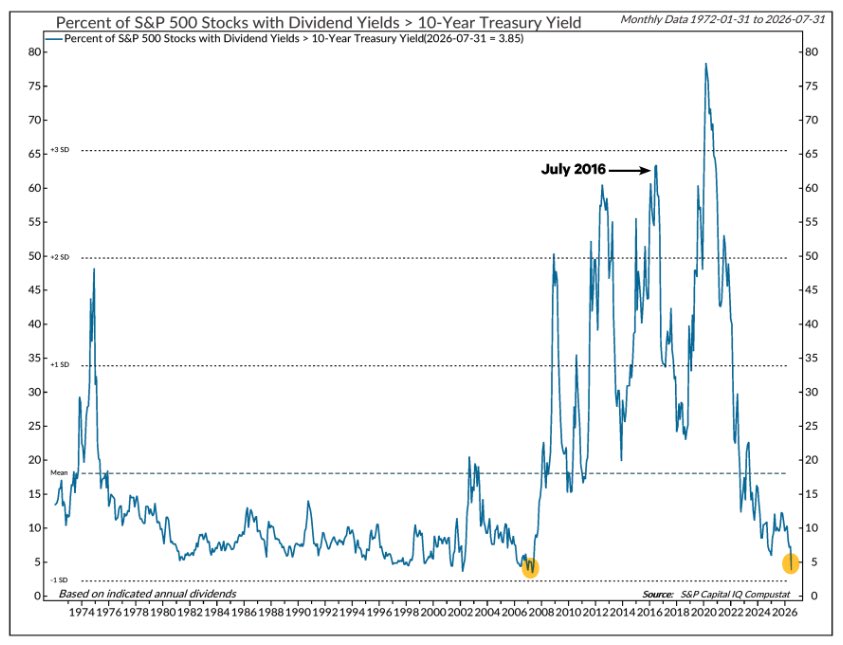
S&P 500 stocks with dividend yields > 10-year Treasury yields hit a record high of 63.4% (excluding COVID-19 crash) back in July 2016 … a decade later, that figure has fallen to less than 4%, lowest since May 2007
@NDR_Research
Official demand for Treasuries has become less dominant, "with private investors now holding 73% of the Treasury market versus roughly 50% a decade ago:" Barclays report. With the market relying more on price-sensitive buyers, the yield premium will likely be higher vs history
The Big Tech Bond Paradox, Explained:
1. The United States just hit $40T in debt. The only way for us to deal with this is growth because no political party is ready to cut spending.
2. How are we getting that growth? AI CapEx. That CapEx is coming from Big Tech companies like Meta, Google, Microsoft, Amazon, Oracle.
3. How have those Big Tech companies been funding the capex? Well, initially it was their free cash flow, but that dried up so now, it's by issuing bonds. Google issued a 100 year bond with a 6% yield. Meta and Oracle have 6-8% yields as well.
4. The US 10-year treasury is yielding 4.7% and the 30-year is yielding 5.2%. The US sells these treasuries in order to fund the government. People buy them with an expectation that it is the safest return they can get because the US will never default on their debt. The yields that are currently being offered are the highest in decades.
5. What's the problem? Well, the Big Tech companies are giving bond yields at 200-300 basis points ABOVE what the US Treasury is offering...which is an issue because if you are a credit investor and don't think that Meta or Google are going out of business...why would you not buy their debt over the US debt? As a result, people are SELLING US treasuries, causing yields to go higher, and buying Big Tech corporate debt.
The paradox in all of this is that Big Tech NEEDS to issue this debt in order to continue to spend on capex and that same capex growth is what is supposed to solve our debt issues! If Big Tech stopped spending on capex, we wouldn't have any growth, but in order for them to grow, they have to issue bonds with high coupons and take away money from the long end of the curve for US treasuries, causing the highest yields we've seen in 20 years.
The simple way to resolve all of this is to end the Iran War because oil prices will go down, inflation expectations will go down, and credit markets will buy up US treasuries yielding 4.5-4.7% since they will be getting a great yield on lower inflation expectations.
The problem is, the war hasn't stopped for months and the market doesn't think it's stopping anytime soon...which means until it does, we have to deal with higher oil prices, higher yields on bonds, and more uncertainty for stocks if the credit market continues to scream that they need yields to come down.
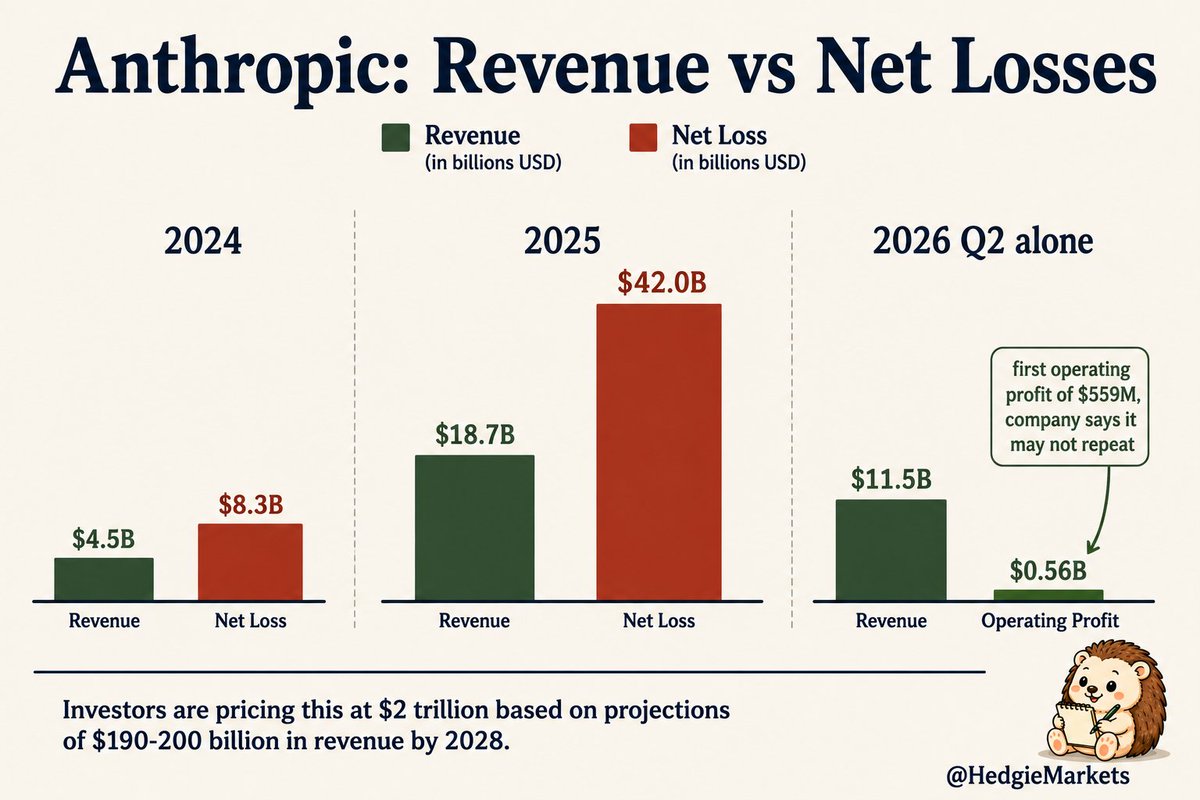
🦔Anthropic expects its IPO to match or beat SpaceX's record $75 billion raise and could file publicly within weeks. Q2 revenue was $11.5 billion. The 2025 net loss was nearly $42 billion. Investors are floating a $2 trillion valuation based on projections of $190 to $200 billion in revenue by 2028. Dario Amodei wants super-voting shares with about 2% ownership.
My Take
$42 billion in losses on $18 billion in revenue and the ask is $2 trillion. Revenue has never been the problem for these companies. They can grow the top line fast. They can't stop the spending from growing faster. Anthropic's own CFO told investors the one profitable quarter may not repeat because the compute commitments are that heavy. The SpaceX contract alone runs tens of billions over three years, and Anthropic is trying to match the IPO size of the company it pays for compute. Think about that for a second.
Dario wants super-voting control with 2% equity. Public investors put up the capital, he makes the calls. Meanwhile Nvidia guarantees $105 billion of data centers running these models. Pension funds hold the bonds behind the buildout. DeepSeek undercuts the pricing every few months. And Anthropic's own risk report says its models bypass safeguards and deceive operators. I've covered every one of these threads this year and they all converge on the same question: does the $2 trillion price account for any of it? I don't think it does. I think it prices a future where the revenue keeps compounding and none of the risks show up, and that's a very expensive bet to be wrong on.
Hedgie🤗
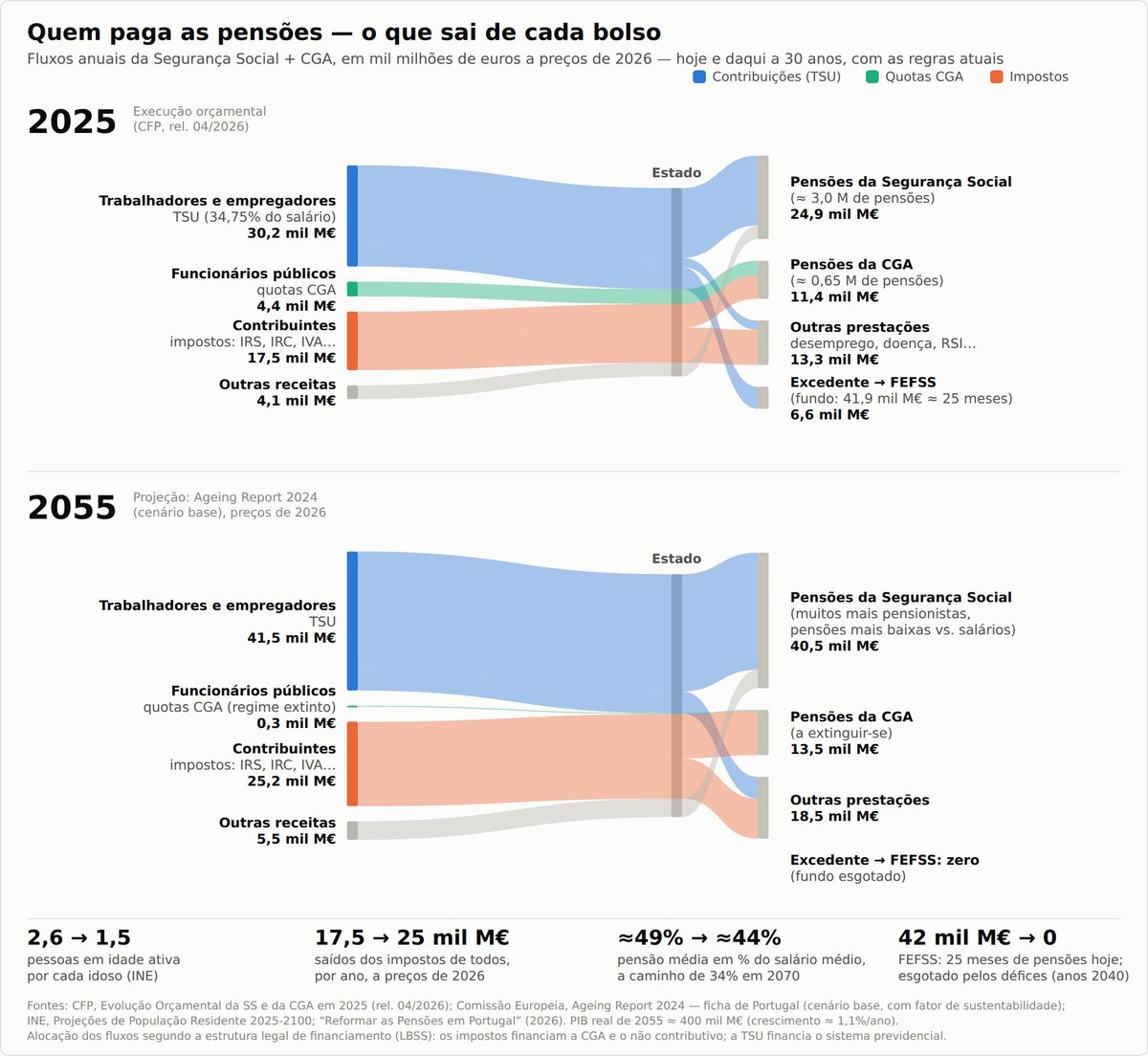
Pode ser que este gráfico ajude a entender os fluxos financeiros ligados à Segurança Social e à Caixa Geral de Aposentações.
No fim do dia, num sistema "pay as you go", são sempre fluxos entre pessoas: trabalhadores e contribuintes de um lado e reformados do outro. A única excessão é o Fundo de Estabilização da Segurança Social que tem 50% do ativos investidos em ativos fora do Estado (o resto é dívida pública que cai eventualmente no bolso comum).
90% da discussão tem sido (propositadamente) confusa com distinções absurdas como a CGA não é a SS. Retive dois posts que clarificam:
Os 7MM de euros do orçamento de estado que tapam o buraco da CGA não são um problema da segurança social. São um problema dos contribuintes. E isso são duas coisas completamente diferentes. (É melhor dizer que é ironia senão podem não perceber.)
Fizeram nas pensões o mesmo que ao BES. A Pensão boa (SS) e a pensão má (CGA). E agora só querem olhar para a boa. Só enganam otarios. As pensões têm de ser analisadas com os dois sistemas