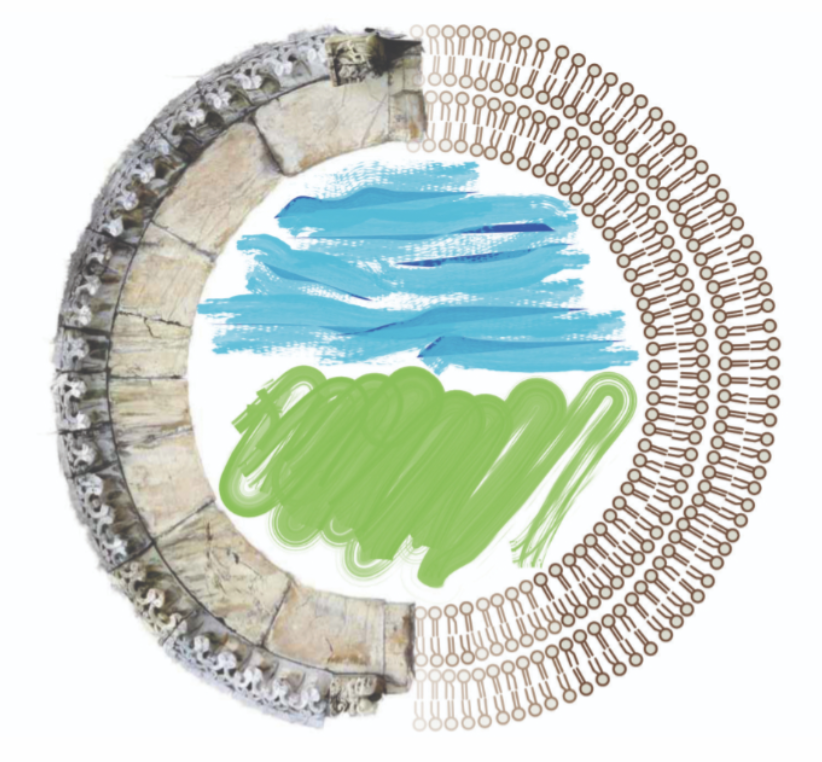
Happy to share our latest study in @Nature revealing how FLVCR1 & FLVCR2 transport choline & ethanolamine, and shedding light on their roles in related rare diseases. Two in One! 🔬 Read more: https://t.co/hDjQDHWIa0 Great teamwork with @SafarianSchara@HummerLab@nguyenln_ 💪
We are excited to announce the publication of high confidence 3D template matching for #cryoET@HummerLab@Beck_Laboratory@jpkreysing @geissler_katha @s_l_schaefer @pc_hoffmann @MPIbp@cziscience
Paper's link: https://t.co/97wkNFMVhI
See it in action in our short video!
In a great collaboration with @HummerLab and the Kräusslich lab, @jpkreysing, @MaziarHeidari1, @VojtechZila and others tackle what happens when HIV capsid goes through an NPC. Instead of the NPC cracking the capsid, the capsid appears to crack the NPC (@MPIbp@CiidHeidelberg).
Heartfelt congrats to our group leader @eugene_kim__ (@EKimlab) on receiving the Heinz Maier-Leibnitz Prize, one of the most important awards for early-career researchers, for her research on genome packaging! #biophysics@dfg_public@maxplanckpress
👉 https://t.co/O6CelvguPY
#ATP, the energy currency of cells, is produced by the mitochondrial protein ATP synthase. Our @HummerLab provides new insights into the structural mechanism and energetics of the crucial proton-driven c-ring rotation by atomistic free energy calculations👉https://t.co/P4nFRH1dKr
🚨Now in print!🚨Sankalp Shukla @Sankalp Shukla_ in collaboration with @PIHanson lab and @HummerLab probes the mechanistic and cellular implications of direct membrane binding by the ESCRT and ERES associated Ca2+- sensor ALG- 2 protein. Read it: https://t.co/TcmuQDRNrW @PNASNews
Video by S. Rao: All-atom molecular dynamics simulation of the membrane-recruited ATG12-ATG5-ATG16L1-WIPI2 complex loaded with the ATG3-LC3 conjugate.
Congratulations to all authors from @LazarouLab, @TheHurleyLab and @HummerLab on this amazing publication in @ScienceAdvances!
S.Rao from our @HummerLab & coworkers resolve mechanism of LC3 delivery to the phagophore membrane, a key step in selective #autophagy, by combining #MDsimulations & experiments. Three-step targeting of ATG12-ATG5-ATG16L1 machinery leads to LC3 lipidation👉https://t.co/9DtGHuFaKP
Scientists from the MPI of Molecular Physiology (@mpimoph) and from our Department of Theoretical #Biophysics (@HummerLab) have identifed a region in actin that functions as a “molecular backdoor” for phosphate to exit through!
👉 https://t.co/Yo7rs9AJy8
Very excited that our manuscript is now online @NatureSMB!
https://t.co/jFMeLSr6bW
We show how actin filaments release inorganic phosphate (Pi) through a “molecular backdoor” and demonstrate that the backdoor is distorted in a disease-linked actin variant.
A thread (1/17)
New preprint! @AutophaZeke’s PI3KC3-C1/RAB1A structure reveals that VPS15 is a GTP-binding pseudokinase that repurposes the kinase fold to regulate a myristoylation, and stabilize a large rotation in the VPS34 lipid kinase to promote membrane binding and PI(3)P synthesis!
The 2024 Gordon Conference on Autophagy will be held at the beautiful Il Ciocco site in Tuscany Mar. 10-15. If you have a passion for autophagy or just want to learn more, apply now before it gets oversubscribed! https://t.co/YYPxG2rEYr
The role of CydDC, a potential target for new antibiotics, in the bacterial energy metabolism has remained nebulous for decades. Scientists from our Institute, @ALIFE_VU, @UGent, @UniKent solved the riddle: CydDC is a heme transporter👉https://t.co/qqkC21S97a
#biophysics#cryoEM