📚🔬 Applications are open! "WMD Non-Proliferation & Disarmament in an Era of Technological Convergence"
@SIPRIorg and EUNPDC are pleased to announce a new intensive online course taking place 30 November-3 December 2026.
Designed for graduate and postgraduate students in technical or natural sciences and early-career professionals, the course will bridge scientific and technical expertise with the policy, legal and institutional dimensions of arms control, non-proliferation and disarmament.
💡 Over four days, participants will explore:
- Nuclear, chemical and biological weapons
- International treaties, institutions and verification
- AI, biotechnology, outer space capabilities and autonomous systems
- Technological convergence and emerging WMD-related risks
- Export controls and other non-proliferation tools
🌍 Approximately 20 participants will be selected. Applicants of all nationalities are welcome, with preference given to candidates with strong EU ties.
📅 30 November-3 December 2026
💻 Online, in English
⏰ Apply by 19 October 2026, 23:59 CET
👉 Learn more and apply: https://t.co/voyKtsoeut
#EUNPDC #SIPRI #NonProliferation #Disarmament #WMD #ArmsControl #EmergingTechnologies
"Iran’s escalation strategy centers on unrestrained retaliation in response to U.S. and Israeli strikes. This strategy reflects a distinct departure from Tehran’s previous practices of a more measured reaction," writes @CSISMidEast.
Read more: https://t.co/cCzywkN9Jt
In this context, Iran’s weight in the regional balance becomes a key factor. Given its size and the depth of its political and ideological influence across the region over recent decades, any significant shift in its position, which now seems likely, would almost certainly leave a regional vacuum larger than the one that followed the fall of the Iraqi regime in 2003, requiring time for the region to adjust and begin shaping the next phase.
The current war could mark the first time in the GCC’s history that all member states, without exception, are facing an unprecedented convergence of regional developments, where operational realities, strategic and economic calculations, and internal management demands are unfolding in parallel.
Interesting. The diplomatic coordination is clear, especially in cases like the UN and IMO resolutions.
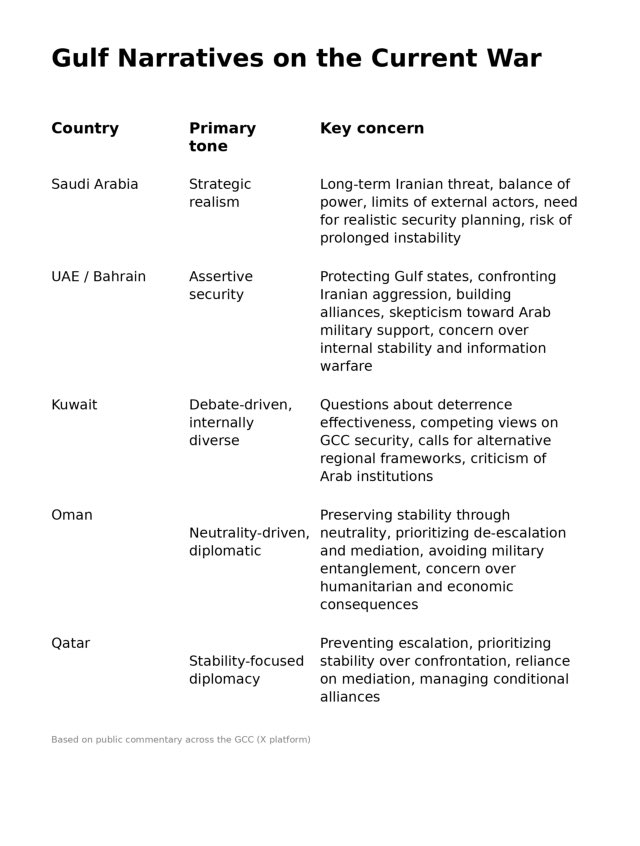
Recent GCC commentary, however, suggests the discourse is more diverse than it appears. While there is broad alignment in opposing Iran’s actions, different voices frame the crisis through distinct security priorities, from coalition-building to neutrality, stability, and long-term deterrence.
I mapped recent Gulf discourse on the current war based on public commentary by analysts, officials, and journalists across the GCC.
The narratives differ in tone, strategic priorities, and threat perceptions across the region.
@YasFarouk After the war, the question isn’t just Iran, it’s what the GCC does next. Can the Gulf reorganize internal cooperation while navigating pressures from Iran and the Israel–U.S. axis? Past hedging worked, but can cohesion hold in a reshaped regional order?
@Cinzia_Bianco Iran adds another variable: the conflict could push its politics toward a more state-centric posture rather than revolutionary ideology, potentially generating internal debate and complicating GCC engagement with Tehran.
@Cinzia_Bianco Worth watching. GCC states are already thinking about the post-conflict regional order and the future Gulf security architecture. If debate in Washington over long-term U.S. military presence intensifies, deeper engagement with Europe becomes a natural strategic hedge.
If you've ever pondered the threat of nuclear weapons and humanity's proximity to destruction, I recommend listening to this insightful podcast. #DoomsdayClock
🧵Today, @BulletinAtomic announced that we are still #90SecondsToMidnight on the #DoomsdayClock.
Coinciding with this, the ELN is pleased to announce Episode Two, "Nuclear War - What is it good for?" of "Ok, Doomer!" the NEVER podcast.
https://t.co/UmpyOwX8HU
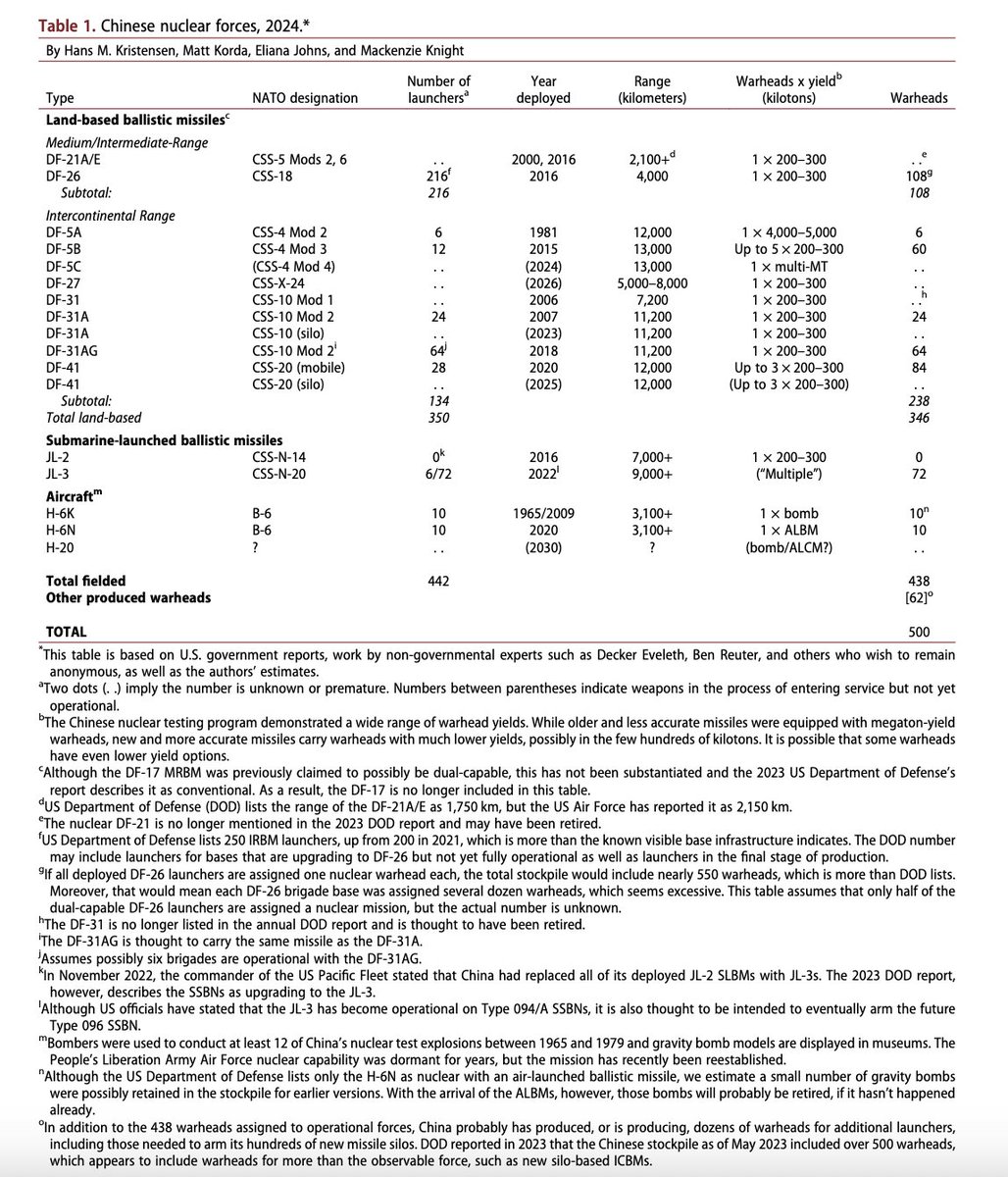
🚨 In our 2024 assessment of China's nuclear forces, we estimate that China has ~440 operational warheads for its:
🚀 350 land-based missiles (including ~135 ICBMs)
⚓️ 6 SSBNs
✈️ revitalized bomber force
+ ~60 warheads for incoming systems
Full article 👇
https://t.co/YBTM4gSmQu
Join the competition & send us by 28 Jan your painting🖼️, music🎵,dance💃, short film or photography skills📽️ depicting your perspective on #CTBT by illustrating the stark contrast between a world with nuclear tests & one without.
Submission Guidelines: https://t.co/xsLI4e7ASA
The nine nuclear-armed states continue to modernize their #nuclear arsenals and several deployed new nuclear-armed or nuclear-capable weapon systems in 2022.
Read more➡️https://t.co/OX8EubuVp2
Explore the world nuclear forces table➡️https://t.co/4ws4EqXGmk
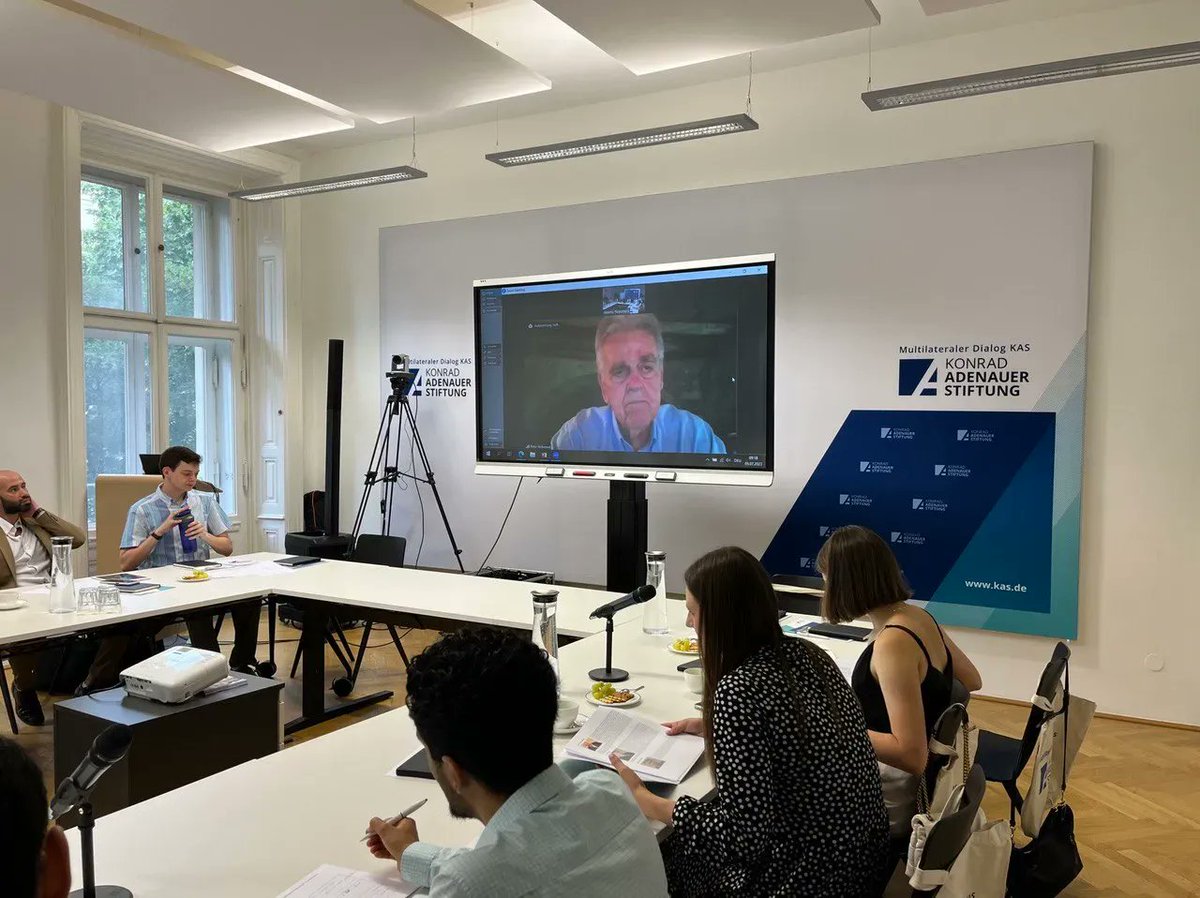
Last week #AtomicReporters in cooperation with #KAS held Second Study Programme in Vienna 🇦🇹
Three days programme was devoted to energy, deterrence, nonproliferation, and disarmament and aimed to unite young professionals with diverse academic and geographic backgrounds 🌍
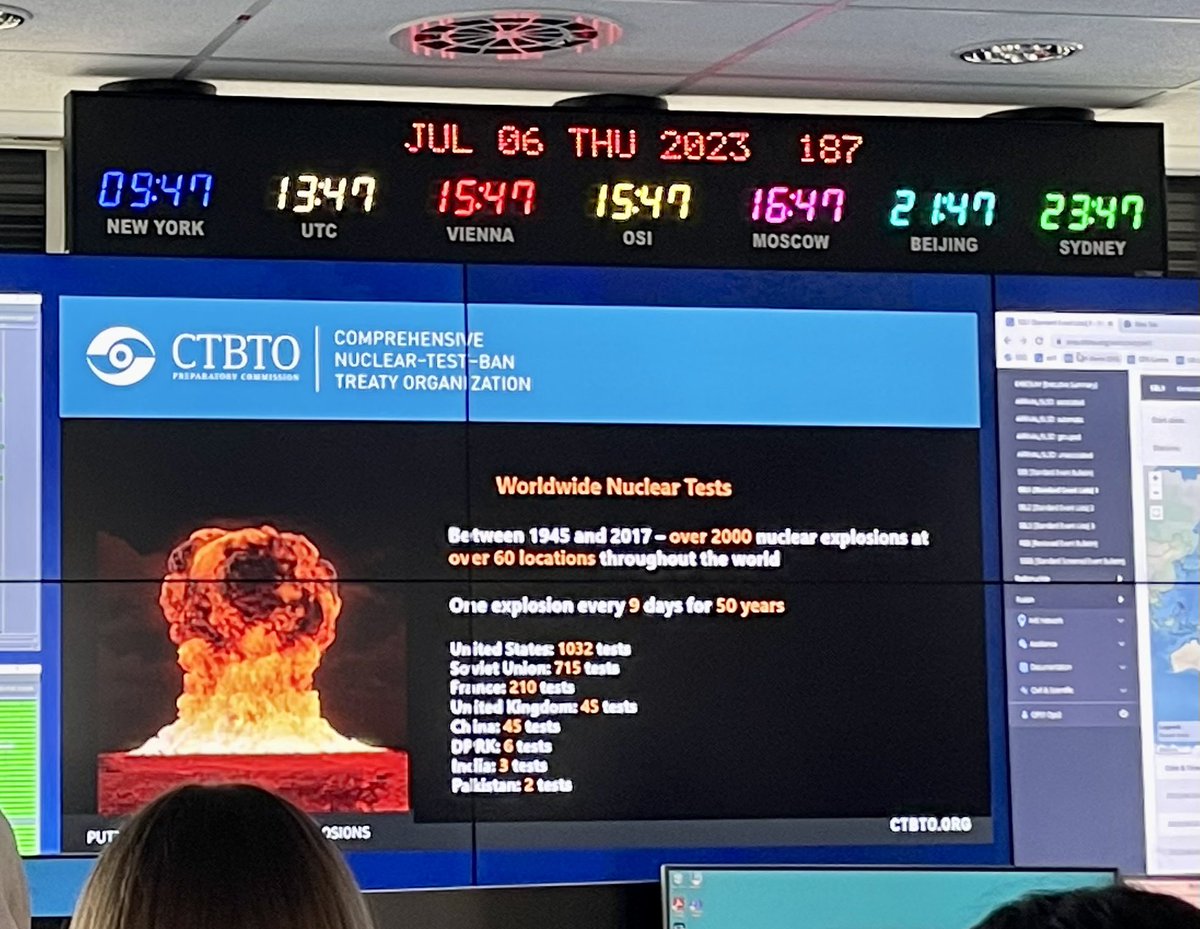
Revisiting the @CTBTO once again, I'm reminded of the paramount technological benefits the #CTBT holds for member states. Let's emphasize the pressing need to set aside political differences and unite towards its entry into force. @AtomicReporters#ctbto#ARKAS2023 #AtomicLegacy2023
I love simplifying things! Today's visit to the IAEA got me hooked on this amazing chart. It brilliantly illustrates agreements requiring safeguards. @AtomicReporters#ARKAS2023#AtomicLegacy2023
Insights from @fgiovannini123@AtomicReporters#KAS on nuclear deterrence:
1- Nuclear deterrence is changing the adversary's behavior without fighting, but nuclear deterrence in practice is proved to be more complicated…
2- The more nuclear players, the more complicated nuclear deterrence get.
3- We need deterrence without provocation. #ARKAS2023 #AtomicLegacy2023