So - @elonmusk wants to turn Twitter into a Super App called X.
What he has going for him? ✅
- A large community of users with strength in the US
- A product that has a high frequency use case
- A strong brand in Twitter (people will quickly adapt to X)
- A strong understanding of payments and fintech
What will be a challenge? 🛑
- We will simply not have an all-encompassing Super App like WeChat in North America so I hope he realizes this.
- Each additional product or service he builds needs to strong on its own so he will have to build fast and/or make some acquisitions to get there
- Building bridges between these products and services are not easy and take time and iteration for a consumer to understand why they are using Twitter to Tweet as well as to pay or purchase or do something else.
Anything else to add to this list?
#twitterx #superapps #twitternews
After 10 years, multiple names, and a major pandemic-era pivot, Super[.]com has officially become a unicorn. CEO
@hussein_fazal reflects on that journey:
https://t.co/bAzYEBdnei
We all remember the question: "What do you want to be when you grow up?" Nobody ever asked what we wanted to be right now.
Kids are the best entrepreneurs I know. Curious. Fearless. They default to yes. Until someone teaches them no.
We should be building on that. Not talking them out of it.
So I wrote a children's book about it.
@bryan_johnson I just hit a 98 sleep score on my oura ring. First one ever. I ate right before I went to bed. Cereal with high fiber and magnesium (quinoa and oats) combined with magnesium and tryptophan supplements... Thoughts?
Boardy introduced a founder to @pmarca this weekend!
After speaking with over 3000 founders currently raising, @boardyai picked the top 60 for us to start working with. These included Thiel Fellows, @ycombinator /@hf0 alum, second-time unicorn founders and Forbes 30u30 (the good ones!)
So many investors reached out to connect with the best founders he's meeting, including almost every tier 1 VC, top emerging managers, family offices and blue chip LPs.
Today, we’re rolling out a program where Boardy will work with select investors to introduce them to the best opportunities in his network. He’ll work directly with you and your team to ensure you never miss a deal and you’re spending time with the right founders
Investing isn’t about capital allocation anymore - it’s all about who you spend your time with.
If you want early access (or know an investor who might) sign up here: https://t.co/1yIUJvOyBW
WHY RETENTION IS SO HARD FOR NEW TECH PRODUCTS
I’ve been staring at retention curve data for 15-plus years now.
I was a founder, a product manager, and now a VC. And at Andreessen Horowitz, I end up meeting hundreds of startups each year, many of them through our a16z speedrun program, where we invest up to $1M in brand new startups.
NOTE: And yes, we just announced the 2026 program and you can apply now: https://t.co/DZZmyTm1iQ
But back to retention — I’ve seen thousands of curves, and it’s among the first things I ask for when evaluating a new startups. I've looked through thousands of data rooms, analyzed retention curves sliced across many segments and denominators. I've also seen it from the other side, as someone building products. I’ve run hundreds of A/B tests and drafted countless variations of onboarding and notification emails in attempts to bend the curve.
There are patterns.
Just as there’s the laws of physics, weirdly there are some constant patterns that keep cropping up over time. Here are a few that I’ll share:
- You can’t fix bad retention. No, adding more notifications will not fix your retention curve. You can’t A/B test your way to good retention
- Retention goes down, it doesn’t go up. And weirdly, it decays (oh, does it decay) at a predictable half life. Early retention predicts later retention.
- Revenue retention expands, while usage retention shrinks. Good news: You lose people over over time, but the ones that remain sometimes spend more more money!
- Retention is relative to your product category. There’s nature, and there’s nurture. Sorry, you’ll never make a hotel booking app a daily use product
- Retention gets worse as users expand and grow. The best users are early and organic. The worst users come after that
- Churn is asymmetric. It’s far easier to lose a user forever than to re-win them back
- Retention is weirdly hard to measure. Seasonality is a real thing. New tests throw things off. Bugs happen. D365 is a real metric but you can’t wait
- Crazy viral growth with shitty retention fails. We’ve run this experiment many many times already, across multiple platforms and categories
- Great retention is magic. When you see it out in the wild, it’s amazing.
We’ll dive into each of these.
You can’t fix bad retention. You've seen this happen before: You spend months developing a new product, and then you launch it. Bad news hits. The initial retention stats come in, and it’s terrible. You're already months into the product development, and it's hard to turn back now. How do we improve retention? I know, let’s add notifications and remind people to come back. Let's add a bunch of new features. Maybe we can A/B test the landing page and increase conversion.
I think we know how this ends. Unfortunately, it seems to be the case that when you have poorer retention, it's very, very hard to fix - nearly impossible. Yes, you might be able to make a marginal improvement. Let's say that your D1 retention is 40% and you'd like it to be 50%. This is great and potentially workable. If the D1 is 10% on the other hand, well, you probably just have built something that nobody wants, and all the local optimizations around A/B tests and notifications aren't actually enough to bend the curve enough for it to work. When there's been months of development and sunk cost, it's hard to not just give it a college try. But I think in many cases new products are better off pivoting right away.
The type of pivot that fixes retention involves a complete new redesign of the app's home screen. If it looks like a feed, maybe it needs to be a structured step-by-step flow. If the product is about sharing, maybe it needs to be mostly about creating and saving. You might need to describe the product in a totally different way and position it against a different product. It needs to be a big pivot in many ways, the bigger the better, in order to have a chance at changing retention.
Retention goes down, it doesn’t go up. Retention curves often follow very geometric curves that you see. For instance many curves I see resemble the following: Whatever the D1, it drops by 50% on D7. Whatever the D7, it drops by another 50% at D30. Months out you might end up at roughly zero, or if you’re lucky you might retain 10% overall. There’s just a predictable decay.
What you never see is a curve that starts high, then goes low, then becomes high again. That’s not possible. In other words, if your early retention isn't incredibly good, then it means that your late retention also probably isn't any good. You need to start strong in order to end strong.
There are some interesting exceptions to this rule that are worth calling out:
- Some products are extremely hardcore (e.g. online poker). You might have relatively low retention, but those who stay are extremely sticky and spend a ton of money. It turns out that this can work.
- A product that has network effects where new users might start out strong, then drift for a bit. But if the product (which might be a social network or a collaboration tool or something else that has network effects) is able to use more and more users to reactivate older users, you often see a small curve where retention comes up. This is a very rare type of situation but amazing when possible.
Revenue retention expands, while usage retention shrinks. One of the best and most important dynamics with retention curves is that you can apply them to users, but then also revenue. Thus far, we've been talking about user retention, and unfortunately, it has the undesirable dynamic of always going down. Revenue retention on the other hand is really interesting because people often end up spending more money over time with you, at least the ones that remain.
This is one of the biggest strengths of B2B SaaS products. Take a product like Slack. If you look at the user cohorts, what you'd likely find is that the retention curves go down just like any other product. Some people take to it, and some people don't. However, for the companies where people spend time adopting Slack, what happens is it will start to organically grow, and the amount of revenue you earn from that company starts to increase dramatically over time. The revenue retention curves start to grow rather than shrink. This is amazing, and unfortunately doesn’t apply to most consumer products. It’s one of the biggest ways in which B2B products have easier business model dynamics than consumer.
The consumer version of this looks more like Amazon where you might have started by buying books and music and over time as the product grows in its capabilities you start to use it to buy more and more things. Because of that your LTV in the product is essentially unbounded. We also saw this at Uber as well where user cohorts would decay over time but the amount of money that people would spend initially on Uber rides to the airport would grow into rides to restaurants or for commuting purposes to work. So the user retention curves go down but the revenue retention curves go up.
Retention is relative to your product category. I've written about this in the past on the concept of nature vs. nurture for retention. The reality is that there's just a natural use case for many products - for example with collaboration tools or coding apps, you might use them every day at work, capping your usage to 5 active days out of 7. Contrast that to something like a bug alert system - hopefully you don’t use it often! Same with consumer products, where people check news, messaging, and social apps daily, but generally don’t use medical reference guides frequently. Some apps have great retention but infrequent usage, like weather or banking apps. And some categories like gaming are highly addictive and frequent, but people usually quit after a few weeks of use once the content is played out.
Nature vs. nurture is important because it tells you that many new products simply don't have a chance. If you're developing a travel app, but it's meant to be social, the reality is people don't travel that much. It'll be hard to create a product that sole mission is interaction with friends. Instead, it would be better to accept its infrequent nature and figure out how to monetize it better by owning part of the transaction or to have a more frequent use case like a restaurant and nightlife app like Yelp but also be able to use travel features as well. It's just hard to fight nature. You can only do so much.
It's also for this reason that if you want to build a very, very high retention, high frequency app, you have to probably build within some of the categories that people are already identifying as core daily products. This means that most likely if your app is successful, it takes away from some other daily product. It's no wonder that my constant use of ChatGPT has dramatically diminished the number of Google searches that I do. Or that when I began to use Substack for reading and writing blogs that I stopped using many other kinds of social news software.
Retention gets worse as users expand and grow. If you are lucky enough to build a product that experiences great retention, one of the natural things is simply to extrapolate all the behavior, monetization, and usage to a much broader market and assume that naturally you end up with a very, very big good number because you're multiplying a bunch of small good numbers together with a big one. The reality is that as you start to scale your user base, bad things start to happen. Let’s say you begin adding Android and international users and you acquire more customers using paid marketing and other channels — you'll quickly find that all of your metrics get worse.
The reason is that the best users show up early. The ones that are the most highly monetizable, that have the highest intent, that are the most digital and plugged in, well, these guys tend to find your product early and start using it due to a recommendation from a friend. Later on, as you bring in new users from other sources, it's likely that your product just isn't as good for them. It could be as simple as building an iPhone app for college students in Western countries and simply getting worse metrics as you bring in Android users from emerging countries where the feature sets just don't quite work. Of course you can work to improve this over time, but I assure you it will never be the same.
Instead, the question is: As you grow your users and they get worse and worse, are they still valuable and can you still operate your product profitably? And more importantly, are you able to hold on to that core highly valuable user base that came in early?
No wonder these early users are often called The Golden Cohort.
Churn is asymmetric. It's incredibly easy to churn users. In fact, most products churn 90% or more in the first 30 days. Simultaneously, it's incredibly hard to win back a user that's already quit. This is the core asymmetry around churn. In fact, it's so bad that it's often easier to simply try to acquire a new user rather than to try to get someone back.
It's for this reason that life cycle marketing that involves trying to resurrect dormant users by sending them discounts or offers tends to be extremely painful and expensive. The version of this that often works is to get existing engaged users to resurrect somebody through the natural usage of the product. For example, if somebody at work tries a new project management tool and it doesn't stick, then you probably won't get them back by bombarding their emails with reminders of features. Instead, you try to get one of their coworkers to invite them back into the tool to work on a new project. That's what works. But again, insanely difficult and complex and is really only available to products that have network effects (i.e., sharing and collaboration).
Retention is weirdly hard to measure. When people talk about retention, they tend to try to measure what happens in the first day, first week, and first month. But they'll rarely talk about what happens two years ahead. The reason is that when you're working on a product, you need a short enough time frame and a thing that's easy enough to measure that teams can make decisions about what is happening. As a result, although annual churn or long-term monetization is incredibly important, you tend not to measure it, instead focusing on what's right in front of you and what's easy. However, this approach has many problems.
Unfortunately, many categories of products experience huge amounts of seasonality. Anything involving commerce, travel, wellness, or online dating are obvious examples. But there are cycles even to the way that companies use business software as well. Seasonality throws things off because you might be down month over month or quarter over quarter, but is that because of features that you launched? Or is it because user behavior is simply different in this quarter? It's just hard to measure retention when it's super laggy.
Same with bugs or new tests that you're running or new market launches. These are all things that muck up the data, and you end up finding yourself reviewing reports where retention curves went up or down. But there's an asterisk on every number because they're trying to validate that the new Android launch didn't create an apples-to-oranges comparison.
Crazy viral growth with shitty retention fails. Many folks working on new products find themselves very focused on signing up new users and not on retention at all. After all, if you just want to see a graph that goes up and to the right, why not simply ramp your top of funnel and show that you're growing quickly, raise a bunch of venture capital money, and then you can figure out the retention issue later.
We're seeing this all the time right now in the industry when products have a crazy TikTok ramp because a creator pushed their app to millions of followers or because a launch video caused a bunch of revenue growth. Even though the usage and churn are not in a good place.
The tech industry has already run this experiment many, many times. And the conclusion is the same: Highly viral products with shitty retention do not last because it's so hard to fix retention. Eventually, the user acquisition fades as the novelty factor goes away, and eventually you're left with shitty user acquisition and shitty retention, and what goes up must come down.
We've seen this across many contexts. During the early social network phase, there were many products that used email address books to spam their way to growth, but drove users to bad products. Sometimes, if you could get them to sign up to some shitty ringtone annual subscription, you could try to monetize them and make some money along the way. It wasn't until Facebook, of course, with their UX innovations like The Feed and Real Names, that eventually created a product that was both highly viral and had very high retention. The same thing has happened in mobile apps as well, where you see big hits pop up sometimes caused by forced invitations via SMS, but again, if the products aren't sticky, the whole thing collapses quickly.
Great retention is magic. You might read this whole essay and feel a little bit depressed. I know that sometimes it's hard to get things going. However, it's amazing when something really works. When you see a product out in the wild with a 50% D30 (I do once every couple years), it's just amazing. I've come to believe that these lightning-in-a-bottle products happen not because the builders had some incredibly systematic way to A/B test their way to great metrics or that they employed some kind of high-velocity iteration process that got them there, but simply that there's a little bit of magic that's required. This magic comes from a fresh insight about the market or customer needs, and while it might seem obvious in retrospect, it drives super high retention because this product is the first to figure it out. We can say this now about video conferencing software or disappearing photos or a magic AI that replies back to you about any topic. There's just a magic here that no amount of iteration and metrics-driven testing can get you to.
The Big Question
You might read all of this and still have a big question: So wait, how do you get to great retention? (If I knew the answer in a deterministic way, my job as a startup investor would be so much easier, wouldn’t it?)
But let’s try our best. In my points above, there’s a few clues:
The idea really matters.
- If you want a high retention product, you need to pick a category that is high retention already.
- You need to pick a product category where you already use an existing product every day.
- You're going to build something that directly competes against that.
- If you win, then you'll stop using that other product and use your product instead.
- That's a high bar, but I think it's a good start.
Of course, if you build something that's quite head-to-head with something that already exists, you might suitably object: "that's going to be really hard to switch somebody over." It is. So then this is where you need to decide to take enough market risk, but just the appropriate amount, where you do something new and different that reinvents that core interaction. But you're probably talking more about a 20% remix rather than an 80%. Ideally, you need to be able to describe this to your users in a way that they can understand quickly and viscerally within the first 60 seconds of usage.
This is where the dreaded investor question "why now?" starts to matter quite a bit. Because what you're saying here is that ideally there's some kind of new development in the industry, whether that's a general-purpose technology like LLMs or a societal difference like the oversaturation of social media, that allows you to make this twist happen at exactly the right moment.
This gets you into an existing market quickly, and you're more likely to have great retention numbers early on. Timing matters a lot. If you get the timing off, and it's a low-interest category, and your differentiation isn't different enough, then what you'll find is you've traded a retention problem for a user acquisition problem. Here's the difficulty with building a new kind of internet browser: if you win, it's incredibly sticky. But people are so happy with their existing browsers that it's very expensive and complex to get them to try yours in the first place.
This is why I don’t blame folks who have a “Cursor for X” idea, or “Figma for X,” just like the “Uber for X” ideas of the past generation. They’re trying to piggy off some existing markets and behavior so that they don’t have to take crazy market risk.
And if you get the differentiation right, the timing right, and there’s a ton of user demand, and you’ve nailed the right base product category, then I think it can really work.
But what about new markets?
The natural counterpoint is that new markets are often more exciting than existing ones. Isn't tech about building brand new things rather than innovating 20% on old stuff? Of course this is true, but I think this is the tiny tiny minority of products.
My counterpoint to this counterpoint is that most products actually have some kind of prior lineage, even if those prior products are quickly forgotten.
Before Instagram there was Hipstamatic, which had become the #1 paid photo app in the early App Store. It demonstrated the success of photo filters. Of course Google was not the first search engine, it was actually #10 or whatever, after Lycos, Excite, Infoseek, etc., which demonstrated consumers wanted search but that it was impossible to monetize. Tesla was not the first electric car, nor iPhone the first smartphone. Sometimes it’s the 10th iteration that matters. Some call this “last mover advantage” rather than first mover. I think an important point.
Yet sometimes new things do happen. Uber was created to turn an existing offline action — calling a cab — into an app, not because there was already a hugely successful ridehailing app. (And no, not Lyft — it was a weird bus booking thing at the time). Of course a lot of ChatGPT, with OpenAI’s 5 year journey between inception and v3 which really took off, and without any real blueprints for what it might replace. These types of journeys are remarkable, and the tech industry is better off for it, because they involve real risk as part of new category creation.
IN NEWS: @hussein_fazal (Co-Founder & CEO, super[.]com) just announced the company has hit $200M ARR.
He joined the show and discussed how they acquire customers:
“Each product has its own channel. We don’t advertise the full membership upfront, we win people over with one product that’s so good, they stick around for the rest.”
Travel runs on intent. “Google, Kayak, TripAdvisor work because people are ready to buy.”
Earning runs on social. “Download Uber for the first time, take a ride, get $20. Uber pays us $30, we pass most back to the member. Same with games: hit a certain level, see some ads, maybe buy some gems. It’s an ad network play.”
In his view, the model is to use high-intent and incentive-based funnels to hook users, then expand them into full members.
@andrewchen I was a Waterloo intern. We now hire over 100 interns a year at https://t.co/hTsNSpH2Em. we love the program. Very talented engineers. Many become full time.
It's official: Super[.]com hit $200M+ in annualized revenue with just over 200 employees and is the first scale-up to join the Lean AI leaderboard.
To celebrate this record-breaking milestone, I am giving away our Lean AI at Scale playbook that made it possible.
We started Super[.]com 9 years ago, when AI was just a buzzword.
Back then, we scaled the traditional way: hiring more people to solve more problems across 5 different industries.
We launched products that seemed impossible to scale efficiently.
But everything changed when we adopted AI systematically across our operations, as our latest product alone went from $0 to $100M ARR in just 2 years.
I have seen most AI transformations fail because companies treat it like a tech project instead of an operational overhaul.
That's why 9 out of 10 scale-ups and growth-stage companies waste months (and millions) on AI initiatives that deliver zero ROI.
But there's a better way.
We cracked the code on systematic AI adoption at scale...
This is what happened when we systematically implemented AI across every department:
• 40% of customer support now runs on AI
• Millions of incremental revenue from AI-optimized pricing
• $290k saved annually on SEM optimization
• 50% increase in code output with the same headcount
• No two users will see the same app thanks to AI personalization
• 25% of Cursor sessions are initiated by non-software engineers
As a result, we achieved something most thought impossible: $200MM+ in annualized revenue with just over 200 employees.
Now, this playbook was originally created for our internal team and board discussions only.
But after seeing so many scale-ups and growth-stage companies struggle with AI implementation, I decided to share our complete operational blueprint.
Because if you are serious about staying competitive, you need to see how AI-first companies actually operate.
So I'm giving away our complete Lean AI at Scale playbook that includes:
• Our proven 3-pillar framework for AI adoption
• Product integration strategies with real performance data
• Customer support automation blueprint (49.8% reduction in agent contacts)
• Revenue optimization through AI pricing strategies
• Cross-functional AI adoption
• Internal AI platform setup and governance policies
• Measurement frameworks and ROI tracking methods
Want the complete playbook?
- Like and share this post
- Comment "Scale"
- Follow me (so I can DM)
I'll send you the link ASAP (I am sharing everything with full transparency).
Shout-out to our CEO, @hussein_fazal and CTO Ryan Fox, for helping me bring this playbook to my readers.
@bryan_johnson@chamath Bryan - how do you maintain a consistent bedtime on weekends when you have work dinners and events that often go later into the night? These can be extremely important for work but obviously goes against the consistent bedtime routine.
Or.... how many cheat days do we get?
Just did an in depth interview with @pablosrugo on the Product Market Fit show.
Yup. 50+ No's from VCs, 4 months of runway with SnapTravel after COVID hit, and here we are.
https://t.co/hTsNSpHAtU is 🚀! $150MM+ revenue, profitable, and growing fast!
https://t.co/0bkh8GGA4y
I recently wrote about how "Every great company was once a one-trick pony startup"
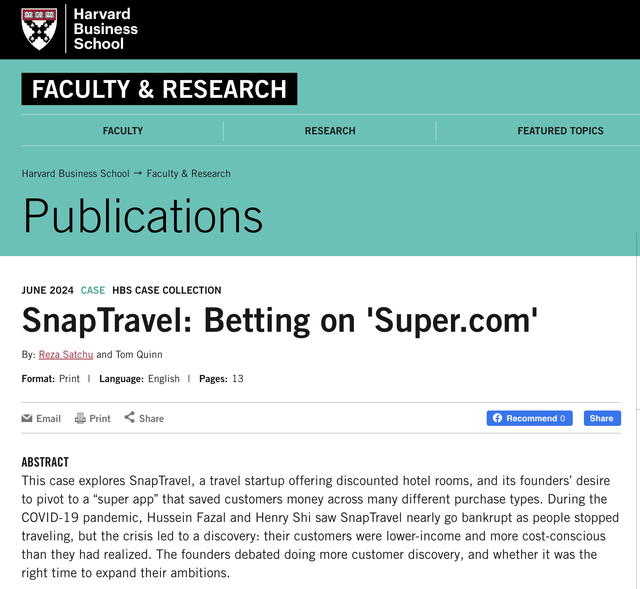
@HarvardHBS just published a case study detailing how we grew up from a one-trick-pony startup that only offered discounted hotel deals over messaging, to a well diversified consumer technology company across fintech, commerce, cashback, gaming, travel and more.
It was a tough bet to make at the time during the pandemic when we were fighting for survival, but today, we're profitable and 80% of our customer's transactions are non-travel and our revenue streams are well diversified across marketplace margins, memberships, interchange, transaction fees, ad-tech, affiliates and more.
Thank you @RezaSatchu for helping co-create this great case with @hussein_fazal and myself and teaching it to the brilliant students at HBS.
I may have not gotten into @Harvard, but the case and our journey now lives on in Baker Library :)
@sandydell123@deedydas We have no employees in India. LinkedIn doesn't allow us to remove fake employees. Apparently a lot of people like to say they work here because of the company / domain name.