We couped the coup. Over the past week, 236 people wrote tweets debunking the media's narrative against Jensen. As these posts grew to 1.7M likes and 87M views - it unleashed a wave of exponentially growing support for him, which then has enabled his return. Chart + analysis 🧵
Relieved and thankful to see this. A sense of balance is returning to the world.
A week ago, I noticed many had given up on him amid the relentless media onslaught. I just didn’t find it fair, and thinking about his journey as a founder, I told myself I am not giving up on Jensen, and will do everything I can to bring him back.
And my skill is asking the right x tough questions. Finding patterns amidst lack of data. So I focused on puncturing the media’s fake but overwhelming narrative by asking the right questions and following up with detailed analysis using my own agentic product (I invented the gossiping swarm pattern earlier this year which many use) - my posts got over 6k likes over the past week and I believe helped inform the pursuit of truth by many other champions who stepped up.
Here is what I do know: every bit of my analysis and work here was exactly spot on. I know I took extraordinary legal, financial and personal risk in doing what I did over the past week at my level.
I am glad I didn’t give up on him when it was the obvious and common thing to do as others were doing back then.
In one week, WE turned it around!
Sometimes you just have to fight. And that’s a lesson learnt from his own story.
Weaponized citation power of the New York Times against Jensen
This is a recording of how my agentic swarm flew through and analyzed recent news stories about Jensen (see https://t.co/qKGMJ2LBV8).
The red-marked stories in this video, signifying basically "poison", are the ones referencing the unproven spy claims (a total of 975 news stories at least). You can see how this poison flew through the entire nervous system of the reporting world. The top-ranked citation power of the New York Times, as measured by it's mathematical PageRank, in multiple successive stories referencing the spy claim, had an impact of causing a ripple effect multiple times over as other newspapers and publications picked it up repeatedly.
So for people around the world over the past few weeks who read these articles, they came to believe a reality which till this date, no one can confirm is even true. There was no spy confirmation - but 1000s of stories were already written, and a founder who worked exceptionally hard for 33 years to build our modern world as we know it, had to resign as CEO from his own company amid that reporting.
Over a $1 trillion in NVIDIA's market value has been wiped out since the first spy story. The entire AI industry is now dealing with abject uncertainty.
This wasn't fair.
PS: This video below is my actual app being recorded as a part of it flows. You can step in it, and explore this from many perspectives.
I ran a PageRank-driven analysis on all recent news coverage related to Jensen, and traced how the New York Times shaped the entirety of this narrative: https://t.co/qKGMJ2LBV8
--
NVIDIA has lost over $1 trillion in market value since the first New York Times story broke about Jensen. I dug deeper to analyze how the news originated and spread, running a swarm of agents which analyzed almost 2000 stories, across 40 US and European news outlets, and applying PageRank to understand how they cited each other.
Core findings:
- Primary news driver: NYT, with 88 stories, most-cited
- Volume drivers: WSJ - 99 stories; Bloomberg - 140 stories; NY Post - 68 stories
All of this started from unknown sources who gave information to the NYT, which then ran the spy story (still unproven), and it was then picked up in other news publications. Curiously, even after that story, there was a 9 day period of extremely low volume reporting (28 stories only), after which there was a sudden spike after Jensen's own letter to NVIDIA staff. NYT then had multiple sequential spy and affair stories, which fed a wave of further news coverage. It was the originating hub of negative Jensen coverage. Multiple outlets since then had an explosion in stories about him starting earlier this week as well.
Overall, as you see this data, you will observe this was an exceptional media onslaught against Jensen with sharply negative coverage about him, his work, style, and family. Infact, it was brutal, and unlike coverage in the past of CEOs who have had affairs (such as Intel CEO in 2018). For eg, NYT ran just 2 stories about Intel's CEO who had an affair with his employee, compared to 88 on Jensen! Why ?
This analysis used a technique of how Google originally ranked webpages, using PageRank, and does deep dive link analysis so you can view how the news spread. What struck here was that it did not matter if there were proven facts or credible sources: the outcome here was pre-decided. The news was making the reality which it wanted.
During this period, NVIDIA has lost $1.27 trillion in market value since the first story broke. On Nov 12th-13th, further news broke that both the US Justice Department, and Singapore - are unable to even conclude the spy allegation.
This has been a catastrophic attack on one of the hardest working founders in modern times, who took an idea from a Denny's booth, through multiple instances of almost going out of business, to building the foundation of the entire modern world with how the NVIDIA story played out. Thanks to Jensen, we have hope that many formerly incurable diseases will get solved by AI, that quality of life will and have improved for billions around the world.
Now I do not know if he will come back as CEO or not, but I hope he does. What happened to him here, and to the wider industry, was not fair.
on Apple entering the local AI inference market with an app: welcome, and finally!
the reason hyperspace built the largest network of people running a desktop app on their Macs (and other devices) to serve inference to others is because we focused on UI/UX. our app was, beautiful. overall the result was, in total lifetime across all devices and form-factors (desktop, server, web) and counting in auto-updates, we had over 3 million installs of our CLI.
hyperspace has been the largest peer to peer inference network on the planet ever assembled, which at it’s peak did more volume of activity in one day (700M API requests, with Datadog budget going through the roof!) than the second largest copycat network did in entire year. the Uber-like matchmaking server was our highest paid “employee” (eventually fired it with a fully peer to peer network once AI advanced to a level I could code it myself)
despite a LOT of early frustration for early users, we eventually nailed UX and game theory to scale it the way we did. lot of sleepless nights by many talented people.
we hit over 2 million unique machines registered in total and over 500k concurrent peaked at one point when some people spent their resources in order to game our system (we under-reported unlike others, kicked spammers out, made the system not interesting for them repeatedly).
the 2M number was twice the audacious goal in the below tweet, which we hit just one year later.
this is the exact gossiping agent swarm pattern I built and launched back in march. frontier labs and several billion dollar startups have used it extensively since as the foundation of scientific discovery, and in other products and experiences.
longer story: https://t.co/VO5vrmdJ3l
@grok verify
Given the Cohere-Qwen story of open weight model trying to phone home with user logs without permission, here is a solution: Hyperspace AgenticOS™️
It has been designed from the ground up to manage AI and agentic workloads on your device, protecting your privacy. An LLM by itself is insufficient, you need the full OS. This AVM, a V8 for agents, is just one of it's 70+ sub-components.
thinking about super intelligence as a narrative and how we got here
agent swarms, the kind that frontier labs have, are the most intelligent thing humans have ever invented. individual capability x ability to gossip and be better together has truly created super intelligence!
three years ago my conceptual framing was around such “collaborative AI” will eventually be smarter (very long essay, published here earlier). that is when I went all-in on @HyperspaceAI, worked without a salary + all savings in. broke as broke can be, but thesis made sense. our first product experiment was around collaborative RAG which went viral! (thank you to @ylecun who RT-ed it at the time!)
it took me to the realization that such AI would one day enable a world of giving a supercomputer to everyone - which is what you see as the foundational poster back in our product launch in sept 2024 here. back then, people were talking about chatgpt - claude code was yet to be invented 6 months later. but multi-agent orchestration seemed like an eventual future to us.
it led me to the framing of first the agentic browser (which many then built, including us) and then building further on Karpathy’s framing of the LLM OS -> which led to expanding that vision to the AI OS (@Scobleizer was the first to post about it as a product, thank you for attending our summit as well at the beautiful shack15)
and then if we were not building an Uber-like peer to peer network (we were quite e/acc thanks to @beffjezos inspiration), which was not super expensive to run, which forced me to again go for broke and re-architect and re-build it myself as a fully peer to peer network instead - i would not have been awake overnight on a weekend in march 2026 when @karpathy asked for someone to create a seti at home type swarm for autoresearchers.
my network, which only did p2p inference at the time, only worked without such a central orchestrator. it was fully peer to peer. so it took me 5 hours since his tweet to push out what was the first such gossiping agent swarm. and then it became a thing. venturebeat (cc @carlfranzen) ran with the first story on how agent autoresearcher swarms showed emergent intelligence on the hyperspace network. forbes wrote about our stats without even mentioning us :)
things went a little viral since. thankful to
everyone who ran a node and participated in the swarm. thankful to @brianrommele and founders of figma, perplexity and huggingface who wrote notes of encouragement on my product experiments at the time.
and agent swarms which no one was talking about in feb 2026, started showing up in frontier labs work in may. they adopted the pattern, instead of 7B open source models i was using, they used multi-trillion param models and powerful infra powering their swarm, and raced faster than the rest of us.
we are still adapting to this new world. but it’s clear this poster’s prophecy has come true: but first it had to be imagined.
in the days ahead i am excited to showcase how it all comes together in a single product experience in the AgenticOS - which to me is the first true personal supercomputer experience (cc @finkd@alexandr_wang)
i believe eventually everyone will have it and it would likely be big tech + frontier labs which will bring it to billions. and that will make the world a better place.
cc @johnternus@sundarpichai@satyanadella@JensenHuang@elonmusk@sama@DarioAmodei
Starting middle of next week, I am looking to do one hour walking meetups (most in SF, some NYC).
I am hoping these turn out to be brainstorming walks where we both learn from each other. If it’s boring or the energy is not there, we ditch each other very quickly. I will say something like “my agents need me, bye”.
Quick intro: I built the first-ever gossiping agent swarm which worked without an orchestrator. A swarm of over 1000 such agents on a fully peer-to-peer network did over 1 million experiment runs across several research domains: their messages are logged on Github and on https://t.co/PLzLwYKnDd
Even frontier lab swarms with similar pattern of using a message board only followed two months later. This work has been covered in the media, cited in a major arXiv paper, and since then I have been working to extend and commercialize this further in products which push the frontier. I believe as simple as it is, it’s going to be the future of AI across all dimensions. And I can show you a demo of how it all comes together.
There’s the good and the bad, and we just have to deal with it all, and put it to good use for the benefit of humanity.
cc @TIME@Benioff consider “Agentic Swarm” to be The Person of the Year! Era of agents autonomously interacting with each other is foundational for the world ahead.
🍔 It's the Big Mac Weekend!
If you want to geek out with me over this weekend, bring your Mac, and we join together into one, wait for it.. Big Mac! Running on Hyperspace, which automatically splits the Muse Spark 816B parameter model across all the Macs which join, across the Internet. And then agents running on these Big Macs, write and compare notes on that exceptionally long neural networks essay which recently dropped, as part of a swarm.
So, distributed inference. agentic swarms. long essays. Are you getting it ?
Point your agent to this website, it will download Hyperspace CLI v5.104.4
https://t.co/7jAP48Vphb
⏰ The experiment runs for 48 hours, until Sunday night, at which point, your Mac will auto-leave the pod and the model layers downloaded will be deleted.
--
Thankful for the industry work:
@johnternus@trebolloc@shshnkp@zcbenz@NasFilippova and the distributed MLX team at Apple
@finkd@alexandr_wang and others at Meta, for the ambitious open weights model
@sundeep fyi, we are working on MLX + CUDA for this model (having proven it for others), cross-framework. so this will soon be cross-framework + cross-internet + open weights
@alexocheema and Exo team for foundational distributed inference work
@FernandoNetoAi for the foundational open source model layer work in earlier years
@JoshuaSWarren thank you for the 2 bit
@twid you might like this
... and thankful to the wider AI research and tinkerer community 🙏
PS: at @HyperspaceAI our past work includes building the first-ever gossiping agent swarm, which, got out of hand..sorry!
some notes from 2023:
"AGIs share new inventions openly, which get forked, re-used and iterated upon quickly and relentlessly. This leads to more rapid cycles of innovation, more progress. This is tough to visualize if you are back in 2023 - where we had a fundamental dependency on human innovative breakthroughs only. The number of step functions we went through led to multiple society-benefiting Black Swan events which kept on improving our technologies and thus our way of life."
Last year we hosted a couple of fantastic events in SF.
Infact at our first event we had to turn away large number of people at the door, lines people and security had not seen at Shack15 in SF. In the midst of preparing for my presentation, also had to deal with security complaining of "too many people, can you ask them to stop coming".
So we held our 2nd on a boring weekday morning, and it was still a packed house. We had to hire multiple security guards and so on. This time there was no other speaker either.
We inspired many - and especially those who attended in-person. We showcased what we built then, what the world was going to be, and then we built towards it even more, and many others did it too - that world pulled towards the reality.
Next one, will be bigger and better. Lots more to come.
this is precisely why we built an efficient and cheap agentic payment infra in hyperspace.
a brief history: outlined the vision one year ago, the tech insight, wrote academic paper, built and optimized a 1 million line+ system which has been running in a testnet.
early days.
Dear Apple,
We built the post product to the MacOS - it is called the AgenticOS™️.
Other products in the market with similar sounding names or thesis are firstly our inferior copycats, and also about 1/100th as capable and powerful as what we have built.
Let me know when you are ready for a demo. Revoking full disk access to every agent is not the long-term solution.
This is the way.
- Varun
cc @johnternus@gregjoz@markgurman
reg your question @socrates1024
"when's the last time someone launched a decentralized network?"
it was in March, 2026. fully p2p, hyperspace launched the first-ever agentic swarm network collaborating without an orchestrator.
this pattern quickly replicated in the industry, with frontier lab swarms appearing in May 2026 onwards, leading to the name of "AI" itself being changed to "SI"!
it didn't happen due to a singular model, but by the specific pattern of multiple agents being able to leave messages for each other, and to build on each others' learning - that level of exponentially growing network intelligence is the new world we live in.
and it happened due to a decentralized network.
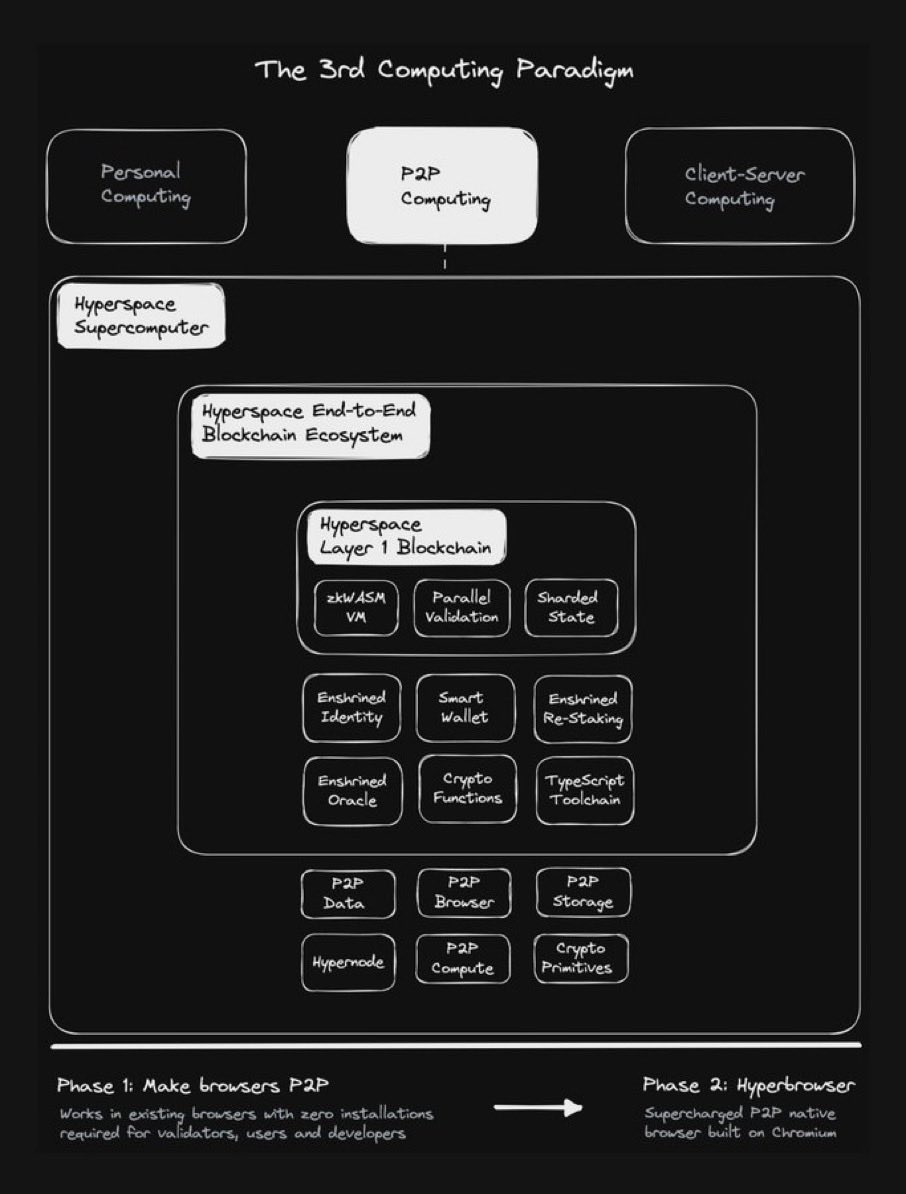
personal computer -> network computer
vitalik’s “world cryptographic computer” vision is the vision I laid out in 2023-2024 of a P2P supercomputer: tweets, blog posts, papers.
hopefully more people understand it now with his reach and remarkable research work Ethereum community has done.
now our path is architecturally different than Ethereum (longer technical blog post..), and arguably better suited for a world of 100s of millions of machines worldwide at home and in datacenters
x able to do trusted activities with each other using cryptography.
we have already proven early aspects of this with building an ephemeral network previously which at one time had MORE number of unique machines connected to than Ethereum, so we know how to build networks, and especially AI-optimized networks.
the ledger is but a very small optional component of such a new computing paradigm for very few use cases.
overall, the world of 2030s would be a remarkable place with multiple such global computers running and available to be used based on need.
and these are also nearly free to use and it’s a race to zero for all of us. there is no viable business model here.
it’s just a global utility being willed into existence.
This is why we built the most efficient (but remarkably boring) payment infrastructure for agents as the base layer for Hyperspace. It’s a race to zero from a product perspective; value capture happens at the transaction-level - where to be uber-efficient, you need full stack.