Prompt engineering has been replaced by loop engineering.
What is it? (Explained in 60 seconds)
For the past 2 years we have been prompting agents with individual tasks. That is starting to change.
So far, if you wanted an agent to build a dashboard for a client, you would give it a task, review the output, improve the prompt, and repeat the process until the work was done.
Looping changes that.
Instead of giving an agent individual tasks, you give it a goal and let it work through a recursive loop until that goal is met.
For example:
→ Research
→ Draft
→ Evaluate
→ Test
→ Improve
→ Repeat
The agent keeps cycling through the loop until it reaches the standard you defined.
Within loop engineering there are two main approaches:
1. Open Looping
You give the agent a goal and allow it significant freedom in how it achieves it.
This is powerful, but also expensive and harder to control.
2. Closed Looping
The human defines the architecture, constraints and evaluation criteria.
The agent is then responsible for executing, improving and iterating within those boundaries until the goal is reached.
The next evolution is orchestrated looping.
Instead of a single agent running a loop, one agent breaks the goal into smaller tasks and assigns them to specialist agents.
Each specialist runs its own loop and reports back.
In other words:
You move from one agent improving itself to an entire team of agents iterating together until the goal is achieved.
Anthropic x https://t.co/5iQpMPQ9sQ just dropped a free course on Agent Skills
stop re-explaining the same workflows to your agents
package them as skills → deploy anywhere
2 hours. beginner. actually worth it
https://t.co/0RZdoQFHGv
As an AI Engineer. Please learn:
Harness engineering, not just prompt engineering
Context engineering, not just long prompts
Prompt caching vs. semantic caching tradeoffs
KV cache management, eviction, reuse, and memory pressure at scale
Prefill vs. decode latency and why they optimize differently
Continuous batching, paged attention, and throughput optimization
Speculative decoding vs. quantization vs. distillation tradeoffs
INT8, INT4, FP8, AWQ, GPTQ, and when quantization hurts quality
Structured output failures, schema validation, repair loops, and fallback chains
Function calling reliability, tool contracts, argument validation, and idempotency
Agent guardrails, loop budgets, tool budgets, and termination conditions
Model routing, graceful fallback logic, and degraded-mode UX
RAG architecture: chunking, embeddings, hybrid search, reranking, and freshness
Retrieval evals: recall, precision, grounding, attribution, and citation quality
Evals: golden sets, regression tests, adversarial tests, LLM-as-judge, and human evals
LLM observability as a first-class discipline: traces, spans, tokens, latency, errors, and drift
Cost attribution per feature, workflow, tenant, and user journey not just per model
Safety engineering: prompt injection defense, data leakage prevention, and permission boundaries
Multi-tenant isolation, cache safety, and cross-user context contamination prevention
Fine-tuning vs. in-context learning vs. RAG vs. distillation and when each is the wrong tool
Latency, quality, cost, and reliability tradeoffs across the full inference stack
Production failure modes: hallucinated tool calls, malformed JSON, stale retrieval, runaway agents, and silent eval regressions
Shipping LLM systems as reliable infrastructure, not demos wrapped around prompts
https://t.co/OhK9MK04ld
Stop learning LLMs from disconnected tutorials.
LLM from Scratch is a hands-on PyTorch curriculum for builders who want to understand how LLMs are trained, modernized, and aligned.
It helps you move from concepts to implementation by organizing the path from transformer basics to tiny-model training, scaling, fine-tuning, reward modeling, and RLHF.
Key features:
• End-to-end curriculum – follows pretraining → finetuning → alignment from foundations through RLHF
• Transformer from first principles – covers positional embeddings, self-attention, attention heads, MLPs, residuals, LayerNorm, and full blocks
• Tiny LLM training loop – includes tokenization, batching, cross-entropy, sampling, validation loss, and a no-Trainer training loop
• Modern architecture upgrades – walks through RMSNorm, RoPE, SwiGLU, KV cache, sliding-window attention, and streaming cache ideas
• Alignment path included – covers SFT, reward modeling, PPO-style RLHF, and GRPO with concrete training-loop notes
It’s open-source (GPL-3.0 license).
Link in the reply 👇
Interested in learning how to run RL at scale? Here are the best resources to read…
Research on Scaling RL
1. The Art of Scaling RL compute for LLMs: https://t.co/PGjI6Gwgv0
2. Scaling Behaviors of LLM RL Post-Training: https://t.co/2u2saB3C0h
3. Optimally Scaling Sampling Compute for LLM RL: https://t.co/rUSdUvJyNH
4. Scaling up RL: https://t.co/O8vV6z8ymx
5. ProRL V2 - Prolonged Training Validates RL Scaling Laws: https://t.co/vu72juvRW4
6. Polaris - A Recipe for Scaling RL with Reasoning Models: https://t.co/rMibSAeJbg
RL Frameworks
1. Hybrid Flow (early outline of the verl framework): https://t.co/GnWXx131uD
a. More up-to-date info can be found here: https://t.co/j801HcJmPP
2. AReal - Large-Scale Async RL: https://t.co/qhOvsQK09N
3. PipelineRL - Fast On-Policy RL: https://t.co/iRM7KzySXe
4. AsyncFlow - Async Streaming RL: https://t.co/YwmzFtiU2q
RL for Agents
1. DeepSWE - Open Coding Agent Trained w/ RL: https://t.co/GHQHcmtE6F
2. AutoForge - Environment Synthesis for Agentic RL: https://t.co/mr3WDIL5vq
3. Agent-R1 - Training Agents w/ End-to-End RL: https://t.co/xpfQJGgzEv
4. AgentRL - Scaling RL for Multi-Turn, Multi-Task Agents: https://t.co/7fbVl0RWXG
5. The Landscape of Agentic RL: https://t.co/OMnSV4rgdW
6. Training SWE Agents with RL: https://t.co/YqMqySbyXS
Case Studies & Tech Reports
1. Kimi tech reports:
a. Kimi K2 - Open Agentic Intelligence: https://t.co/aAw17SXrIw
b. Kimi End-to-end Agentic RL: https://t.co/ProBpOPIiI
c. Kimi K1.5 - Scaling RL for LLMs: https://t.co/kRGOxY9Jvp
2. Composer series from Cursor:
a. Composer 2: https://t.co/K0v8rNCE6Z
b. Composer 2.5: https://t.co/D9PYimfOMU
3. Olmo 3 (also has open code / data): https://t.co/khetJFvp6N
4. MiniMax tech reports:
a. MiniMax-M2: https://t.co/HApb0OB80S
b. MiniMax-M1: https://t.co/mZj9UQsrnC
5. Nemotron 3 (NVIDIA): https://t.co/lCpE1GzxSi
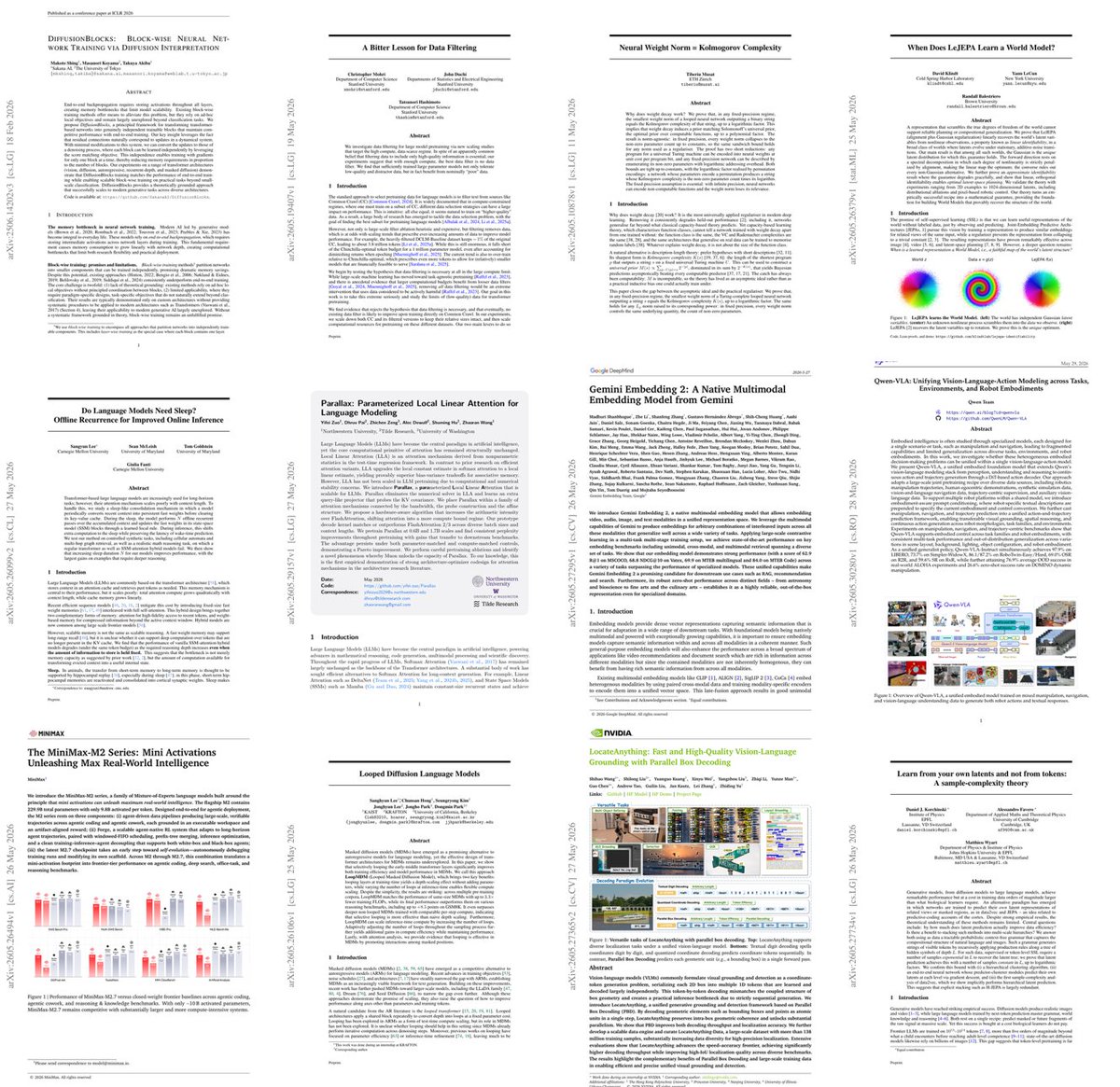
🚨This week's top AI/ML research papers:
- DiffusionBlocks
- A Bitter Lesson for Data Filtering
- Neural Weight Norm = Kolmogorov Complexity
- When Does LeJEPA Learn a World Model?
- Do Language Models Need Sleep?
- Parallax
- Gemini Embedding 2
- Qwen-VLA
- The MiniMax-M2 Series
- Looped Diffusion Language Models
- LocateAnything
- Learn from your own latents and not from tokens
overview for each + authors' explanations
read this in thread mode for the best experience
🚨 𝟔 𝐓𝐲𝐩𝐞𝐬 𝐨𝐟 𝐋𝐋𝐌𝐬 𝐩𝐨𝐰𝐞𝐫𝐢𝐧𝐠 𝐭𝐨𝐝𝐚𝐲’𝐬 𝐀𝐈 𝐚𝐠𝐞𝐧𝐭𝐬
1️⃣ 𝐆𝐏𝐓 – 𝐆𝐞𝐧𝐞𝐫𝐚𝐭𝐢𝐯𝐞 𝐏𝐫𝐞-𝐭𝐫𝐚𝐢𝐧𝐞𝐝 𝐓𝐫𝐚𝐧𝐬𝐟𝐨𝐫𝐦𝐞𝐫
(𝑇ℎ𝑒 𝐺𝑒𝑛𝑒𝑟𝑎𝑙𝑖𝑠𝑡)
Trained on massive datasets, these autoregressive models are the foundational engines for writing, reasoning, coding, and open-ended conversation.
➜ Highly versatile across diverse domains
➜ Excels at zero-shot and in-context learning
➜ The ultimate foundation for downstream fine-tuning
2️⃣ 𝐌𝐨𝐄 – 𝐌𝐢𝐱𝐭𝐮𝐫𝐞 𝐨𝐟 𝐄𝐱𝐩𝐞𝐫𝐭𝐬
(𝑇ℎ𝑒 𝑆𝑐𝑎𝑙𝑒𝑟)
Instead of activating the full neural network, MoE uses sparse routing to send each input only to the most relevant subset of "expert" sub-networks.
➜ Radically higher compute efficiency during inference
➜ Scales seamlessly to trillions of parameters
➜ Achieves deep specialization without sacrificing overall performance
3️⃣ 𝐕𝐋𝐌 – 𝐕𝐢𝐬𝐢𝐨𝐧-𝐋𝐚𝐧𝐠𝐮𝐚𝐠𝐞 𝐌𝐨𝐝𝐞𝐥
(𝑇ℎ𝑒 𝑀𝑢𝑙𝑡𝑖𝑚𝑜𝑑𝑎𝑙)
Combines advanced vision encoders with language models to natively process and reason over spatial data—like images, complex diagrams, and video streams.
➜ Understands deep visual and spatial context
➜ Perfectly aligns pixel data with semantic text
➜ Enables rich multimodal tasks (like visual QA and image-based telemetry)
4️⃣ 𝐋𝐑𝐌 – 𝐋𝐚𝐫𝐠𝐞 𝐑𝐞𝐚𝐬𝐨𝐧𝐢𝐧𝐠 𝐌𝐨𝐝𝐞𝐥
(𝑇ℎ𝑒 𝑇ℎ𝑖𝑛𝑘𝑒𝑟)
Built for "System 2" thinking. Optimized for multi-step reasoning, logical problem-solving, and planning through explicit verification and self-correction loops.
➜ Elite mathematical and logical planning
➜ Drastically reduced hallucinations through step-by-step verification
➜ Excels at complex, highly constrained problem-solving
5️⃣ 𝐒𝐋𝐌 – 𝐒𝐦𝐚𝐥𝐥 𝐋𝐚𝐧𝐠𝐮𝐚𝐠𝐞 𝐌𝐨𝐝𝐞𝐥
(𝑇ℎ𝑒 𝐿𝑖𝑔ℎ𝑡𝑤𝑒𝑖𝑔ℎ𝑡)
Compact, highly optimized models engineered specifically for edge devices, offline execution, or highly cost-sensitive environments.
➜ Ultra-low latency and blazing-fast inference
➜ Highly cost-effective to deploy and maintain
➜ Ensures data privacy through strictly on-device processing
6️⃣ 𝐋𝐀𝐌 – 𝐋𝐚𝐫𝐠𝐞 𝐀𝐜𝐭𝐢𝐨𝐧 𝐌𝐨𝐝𝐞𝐥
(𝑇ℎ𝑒 𝐷𝑜𝑒𝑟)
Designed not just to generate text, but to execute real-world tasks using tools, APIs, and external environments. It operates on a continuous agent loop:
🔄 Plan ➟ Action ➟ Observation ➟ Reflect ➟ Update Memory
➜ Autonomous real-world execution
➜ Native integration with external systems and software
➜ Dynamically adapts to environmental feedback
Agents aren’t just chatbots anymore. They see, act, reason, and run anywhere from cloud GPUs to edge devices. 𝐶ℎ𝑜𝑜𝑠𝑖𝑛𝑔 𝑡ℎ𝑒 𝑟𝑖𝑔ℎ𝑡 𝐿𝐿𝑀 𝑡𝑦𝑝𝑒 𝑑𝑖𝑟𝑒𝑐𝑡𝑙𝑦 𝑖𝑚𝑝𝑎𝑐𝑡𝑠 𝑐𝑜𝑠𝑡, 𝑙𝑎𝑡𝑒𝑛𝑐𝑦, 𝑟𝑒𝑙𝑖𝑎𝑏𝑖𝑙𝑖𝑡𝑦, 𝑎𝑛𝑑 𝑟𝑒𝑎𝑙‑𝑤𝑜𝑟𝑙𝑑 𝑐𝑎𝑝𝑎𝑏𝑖𝑙𝑖𝑡𝑖𝑒𝑠.
Cc : Author
9 database types explained in one sentence:
1) 𝗥𝗲𝗹𝗮𝘁𝗶𝗼𝗻𝗮𝗹
↳ Stores structured data in tables with predefined schemas & SQL queries.
2) 𝗞𝗲𝘆-𝗩𝗮𝗹𝘂𝗲
↳ Stores simple key-value pairs for ultra-fast lookups & caching.
3) 𝗗𝗼𝗰𝘂𝗺𝗲𝗻𝘁
↳ Stores data as JSON-like documents with flexible, nested structures.
4) 𝗪𝗶𝗱𝗲-𝗖𝗼𝗹𝘂𝗺𝗻
↳ Stores data in flexible column families for large-scale distributed workloads.
5) 𝗧𝗶𝗺𝗲-𝗦𝗲𝗿𝗶𝗲𝘀
↳ Stores time-stamped data for real-time metrics, logs, events, & telemetry.
6) 𝗚𝗿𝗮𝗽𝗵
↳ Stores relationships between entities to query connected data efficiently.
7) 𝗩𝗲𝗰𝘁𝗼𝗿
↳ Stores embeddings to enable similarity search & AI-powered retrieval.
8) 𝗖𝗼𝗹𝘂𝗺𝗻𝗮𝗿
↳ Stores data by columns instead of rows to optimize analytical queries.
9) 𝗦𝗲𝗮𝗿𝗰𝗵
↳ Stores indexed text and structured data to enable fast full-text and relevance-based queries.
Most modern systems use several of these together.
As systems become more real-time and AI-driven, the need for time-series infrastructure has grown significantly.
I like using TimescaleDB by Tiger Data because it keeps the simplicity of Postgres while making it much easier to work with large volumes of time-series and real-time data.
Try Tiger Data free with my link below. You'll get a $1,000 30-day credit, no credit card required. It takes just a few minutes to get started, and you can use the credit to build and experiment with whatever you want (new accounts only).
Try it here (for free) → https://t.co/Gcz0RaBFxg
What else would you add?
——
♻️ Repost to help others learn and grow.
🙏 Thanks to @TigerDatabase for sponsoring this post.
➕ Follow me ( Nikki Siapno ) + turn on notifications.
HUGGING FACE DROPPED A FREE CONTEXT ENGINEERING COURSE
and the curriculum is stacked:
▫️ unit 1: agent skills + SKILL.md format
▫️ unit 2: MCP (model context protocol)
▫️ unit 3: plugins for tool distribution
▫️ unit 4: subagents + multi-agent workflows
▫️ unit 5: hooks to guard the agent lifecycle
▫️ bonus: build your own agent from scratch
https://t.co/1HjjaXVOek
𝗛𝗼𝘄 𝗧𝗵𝗲 𝗜𝗻𝘁𝗲𝗿𝗻𝗲𝘁 𝗔𝗰𝘁𝘂𝗮𝗹𝗹𝘆 𝗪𝗼𝗿𝗸𝘀 — 𝗧𝗵𝗲 𝟮𝟬 𝗖𝗼𝗻𝗰𝗲𝗽𝘁𝘀 𝗘𝘃𝗲𝗿𝘆 𝗗𝗲𝘃 𝗦𝗵𝗼𝘂𝗹𝗱 𝗞𝗻𝗼𝘄
Most people use the internet every day.
Very few understand what happens after pressing Enter.
If I had learned these concepts earlier,
I would’ve understood backend, DevOps, cloud, APIs, and scaling way faster.
Here are the 20 internet concepts that make everything click:
→ DNS
→ IP Address
→ TCP/IP
→ HTTP vs HTTPS
→ SSL/TLS
→ CDN
→ Load Balancer
→ Reverse Proxy
→ Caching
→ Cookies & Sessions
→ REST APIs
→ WebSockets
→ Authentication
→ Databases
→ Serverless
→ Containers
→ Kubernetes
→ Message Queues
→ Rate Limiting
→ Edge Computing
Once you understand these,
modern system design stops feeling like magic.
bookmark this before your next backend project.
Most people use AI every day…
without understanding the 20 core concepts that actually make it work.
If you learn these once, AI suddenly becomes far less “magic” and far more predictable.
Here’s the roadmap every modern AI engineer should understand in 2026:
• Neural Networks
• Tokenization
• Embeddings
• Attention Mechanism
• Transformers
• Pretraining
• Fine-tuning
• RLHF
• Guardrails
• RAG
• Vector Databases
• Chunking
• Decoding
• Temperature & Top-P
• AI Agents
• Tools & Function Calling
• Planning
• Evaluation
• Iterative Improvement
• Bias & Fairness
The biggest realization?
AI is not magic.
It’s:
Math + Data + Compute + Iteration.
Once you understand how these layers connect:
• RAG starts making sense
• Agents become easier to build
• Hallucinations become easier to reduce
• Prompt engineering becomes more effective
• Production AI systems become less intimidating
The people winning in AI right now are not the ones memorizing prompts.
They’re the ones deeply understanding the architecture behind the models.
Learn the foundations once.
You’ll be able to adapt to every new AI trend that comes next. 🚀