Since this war began, many have noted that it feels different than June '25 and from the conflict with Hezbollah in Sept. '24 and post-Oct. 7.
Tomorrow (2pm ET), @eJPhil is hosting a panel on this issue with Tova Dorfman, Masua Sagiv and Barak Sella.
https://t.co/mlu6QLG9gM
Glad to see this addressed in the scientific press. Too often the gulf between academia and the clinic leaves two dialogues, rarely interacting. This book clearly impacted the field and yet has been untouched by academia. Agree with most but watch this space for our SE study
It finally happened. Some readers had asked for a concise, peer-reviewed critique of The Body Keeps the Score. 🔥🔥It’s open access, so everyone can read it — even people who think trauma made them do it. You’re welcome, science.
Evaluating evidence behind popular trauma narratives: neurobiological and treatment claims in The Body Keeps the Score | BJPsych Bulletin | Cambridge Core - https://t.co/Yn6A6mWMPN
In February 2024, I wrote Scientific Reports about a published meta-analysis claiming that mindfulness interventions affect neural plasticity, 'cementing the neuropsychological basis of mindfulness-based interventions'.
Paper was retracted yesterday—here a process summary.🧵
Eventually we submitted our report to @arxiv. Although even they flagged and held it for 2 weeks, we're grateful to them for posting it. But Science has a big problem. There ought to be a place to publish critique of a body of work. Not just a complaint about one paper. 20/
Interoception (measurement and change) is a key element of two major studies currently running in our department. The influence of somatic based treatments has challenged us to identify new pathways of change which inc. learning our own body's music as the thread below describes
Why is interoception so important for our mental health?
Homeostasis is the process of maintaining the physiological parameters of a living organism within the range most conducive to optimal functioning and ultimately survival.
Our awareness of our inner feelings not only tells us to sleep when we need rest, eat when we need energy and drink when we are thirsty. It can also help us tweak and adjust our actions, prompts changes in our relationship to others and adapt our bodies to our environment. All in the interest of survival.
Research finds there is an association between low interoceptive sensitivity and alexithymia. Sometimes called “emotional blindness”, alexithymia makes it hard to know or communicate what you’re feeling. This can affect your mental health as well as your relationship with others.
Emotion and feeling is what makes us vibrant. When people lack awareness of what they are feeling, they can come across as monotonous. It’s the emotional content of someone’s speech that often hooks us in, keeps us interested.
If you’re not sure what you’re feeling it can also be hard to know what you want or need. And if you don’t know much about yourself, how can others get to know the real you?
Yet you probably crave relationships with others, just like anyone else. It is possible to improve your interoceptive sensitivity.
Listening to the musical score playing out within your body is an antidote to this. Practicing listening to emotive music and noticing what impact it has can be a good starting point.
And if you want to learn more about interoception, listen to this conversation me and David Jones had with Jenny Murphy who specialises in researching this:
https://t.co/WprYJ7BjiK
2/2 I agree that the current evidence based needs to be challenged, specifically by people not coming from the field (read: non enthusiasts) and that the therapy should be clearly regulated, not just the drug. There is still a long way to go but quality and transparency vital.
1/2The results of the prelim MDMA hearing are indicative of what has driven our MDMA - SEA IT study. Bolstered by the placebo findings we designed a concurrent non MDMA treatment for comparison and to harness the promising treatment effects of psychedelic influenced psychotherapy
3/3 This current work was the result of a collaboration formed at @ISTSSnews in Atlanta and hope to continue working together both in respect to treatment and theory. Great to work with Andreas, a deep thinker and kind researcher. @aenordstrand
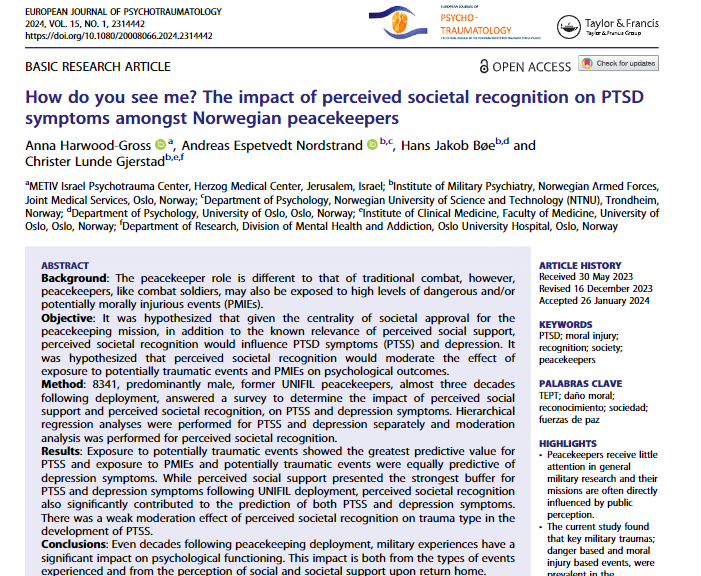
1/3 Scary period to publish research on military psych but excited that our latest collab between METIV Israel Psychotrauma Center and Norwegian military psychs has just gone to press.
In short, we demonstrated that even 30 years following service, recognition matters @ESTSSnews
2/3 How your government, the public and even the media perceived your military service is related to military-related PTSD symptoms decades after service. We attempt to address this in our Peace of Mind program and are studying how to integrate this into PTSD treatments.
Interesting to compare the weightings of intervention impact versus traumatic events. Note the high weighting of food scarcity and migration from middle income countries. The paper also highlights the effects of housing and incarceration difficulties compared to parenting.
IMO Andy Field is the best stats textbook writer, ever! I started with his SPSS book and then moved to the R version many years ago (12!?). His humor and artful way of making statistics interesting are 👍👍
📢New preprint with @JSchleiderPhD@JeremyWEberle @TeachmanBethany
Anxiety identity centrality is associated with avoidant coping in anxious adults - even after controlling for symptom severity.
Free preprint: https://t.co/bOFVQmk7ZV
It feels appropriate that today, 7/2, 4 months after the 7th of October, the MDMA for our MDMA-SEA IT mechanisms of change study for military PTSD, has arrived in Israel and is now on its way to our hospital. Hopeful that we will see peaceful days and the return of our hostages.
For the first time since the war started, returning to our journal club where we bridge trauma research and clinical work. Appropriate that this evening's presenters are presenting research on SEE FAR CBT for PTSD, on the work reintroducing play & imagination following trauma