@GlasgowCC Love this. But maintenance is very important! Will @GlasgowCC have the resources to keep the beds litter-free, and planted over the next years?
@ahmtamim9 Das Denkmal „Die befreite Frau“ in Baku – dessen Gestaltung die Geste des Ablegens des Tschadors aufgreift – symbolisiert die Befreiung der aserbaidschanischen Frauen von religiösen Fesseln sowie die Erlangung der Möglichkeit, am gesellschaftlichen Leben des Landes teilzuhaben….
@sarahstuartxx The groups which ask loudest about integration are very good at self-segregation. What is it a LGBTQ+birder needs that's different from any other birdwatcher?
Whoever defends the burqa, hates women. No women wears this fabric prison voluntarily. The burqa has nothing to do with dressing modestly to show dedication to Islam. It is about the subjugation of women only.
@gracebrod1e It’s a garment created by Muslim men to oppress women
They make them dress like that so at to try and protect them from Muslim men who would otherwise want to rape them
A disgusting ideology
Not a surprise. This trend is visible for the last years in official communication from most public services. We hear instead lots of "festive period", "restful winter break", "season of rest and reflection". Christ is the name not to be named
@AgentP22 This is not a surprise. Public services try to avoid the word Christmas for the last years. "Festive period", "winter break" is often used as replacement
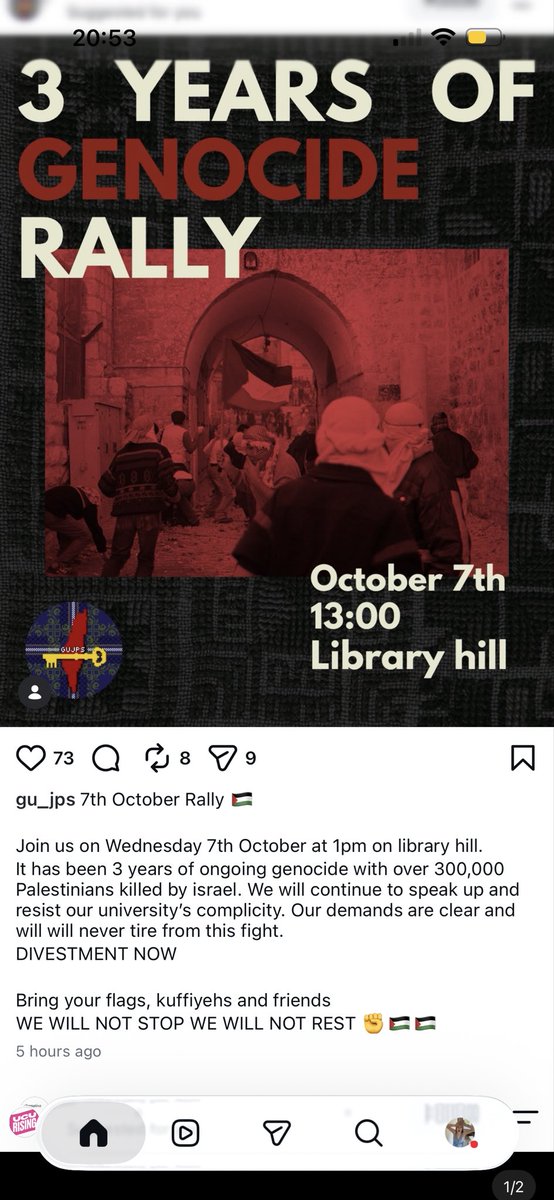
@heraldscotland You forgot to show the "Glory to our matyrs" banner. Somehow, I don't think they mean the 1200 Jewish people killed on this day 3 years ago
Pro-Palestine student demonstrators march through the Glasgow University campus behind signs reading “students for Palestine” and “Glory to our Martyrs”
- @LBC
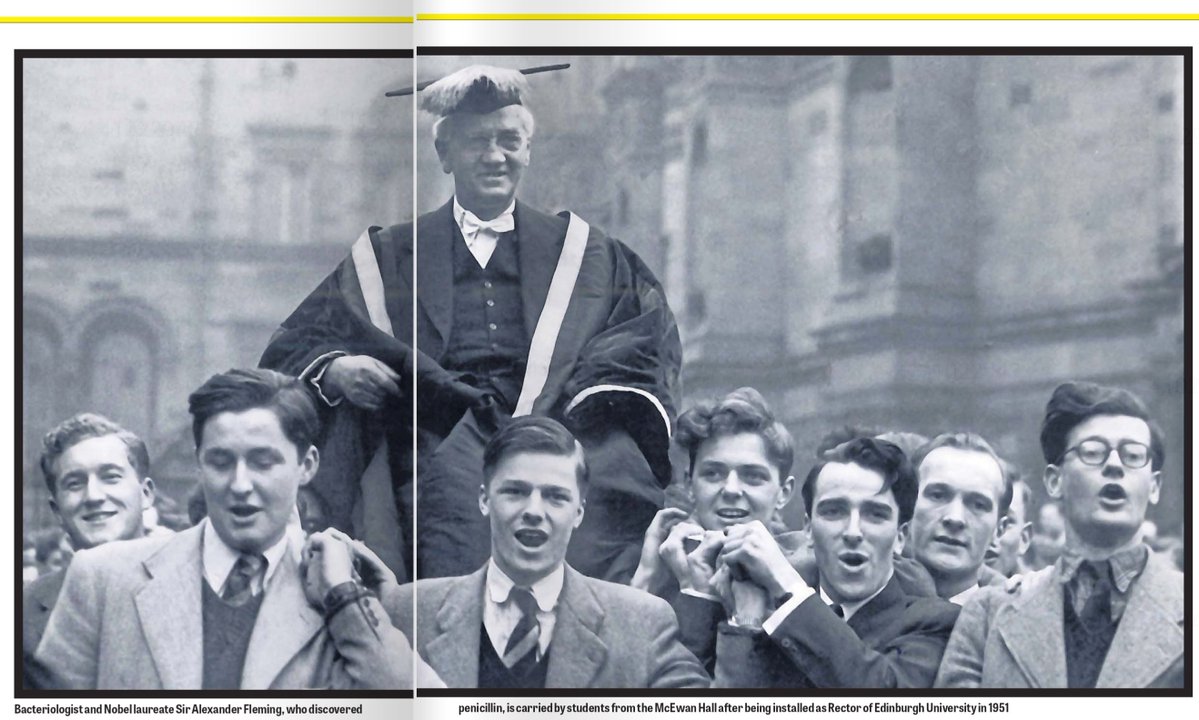
A great photo of Sir Alexander Fleming, the man who discovered penicillin, being installed as Edinburgh University rector in 1951.
How times change.
These days we get university rectors, Maggie Chapman, Iona Fyfe and Aamer Anwar.
See the difference?
@UofGlasgow students continue to glorify terrorism. Last year, GU Justice for Palestine Society ‘[celebrated] the glorious Al-Aqsa Flood which permanently crippled the Zionist entity.’ The University made no comment.
There is no evidence that Women's Declaration makes anyone actually unsafe. That's why the concept of 'psychological unsafe' was invented by these trans activists
Greens ban gender-critical group from conference
https://t.co/giCx7U5ror
A gender-critical women’s group has been barred from the Green Party conference after being told it would make trans members “feel unsafe”.
The Green Women’s Declaration (GWD) was told it was not allowed to have a stall at this year’s party gathering in Brighton.
John Swinney believes that Transwomen are women....
Q. "Is it your position that transwomen are women?"
A. "I've, I've said, the answer I've given to that before, is that erm...I accept that to be the case"
🤨
I listened. According to him, schools will sort the VAWG crisis with teaching children about consent. Girls only have to say "No!", and all will be fine
Violence against women and girls is an epidemic and I have pledged my personal leadership to tackling it - that means listening and driving urgent action across government and society.
This morning I will be taking your calls on BBC Radio Scotland on this issue.
As someone who works for the BBC and knows how absurdly difficult it can be to get pieces commissioned for the website - the hoops, the meetings, the endless process - it’s genuinely staggering that something like this sails through.
For starters, it isn’t news. Yet there it is on the BBC News website, complete with twaddle about how the way a woman does - or doesn’t do - her nails can apparently be linked to white supremacy.
I was blissfully unaware of the supposed politicisation of nail polish, and I’m sure most people were. But by reporting claims like this, the BBC doesn’t simply observe a debate - it helps create one. It amplifies a narrative and gives prominence to voices that seem determined to detect white supremacy in the most mundane aspects of everyday life.
There’s something deeply unhealthy about that. Imagine the BBC publishing an article suggesting some equally trivial cultural habit was evidence of a “black supremacist mindset”. You can’t really imagine it, because it would never happen. Yet the nation’s broadcaster apparently has no difficulty amplifying extraordinary claims about white supremacy.
This is the sort of thing that makes me despair about the BBC. I’ve criticised it for years for being captured by progressive ideology, identity politics and gender woo-woo. Every so often I start to wonder whether things might finally be improving.
Then an article like this appears and disabuses me of that notion pretty quickly.
If anything, the problem seems to be getting worse.
“How the bare nails trend became a class issue” https://t.co/PZyzuUPvsT
Artemisia Gentileschi was raped in her own home at seventeen, in 1611, by a friend of her father. In the trial that followed, she was the one made to suffer to prove she was telling the truth, while her attacker walked free.
Some of that pain found its way into her paintings, and few are as raw, or as unforgettable, as this one...
It's called Judith beheading Holofernes: two women are pinning a man to a bed. The younger one, a servant, throws her whole weight across him to hold down his flailing arms while his fist shoves back at her. The other, Judith, forces his head into the sheets with one hand, and with the other drags a sword through his throat. The blood pours into the white linen at the very front of the canvas, as close to you as the painting can bring it.
The story comes from the Book of Judith. Holofernes is an Assyrian general laying siege to her city. Judith, a young widow, walks into his camp, wins his trust, and when he collapses into a drunken sleep, she and her maid cut off his head and save her people. Caravaggio had painted the same scene in Rome a decade earlier, but his Judith shrinks back from the act, holding the sword at arm's length while a withered old servant simply watches. Artemisia's two women do it together, and her Judith does not flinch. You can see the strain in her wrists.
She had painted this subject once before, around the time of the trial, before she turned twenty. But she could not let it go. Roughly eight years later she painted this version, larger and bloodier. The blood here is leaping from his neck in long arcs that, one study found, closely trace the curved path of a projectile, the same path her friend Galileo was working out in those very years. On Judith's arm she added a bracelet, its tiny carved figures, one scholar suggests, showing Artemis, the goddess whose name she carried...
To understand the fury in it, you have to know what happened to her. The man who raped her, Agostino Tassi, was her father's colleague, and afterward he promised to marry her. When he never did, her father took him to court. The case dragged on for seven months. To test whether she was lying, the court wound cords around her fingers and pulled them tight, the same fingers she painted with. Tassi was subjected to nothing of the kind. As the cords bit into her hands, she screamed the same words over and over: "È vero. È vero. È vero." It is true. Then she turned to the man who had promised to marry her and said:
"This is the ring you give me, and these are your promises."
Tassi was found guilty and offered a choice between five years of hard labor and exile from Rome. He chose exile, and the sentence was never enforced. Her reputation did not survive as easily: Tassi had bribed witnesses to swear she had slept with other men, and produced forged love letters in her name, and soon she was the subject of lewd sonnets traded around the city. To salvage what was left of her honor, she was married off to a Florentine painter, Pierantonio Stiattesi, the day after the trial ended, and sent away from the only city she had ever known. The man who raped her walked free. She was the one forced to leave...
But nothing said in that courtroom could touch what she could do with a brush, and today she is regarded as one of the finest painters of the seventeenth century.
In 1649, reassuring a client about the quality of the work she was making for him, she wrote a line that has outlived everyone who tried to break her:
"I will show Your Illustrious Lordship what a woman can do."
BREAKING 🚨
Lanzarote’s emergency chief says a 2-year-old was thrown off a migrant boat because he would not stop crying — in front of his mother.
Enrique Espinosa said it while discussing a gang-rape on a patera to the island: they threw the child into the Atlantic. No date given. No arrests announced for the boy.
That’s an official repeating survivor accounts, not a closed case.
Same week: three men arrested over the alleged rape of a woman on the 16 September crossing. Bodies recovered. Hundreds more pulled off boats around Lanzarote.
A crying toddler treated as a problem. Investigate it as a killing.
https://t.co/4yXqLe8FX0
@GlasgowCC Congratulations @Bell45. Unfortunately I noticed that you are constantly scrolling on your phone during full council meetings. I doubt you are able to give due attention to what's discussed at these meetings. Does your new role mean this will stop now?