Six ETF issuers have filed preliminary prospectuses for ETFs on compute futures. These are among the first ETFs in history to be filed before the underlying futures trade. How futures ETFs work, how they differ from stock ETFs, and specific design considerations for compute:
AI workloads are creating new memory objects that are too large for HBM but too valuable for cold storage. It’s simply to expensive to use DRAM for everything if it’s possible to use NAND for some of it. We’ve gotten three announcements focused on flash from three major players in the past couple weeks:
Nvidia is using flash to store reusable KV cache via CMX. This targets long-context, multi-turn and agentic inference by extending GPU memory with a shared KV-cache tier, allowing flash to become context memory for long-running agents.
AMD is using flash to store some system memory until it is predicted to be hot enough to go to DRAM. They’re buying MEXT as a software layer to accomplish this.
Apple is using flash to store some model weights until needed. Apple stores inactive experts in flash on the device side (AFM 3 Core Advanced, published a week ago).
If you can get the system to know what data is likely to be needed next, flash goes from simple storage to cheaper memory.
1/8
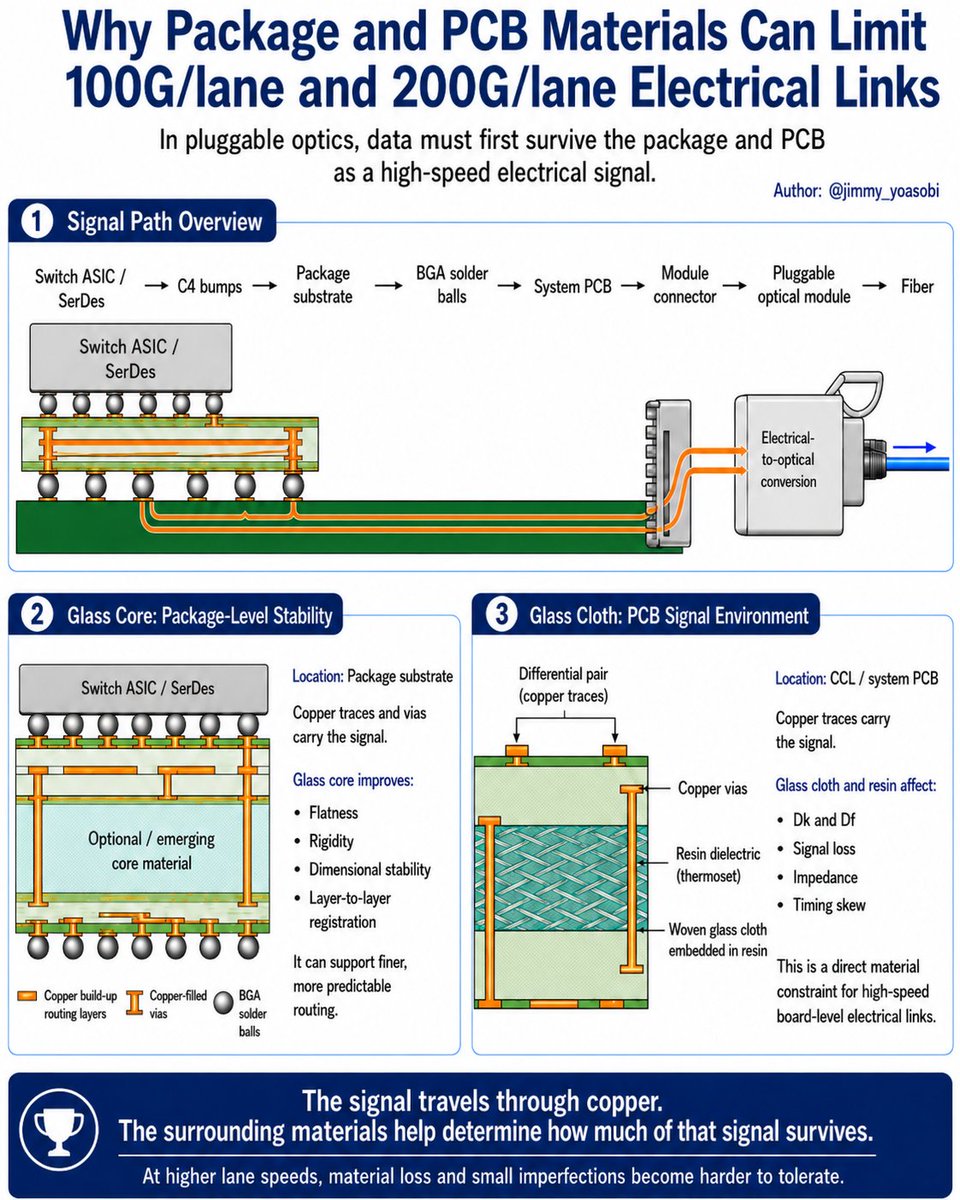
We previously separated two materials that are easy to confuse:
Glass core sits inside the package substrate.
Glass cloth is used inside CCL / PCBs.
But this leaves a more important question:
Why do AI servers care about the materials inside these substrates and boards?
Because before data becomes light,
it usually travels through a high-speed electrical path.
Hardware is the bridge between AI and the physical world
Atoms and bits must work together to create future systems embedded with physical intelligence
We wrote a guide for those curious about the atoms.
1/9
The market is talking about “glass” again.
But this is not the same glass story.
Glass core helps stabilize advanced chip packages.
Glass cloth is used inside materials that become server PCBs.
Same word.
Different layer.
Different suppliers.
Different bottleneck.
Before interpreting the latest supply and pricing headlines, we need to understand where each one sits.
i get asked a lot about whether you should trade your personal money vs joining a hedge fund.
the decision is usually as follows (assuming you have edge):
1) cashflow: analysts get paid $130-200k (PMs higher), so if you're running $1m of personal money, you need to make 13-20% per year just to break-even on your monthly salary (which carries zero risk). the math makes more sense if you're running >$5m book.
2) strategy capacity: you join a hedge fund if your cut of the potential profits is more than what you'd make on your own book, and your strategy's capacity is large (if your strategy is running solana microcaps or small prediction market arbs, you're out of luck)
example: your strategy has $10m capacity and a 2x potential return, and you get a 10% profit share from the fund. You will make $2m. Whereas even if you somehow fullport your $1m, you will still only make $1m.
3) loneliness / being around smart people: Trading solo can be pretty depressing because you can't discuss your edge with other people. Also, your trader friends will rightfully be slightly cagey about their strategies to prevent edge decay.
4) alpha in infra, scale, or access: There are certain edges which require a lot of maintenance on infra (systematic strats) or scale (special exchange relationships & rebates / deals due to the volume your MM algos do). In terms of access, funds have access to some institutional instruments that solo traders might not have (e.g., complex options products via MMs, forwards)
5) learning the ropes before starting your own fund: there is lots to learn at an institutional fund around legal, compliance, trading operations, opsec, tax, fund structure, etc. which are transferrable when starting your own fund.
6) utilising connections and intros: Projects don't want to talk to a solo trader especially if you're just starting out (don't have a brand name yet) and your port is small (<$1m). If you're starting out you can leverage your fund's name to get to places you want to be.
A lot of the trading discourse is poor because people overly focus on being right/wrong (batting avg) at a point in time (one at bat), rather than looking at slugging percent/wOBA (how much do you make when you're right vs lose when you're wrong)
Sizing+riding convictions >>
1/12
AI Memory Stack Trade
Long $MU HBM
Long $SNDK NAND / Enterprise SSD
The memory trade is not just about AI demand.
The real debate is whether memory earnings are becoming less cyclical.
Customers are no longer only buying chips.
They are paying for supply security.
Directionally agree with this. We think timeline is longer, the IB is probably worth a little less, and overall multiple will have crypto drag, but $GLXY is still wildly undervalued by all measures based on the data center business alone.
@Crypto_Alex17 nailed the $IREN $WULF and $CIFR thesis for us last year... has nailed GLXY thus far too. He's your guy for understanding crypto companies that have pivoted to AI
Some napkin math on $GLXY.
It's market cap is around $12B.
$GLXY has three core businesses:
> its crypto balance sheet, currently around $3-4b;
> its crypto Investment Banking type business;
> its data centre business.
Essentially, $GLXY already has 800MW approved and leased to $CRWV and has another 800MW approved (@novogratz said we'll learn of the tenant by July hopefully).
If you apply the same margins as their $CRWV deal, that is 2.4B in revenue and 2.16B in EBITDA (90% EBITDA margins). Say you slap a 15x P/ EBITDA, that's $32B on its data centre business alone. Say 1.6GW comes online 2028? So since market is forward looking, that's a FY 2027 price.
It also seems very likely that $GLXY can have 3.5GW come fully online by 2031/2032. Applying the same metrics, that's $5.25b in revenue and 4.725b in EBITDA in 2031/2032 just from the data centre business alone. At15x P/EBITDA that's $70b ($170 per share) in 7 years.
It's crypto IB business is another beast altogether, but I think it can conservatively be valued at $5B (bull $20B).
Conservatively, $GLXY should at least be $5B (IB Business), $30B (data centre, accounting also for 1.9GW more in study), and $3B crypto balance sheet.
That adds up to $38B. $GLXY is trading at $12B now.
I am long $GLXY.
This article gives a good educational content regarding price discovery and lead-lag relationships. A couple of thoughts from my side:
1. Some of the numbers are correct, but a lot of are wrong mostly due to the fact that analyzing HFT data with 10/50/100ms windows is a bad idea.
2. Crypto is already very, very sophisticated in terms of the latency on the best exchanges, so the windows should be as small as possible in order to give you decent conclusions.
3. If you think that Binance does not lead Lighter on ETH (and that's the conclusion from the chart) then you cannot be further from truth.
4. Lighter does not lead Hyperliquid in any trading sense. You have this kind of chart only because of the matching engine differences, not the actual leading. It's all caused because from those 3 exchanges, most of the information comes from Binance and if execution is faster on Lighter then it will always be earlier than Hyperliquid even if this kind of information gives you nothing that you can monetize - it's no the methodology that you are interested in.
5. Assuming that Binance leads all the markets and you have exchange A in the same datacenter and exchange B in different, according to this methodology A will always lead B even if A is tier-5 zero-turnover exchange and B is Bybit. The numbers are ok, but the methodology is wrong if you think about price discovery from HFT perspective.
6. Peak-lead-lag analysis is good for educational purposes, but it's not what is measured or analyzed in HFT and it's not what you optimize you algorithms for.
7. In most cases Binance is way faster than it is on the graph (and a lot other exchanges are already much faster). The crypto has changed massively in that aspect in recent years.
8. Ligher impact on price discovery is negligable.
9. Final remark - the beauty of HFT is that the devil is in the details. If you want to make a proper analysis on such thing like price discovery in HFT perspective, the number of assumption that you need to test, the number of timestamps that you need to consider and the number of methods for noise filtering that you need to apply is tremendous.
@choffstein